November 30th to the 8th of December 1857
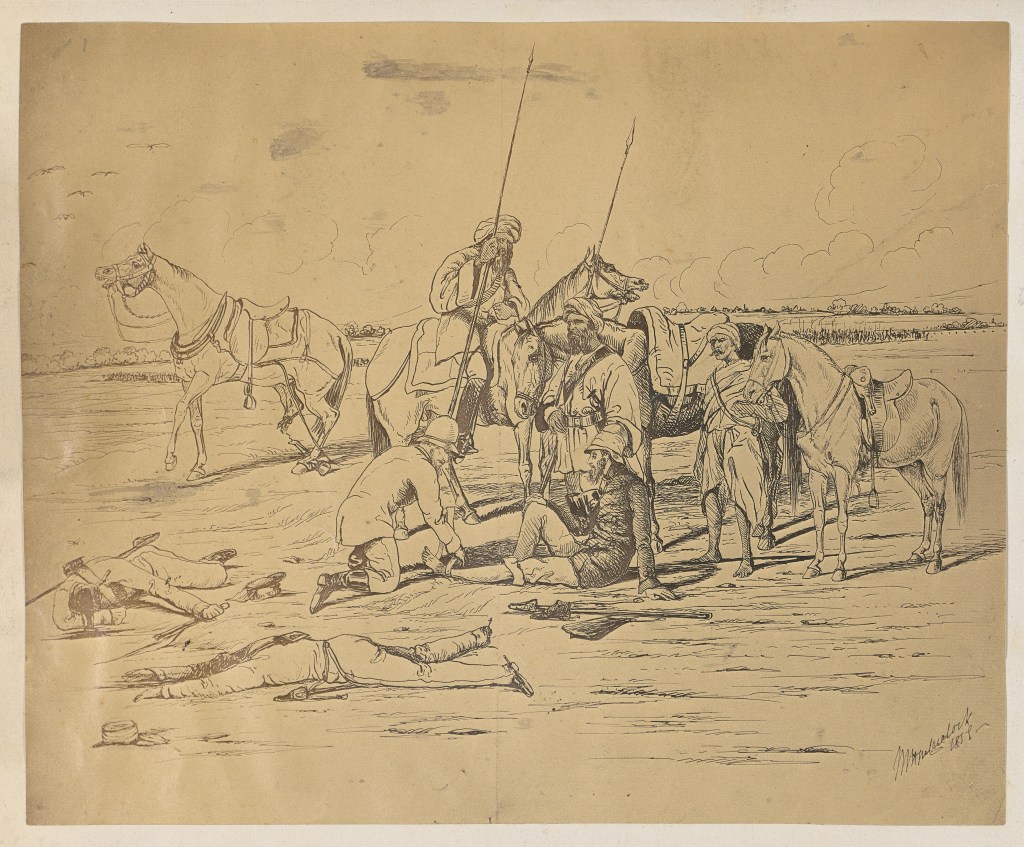
“Patients, soon after being wounded, seldom object to the extraction of the bullet, however reluctant they may be after months or years of a state of things of which they have become accustomed to, with all the attendant evils, such as pains, gleety discharges, &c.; still, when they have been persuaded to have the ball extracted, they express themselves as very much delighted.” (Williamson)
30th of November
93rd Regiment of Foot
Sergeant William McIntyre – wounded
Private Hugh Curranduff – died of wounds
1st December
1st Battalion, 8th Foot
Privates
Finnity, Martin – wounded
Murray, Thomas – wounded
2nd Battalion, Rifle Brigade
Private William Burton – died of wounds
93rd Regiment of Foot
Major John Ewart – arm shattered by round shot. Amputated
Captain George Cornwall – wounded
Naval Brigade
Able Seaman Thomas Blundell (Shannon) – killed in action
2nd December
93rd Regiment of Foot
Lieutenant E.C. Haynes – wounded near Cawnpore
3rd to the 8th of December
Return of Casualties of the Field Force under the Command of General Sir Colin Campbell, K.C.B., Commander-in-Chief, from the 3rd to the 8thDecember (inclusive), 1857.
Head Quarters Camp, Cawnpore, December 1, 1857.
With Headquarters, Staff.
1 subaltern, killed; 1 field officer, 1 captain, wounded.
Naval Brigade.
Marines and Seamen of Her Majesty’s ship Shannon— 1 serjeant, 2 rank and file, wounded.
Engineers.
Royal Engineers, Bengal and Punjab Sappers— 1 rank and file, wounded.
Artillery.
Royal Artillery, Bengal Artillery, Madras Artillery—2 rank and file, 4 troop horses, killed ; 1 captain, 1 serjeant, 16 rank and file, 4 troop horses, wounded; 3 troop horses, missing.
Cavalry Brigade.
Her Majesty’s 9th Lancers—1 officer’s and 4 troop horses, killed ; 1 rank and file, 3 troop horses, wounded; 2 troop horses, missing.
1st Punjab Cavalry—l rank and file, killed ; 1 captain, 3 troop horses, wounded.
2nd Punjab Cavalry—1 rank and file, 4 troop horses, killed ; 3 rank and file, 2 troop horses, wounded.
5th Punjab Cavalry—1 serjeant, 1 rank and file, killed ; 1 troop horse, wounded ; 2 troop horses, missing.
3rd Infantry Brigade.
Her Majesty’s 8th Regiment—1 subaltern, killed ; 2 rank and file, wounded.
Her Majesty’s 64th Regiment—2 rank and file, wounded.
2nd Punjab Infantry—2 rank and file, wounded.
4th Infantry Brigade.
Her Majesty’s 42nd Highlanders—1 rank and file, killed.
Her Majesty’s 53rd Regiment—1 staff, 8 rank and file, wounded.
Her Majesty’s 93rd Highlanders — 1 rank and file, killed ; 1 subaltern, 2 serjeants, 9 rank and file, wounded.
4th Punjab Rifles—5 rank and file, wounded.
5th Infantry Brigade.
Her Majesty’s 23rd Fusiliers—1 rank and file, killed ; 2 subalterns, 1 rank and file, wounded.
Her Majesty’s 82nd Regiment—1 rank and file, killed.
6th Infantry Brigade.
Her Majesty’s 38th Regiment—1 rank and file, wounded.
Her Majesty’s 2nd Battalion Rifle Brigade—1 rank and file, killed ; 1 subaltern, 1 serjeant, 7 rank and file, wounded.
Her Majesty’s 3rd Battalion Rifle Brigade—1 field officer, 11 rank and file, wounded.
Total—2 subalterns, 1 serjeant, 10 rank and file, 1 officer’s and 12 troop horses, killed; 2 field officers, 3 captains, 4 subalterns, 1 staff, 5 serjeants, 71 rank and file, 13 troop horses, wounded ; 7 troop horses, missing.
H. W. NORMAN, Captain, Assistant Adjutant-General of the Army.
6th of December
“In the rear of the 93rd, and between them and the 42nd, was a long line of dhoolies, for by this time I had trained my bearers, attached the regimental number to each man’s arm, and mounted a little, yellow flag, with 93 in the centre, on each dhooly, and detailed them to wings and companies, and on this day, as the regiment formed into line, so did the bearers with their dhoolies; and a very imposing sight it was.
Myself and the senior assistant followed the regiment, immediately behind the colours; my second assistant behind the centre company of right wing; and my third behind the centre company of left wing; each accompanied by an orderly in charge of a dhooly fitted up with all necessary surgical appliances.” (Munro)
Staff
General William Mansfield — slightly wounded at the Subadar’s Tank
Captain J.W. Mansfield — severely wounded in the foot by grape shot (ADC to and brother of the above)
1st Battalion, 8th Foot
Lieutenant F.M. Vincent – killed in action, 7th December
1st Battalion, 23rd Foot
Lieutenant Alan Graham – severely wounded
Ensigns
Wrench, C.J. – severely wounded (accidentally)
Graham, A. – severely wounded (accidentally)
Privates
Hall, Jacob – severely wounded
Rogers, George – killed in action
The Rifle Brigade, 6th December
“The casualties were: in the 2nd Battalion, 1 sergeant, 1 corporal and 6 Riflemen wounded, and 1 man was killed during the night in the town of Cawnpore, it was never known how; in the 3rd Battalion Colonel Horsford was slightly wounded, and 11 rank and file were wounded.” (History of the Rifle Brigade)
2nd Battalion, Rifle Brigade
Ensign Dyce – severely wounded – a musket ball passed through both cheeks and lost most of his teeth. The wounds eventually healed, but Dyce died young.
Private Henry Edwards – wounded. Died of wounds, 7th December
3rd Battalion, Rifle Brigade
Lieutenant Colonel Alfred Hastings Horsford – slightly wounded at the Subadar’s Tank. He was hit by a fragment of a shell but continued leading his men.
Born in Bath in April 1813, the son of Major-General George Horsford and Mary Ann Brocksopp. Educated at the Royal Military College, Sandhurst and commissioned to the Rifle Brigade in 1833. Served in the Cape Frontier War in 1847 and in 1852, was the commanding officer of the 1st Btn., Rifle Brigade during the 8th Xhosa War. He served in the Crimean War (Alma, Inkerman, Balaklava and early on at the Siege of Sevastopol). In March 1858 he would once again accompany Campbell for the final capture of Lucknow. He was the military secretary from 1874 and died in September 1885.
53rd Regiment of Foot
Lieutenant and Adjutant John M. McNeil – severely wounded
Privates
O’Donnell, John – severely wounded by a musket ball which hit him on the head. The bullet was immediately extracted, after which “exfoliation of the bone” ensued. By the 13th of July 1858, the wound had healed, but there was “deep depression capable of holding a cherry; the whole thickness of his skull seems to have come away; still the pulsation of the brain could not be felt; complains of pain in the head.” The doctors listed him as undisposed of.
Gregory, Alfred – died of wounds
William Thomas – severely wounded
93rd Regiment of Foot
“I was about to commence the amputation of the lance corporal’s shattered arm, in a sheltered spot behind a bank where the ammunition camels were collected; but, as I knelt down and had taken the knife in my hand, a tremendous explosion took place near me, and bullets went flying in every direction; one of the enemy’s shells had struck an ammunition box and exploded the contents. Then I thought it prudent to move further off and seek a safer spot to perform the amputation….and it was one of the most successful operations I ever performed, for within fourteen days the man was walking about with his stump quite healed.” (Munro)
Lieutenant H.C. Stirling – severely wounded. He was taken to the hospital at Cawnpore, where his leg was amputated as his thigh was shattered. Died of wounds, 12th of December.
“Poor Stirling died of his wound in the field hospital a few days afterwards. Major Stirling of the 64th, who was killed serving with Windham’s force on November 28, was the husband of Lieutenant Stirling’s sister.” (Alexander)
Assistant Surgeon Bell – wounded at the Subadar’s Tank
Privates
Brown, John -killed in action
Gibson, Andrew – dangerously wounded. Died of wounds, 8th December.
Miller, Andrew – killed in action
Royal Artillery
Major C.S. Longdon – Slightly wounded
Captain C. Longden – (5/13) slightly wounded
Gunners and Drivers
Bracey, H. (6/13 – slightly wounded
Conlan, G. (5/13) – slightly wounded
Holdsworth, Thomas (6/13) – severely wounded
Jones, William (6/13) – slightly wounded
Kerrigan, M. (6/13) – killed in action
Lankey, J. (5/13) – slightly wounded
Lonergan, Patrick (6/13) – severely wounded
Owens, John (7/14) – slightly wounded
Naval Brigade
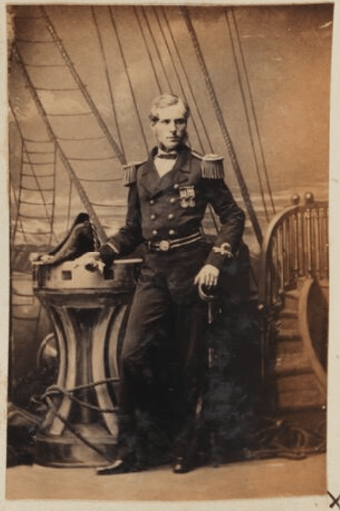
by Camille Silvy
albumen print, 4 July 1862
National Portrait Gallery, NPG Ax60060
Midshipman Lord Walter Talbot Kerr (Shannon) – wounded in the leg.
Born at Newbattle Abbey on the 28th of September 1939, the 4th son of John Kerr, Marquess of Lothian and Lady Cecil Chetwynd Talbot. He was educated at Radley College and joined the HMS Prince Regent as a naval a cadet in August 1853. He saw action in the Crimean War while serving aboard the HMS Neptune (1854) and then on the HMS Cornwallis in 1855. Promoted to midshipman in August 1855, Kerr joined the HMS Shannon, in 1856.
His wound had sufficiently recovered, so he was able to take part in the final capture of Lucknow in 1858. He was mentioned in despatches in March 1858. He died, at the age of 87 on the 12th of May 1927 as the Admiral of the Fleet.
Obituary: https://www.pdavis.nl/ShowObit.php?id=322
Punjab Cavalry
Captain Hamilton Forbes (1st Regt.) – slightly wounded
7th Bengal Light Cavalry (Adjutant, 2nd Gwalior Contingent)
Captain Charles James Salmond – ADC to Brigadier Grant
Memorial at St. Andrews Church, Dacre, Cumbria –
“Sacred to the memory of Charles James Salmond, Captain, 7th Bengal Cavalry, eldest son of James and Emma Isabella Salmond, of Waterfoot in this parish. Born at Nottingham 11th November 1833 of conspicuous gallantry and incessantly engaged during the Indian Mutiny of 1857, present at the Battles of Agra and Cawnpore and at the relief of Lucknow under Sir Colin Campbell, by whom he was on that occasion he was honourably mentioned. Five times previously wounded, he fell at Cawnpore while acting as Aide de Camp to Sir James Hope Grant KCB on the night of the victory of the 6th December 1857. His sorrowing parents erect this memorial to their beloved, gallant and affectionate son.”
Sources:
Bulletins and Other State Intelligence for the Year 1858. Part 1. London: Harrison and Sons, 1859.
Cope, William H. The History of the Rifle Brigade (The Prince Consort’s Own) Formerly the 95th. London: John Chatto & Windus, 1877.
Munro, William. Reminiscences of Military Service with the 93rd Sutherland Highlanders. London: Hurst and Blackett, 1883.
Tavender, I. T., comp. Casualty Roll for the Indian Mutiny, 1857-59. Polstead, Suffolk: J. B. Hayward & Son, 1983.
Williamson, George. Notes on the Wounded from the Mutiny in India: With a Description of the Preparations of Gunshot Injuries Contained in the Museum at Fort Pitt. London: John Churchill, 1859
 Mutiny Reflections