Turner Goes to the Passes
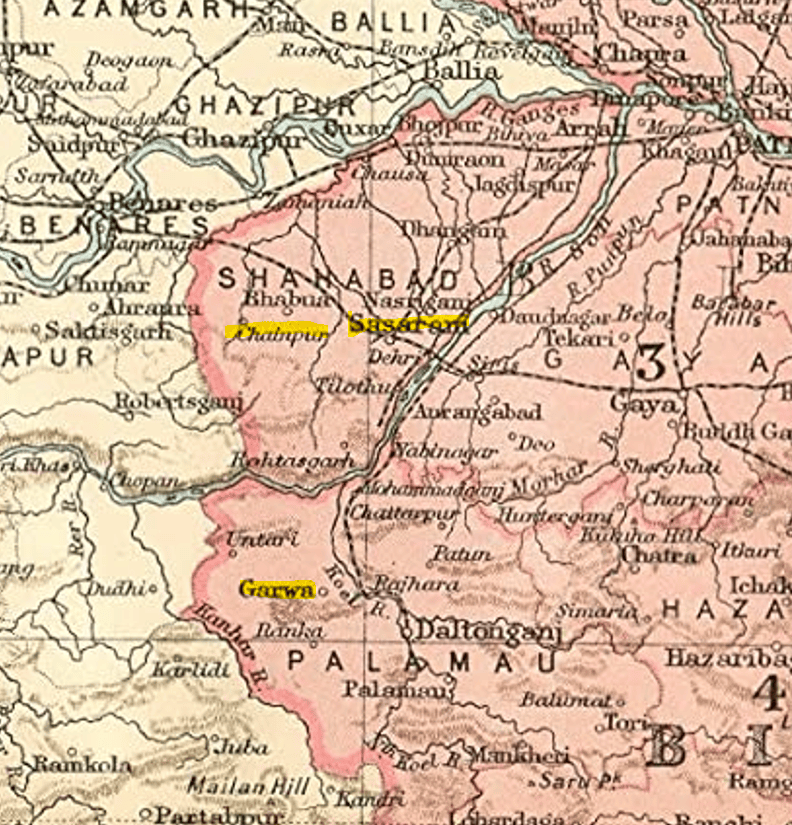
As expected, the rebels who had escaped the night attack were quick to forsake the hills and make their way to the neighbouring district of Palamau and, under Amar Singh, swiftly reverted to plundering for their sustenance. Lieutenant-Colonel Turner started from Saseram on 6 December, having heard that they were busy harassing the people near the town of Garwa.
Turner arrived there on the 10th, only to find the rebels had done their work and vanished. He also found the people very reluctant to impart any information; all he could ascertain was that within 15 miles of him, there were no rebels. Turner now continued his march towards Chainpur (Chynepore) where the Assistant Commissioner, Lieutenant Graham, with the remains of the Ramgarh Battalion had his camp. Graham’s information was better, but the nature of it hardly inspired confidence. The rebels, he said, were at Saneya (Sunnya), a village situated in a valley on the other side of the mountain passes. Thirty-five miles from Chainpur, it was said to be their main position, but they had also fortified the three passes with the very intention of holding them.
Of these, the main road to Chota Nagpur passed through Panch Nudia; the Buglumara Pass was on the direct road from Chainpur; and the Bunjunna Pass, only a mile and a half west of the Chainpur Road. The rebels numbered anywhere between 1200 and 1400 men, but if the information was correct, they were indifferently armed.
The rebels had taken care to ensure that Panch Nudia was the best fortified and had placed 1200 men there, obviously expecting a British attack from that side. At the second were 800 men and the third only had a small picquet. It did not take Turner very long to decide he would march to Buglumara.
Turner reached there by noon on the 14th. He did not have any intention to force the rebels to fight; instead, he sent them a copy of the Queen’s Proclamation and a summons to lay down their arms. They replied with “harmless fire” and shortly after midnight made a weak attack on one of Turner’s outlying picquets.
The next morning, the rebels had still not answered Turner’s summons, leaving him little choice but to force the two passes, but with the determination to not fire unless he was fired on first.
At 9 am he directed Lieutenant Gibson of HM’s 87th, then commanding the cavalry detachment, to march without delay to the Bunjunna Pass which was only being watched by a small picquet and then to pass through the Kutku Plain just beyond, in the rear of the Buglumara Pass and “be prepared to act against the enemy holding it, as soon as my advance should force him into retreat.” Turner knew that Buglumara was “naturally strong and flanked on both sides by wooden spurs of greater elevation, and only 50 yards distant, was defended near the top by an abattis stretching from side to side, which again was flanked by three circular stone breastworks, loopholed.” It would not be easy work.
At 10 am, Turner could hear firing in the direction of Bunjunna, telling him that Gibson was making good his advance. It was also the signal for Turner to move his troops forward.
“40 of Her Majesty’s 37th Regiment, under Captain Luxmoore, supported by a similar number of Her Majesty’s 29th; the whole under the command of Captain Colvill, of the latter regiment, to secure the spur commanding the enemy’s right; a similar detail of Her Majesty’s 29th, under Captain Kneebone of that corps, to secure the spur dominating the enemy’s left; then, giving these two parties half an hour’s law, I advanced, with the remains of the Ramghur Battalion, under Lieutenant Graham, supported by the reserve of the detachment Her Majesty’s 29th Regiment, under Major Wheeler, into the mouth of the pass, and pushed steadily upwards. The enemy almost immediately, after firing a few dropping shots, retreated, and
skirting the edge of the river, which flows round the base of the river side of the pass over a very rocky bed, dispersed in all directions through the jungle lining its banks.”
After crossing the river, the troops assembled on the Kutku plain and Turner ordered a rapid advance on the village of Sunnya, only to find it deserted. Without finding any signs of the rebels in the surrounding jungles, the troops bivouacked for the remainder of the night.
This left the Panch Nudia Pass, which, as far as he could ascertain, was still in the hands of the rebels, and he was now in the position to attack from the rear. The next morning, December 16, Turner sent the Ramghur Battalion under Lieutenant Graham and 100 of HM’s 29th Regiment under Captain Colvill to attack it. Finding it strongly defended by “four different lines of loopholed breastworks, flanked by small rifle pits,” it is no wonder the men were expecting a fight. Instead, the rebels dispersed without firing a single shot. Turner ordered the breastworks destroyed. Holding the pass now with 100 men of HM’s 29th Regiment, he directed Lieutenant Graham to take his men and effect a junction with Captain Davis, then at commanding at Chicharee and having at his disposal 100 men of the Sikh infantry and some 80 cavalry. They were to return together to Saneya. At the same time, he sent Lieutenant Gibson with all his cavalry to scour the plain.
“…westward as far as the Mudguree Pass (Madguri Pass), with orders to search the whole country, and bring in intelligence of the enemy’s movements. He failed in finding any traces either of them or the inhabitants, and, though out from sunrise to sunset, found only one half-starved native living behind a rock; this man he secured and brought in; and he, on examination, stated that of sepoys there were only 200 in the hills, and that the rest were men of the Khyrwa Tribe, who are in fact, regular hill robbers.”
As hill robbers were not in his purview for this expedition, Turner called the whole thing off. He had possession of the passes and the plateau inside them. Responsibility for these he now gave to Lieutenant Graham with his troops and those under Captain Davis (22o infantry, 80 cavalry and 110 matchlock men under the Thakur of Chainpur), he returned to Saseram.
 Mutiny Reflections