Into the Hills
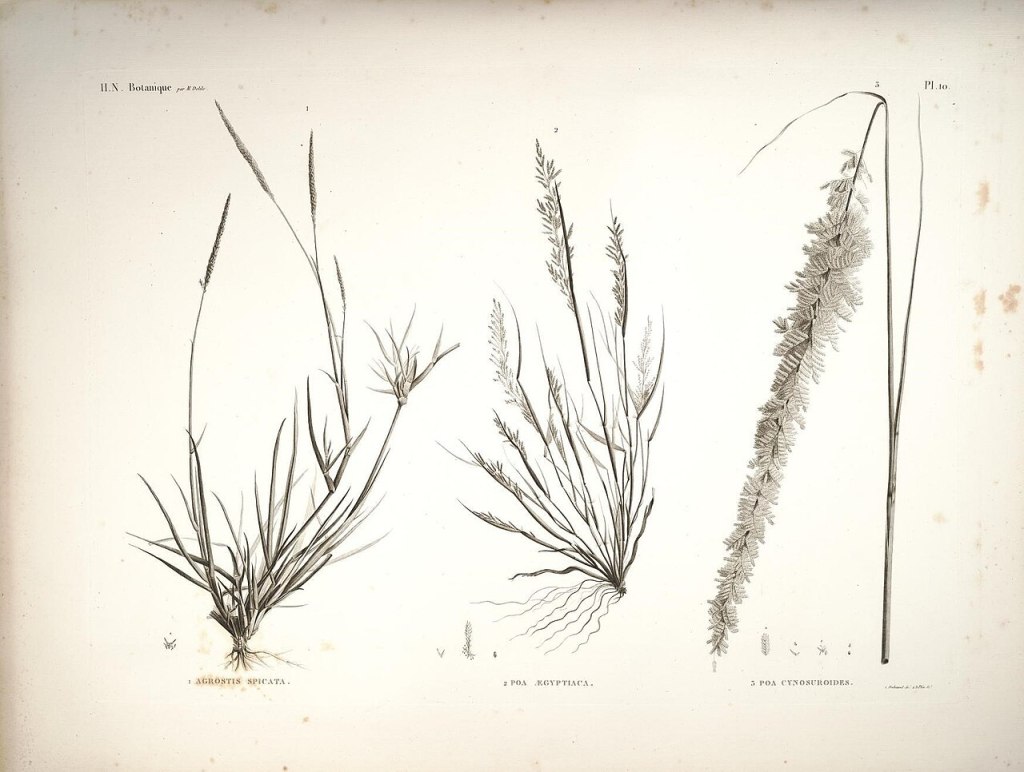
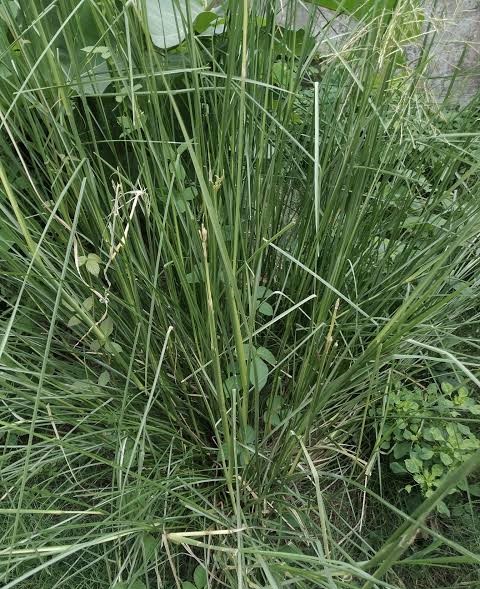
The Kaimur Hills were not the sort of place anyone entered lightly. Forming the easternmost part of the Vindhya Range, beginning in Jabalpur (Madhya Pradesh) and ending near Sasaram in Rohtas, these hills are among the oldest rock formations (along with the Aravallis) in the Indian subcontinent and mainly consist of old igneous rocks. When Mr O’Malley was compiling the District Gazetteer for Shahabad in 1897, he noted that the plateau leading up to the hills was covered in long spear grass – Poa cynosuroides (locally known as kus and depicted below on the right) and khas khas (Andropogon muricatus) a grass used to make matting. Neither of these presented ideal marching conditions, growing in dense clumps, with stiff, erect stems that could reach up to 10 feet high and possessing narrow leaf blades with spiny edges. To add to the discomfort, the underground crown forms an elevated tuft, making for uneven footing.
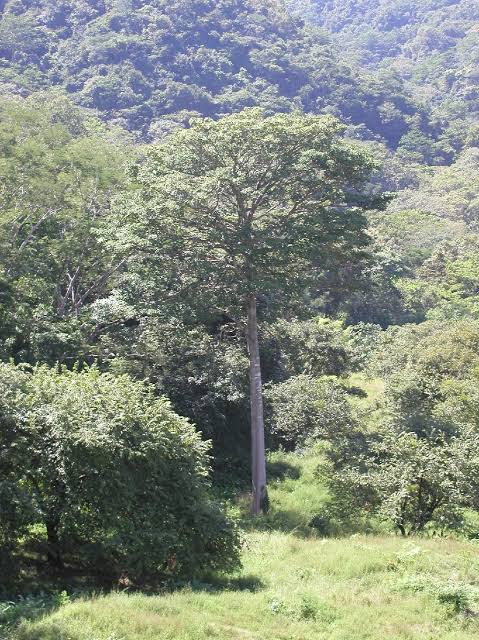
The plateau did offer some shade trees, but for most part, it was bare and covered in grass, while on the precipitous cliffs, the white-barked Sterculia foetida or skunk tree, made its home.
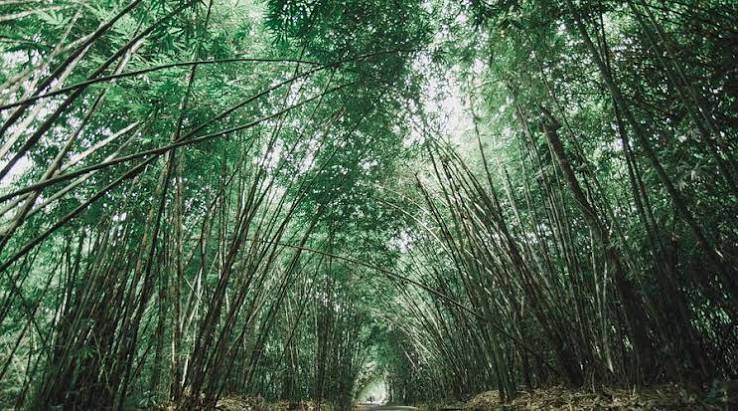
The base of the hills themselves consisted of vast stretches of thick bamboo forests.
While this in itself was a difficult obstacle, the hills themselves rose sharply up from the plains, presenting steep drops and heights ranging from 500 to 1000 feet. They were covered in dense, thick deciduous forests and large boulders. There were no paths or roads, and those that did exist were slippery and little more than mud tracks. Douglas would further find the hills had barely any drinkable water.
This, of course, does not mean that the hills were not populated. The hills are tied to many legends and today are known to feature one of the densest clusters of prehistoric rock shelters in North India, with over 500 documented sites dating back to the Mesolithic era (more than 10,000 B.C.). Archaeologists have mapped massive fields of megalithic tombs, with a single site at Dantari Hill containing 482 megaliths, while Rohtasgarh features numerous Sangora (cairn circles) and vertical Menhirs (standing stone pillars). To this day, three main tribes inhabit the hills and back in 1858, none of them were supporters of the British. This particular war is deserving of its own chapter at a later date.
So Brigadier Douglas had a problem. He had to put to task the last rebels of Shahabad but in order to do so, he would have to drag his army into hills inhospitable for his purposes, without any idea of where the rebels were hiding or keeping their camps. It was not a campaign for the feint of heart but Douglas was going to attempt it.
It begins with a short, and non-descript mention in a letter.
“Extract of a letter, dated 25th of November, 1858,
from Mr. Bingham, Honorary Magistrate of
Chynepore, to Mr. Money.
FROM intelligence which I received about noon yesterday, the Brigadier determined to make a night attack, and attempt a surprise. The rebels, at least 250 in number, yesterday morning plundered Burdehra and then moved on to Dahar, from thence after dark to Sulya, in the same valley, about 12 miles from this place; not a word was said to any one, but at half-past seven a small force was quietly got under arms, and marched off without noise; the intelligence was perfect, although we were afraid the moon, which was bright, would betray us; but we took no baggage, so were enabled to move quietly. When we reached Dahar it was about 11 P.M., and we found the enemy had left their quarters at Dahar, after night fall, and gone to Sulya, but were still there: so we moved on quietly till, on the east of the village, on the bank of the Soorah river, we saw their watch-fires in the open, under three or four large pepul trees. The Brigadier immediately extended part of the force in skirmishing order, and the whole rapidly, but silently, advanced. The only sentry they had awake was bayoneted without a murmur, and the enemy did not perceive us till we were within twenty yards of them ; and to complete their confusion a withering volley from about 100 Rifles was poured into them, and with a cheer we rushed on with the bayonet. About 50 at least of the enemy were killed ; how many more I cannot say, as we followed them up sharp into the jungle, and several leaders sunk in the river.
The surprise was so complete, and their confusion so great, that they did not attempt to fire a single shot, but tried their best to get away. They were all Sepoys of tbe 40th, 37th, 72nd, 5th, 13th, and other corps; and a subadar of 72nd was killed. We took 116 muskets and matchlocks, the latter of which we broke them (?) away, having no carriage, 153 swords, their cooking pots, and 16 ponies, all their clothes—they had not time to put on their shoes j a number more of muskets are scattered in the jungle,-and several are known to be in the river.. They took away very few, if any, weapons with them, and I think that party may be considered as fairly dispersed.”
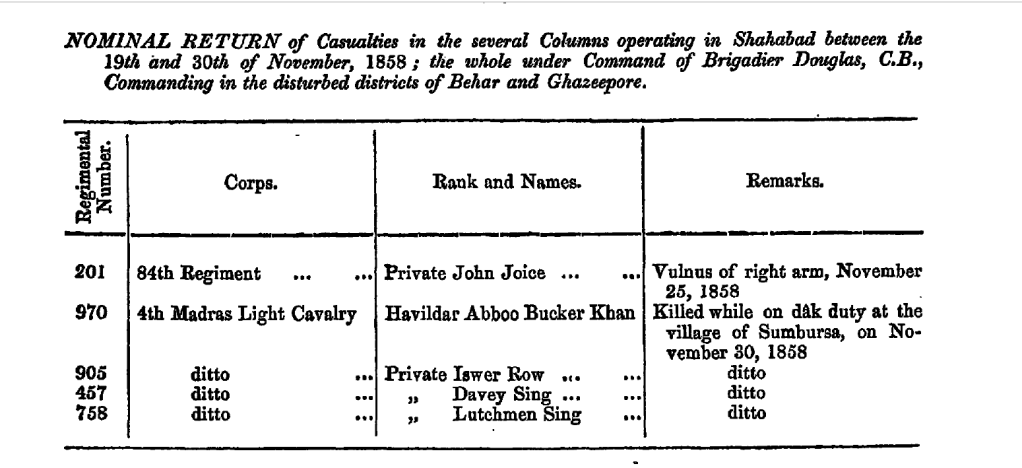
Douglas had succeeded in his venture; however, what the extract does not mention is that he had opened his campaign into the hills on 19 November.
The rebels by now had not remained in one large group; instead, they had broken up into smaller parties, and Douglas found any attempt to hem them in, as he had tried with Jagdispur, was impossible. Instead, he divided his force into seven columns, of 300 men each, “with a view of intercepting the scattered bodies; and by following them rapidly, I hoped to thoroughly disorganise and compel them to accept the terms of amnesty or capitulate.”
Lieutenant-Colonel Turner and Colonel Walter were dispatched to watch the Son River, two columns under Colonel Seymore (84th Regiment) and Major Carr were to guard to the foothills on the north with orders to follow up any party of rebels attempting to double back on Shahabad, another column under Captain Gordon (42nd Highlanders) with his 150 new recruits of the 42nd and the 79th Highlanders with a few native levies under Captain Knyvett were to station themselves on the Mirzapore side, and the two remaining columns, one under Douglas himself and the other under Major Lightfoot would enter the hills. At Bhagwanpur was a detachment under Captain Browne of the 35th Regiment to hold the Jagdispur jungle with 300 men. Additional posts were established along the Grand Trunk Road and at various positions throughout Shahabad District.
The columns under Douglas and Lightfoot now took two paths, each entering the hills through a different route. For Douglas the ascent presented the worst of everything a military man could expect. There were no roads, but mere pathways, leading steeply up from the plateau. His men were left scrambling over and between “ledges of huge rocks” and to make matters worse, the baggage animals frequently lost their footing and slipped. To lessen the danger of losing the animals wholesale, Douglas ordered their packs removed and carried up by hand. For the first 36 hours, the men were reduced to beasts of burden, each carrying what the animals could not. The jungle became so dense, they frequently had to cut their way through and when this was not possible, scouts were sent to find alternate routes. As a marching army often relied of supplies, bought or purloined from villages on the way, Douglas had hoped he could expect some cooperation from the inhabitants of the hills. Instead, they fled in a body on his approach and their villages, comprising of no more than 5 or 6 huts at the most, stood empty until he was gone. As for information, there was none to be had and meanwhile, the jungle was having its toll as his men began to fall ill. Meanwhile, the rebels contrived to stay out of sight.
The column under Captain Gordon had a better prospects. While Douglas was carrying his provisions up hill, Gordon was informed by Mr Dennison, the Mirzapore magistrate, that a body of rebels Kirkhut Ghur (likely Karakat) had separated themselves from those in the hills. Accordingly, on 20 November, Gordon with his Highland recruits and the the Mirzapore Levy advanced on them just at dawn and took the rebels completely by surprise. After a brief skirmish, these now fled, leaving behind 50 dead, all their ammunition and their horses.
Back in the hills, after days of struggling in the jungles, on the morning of the 24th, Douglas finally received some news that sounding promising. A band of rebels were directly on his proposed line of march. He quickly dispatched his baggage under a strong escort to the new camp ground and followed the guides up the path the place the rebels have been seen. All they found, however, was an empty camp ground for once again, news had travelled faster than Douglas could march. Once again, the rebels had thwarted him. Returning to his camp, Douglas was greeted by more news. This time, it was said they were encamped at Sulya Dhar, some 12 miles to the front.
As he had been unsuccessful in forcing the rebels out in the open during the day, Douglas now decided the only option left open to him, if he was ever going to bring this expedition to an end, was to attack them at night. His only chance of success was stealth – to approach in absolute silence, with no firing and no lights. Taking 200 men with him of the 35th and the 84th Regiment under Captain Tisdall and Captain Hardy respectively, the plan was to converge on the rebel position just as the moon rose at midnight. They had 11 miles of marching through heavy jungle to navigate first and just when it appeared the rebels might well had thwarted them again, the force came on to an open plain. The first thing they saw, just to their front, was a campfires under a tope of trees.
Douglas now advanced, extending the Light Company of the 35th under Captain Blyth, the orders still being to be quiet and above all, not to open fire. As they proceeded, more lights appeared “and suddenly within fifty yards of us, one or two persons rose from the ground, followed by several others, who began moving silently away.” Convinced, but not rightly so, that the rebel camp was directly before them, “with a cheer and levelled bayonets” the men began to run across the plain rushing the sleeping men and bayonetting them were they lay. Others, desperate to escape the British onslaught, threw themselves into a shallow ravine hard by, beyond which was a thick jungle, which was the only thing that saved the entire rebel camp from being annihilated that night. Those that made it across, disappeared in the darkness. Not a single rebel had had time to shoulder his arms; they neither rallied nor put up a resistance. In the end, 64 of them departed their lives that night. The British captured nine Enfields, all of their ammunition and accoutrements, some 250 swords, tulwars and shields and 20 of their horses. They also took their cooking pots and pans.
For the rebels, all that was left was flight. One body slammed into Major Carr who drove them back. Breaking up into smaller groups, with the night still to the advantage, and by avoiding the roads and villages, 500 of them managed to get to the plains only to find that Colonels Walter and Seymour were waiting for them.
These two officers now started the pursuit “at a rate of 25 and 35 miles a day,” from pillar to post until 25 November.
“On the 25th, Colonel Walter had a conference with some of the rebel leaders, who appeared inclined to lay down their arms, provided they obtained for themselves exemption from all further penalties; but as Mr. Money, who was present at the interview, did not consider that such stipulation could be entertained, the conference was broken off, and the enemy retreated. The pursuit was continued till nightfall.”
In this estimation Mr Alonzo Money was wrong – the proclamation, which was read out to the rebels on this occasion would have allowed for negotiation. However, Money, in his own self-importance, was unwilling to rise to the occasion.
That evening, a party of rebels made for the Ganges with every intention of crossing but the steamers – acting as gun boats – were waiting for them. Warned that just such a situation might arise, the boats opened fire on the assembled men. In their luckless state, they had failed to realise that the British had removed all possible modes of transport across the river already and their only option, at this point, would have been to swim.
“Baffled on every side, disheartened by the daily defection of numbers of their adherents, and hotly pressed by the pursuing columns, the rebels, suddenly breaking up, scattered to their homes, many of them abandoning their arms and horses, numbers of which have been brought in by the villagers. So complete was the enemy’s dispersion that within a few days not a dozen men throughout the district remained banded together, and the leaders, attended by only three or four followers, were flying for their lives. In every village in Shahabad, sepoys are to be found, but they are no longer in arms, in proof of which, numbers are coming in daily to accept the terms of the amnesty. Of those rebels who lately infested this district, I believe that there only remains one small body of about 200 men to be disposed of; they have made across the Soane,
and I have sent Lieutenant-Colonel Turner, C.B., to try and break them up.”
So ended the expedition into the Kaimur Hills.
 Mutiny Reflections