By the time November 1858 rolled about, the situation in India had changed. No longer was the directive to seek out and destroy mutineers. The attitudes in Britain had changed and what had been seen in 1857 as a justifiable punishment of mutineers was now being seen more as unnecessary, hard-hearted retribution.
Men returning home, expecting to find themselves lauded for their bravery were increasingly finding they were looked upon with some disdain instead. While attitudes in India had not changed greatly, the public in Britain was starting to view the actions of the government in this far-off land as wantonly cruel.
Much of this was down to the sudden and radical change in the administration of India. The East India Company was no longer the mighty arm of Britain abroad – it was now a defunct company whose officials were to blame for the mutiny. As of August 1858, the East India Company had ceased, essentially to exist on paper with the passing of the India Government Act and by November 1858, it was made official when Lord Canning at Allahabad, read out the Queen’s Proclamation. Everything the army now did was no longer with the approval of a board of directors, but at the discretion of Queen Victoria herself.
As soon as the proclamation was read, and copies translated and distributed, much now changed for the mutineers. While the ringleaders such as Tantia Tope, the Nana Sahib and Begum Hazrat Mahal could not expect to benefit from the amnesty promised in the proclamation, regular sepoys and zamindars (amongst others) with a good excuse could. Their necks were not longer in fear of the hangman’s noose. The provisions set out were clear – surrender and behave. The effect of the proclamation would be seen on a large scale in Bihar, where rebels tired of running and fed up of being chased, did lay down their arms without the fear of retribution. However, news did not travel quickly in India and Brigadier Douglas, in early November, still had to deal with the rebels now hiding in the Kaimur Hills.

It calls to mind, at this point, that it is necessary to point out that the men Douglas was now instructed to chase, had been defeated. Their chances of joining a larger rebel force had been shattered, and those hiding in the hills were no longer launching attacks on the British. Douglas was not interested in sending any more of his men on long marches nor did he have the need to prove his might in Bihar. By December 1858, in light of the Queen’s Proclamation, the government was implementing rules for returning sepoys that would in effect, curb the hanging powers of the district magistrates and allow for a certain amount of clemency.
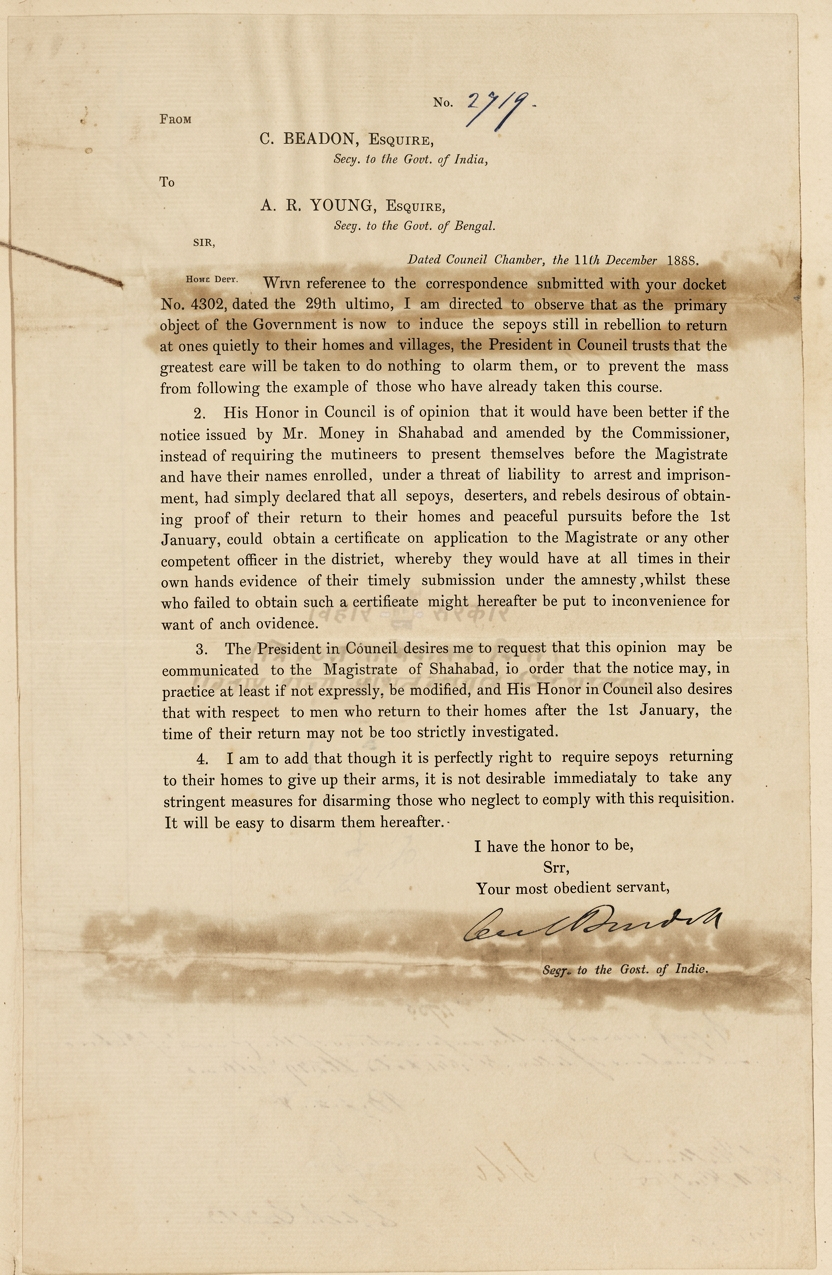
No. 2719
FROM C. Beadon, Esqure
Secy. to the Govt. of India
TO A: R. Young, Esquire
Secy. to the Govt. of Bengal
Dated Council Chamber, the 11th December 1858
Sir
Home Dept
With reference to the correspondence submitted with your docket No 4302, dated the 29th ultimo, I am directed to observe that as the primary object of the Government is now to induce the sepoys still in rebellion to return at quietly to their homes and villages, the President in Council trusts that the greatest care will be taken to do nothing to alarm them, or to prevent the mass from following the mass of those who have already taken this course.
2. His Honor in Council is of the opinion that it would have been better if the notice issued by Mr. Money of Shahabad and amended by the Commissioner, instead of requiring the mutineers to present themselves before the Magistrate and have their names enrolled, under a threat of a liability to arrest and imprisonment, had simply declared that all sepoys, deserters and rebels desirous of obtaining proof of their return to their homes and peaceful pursuits before the 1st of January, could obtain a certificate on application to the Magistrate or any other competent officer in the district, whereby they would have at all times in their own hands evidence of their timely submission under the amnesty, whilst those who failed to obtain such a certificate might hereafter be put to the inconvenience for want of such evidence.
3. The President in Council desires me to request that this opinion may be communicated to the Magistrate of Shahabad, in order that the notice may, in practice at least if not expressly, be modified, and His Honor in Council also desires that with respect to men who return to their homes after the 1st January, the time of their return many not be too strictly investigated.
4. I am to add that though it is perfectly right to require sepoys returning to their homes to give up their arms, it is not desirable immediately to take any stringent measures for disarming those who neglect to comply with this requisition. It will be easy to disarm them hereafter.
I have the honor to be,
SIR,
Your most obedient servant
(Cecil Beadon)
Secy. to the Govt. of India
However, it was also the insistence of Sir Colin Campbell, that no mutineer should remain in any of the districts and for that Brigadier Douglas would now have to launch a final campaign.
 Mutiny Reflections