The Action at Simri, 12 May
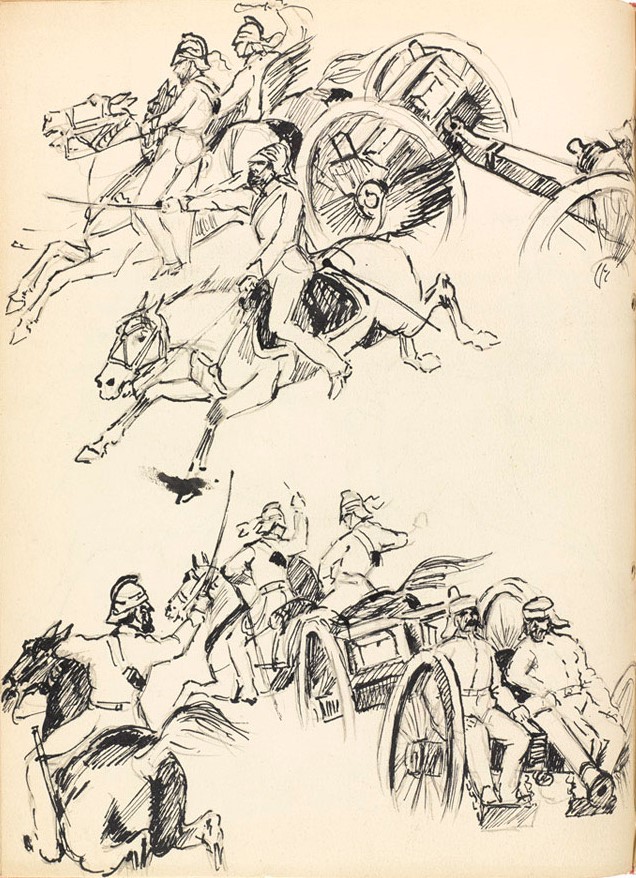
The men, by now, were wondering what Grant was up to. In the many miles of marching they had undertaken until now, there had been precious little fighting, and yet, here they were, their numbers falling as the sun took its toll, without a rebel in sight. On 12 May, the force marched to Nagar, where everyone hoped Grant would hold off taking them any further, at least for a few days. They pitched camp only to be disappointed, for no sooner were they under canvas than the news came that the rebels were barely 6 miles away, at Simri. At 3 in the afternoon, with the sun blazing overhead, Grant ordered the march. His staff tried to dissuade him, the regimental commanders remonstrated, but he was having nothing of their complaints. A guard of some 200 men with two guns and a squadron of cavalry were left behind to guard the baggage and stores; nothing was to be carried to Simri, for should need arise, the men would bivouac in the open air.
It is therefore little surprise that both Garnet Wolseley, with the 90th and Lieutenant Cracklow of the 2nd Troop 3rd Brigade Horse Artillery, both had some rather unkind things to say about Hope Grant. Wolseley deemed Simri a mistake; Cracklow would call Grant idiotic. Both men saw the battle from different, and quite unique perspectives. What all three men could agree on was that the day was fearfully hot.
A fiercely hot wind blew upon me, clouds of burning dust as I turned in the required direction. I felt it burn my skin, and I had some trouble with heel and spur to make my Arab charger face it. About a mile or two from camp, I came upon a squadron of the 7th Hussars on outlying picket. Its general appearance was appalling. Two of its three officers lay helpless under trees with wet towels round their heads, and the men in an exhausted condition lay about in twos and threes under whatever shelter they could find. I had a good helmet with an unusually long turban wound round it, yet the sun seemed to gimlet a hole through it into my brain. My very hair seemed to crackle from the burning heat, and the nails of one’s fingers became as if made of some brittle material that must soon break. (Wolseley)
Even before the force was fully formed up, men dropped out of line, some never to get up again, struck dead by heat apoplexy. Wolseley blames Grant for having spent “all his life in the cavalry” and being, as a result, unaware of the suffering of the infantry, laden as they were with not only their rifles, bayonets and accoutrements, but 60 rounds of ball ammunition. He then finds fault with Grant’s actions in general.
“He consequently adopted a formation to advance in which in temperate zones, and when not exposed to any serious artillery fire, is a very convenient one to deploy from into line of battle. I mean a line of quarter columns at deploying intervals. But in the great heat and dust of that season of the year it was an extremely unwise formation. His mind was apparently so full of the question from a tactical point of view that having had little experience with infantry, he overlooked all other considerations. The result was a most disastrous march, during which the men in the centres of these quarter columns absolutely stifled from want of air and the dense dust they inhaled, fell out by dozens, whilst the enemy’s cavalry, sweeping round our flanks, fell upon our dhoolies, already filled with soldiers in every phase of sunstroke. I regret to say the enemy’s sowars killed many of them, decapitating several as they lay in an unconscious state.”
Cracklow is far less generous and simply writes that “Old Grant went in, in his usual idiotic manner, tearing ahead with the Horse Artillery and Cavalry. The Infantry were done up with their march in the sun and could not get on very quickly, and the enemy got around our right flank. It became a rather critical business towards evening. The old general skying about somewhere to the left, and there was no one to give orders.”
What Grant had done was to open the affair with artillery. Then, extending the Rifles and the Sikhs in skirmishing order, with the 38th and 90th in reserve and covering the heavy guns, they first cleared a nullah and took two guns. The rebels were quickly deprived of their leader, Amruthun Singh and his brother before they decided they had had enough and began to retreat, still followed by Grant’s force. When the force engaged the rebels, who were purported to be some 7000 strong, the fight itself was swift. The cavalry charged another two guns and captured them; the artillery showered them with a few volleys, and the infantry gave chase. The rebels did not give up; time and time again, they would turn to face their attackers, only to be repulsed by artillery and charges of the cavalry. Grant continued pushing onwards, always keeping the rebels before him until well after sunset; only when it was dark did he finally call a halt.
On their part, the rebels too realised the fight was indeed over, for like Grant, they could no longer see their enemy, and the dark gave them opportunity to disappear. For Cracklow, it was one of the most irritating things he had ever experienced. “When it became dark, they ceased firing, and we lay down on the ground with the enemy all around us, our people scattered all over the field, and no one knew where to find anything. Old Grant then made up his mind to retire to the place where our baggage had been left, as he was apprehensive of their making a dash for it. Tis would have been fatal and would have been a regular retreat; however, Mackinnon persuaded him out of it, and we remained on the ground all night.”
Vivien Dering Majendie (RA), who also happened to be present, called Simri a “barren victory” and an expensive one. 160 men were placed hors de combat, and 50 died of apoplexy before the day was over. The 38th Regiment alone buried 20 men; the sun had indeed been on the side of the rebels that day. “It is difficult, in fact, to see what we gained by this victory: the slaughter of three or four hundred Sepoys, at the expense of between seventy and a hundred British soldiers, was an advantage too dearly purchased to be satisfactory, nor did the capture of four miserable guns, or the so-called ” moral effect” (which with a people who look upon running away as the natural consequence of fighting, is hardly of much account), compensate us for the losses we sustained by sickness and sunstroke.” (Majendie)
During the course of the fight, some rebel sowars had managed to get in among the sick in their doolies – the bearers fled, and one man of the Rifle Brigade was beheaded where he lay, his head taken away as a trophy. As for the captured guns, the rebels simply sneaked back in the dark and took them back without anyone noticing.
Returns:
Artillery
2nd Troop, 3rd Brigade, Bengal Horse Artillery – 1 troop horse killed, 1 havildar, 1 troop horse, wounded
Q Field Battery Royal Artillery – 3 rank & file, 1 troop horse, killed; 1 captain, 3 t rank & file wounded
Cavalry
HM’s 7th Hussars – 1 rank& file, 1 officer’s horse, 1 troop horse, wounded
1st Sikh Cavalry – 1 rank& file,1 lascar, and 1 troop horse, wounded
Infantry
HM’s 38th Regiment – 13 rank & file killed; 2 rank & file wounded
HM’s 90th Regiment – 3 rank & file killed
2nd Battalion, Rifle Brigade – 2 rank & file killed; 5 rank & file wounded
6th Punjab Rifles – 1 rank & file killed; 1 native officer, 6 rank & file & lascars, wounded
Total: 22 rank & file and lascars, 2 troop horses, killed
1 captain, 1 native officer, 1 havildar, 18 rank & file and lascars, 1 officer’s horse, 3 troop horses, wounded
A Panic in the Night
While the battle itself had been won under the most trying of circumstances, the night would prove to be a trial in itself. The men bivouacked on the ground, their nerves on edge, many suffering from the heat. The night was exceptionally dark, with neither the moon nor the dim light of the stars to provide any solace to exhausted minds. Out in the plain, aware there might well be an entire army ready to pounce on them unawares, it is no wonder that when, during the night, someone, screaming in his sleep, caused a panic that would have some unexpected consequences.
Some time during the night, if Grant and Majendie’s version of events is correct, a snake unfortunately crawled over the face of a sleeping soldier. The man “…thereupon awoke, and not knowing, or thinking what he was doing, discharged his piece, thus waking up others, who, hearing a shot so near them, at once concluded that the enemy had got among us; and, in a state of semi- idiocy from over- fatigue and sleepiness, began to yell, and give the alarm, which, spreading as fire does in tinder, soon communicated itself to the whole force.” (Majendie) A horse, quite startled by the sudden shot, managed to break its line and dashed off, leading several men to believe they were being attacked by the rebel cavalry, which had managed to break through the pickets. With no one being able, in the dark, to ascertain what had happened, several things happened at once. Cracklow, Majendie and Wolseley were all suddenly woken up by a “fiendish uproar, as if the devils in hell had been let loose. Everyone seemed to be engaged in shouting on his own account as I awoke; the tramp of riderless horses galloping to and fro added much to the confusion; some shots were fired…” (Wolseley) for, unable to see in the dark, with no one taking charge, the entire force believed the man next to them was a mutineer.
“The discharge of fire- arms, throwing now and again flashes of lurid light over the scene; the press of men endeavouring in the darkness to find their places; the words of command, and orders to the men to fall in; the confused cries and shouts which always seemed to form themselves into the alarming words, ” the enemy are upon us !” the whistling past of stray bullets; the feeling of uncertainty as to the direction from which the attack might be looked for; and, worst of all, the rush here and there of affrighted camp -followers, doolie bearers, bullock- drivers, and other natives, who were mistaken in the dark for the enemy, and fired at accordingly, made the panic complete, and the men, half stupefied with sleep, thus suddenly alarmed, lost for some little time all semblance of order and regularity, and became temporarily insane; at least if one may judge from the fact that, in some instances, they deliberately set to work to knock one another down with the butt-ends of their rifles, and even to bayonet the comrades who were sleeping alongside them !!” (Majendie)
To make it worse, an officer of the Royal Artillery (much to Cracklow’s satisfaction, as he himself served the Bengal artillery), whom Wolseley calls a “fat, prosy, stupid little man” believed he had been beset upon by a mutineer, for he saw “something rise between himself and the sky” and he fired his revolver at what happened to be a camel. He then shot an unfortunate bullock driver dead, whom he was convinced was coming to kill him, before stumbling and shooting himself in the foot. Another officer with his revolver blazing in every direction was only stopped when a rifleman clubbed him over the head, he himself mistaking the officer for a mutineer. In the Rifle Brigade, men fought against each other with rifle butt and bayonets with some abandon, leaving seven wounded; a further three of the 38th ended up on the sick list with broken heads.
Among others, it is related how a certain gallant colonel engaged in a desperate single combat with a private of the Sappers; luckily, however, having a tree between them, which prevented the engagement- in which, it is said, great valour was shown- from being sanguinary, the chief sufferer being the trunk of said tree. Again, an officer is said, on having been roused from his sleep by the noise, to have deliberately discharged the five barrels of his revolver all round him, without regard to persons, by way of clearing a space for himself, and as a preliminary to further operations…” (Majendie)
The panic eventually died down, and at daybreak, the officers collected the scattered division and returned to Nagar, certainly worse for wear from the panic in the night. It would repeat itself on the march back to Lucknow, three days later, when, in the middle of the night, a cry once again went up in camp that the rebel cavalry were attacking – Majendie only recalls,
“…plunging legs foremost- but unluckily wrong side foremost- into a pair of pyjamas; of becoming terribly entangled in a pair of boots, and performing a sort of wild hornpipe on one leg, in consequence; of upsetting my table, and a few other articles of furniture; and of breaking more crockery than I imagined I possessed; of seizing a pistol and a sword, and trying in my confusion to cock the latter !-of tumbling over a tent rope in the endeavour to get out of my tent; of picking myself up in the full expectation of finding myself engaged hand -to -hand with a black gentleman, armed with big whiskers and a tulwar, and of a sort of shadowy presentiment that I should get the worst of it; of hearing people talking excitedly to one another, and men rushing to their places in the ranks; of all being for about five minutes noise and confusion; of waiting some time, and straining my eyes in an attempt to discover these phantom cavalry, of the tumult subsiding as suddenly as it had commenced; of the whole thing being at an end and proving a false alarm.”
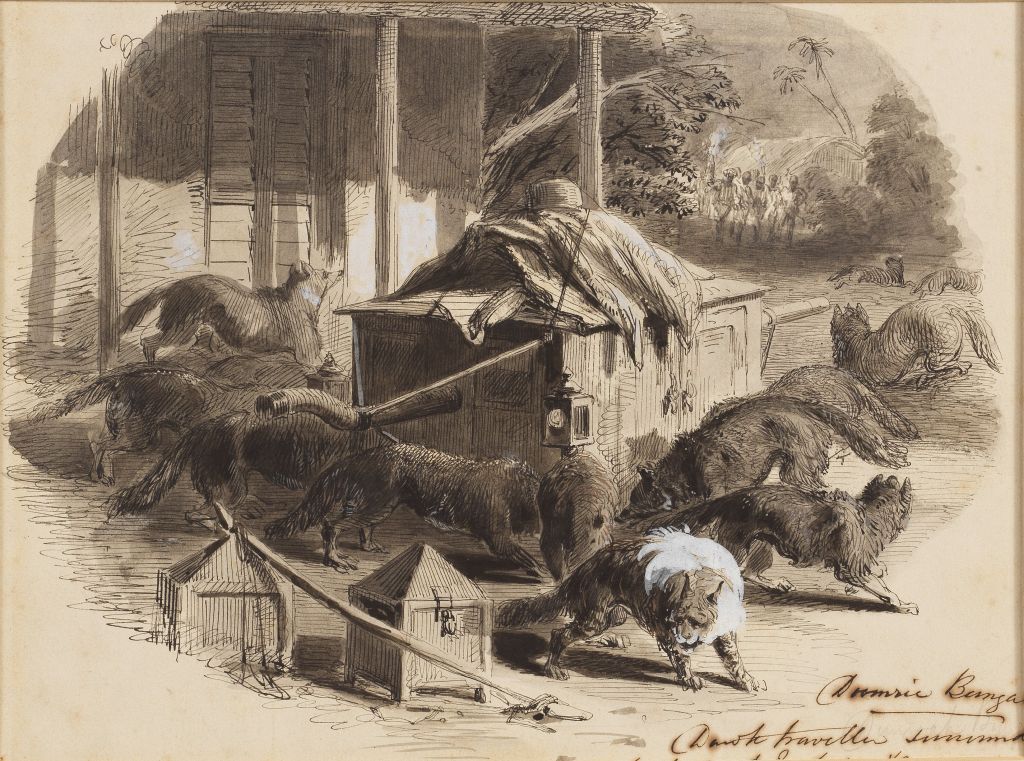
This time it had been caused by a pack of jackals howling close to the camp – to fevered minds, the sound had been mistaken for the screams of attacking sowars. It was time to give the army a long and well-deserved rest, before they harmed themselves; however, there would be one more fight before they could finally call an end to what had been, until now, a most unsatisfactory campaign. The Baiswara Campaign ended as swiftly as it had started, and the Battle of Nawabganj, which followed in its wake, set a new precedent – the rebels would never again be able to find a foothold close to Lucknow and the city, as far as anything was certain in 1858, was firmly in British hands.
Page 3 of 3
Sources:
Barrett, Charles Raymond Booth. The 7th (Queen’s Own) Hussars, Vol II. London: Royal United Service Institution,1914.
Behan, T. L., ed. Bulletins and Other State Intelligence. Part 3 (1858). London: Harrison and Sons, 1858–1859.
Broehl, Wayne G., Jr. Crisis of the Raj: The Revolt of 1857 through British Lieutenants’ Eyes. Hanover, NH: University Press of New England for Dartmouth College, 1980.
Cardew, F. G. Hodson’s Horse 1857-1922. Edinburgh & London: William Blackwood & Sons Ltd., 1928.
Cope, William H. The History of the Rifle Brigade (The Prince Consort’s Own) Formerly the 95th. London: John Chatto & Windus, 1877.
Jocelyn, Julian R. J. The History of the Royal and Indian Artillery in the Mutiny of 1857. London: John Murray, 1915.
Knollys, Henry, ed. Incidents in the Sepoy War, Compiled from the Private Journals of General Sir Hope Grant. Edinburgh: William Blackwood & Sons, 1873.
Majendie, Vivian Dering. Up Among the Pandies: A Year’s Service in India. London: Routledge, Warne & Routledge, 1859.
Strange, Thomas Bland. Gunner Jingo’s Jubilee. London & Sydney: Remington & Co., 1893.
Wolseley, Field-Marshal. The Story of a Soldier’s Life, Vol I. New York: Charles Scribner’s Sons, 1903
 Mutiny Reflections