And Onwards
The man the British were chasing now was Rana Beni Madho. A Rajput of the Bais clan, he was the ruler of the Shankarpur Estate in what is today known as Rae-Bareli, and part of the old Baiswara State of Oudh. From the onset of the mutiny, the Rana was determined to make his stand against the British; as soon as they lost control of Azamgarh and Jaunpore, he was appointed the new administrator by the Lucknow court. Backed by local landlords and peasants, his army was said to have been, at one time, 25’000 strong. Locally popular and able to lead his men in the same hit-and-run tactics favoured by the Maulvi, the Rana was certainly a sore point for the British; as long as he was on the loose, there was very little chance the pacification of Oudh would be a success. The problem Hope Grant faced, though, was catching him.
At dawn on the 21st, the force marched for Masauli, searching for the army of Jung Bahadur, whom they were supposed to escort through hostile country. Grant found them and listened with some patience as the European officer pleaded for support – he had 8000 men at his disposal, and 20 guns, but only 2000 were fit for fighting. Another 2000 were sick, and the force was taking back to Nepal 4000 carts filled not only with the plunder from Lucknow but also with private property, and each cart had one man to guard it. Should they meet the rebels, the European officer predicted their doom. Grant was not feeling particularly sympathetic to this self-made disaster; on 22 April, he bid the Nepalese a fond farewell and sent them on their way. They would eventually cross the border in June without suffering any mishaps or nuisance from the rebels. As for Grant, he had a fort to take care of.
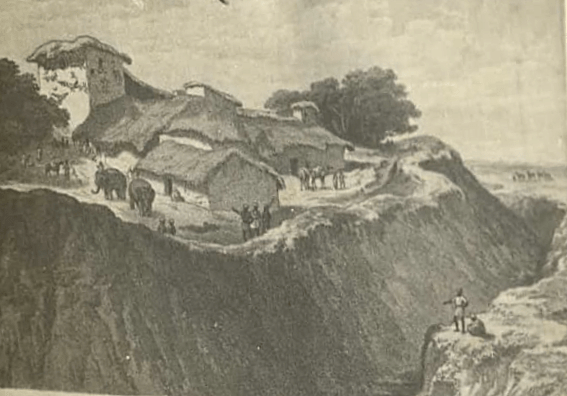
The strong mud fort surrounded by nearly impregnable jungle belonged to one Rajah Raza Bakht, who had, according to Grant, “played a double game” since the mutiny began. Grant felt it was high time someone taught him a lesson.
“The same morning, he came into camp with profuse protestations of good behaviour and fidelity, and offered to hand over to us the only three guns which he said he had in his possession. I took with me two squadrons of cavalry, and after picking our way for some time through the jungle, we came to the gate of his stronghold, which we entered. Inside was a dense jungle of bamboo and a thick thorny plant, through which it was impossible to advance except by a narrow tortuous path. At last, we came up to a miserable mud house, which he called his palace. The people were very civil and told us that the guns had been sent away to the commissioners; but one of our Sikhs, who are famous hands at making discoveries of concealed property, found out two guns in an enclosure where no one had thought of looking. We immediately caused the gate to be burst open and secured a 9 and a 6-pounder. I sent for some bullocks of the worthy Rajah, and found that they were Government animals, which the old scoundrel had stolen. A native also informed me that there was another gun close to the gate by which we entered; and on further search, we found a 9-pounder, most skilfully masked, facing the road along which we had travelled, double-shotted with grape and roundshot, ready primed, and having a slow- match fixed and lighted. All this looked very suspicious, especially as at the same time an officer reported that he had found a number of treasonable papers in the Rajah’s house. I therefore resolved not to let the old gentleman off, and the next day I sent a force, under Brigadier Horsford, from Nawabgunj, to destroy the place. This was thoroughly carried into execution. The jungle was burned, and the palace levelled to the ground.”
The marching continued. Grant was next ordered to go to Cawnpore and to ignore, with Sir Colin Campbell’s sanction, the complaints of the chief commissioner of Oudh, Robert Montgomery. Montgomery, who had taken over from Sir James Outram, had begun to make a habit of writing to Lord Canning at Allahabad to voice his displeasure at Grant’s refusal to march at Montgomery’s whims. In his zeal to pacify Oudh, Montgomery believed the only measures required were to level every fort and scour the earth for every rebel or sympathiser still alive in the district. He was wholly neglectful of the fact that this would effectively have spelt the death of Grant’s force. Encumbered by thousands of camp followers, a baggage train that measured fully 10 miles, marching in temperatures that regularly soared over 110°F, and a local population that was unable or unwilling to provide supplies, Montgomery’s bleating to raze this or that fort wisely fell on deaf ears. Sir Colin Campbell himself alluded to,
“It does not seem to have occurred to the Commissioner that the rainy season may be expected to commence in the first week of June, when troops must remain in the situation they find themselves in until the termination of the rainy season. The baggage animals (camels) cannot travel on the Kutcha roads j and I must take care that you are not without food for the men under any circumstances. The necessity of having the men under the cover of a house during the rainy season does not appear to have been taken under consideration by the Commissioner. This evidence of want of thought and care for those noble fellows, to whom the State and all of us individually owe so much, vexes me and puts me out exceedingly.”
Sir Hope Grant would take his orders from Sir Colin Campbell; what Robert Montgomery thought or said was of little concern on this particular expedition. He could rant and rave to himself if he pleased, but there would be no hot weather campaign in Oudh without Sir Colin’s directive.
As ordered, Grant now left his troops at Nawabganj and, with his own staff, returned to Lucknow. Here, he received yet another order to march with the column he had just left behind to Rai Bareli and from there, take up operations along the Ganges line. In the meantime, Montgomery insisted that Grant move on Unnao, which he was certain would be attacked soon; within moments, another letter arrived, this time demanding that Grant turn his attention to Bani, where the rebels had burned a few villages and cut the telegraph wires. As this latter incident appeared to be of immediate concern, Grant did send a column of troops to Bani; these reported back that a party of rebels had burned a village, not several, and the wires had been accidentally broken, not cut. The wires were speedily repaired, and there was nothing left to do as the rebels, whoever they were, were long gone. While Montgomery continued to send increasingly “disagreeable intelligence,” Grant determined to “pay no attention to his request to despatch my troops hither and tither.” Instead, he ordered the main body to prepare to march from Nawabganj. On 28 April, they crossed the Gumti over a bridge of boats close to the Dilkusha. He joined the force the next day; the following morning, they marched to Kantha and the day after to Poorwah.
Grant had made some changes to the composition of his force, which now comprised 4500 men.
1 Battalion Rifle Brigade under Colonel Hall
HM’s 38th Foot under Colonel Kelly
HM’s 90th Foot under Colonel Purnell
Captain Gibbon’s 9-pounder battery
Captain Mackinnon’s 6-pounder troop
two 18-pounders
two 8-inch and two 5 1/2 inch mortars
the 7th Hussaes
Wale’s Horse
1 squadron Hodson’s Horse
a detachment of Sappers and Miners
“We first made for a small fort surrounded by jungle, called Puchingaum, where a Bais Rajpoot held sway— an influential man— but he did not show fight. We took possession of some matchlocks, swords, shields, a 4-pounder gun, and two 6-pounder wall-pieces. Presently, I saw my Sikh orderly coming out of a building carrying a sack, and as these black gentlemen were great hands at looting, I stopped him. The sack was found to contain nothing but fine flour, but every sort of plundering was considered a great misdemeanour and could not be tolerated. It was therefore emptied all over his head; and the contrast between his dark skin and the white powder had a most ridiculous effect, and acted as a useful warning to his comrades.” (Grant)
On the morning of the 10th of May, exactly one year since the mutiny had begun, Grant was standing at Dundi Khera, a strong fort close to the Ganges. It was here that the solitary boat from Cawnpore had been attacked by the men of Ram Baksh. Several of the fugitives had been killed, and the rest taken back to Cawnpore to meet their fates. It was not surprising, therefore, that there would be little mercy shown; however, Baksh, quite aware of what would happen if the British caught him, had decided that retreat really was the wiser choice. He abandoned his fort and fled before Grant could put a noose around his neck. It was also just as well for Grant.
“It was one of the most formidable forts I had ever seen in India, with large, enormously thick mud walls, and surrounded by a jungle so dense as to be imperviable, except where pathways had been cut. Inside this jungle was a small circular work, quite concealed until within a few yards’ distance, where a gun had probably been placed; a narrow covered way communicated with it and the main work. Had the post been disputed, our loss must have been severe. It had apparently been entirely denuded of all means of defence; but when my Sikhs began their search, they found two guns and a French 32-pounder brass howitzer, the latter in an excellent state of preservation, which had been thrown down deep dry wells.”
However, Grant was sure he could still catch Beni Madho. According to intelligence, the Rana was a mere 20 miles away, and Grant was sure a brisk night march would put Madho in his sights. He had indeed been cornered at Dundi Khera, and some 12000 of his men had fled. However, Madho was not about to let himself be caught – very much under Grant’s nose, he escaped across the Ghaghara River.
Page 2 of 3
 Mutiny Reflections