“It was now the merry month of June, and after one of those scampering little skirmishes and long pursuits, fourteen sunstruck Hussars lay dead under one tree.” (T.B. Strange)

A more pressing problem than Rana Beni Madho presented itself in June, for the rebels had begun gathering again. Since the beginning of the month, repeated alarms by the rebels, none of which came to fruition, had seen the formation of a camp at Chinhat, where four companies of the 3rd Battalion, Rifle Brigade made their quarters. For the 2nd Battalion, things were worse – their duties would see them out in the field, marching almost continuously, searching for an enemy that was nowhere in sight.
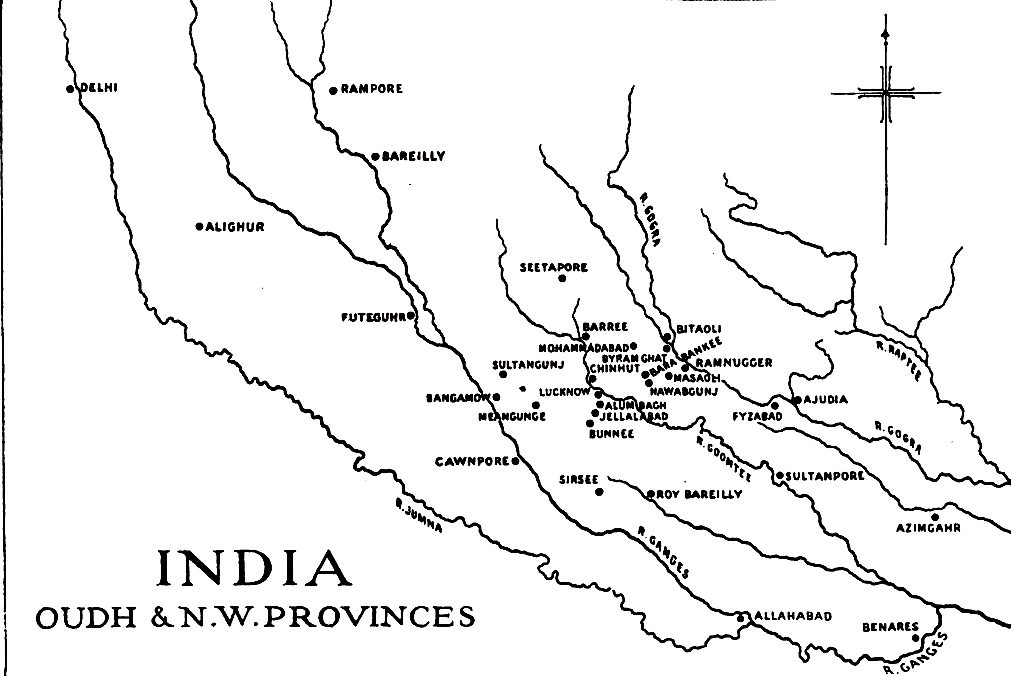
Then suddenly, scarcely 18 miles from Lucknow, at Nawabganj-Barabanki on the Fyzabad Road (not to be confused with the Nawabganj on the Cawnpore Road), the rebels were indeed gathering, in ever-increasing numbers, and much too close to Lucknow for comfort. On June the 2nd Battalion, Rifle Brigade were recalled to Lucknow, and their march was gruelling.
“Starting again on the 7th early in the morning, they marched to Mirzee, twelve miles, and on the 8th to Bunnee, five miles. These marches were by a different route from that by which they had marched through these places on former occasions. On the 9th, they marched to Bunteerah in a very hot wind; on the 10th to Jallalabad; and on the nth to the Dilkoosha. On this occasion, Brigadier Horsford had procured for the Battalion the permission to halt in Lucknow itself, and not merely to march through it as on some previous occasions, which gave them the opportunity of obtaining some much-needed supplies, which they had not had since landing in the country. But the time even for this was short; for on the afternoon of the 12th, they marched at three o’clock to Utterdowna, about two miles beyond Chinhat. Here they were rejoined by the 3rd Battalion.” (Cope)
From here, they joined up with the Punjabis, a part of the Dragoons, the 7th Hussars and some of Hodson’s Horse. After a very short halt, they started up again at 11 at night for what would be the worst march the Rifles had ever made. Carrying only one day’s rations and some rum but all of their ammunition, the men, who had been without sleep the night before and had hardly any during the day due to the heat, staggered onwards in the suffocating dust over a road pitted with holes....”So weary were the men that whenever a halt occurred, by a block from a gun sticking fast or turning over, they sank down on the road, many inches deep with dust, and slept. Soon, the water carried with the column was exhausted; no wells were near or could be found; and the cries of the men for water were pitiable in the extreme. Numbers of doolies accompanied the column (the 3rd Battalion had sixty); but these were soon filled, and the fainting soldiers were left on the road on the chance of being picked up by the Hospital staff of other regiments, or of rejoining when strength returned.” (Cope)
The rebels had placed themselves on an extensive plateau, surrounded on three sides by stream and on the fourth by jungle. A stone bridge crossed the stream directly in front of their position. Grant intended to turn their right and place himself between them and the jungle. He ascertained there was a ford, some two miles up the stream, complete with a platform bridge which the rebels had failed to destroy or indeed did not appear to notice – it was here that Grant would cross. Leaving every form of encumbrance behind, they reached the bridge half an hour before daybreak, leaving the men just enough time to have a mouthful of food and a little rest.
The whole force mustered just over 3500 men and consisted of:
2nd Dragoon Guards
7th Hussars
Hodson’s Horse
Wale’s Horse
Oudh Mounted Police
2nd and 3rd Battalions, Rifle Brigade
5th Punjab Infantry
2/3 Bengal Horse Artillery – Captain W.A. Mackinnon
5/12 Royal Artillery (Q Battery) – 2nd Captain A. C. Johnson (replacing Captain Gibbon, who had shot himself in the foot)
No. 12 Field Battery 2/3 Bengal Artillery – Major H. A. Carleton
O.C.A. – Major H. A. Carleton
S.O. – Lieutenant T.B. Strange, R.A.
They were expected to face a rebel army of no less than 15’000 with an unknown amount of guns.
As soon as it was daylight, the men fell in. The rebels had three guns pointed towards the bridge, but they had not placed them under any cover, and as they would soon find to their consternation, they were too far away to pose any threat to Grant. Grant brought up the Q-Battery of the Royal Artillery, whose 9-pounders quickly silenced the rebel guns and dismounted one in the process.
‘Q’ pushed through the enemy’s irregular skirmish line and opened upon the main position. The battery was surrounded by low brush, but from a bush about one hundred and fifty yards in rear, bullets whizzed at regular intervals in unpleasant proximity to Jingo and Jack Hallows of the 87th Royal Irish, the latter being attached to the Artillery as interpreter. They were two extensive targets with nothing to do but look pleased.
‘Better flush that fellow,’ said Jack.
Waiting until the next puff of smoke told them that the man was unloaded, they both rode at the bush where the smoke still lingered, Jack, firing his revolver as he advanced. The Oudh man rose from his lair, threw down his gun, and drew his tulwar. Jingo, in passing, delivered a regulation sword-exercise cut with his ponderous blade. Young Jingo was proud of his swordsmanship; he could cut the thick part of a hanging leg of mutton, bone and all, and now he expected to see that unbeliever’s head fly from his shoulders. Instead, the tulwar deftly turned the sword, while a round white spot of bare skull, the size of a rupee, showed that the poor fellow had lost his Houri handle. His turban, wound round his head, had left the top unprotected. Circling his horse, Jingo passed his sword through the poor devil’s brown body just above the cummerbund. One of Jack Hallows’ small revolver bullets had struck the breastbone, and another had penetrated the turban, without reaching the skull. It was hardly a fair scrimmage and could not well have been avoided, yet the pair felt disgusted. ‘Mais, à la guerre, comme à la guerre.’ That was a cruel war. (Strange)

Four companies of the Rifle Brigade were sent forward in support of the horse artillery and cavalry, and together, they crossed the stream, followed by the main body. The rebels, who were still quite surprised by Grant’s manoeuvres, had been unable to consolidate their force; to Grant’s astonishment, he found they were divided into four parts, each with their own leader, and all acting independently from one another. This of course, did not mean they would not fight. They formed themselves in a crescent shape and, undaunted by the British advance, their chief, made more remarkable by the large goitre on his neck, swiftly planted two green standards close to the guns to serve as a rallying point.
“A large body of fine daring Zemindaree men brought two guns into the open and attacked us in rear. 1 have seen many battles in India, and many brave fellows fighting with a determination to conquer or die, but I never witnessed anything more magnificent than the conduct of these Zemindarees. In the first instance, they attacked Hodson’s Horse, who would not face them, and by their unsteadiness placed in great jeopardy two guns which had been attached to the regiment. Fearing that they might be captured, I ordered up the 7th Hussars, and the other four guns belonging to the battery to within a distance of 500 yards from the enemy, opened a fire of grape, which mowed them down with terrible effect, like thistles before the scythe.” (Grant)
The scenario as depicted by Grant would have meant that Hodson’s Horse was unwilling to engage; however, according to their commander, Major Henry Daly, this was far from the truth. Hodson’s Horse had been detailed, acting on instructions from Major Hamilton (AAG to Grant) to move, with the Oudh Irregular Police, to a plain to the right, to meet any rebels who might consider threatening the right and the rear. The ground was “well adapted” for cavalry, and even the ravine to the front was not enough to stop a horse. Daly ordered Lieutenant Mecham with Lieutenant, the Hon. J. Fraser and 100 sowars to cross the ravine and take the left rebel flank, while Daly would take the remainder and attack from the front as ordered by Grant. However, Mecham quickly found that the rebels were in larger numbers than Daly had anticipated, but he carried on anyway. The attack proved a success, but Mecham was severely wounded, and his horse badly cut up. The delay caused by the manoeuvre was interpreted as Hodson’s Horse hanging back, and as the guns were at risk, Grant “ordered up” the Hussars. As it was, Hodson’s Horse did form up under Major Daly and was very much a part of the cavalry charge, which would be led by the 7th Hussars. Grant would have known that, for he rode with them.
As two companies of the Rifles and Vaughan’s Punjabis approached the rebels, it was suddenly clear that these were not just regular sepoys or dashing Zamindari levies, but Ghazis, who were determined to fight to the death. They quickly formed up to face the oncoming infantry. One company of the Rifles, led by Major Atherley, took the brunt of it. The Ghazis, “…in all the ‘ pomp and circumstance ‘ of regular troops. They planted their green standard, shouted ‘Deen, deen! ‘ and stood their ground. The Riflemen engaged in a hand-to-hand conflict, killing many with their swords…One Rifleman, having driven his sword fixed on his rifle through the shield of his opponent, was unable to draw it back, and the man making a cut at his hands, he was compelled to let it go, and it was never recovered. Some terrible drawing cuts were inflicted. One Rifleman’s hand was cut off at a blow, the next cut severed the thumb and forefinger of the other hand, the third cut him across the stomach, and killed him. Meanwhile, the enemy did not yield. Cragg’s company had come up, and the Riflemen were nearly exhausted. Five of the enemy surrounded Atherley; four of them were shot by Percival with his revolver; the other was trampled on and disposed of by the pony on which Atherley was mounted, which was very vicious. Percival, having fired all six barrels of his revolver, drew his sword and, resting it against his thigh, began to reload. At that instant, looking round, he saw a native aiming a lance at his side; he evaded it, and the man was killed. This sort of thing could not last forever.” (Cope)

While the infantry fought their foes to the death, two squadrons of the Hussars under Sir William Russell charged. With them went Garnet Wolseley. “Captain Charles Frazer, in command of his squadron of the 7th Hussars, got right in amongst some of the enemy’s horse and foot. I had charged with it to see what the thing was like. But the dust raised was so great that all I really saw when in the thick of the melee was the flashing of tulwars and of sabres.…Augustus Anson, V.C., was riding a big flea-bitten greyish Gulf Arab that had belonged to his uncle General Anson, who died when Commander-in-Chief at the beginning of the Mutiny. Augustus, an indifferent horseman and a bad swordsman, never lost a chance of taking part in any cavalry charge that ” was going ” in his neighbourhood. So of course, he also charged with Frazer and joined in this melee to his heart’s content. When I saw him after the charge, his flea-bitten grey was bleeding from many a sabre cut. (Wolseley) The charge nearly cost Frazer his hand. The Hussars charged twice through the rebels; they broke through the rebel line with the first charge but failed to capture the guns. By now, the dust thrown up by the charge was so thick that no one could rightly see anyone else, and Hodson’s Horse ended up veering too far to the left. Daly quickly gathered up his regiment in time for the second charge. This time, the guns were captured, and when their work was done, 125 dead men were counted around the guns. To the last, they had stood their ground, “undaunted, and with waving swords, spears and abusive language, called on the British to come on.” It also cost Hodson’s Horse four sowars killed and 21 wounded.
It was when the Ghazis entered the fight that Hodson’s Horse came into their own. “With wild shouts, in rather open order, on swept the Irregulars, mostly Sikhs, without sympathy for Oudh Poorbeah, or Moslem. Their keen tulwars, making drawing swoops, always in a direction supplemented by the speed of the horse, did work the clumsy British blades could not do. A Ghazee, rising from the ground, turned to fly, his tulwar raised to protect his head. A passing Sowar severed from the wrist the hand holding the sword. The hand, still clutching the weapon, flew off some feet, and a jet of blood spurted from the artery. Another man, just staggering to his feet, had his back laid open diagonally from shoulder to waist, and the spine severed. Nothing escaped the torrent of horsemen, whose front rank used with deadly dexterity that queen of armes blanches the lance. It was held tent-pegging fashion, except that here the weapon was deftly extracted by the rider bending forward and letting his right arm go with the butt over his back and the point to the rear, when the weight of the stabbed body and the speed of the horse extracted the lance.” (Strange)
Even Garnet Wolseley would have his moment with a Ghazi, and the fight surprised him. A man, resplendent in a green turban and shouting to Wolseley to “come on with your tulwar!” happened to be on foot; Wolseley was mounted. He only had a regulation infantry sword, and he had also not been taught to fight on horseback, but he could not “shirk from a challenge.” Drawing his sword, Wolseley put spurs to his horse and rode as hard as he could at the man; just as he reached him, he made his horse swerve to knock the man down. At the same moment, the Ghazi cut at Wolseley. In trying to avoid the horse, the Ghazi jumped to one side, stumbled and fell, and before he could get back to his feet, Wolseley’s orderly, who must have figured the sahib had gone mad, rushed in and finished him off with his lance. Shame-faced, Wolseley kept the incident to himself.
While all the fighting was going on in the front, another scenario was playing out in the rear. The rebels had managed to find their way around Grant’s right flank and were causing mayhem among the camp followers. As the Dragoons had brought their camp equipment with them, and Grant had not set a rear-guard, it was left up to the 2nd Battalion of the Rifle Brigade to defend the baggage and the camp followers. Lieutenant Ames, who happened to be coming up with spare ammunition, suddenly found himself attacked; Colonel Hill, wide awake to the mess, called, ‘Right-about, turn,’ and extended three companies to what was now his front, sending one to protect the right flank – as soon as the the camp followers had passed the line of skirmishers, these opened fire and advancing to the nearest cover, now halted, while Colonel Hill sent a message to Grant to send him some artillery. Meanwhile, the now left was enfiladed by two of the enemy’s guns, and Captain Dillon was sent with two companies to take or to silence them. The skirmishers were keeping up an incessant fire, which the enemy briskly returned, at a distance of about 400 yards, but as the Riflemen were well covered, they did not much suffer. As no Artillery made its appearance. Colonel Hill ordered the men to make a rush on the enemy. They did so, and the rebels retired through a village when the Riflemen were ordered to halt. Having waited there till the enemy had disappeared, the Battalion moved to a tope of mango trees not far from the river, and there awaited further orders. (Cope) Expecting to have some support, the men cheered when they thought they saw Hodson’s Horse approaching, only to realise, quickly enough, it was rebel cavalry, followed by some infantry. Two companies of the Riflemen were quickly brought down into a hollow and into cover; as soon as the cavalry passed, they gave them a volley at 500 yards; the rebel infantry paused, returned fire, turned and fled. After a fight that lasted three hours, Grant entered Nawabganj. The rebel army, their spirit at least for a time, broken, fled in all directions, each of the four bodies making off in a different direction, and Grant did not pursue them. He had 67 men killed and wounded, 33 dead of sunstroke and a further 250 down from heat apoplexy.
Grant encamped his men that night on the battlefield, and before the sun had set, Garnet Wolseley was set the task of sketching the grounds just fought over among the “largest number of the enemy’s dead” he had ever seen.
“The moon rose early on the night after the action. Jingo was riding slowly back to his tent, over the ground where the dead were lying thickest. He noticed the body of a very handsome man whom he had seen killed the day before. Stripped to his loincloth, he lay on his back, with his arms outstretched and his broad breast bare, his face upturned to the moonlight, with glazed eyes unclosed, and upper lip still curled with the death grin of rage and pain. His white teeth gleamed under his black moustache, his head was towards Jingo, pillowed on a little hillock, and Jingo sat regarding him rather sorrowfully, as having passed in the prime of life from all the pleasant things of a not unpleasant world for those who are wise enough to enjoy. Now, Jingo knows that ” whom the gods love die young.”
Could it be a trick of the moonlight? The man moved! Slowly contracting his arms, he then shot them out with a jerk like a satisfied stretch. Great heavens! Jingo had seen the man killed the day before; he could not possibly be alive. An eerie feeling crept over him; the oft-told tales of Indian ”zadoo ” (magic) flashed through his mind. He would see this out. The Butcha (his horse) snorted, trembled, and broke into sweat under the caressing hand of his master. The spur was equally ineffectual; the animal was rooted to the spot. His rider dismounted and walked up towards the corpse, which lay on the further slope of the little hillock. As he approached, he could see the whole athletic form of the dead man, his shield and sword lying beside him. The corpse stretched its hands towards its weapons, the head was slightly lifted, as if in an effort to rise, and then sank back as if exhausted.
Jingo’s brow was damp, and his heart throbbed. Another stride or two, and a vulture flapped out from the dead man and hopped a short distance, too gorged to fly, its bald head and neck besmeared with blood. It had eaten its way into the carcase and, tearing at the tendons, had caused the hideous contractions. Jingo drew his revolver and shot the vulture, which, after all, was only partaking of the feast prepared for him by man. But it was useless. Long lines of flapping wings were sailing towards the spot, the prowling hyena laughed, and pariah dogs and jackals raised a yowl of discontent at being disturbed by one of the illogical givers of that repast.” (Strange)

For Sir Hope Grant, there would be more work to do, but for now, we leave him on the battlefield, surrounded by the dead.
Sources:
Barrett, Charles Raymond Booth. The 7th (Queen’s Own) Hussars, Vol II. London: Royal United Service Institution,1914.
Behan, T. L., ed. Bulletins and Other State Intelligence. Part 3 (1858). London: Harrison and Sons, 1858–1859.
Cardew, F. G. Hodson’s Horse 1857-1922. Edinburgh & London: William Blackwood & Sons Ltd., 1928.
Cope, William H. The History of the Rifle Brigade (The Prince Consort’s Own) Formerly the 95th. London: John Chatto & Windus, 1877.
Daly, Hugh. Memoirs of General Sir Henry Dermot Daly. London: John Murray, 1905.
Jocelyn, Julian R. J. The History of the Royal and Indian Artillery in the Mutiny of 1857. London: John Murray, 1915.
Knollys, Henry, ed. Incidents in the Sepoy War, Compiled from the Private Journals of General Sir Hope Grant. Edinburgh: William Blackwood & Sons, 1873.
Strange, Thomas Bland. Gunner Jingo’s Jubilee. London & Sydney: Remington & Co., 1893.
Wolseley, Field-Marshal. The Story of a Soldier’s Life, Vol I. New York: Charles Scribner’s Sons, 1903
Links:
https://www.antique-swords.co.uk/a-sword-of-captain-clifford-henry-mecham