Further Proceedings
On the morning of the 7th, Brigadier John Jones finally met with Sir Colin Campbell. There was, of course, more work to do and in the first place, was the relief of Shajahanpore, where Hale, cooped up in the jail, was having a rough time of it. Jones would now march with the 60th Rifles, the 79th Highlanders, the 22nd Punjabi Infantry, two squadrons of the Dragoons, Cureton’s Multani Horse, some heavy guns and some horse artillery to Shajahanpore. What he had not considered in this, however, was the strong support the Moulvie had garnered in the meantime and kicking him out of Shajahanpore would prove to be a tougher fight than anticipated. The very next day, Jones left Bareilly and Sir Colin, satisfied that Jones would manage the rebels at Shajahanpore, set about making his plans. His first was to break up the Rohilkhand force.
He nominated Brigadier Walpole as divisional commander of the troops in Rohilkhand, much to the “indignant surprise and disappointment” of all the ranks who were remaining with him in Bareilly, which included many of the men who had not yet forgiven him for Ruiya. Garrisoning Bareilly would be Remmington’s Horse Artillery, the 2nd Punjab Cavalry, a wing of the 42nd with the 78th and 93rd Highlanders, all under Brigadier Sisted and the 17th Punjab Infantry. Of the remainder, a portion was sent back to Lucknow, and others would proceed to Meerut.
A column, consisting of a wing of the 42nd Highlanders, the 4th Punjab Rifles, the 1st Sikh Infantry, a portion of the 24th Punjab Infantry, a squadron of the Dragoons, a detachment of the 17th Irregular Cavalry, with enough artillery in tow and supplies for three weeks, were to make their way, under Brigadier Coke toward Pilibhit, in the footsteps of Khan Bahadur Khan.
As for himself, Sir Colin Campbell intended to “some central station on the great line of communication, whence he could more easily direct the general campaign.” With his headquarters’ staff, the 64th Foot, two troops of the 9th Lancers, the Baluchi Battalion, Tombs’ horse artillery, and Le Mesurier’s foot artillery, he intended to return to Fatehgarh. However, just like in 1857, 1858 would prove full of surprises. Even the best laid plans had a way of unravelling, as we shall see.
8 May – Hornets and a Magnificent Storm
The 8th of May broke in the camp at Bareilly with heat that surpassed even the worst days on the 21 days of marching. Jones and his column had set off early in the morning towards Shahjahanpore; there was scarcely a breath of air. At dawn, the vast plain shimmered under the first blinding rays of the sun. Back in camp, sleeping in the tents was impossible with the thermometer climbing slowly towards the 45° mark by mid-morning. It was to be a day of rest, but rest itself was impossible.
In tope of mango trees, a mile from the camp, was a picquet of the 93rd. The only work they had to break the monotony of the days was “to arrest all who strayed within our line of outlying sentries, and, after ascertaining that they had no arms concealed about their persons, placed them, unbound, under a special sentry, near the pile of arms. When the picket marched back to camp, on relief, each picket took its own prisoners with it and handed them over to the divisional authorities.” It was not as if people were flocking to and from Bareilly, and at some time in the afternoon, probably bored out of his mind, a young private picked up a stone and flung it, quite carelessly, at a hornet’s nest.
Gordon-Alexander was out visiting his outlying sentries that afternoon, accompanied by a corporal, three men and a bugler. He was suddenly “startled by startled by a tremendous hubbub amongst the picket, some 400 or 500 yards from where we were standing, and astonished to see the men running about in all directions; but we quickly attributed it to its true cause, viz., an attack by hornets, such as we had witnessed at the Alambagh. I ordered the bugler to sound the ‘ disperse, ‘ which was quickly taken advantage of by the main body of the picket to scatter themselves, pursued by the hornets, in all directions. One of the men had thrown a stone at a nest in one of the trees. I noticed, however, that the sentry over the prisoners, of whom there were five or six, had not moved, and seemed to be surrounded by little groups of hornets, which were apparently making vicious darts at him. I shouted to him to leave the prisoners, and again sounded the disperse,’ but he took no notice.
Eventually, when the hornets had dispersed, and I returned to our bivouac, and felt justified in sounding the ‘ assembly,’ I found the sentry still standing at ease at the head of the line of prisoners, who, far from making any effort to escape, had each covered himself up from top to toe in his loin- cloth under his head at one extremity, and under his heels at the other, to protect himself from the hornets, whilst the sentry, with bare knees, hands, and face, had ordered his arms, stood at ease, and, closing his eyes, had quietly endured their most painful stings. When we returned to him, his bare knees, head, neck, and face were swollen beyond recognition, and, although he was still standing, he did not understand us when we spoke to him, and fell down as soon as we took his rifle out of his hands. I sent him in a dhuli immediately to the regimental hospital in camp, where for some days his life was in great danger. On my return to camp next morning, I recommended him for some special reward for this display of Roman fortitude, first verbally, and then in writing, to the officer commanding the regiment. He might, I think, at least have been complimented before his comrades on a full -dress parade of the regiment when he recovered. Eventually, he was commended in a perfunctory manner by the officer commanding the regiment at the time, in the orderly- room tent, where I paraded him of my own initiative, after his discharge from hospital.“
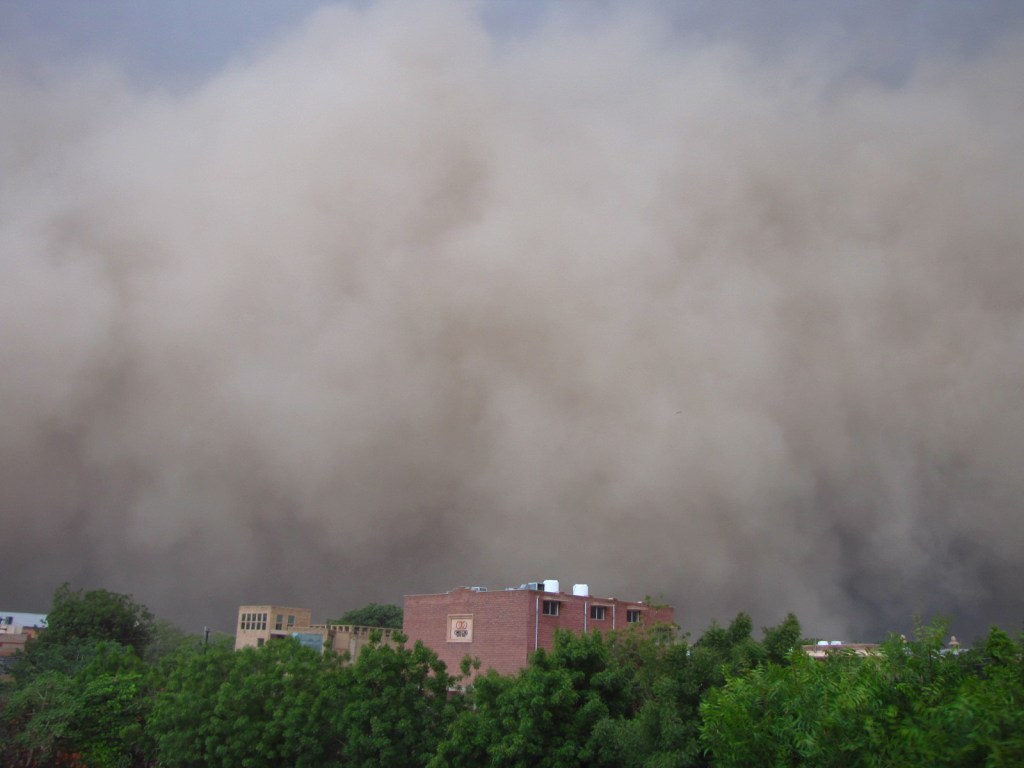
An hour before sunset, the air in the camp and the plains suddenly became so still it was practically visible, with one man noting it could have been cut with a knife. In the distance, a rumble of thunder promised rain, but what happened next was beyond even the most vivid of imaginations. The wind, which first began as a stiff breeze, worked its way up in minutes to a gale and brought with it dust. “From the point whence this wind came, there was visible, behind and above the clouds of dust, something which looked like a gigantic wall of bright red brick, advancing at a slow and equable pace, and spreading as it approached more widely across the horizon. About it tumbled a confused mass of whirling black clouds, scintillating with incessant lightning, and convulsed by the throes of the thunder which echoed within them.”
The men started out of their tents and stood transfixed as a wall of sand rose high up into the air, and “and came across the track of the setting sun, darkness, as of an eclipse, fell upon the land, though on the opposite side of the horizon there still appeared a sort of pale, sickly twilight through the dust. As the storm approached it seemed as if the earth were beaten by the hoofs of myriads of cavalry.”
The storm broke just as the NCOs of No. 2 Company, 93rd Regiment were falling in to bury one of their own – Colour-Sergeant Mackie, who had succumbed the day before to sunstroke. Just as they were lowering the body into its grave, there came a crash of thunder as loud as an explosion of a powder mine. With the wall of sand, came hail, as large as pigeon eggs, sending the men of the funeral party rushing for cover; in the mango tope, the wind howled ferociously through the wind, sending the hail with such force against the bare legs and arms of the men that they were soon covered in cuts, as if from glass.
“The lightning flashed out in every variety of form—in narrow streaks, in broad belts of blinding light, in bright blue zigzags, in balls and bolts of fire, and in snapping jets, which seemed to leap from tree to tree, and to run along the ground amidst the hail. With two or three invalids. Brigadier Hagart and his aide-de-camp, Mr Gore, of the 7th Hussars, I was located in the ruined bungalow, compactly built of brick, and, though the windows and doors were gone, and even the framework had been removed, the roof, fortunately for us, had been left. So great, however, appeared the violence of the storm and the strength of the gale, that Ave were apprehensive the stout walls would be brought down upon us…The moment the tempest reached the spot upon which the bungalow stood, we were plunged into darkness, or rather, rapidly intermittent intervals of darkness barred the glare of the blaze of incessant lightning. The rain fell in torrents; with it were jagged hailstones, or transparent frozen lumps of water, the majority of which, as far as I could form an opinion from the numerous specimens which came into the bungalow, exceeded in size a pigeon’s egg. In a short time, we were driven to the lee of a wall in another room by the torrents of rain. One globe of fire, descending like a shell, struck a tall tree in the middle within a few feet of the house, and clove it in two, the upper part beating down a tent below it to the ground, the occupant happily escaping unhurt.”
Tent pegs wrenched from the ground by the sudden force of the wind, sent tent after tent to the ground, burying within them their occupants; a mess tent was soundly blown away and hurtled across the plain, chased in vain by a few servants. After raging for an hour and levelling nearly the entire camp, the storm rumbled its way across the plain, leaving in its wake a torrent of rain that lasted most of the night. Every stream and dry creek woke to life, and by morning, where there had been a rivulet was now a small river in its place, while the plain turned into a vast marsh. Gordon-Alexander could not resist his natural urge to grumble, stating, “My native servants were rendered so stupidly helpless by the storm that it was past eleven o’clock that night before they brought me from camp a dry suit and something to eat.”
Campaigning in India had just taken a new turn; while this was only prelude to the monsoon that was on its way, the soldiers of the army had just had a taste of an enemy they would never be able to fight – the rains.
Sources:
Behan, T. L., ed. Bulletins and Other State Intelligence for the Year 1858, Part III. London: Harrison & Sons, 1860.
Forbes-Mitchell, William. Reminiscences of the Great Mutiny. London: Macmillan & Co., 1894.
Forrest, George William. A History of the Indian Mutiny. Vol. 3. London: William Blackwood & Sons, 1912.
Gordon-Alexander, William. Recollections of a Highland Subaltern. London: Edward Arnold, 1898.
Jocelyn, Julian R. J. The History of the Royal and Indian Artillery in the Mutiny of 1857. London: John Murray, 1915.
Malleson, George Bruce. History of the Indian Mutiny 1857-1858. Vol. 2. London: William H. Allen & Co., 1879.
Russell, William Howard. My Diary in India. Vol. 2. London: Routledge, Warne, & Routledge, 1860.
 Mutiny Reflections