The Taking of the Begum Kothi
All was now in place for the taking of the Begum Kothi. Throughout the night, the guns near Bank’s house threw a veritable storm of fire against the enclosure with its myriad of buildings inside, and the mortars sent “their flight of shells, which shot like showers of falling stars” into the city itself. At daybreak, the Naval Brigade hauled their monstrous guns into place and hour after hour, as Outram from the other side of the river enfiladed the defensive lines of the rebels, while simultaneously two additional 24-pounders played against the Mess House and the Kaiser Bagh, it was turning into a dreadful day for the inhabitants of Lucknow.
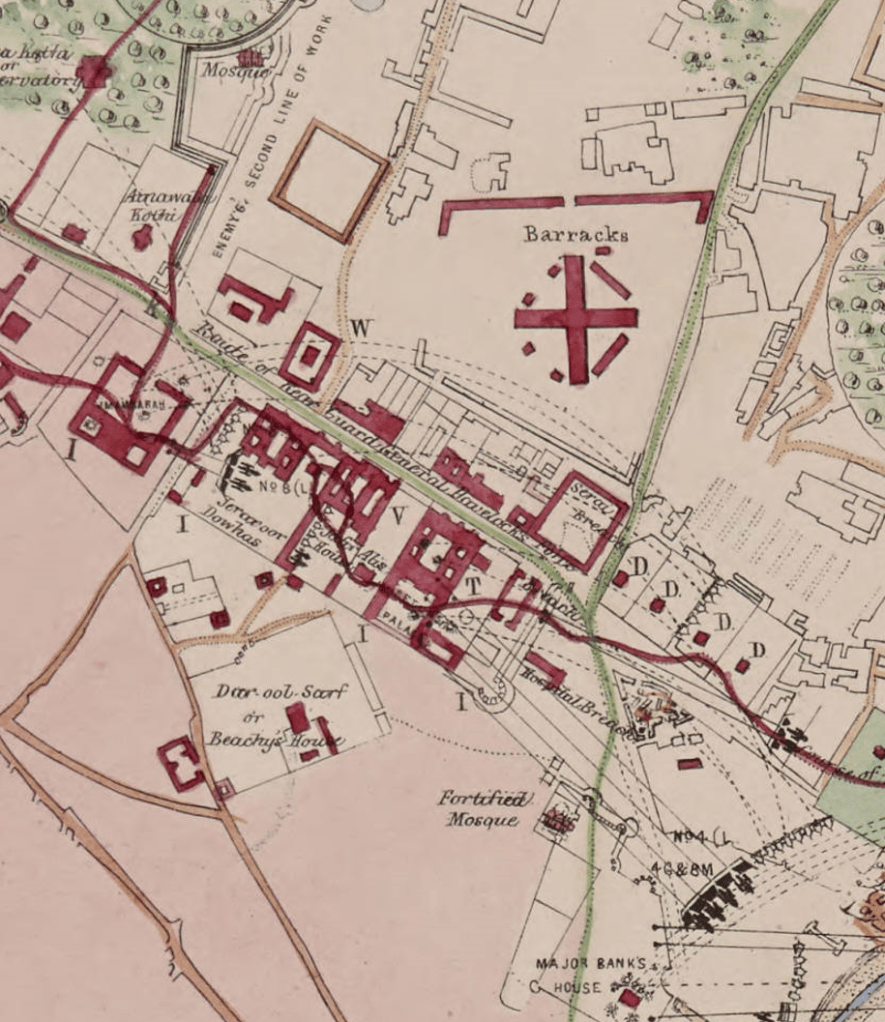
“A puff of blue smoke at the Naval Brigade Battery, then a cloud of dust at the Begum Kothi; a cloud
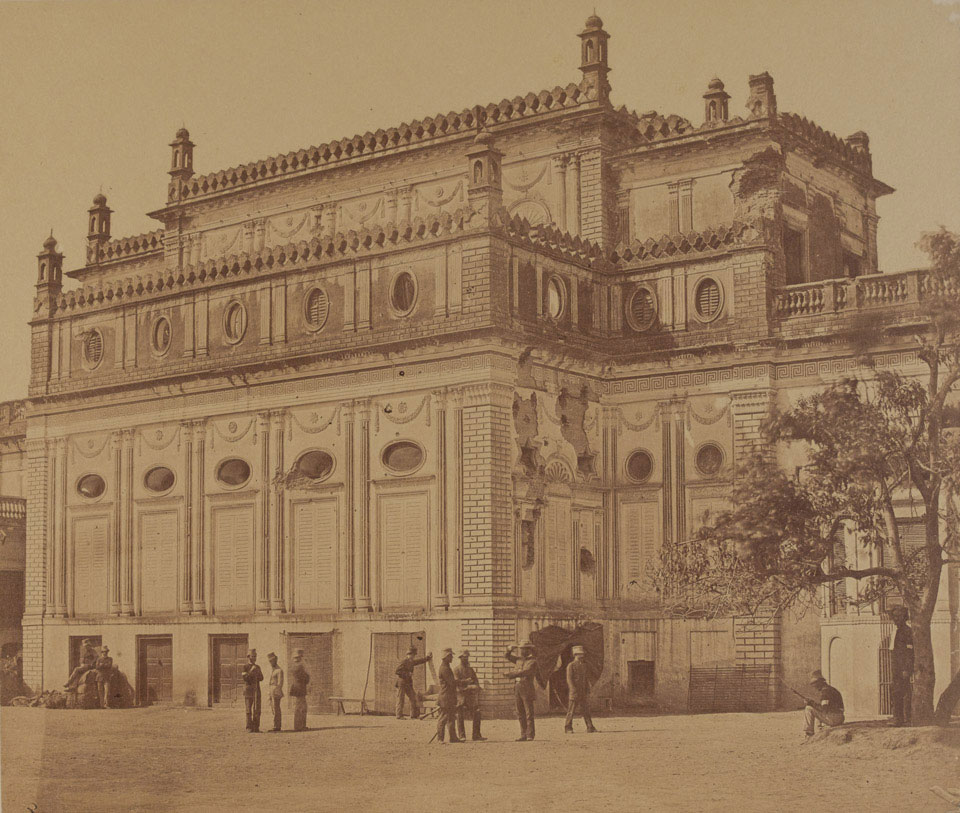
of blue smoke beyond Banks’ bungalow; then another cloud of dust at Begum Kothi; a cloud of blue smoke in the King’s Garden; a shell describing a parabola through the air; another cloud of smoke at the Begum Kothi; then crack, crack, as the shells burst among the rebels. When the heavy volumes of dust and smoke rolled away from the Begum’s Palace, high above its walls were seen its richly ornamented gables and entablatures with minarets and gilt spires, and roofs of the adjacent buildings swarming with rebels. Their guns boldly bellowed forth a reply, and the fire on both sides waxed hotter and hotter. The day was far advanced, and no breach was reported as practicable.”
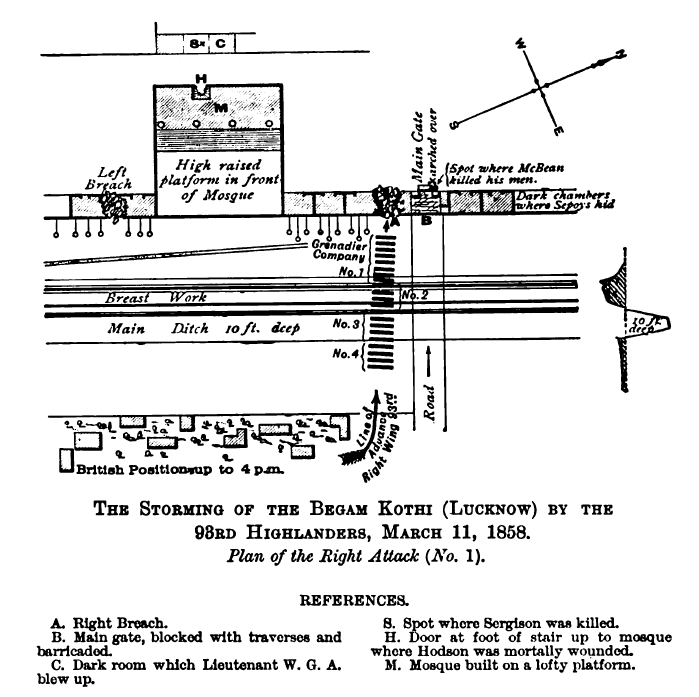
The position the 93rd Regiment and the 4th Punjab Rifles (Wilde’s) had been told off to storm, as soon as the breach was practicable, was immense. It consisted of a straggling line of buildings, divided by courtyards and gardens. None of the buildings had an upper floor, but all had wide, flat roofs; those abutting the exterior wall of the Begum Kothi itself were “provided with extemporised mud breastworks all round…” providing ideal cover for shooting at the oncoming troops. Along the whole front, which faced the British line of attack, the rebels had constructed a ditch some 10 feet deep and 18 feet wide at the top, with a substantial breastwork on the inner side.
“The whole palace had been prepared for a defence à outrance, for we found every gateway or passage
leading from one court to another barred by traverses made of sun-dried mud, admitting only one man at a time. During the 10th, and up to four p.m. on the 11th, the guns from our heaviest batteries poured shot and shell into every corner of the enclosure, and yet, when we effected our entrance, the Begam herself, with more than 100 of her ladies, was still occupying the zenana in the central court…”
As soon as the two breaches were deemed practicable, Sir Edward Lugard made his disposition for the upcoming attack. At 3 pm, the pickets of the 93rd were relieved by the 90th Regiment of Foot, and they rejoined their regimental headquarters.
They now found out they had been detailed to take the lead in the storming of the Begum Kothi. Brigadier Adrian Hope instructed the officers of the play of the day – the right wing, under Lieutenant-Colonel Leith Hay, would assault the main gateway where a breach had been made to one side. “The Brigadier explained to us of the left wing, after we had been moved away from the right wing more to our left to be nearer the corner from which we should emerge from the friendly shelter of the low mud walls of the ruined huts and outhouses to deliver our assault, that we should see the breach we had to storm to our right front, not immediately in front of us, and bade us be sure to keep our left shoulders up.”
The storming parties were supported by a wing of Wilde’s Rifles, 500 Nepalese Gurkhas whom Jung Bahadur had sent forward, and a party of Sikh sappers carrying power bags. Then, with rapid precision, by 3.45 pm, the men were drawn up as close to the positions as possible; exactly 15 minutes later, the guns fell silent. With determination, the 93rd began their advance, up the road, to the cover of some ruined buildings where they were told to halt and wait.
Adrian Hope now gave the signal, and both wings, at the double, dashed out from their cover and “…over the field rose the Highland slogan as a wave of tartans swept forward, unruffled by the storm of musketry sent from wall and loophole. The right wing, on reaching the high wall forming the outer barrier of the palace, found in front of them a huge parapet of earth with a steep scarp and ditch nearly eighteen feet wide and ten feet deep. Instantly, Captain Middleton and four grenadiers leapt into it and were quickly followed. Hay, Middleton, and Wood got shoved up the ditch onto the berm, and, having obtained a footing, proceeded to pull up the men.” One by one, they pushed through the breach, much to the surprise of the rebels who now realised, much to their consternation, not a single one of their men was on the ground, ready to defend it.
No sooner had the right wing made it through the breach than they found themselves confounded by another high wall, and by now the rebels had woken up from their daze and began a concentrated fire upon their heads. Pipe-Major John Macleod, who had been one of the first through the breach, decided it was high time to up the ante and commenced playing his pipes, quite unconcerned by the bullets flying around him. “Having no means of protecting themselves against the fire or of returning it with effect against men who were under cover of their battlements, the Highlanders made a dash at a small narrow hole which had been made by our 9-pounder in the walls.”
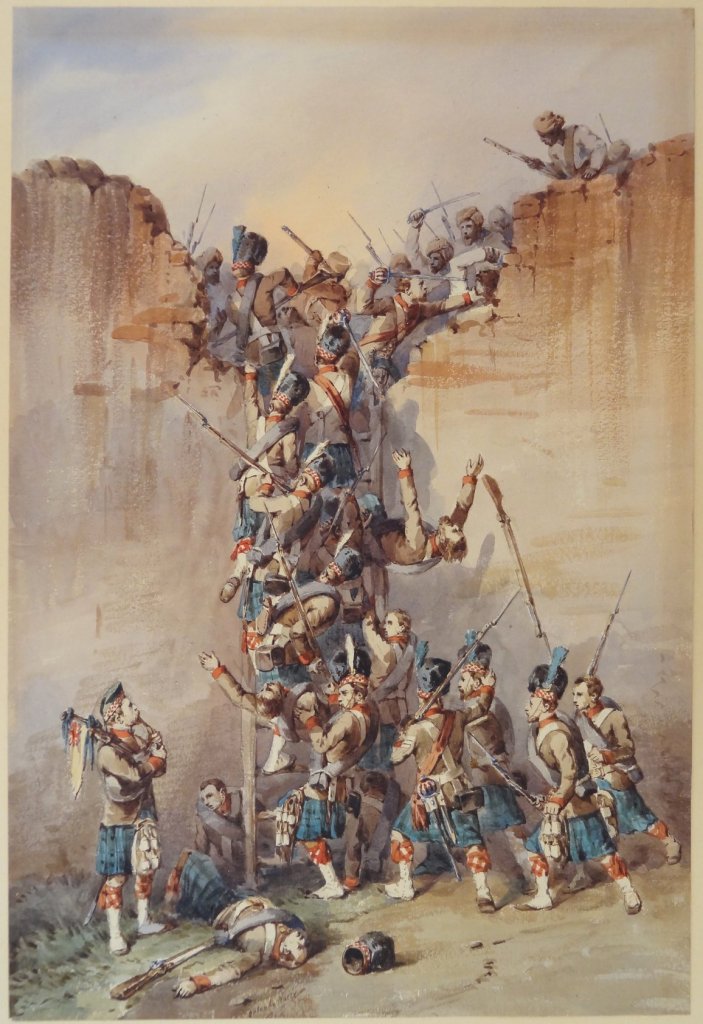
The 93rd were now held in check by a concentrated fire of musketry until some of the men had managed to break open a few blocked-up windows of the building to their fore, and shoved their way through. Things were about to become a shade more complicated.
Begum Hazrat Mahal had kept council in the walls of the Begum Kothi until just before the assault began. Much to the embarrassment of the Highlanders, she escaped out the back just as they came in through the breach. To their surprise, the first people they captured in the Begum Kothi were 80 ladies of the old Nawab’s zenana, and they sent them under an escort, straight to Sir Colin Campbell, who was at a loss as to what to do with this curious group, for they stood around him, chatting and laughing as if nothing had happened. However, things at the Begum Kothi were about to become serious.
The rebels were manning every window in the myriad buildings and had placed themselves on the roofs, taking advantage of every angle to fire on the oncoming Highlanders. Inside the building, things were no better. The passages, narrow and dark, left the men momentarily blinded, having just come in from the strong sun and the marksmen, hiding behind doors and in far corners, picked off the advancing Highlanders.
“Barrier after barrier was forced, and in small parties, headed by their officers, the soldiers pushed on till the great inner square was reached. Here, a host of sepoys stood ready to receive them. The assailants were few in numbers, but the Highlanders stood unappalled. The command was given, “Keep together and use the bayonet,” and a firmer grasp of the weapon told of the stern spirit which wrought within. Then with piercing steel, they forced their way into the dense mass of men, being well supported by the Sikhs, who kept pace and stroke in the tremendous conflict. No quarter was given, no quarter was expected. The Highlanders and Sikhs drove the insurgents from court to court. They fought them in the cloisters, and they bayoneted them in the small dark rooms. Bands of rebels, maddened with fear at the bags of gunpowder with lighted slow matches thrown into their lairs, rushed out and perished on the bayonets of their foes.”
In one room, it was the rebels who had a shock when the huge form of red-haired Brigadier Adrian Hope, shoved without ceremony through the window by his men, tumbled headlong into the room, sword and pistol in hand – the two parties stared at each other for second, long enough for the few rebels to realise that this was one foe they preferred not to meet. They bolted with Hope relieved no one had thought to shoot him.
Captain C.W. Macdonald was not so lucky. As he attempted to enter one of the rooms in the courtyard, he was shot – before anyone could come to his assistance, a rebel stepped forward and shot him again, while another ran his bayonet through his body before disappearing back into the darkness.
“Macdonald, a particularly handsome little fellow, was a great favourite with both officers and men. He was very quiet and reserved in his manner, and very youthful in appearance, full of zeal for his profession, a perfect gentleman, as brave as a lion, and as tender as a woman. He always went into action with his drawn dirk in his left hand-which, alas! was no protection against bullets-when most of us discarded it as merely an ornamental weapon; and one day at Bithur he illustrated to me how the Highlanders used to use it, not only as a weapon of offence, using it then with its point turned outwards, but as a shield and buckler to protect the head and the whole body against sword – cuts, with the broad back of the blade pressed against the forearm, point towards the elbow and edge turned outwards, always, of course, using the left hand.”
However, another, who was certainly luckier than poor Macdonald, was Lieutenant and Adjutant William MacBean. Armed with his heavy cavalry sabre, he took up his position just by the main gateway, ready to cut down any man who attempted to escape the slaughter within. “McBean, who was a powerfully-built, fine-looking Highlander, and esteemed by his officers, both when in the ranks and as a non-commissioned officer, performed this feat of strength on some, one of the officers, calling out to
him, as the Sepoys began to bolt one by one from the gateway: ‘ Now, McBean, let’s see how many you can cut down by yourself!”
At the same time, the Light Company of the left wing, headed by Captain S. Molyneux Clarke, waving his claymore and shouting, “Come on 93rd!” reached the right breach. Once again, the rebels kept their distance – only later would it become clear it was with good reason. The rebels had planted a mine close to the breach, but if they had been hoping it would blow up Clarke and his men to infinity, they were wrong. The mine failed to explode.
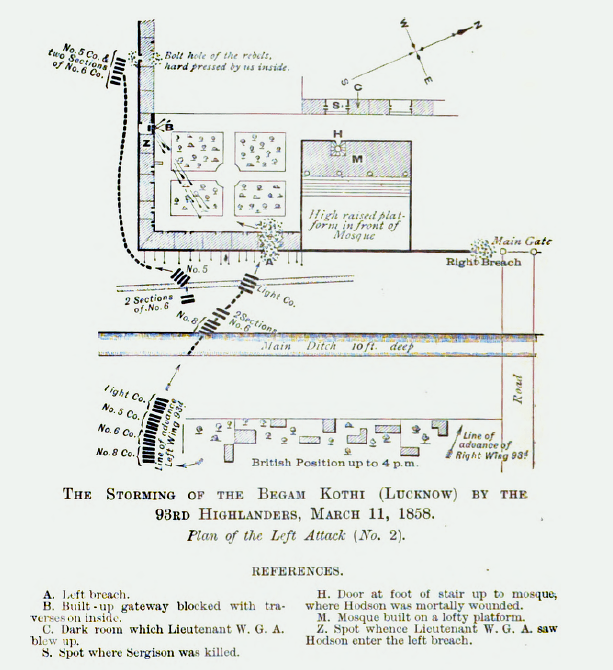
Their breach, as carefully explained by Adrian Hope, was not in their front but towards their right – they were to keep in columns of sections, with their left shoulders up and their eyes focused on the breach. After they started, they had to swing around their shelter of mud buildings out into the open at the double, and Gordon Alexander, subaltern of No. 6 Company, was ready for anything but not for laughter. Yet, from the companies in front of him, the companies were having a right laugh. As soon as he came up, it was clear why.
“…we saw, as we wheeled first to our left rear and then past them to our right and front out into the open, the 500 men of Jung Bahadur’s Gurkhas who were to act behind the wing of the 4th Panjabis as our supports. They were all squatted on their hams, in column of companies, dressed in very bright scarlet tunics, and it looked, as we doubled past, as if every man had an umbrella in addition to his rifle, and a
tame green parrot seated on his shoulder. Probably there were not more than twenty men in each company, besides all the officers, who had an umbrella and a parrot, but the idea of going into action thus equipped was so very funny, that it made us all forget the serious business before us, and elicited from all ranks peals of laughter as we swung round into view of the enemy.”
However, things would soon be rather more sombre. The Light Company, led by Captain Clarke and Lieutenant Macpherson and accompanied by Major Macdonald, were the first to reach, surmount and enter the breach without any real opposition, but Lieutenant Richard Cooper, perhaps distracted by the sight of the Gurkhas, had completely forgotten to keep his eye on the breach. His men crossed the first deep ditch but suddenly encountered a second one, which was wholly unexpected. Cooper had brought up his right shoulder, and instead of climbing the breach as he should have, he had turned off to his left, missed it completely and led his men to the outer palace wall on the southeast side. Confusion was not far behind. Officers, busy with getting their men back into order after they came out of the ditch, deafened by the roar of cannons and musketry, their men unable to hear their words of command, looked towards Cooper to see what he was doing. Captain Burroughs, with No. 6 Company, hard on the heels of Cooper and No. 5, swiftly took the two leading sections and followed Cooper. Lieutenant Alexander, on coming out of the ditch, took a moment to understand what was happening. He fortunately remembered Hope’s injunction and started to look for the breach. Seeing the men in front of him disappearing off to the left, he halted the leading sections of his men as they came out of the ditch
“…and, by dint of shouting and gesticulating, stopped any further advance till I got the whole of my two sections landed clear of the ditch and in their places; I then sent Corporal Steele, who was the left -hand front- rank man of my leading section, back to the officer leading No. 8, to warn him of the mistake in front, that there was a second shallow ditch in front of us, and that he had to keep his left shoulder up.
Steele, who was a very cool, fine young fellow, came back in a few minutes to say it was all right, and No. 8 would follow us.”
This done, Alexander started at the double with his two sections in the direction of the breach to the right by which time Cooper and the two leading sections of No.6 had vanished around a corner of the outside palace wall. Leaving them to their own devices, Alexander mounted the breach, meeting no opposition at all. On top of it, he met an irate and very excited Major Macdonald, who wanted to know what had happened to the rest of the storming party. Alexander quickly explained, and Macdonald replied that the Light Company needed their support without delay, pointing off towards a barricaded gateway, where the Light Company could be seen, rather at odds against a formidable foe.
Alexander quickly formed his men into file and dashed off.
“…we found the Light Company very hotly engaged with a body of some eighty of the enemy, which had retreated into a barricaded gateway built up on the outside, and were fighting like rats in a pit. They were able to fire straight out past one of their traverses in the gateway, and, following Major Macdonald’s
instructions, I unwittingly led direct for it, losing at once poor Corporal Steele, shot through the heart, and the other leading man of the file, also shot through the body. Steele, who was next to me as we ran, jumped a foot off the ground, I should say, throwing his rifle into the air, and ejaculating, ‘Oh, my poor mother !’ “
Fortunately, No. 8 Company had taken Steele’s lead and now, with a party of Sikh sappers and a wing of the 4th Punjabis, emerged from the rear. As for Lieutenant Cooper, his mistake, which might have proved fatal had the rebels been up for a fight, turned out to be a fortunate accident. He led his company to the left, outside the wall, almost opposite Bank’s House and to his surprise and no doubt theirs, came upon a hole the rebels had made in the southeast wall as a means of escape from the slaughter within. They had not expected, as they emerged from the low hole with their heads bent, to stumble straight into Cooper and Burroughs, and as such, it was also their end.
As for their comrades, still fighting inside, the situation was becoming worse by the minute. Like at the Sikandar Bagh, they had made the fatal mistake of blocking up the gateway with masonry and could not get out, but they were determined to sell their lives dearly. Alexander, too, realised his men were running into an impossible situation. He could not rush the rebel position, as his way was blocked by three mud traverses, which only allowed for one man to enter between them, and the only solution was to blow up the gateway but to do this, someone would have to climb to the top of the room directly to the left of the gateway, and drop a bag of gunpowder, with fuse attached directly on the rebels’ heads. A man of the Light Company rushed to the fore with a crowbar in hand, scrambled up a scaling ladder onto the roof and was promptly shot dead by the men on the opposite side of the gateway. Alexander, realising things were really not going very well, scrambled up onto the roof and, crouching down, raised his feather bonnet on the tip of his claymore to see what would happen – several bullets ripped through it. The only way to make a hole, then, was to lie down flat and work the crowbar, first with one hand and then the other, round and round, until a hole took shape. The Sikh sappers were swiftly at hand, and two of them took Alexander’s position, enlarging the hole while he backed away on all fours. Very cautiously, he ventured to stand up, just in time to see two officers clambering over the left breach. They then skirted the wall until they reached a passage and disappeared. Within a few minutes, Major Hodson would be mortally wounded by the last act of a desperate man.
 Mutiny Reflections