“He was remarkably well made, lithe, and agile, in height about five feet eleven inches. His hair had slightly receded from a high and most intellectual forehead, and was light and curly. His eyes were blue, but animated by a peculiarly determined and sometimes even fierce look, which would change to one of mischievous merriment, for he was keenly susceptible of the ridiculous, in whatever shape it presented itself; but usually his look impressed me at once with that idea of his determination and firmness which have ever characterised his actions. His nose was inclining to the aquiline, and the curved, thin nostrils added a look of defiance in noways counteracted by the compressed lips, which seemed to denote many an inward struggle between duty and inclination… if you add to this an open, frank manner, that, bongré malgre, impressed you favourably at first sight with the owner, you will have the charming ensemble that presides over my recollections…“
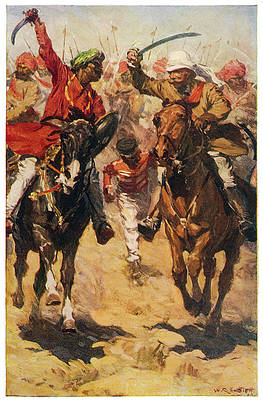
Ever since the affair at Shamshabad that had cost the life of his friend, Charlie McDowell and had put him hors de combat, with a sabre cut to his sword arm, it would appear the fight had left Major Hodson. He wrote to his wife that he wanted a change after 12 years of service, and wanted to know what “home and good treatment” could do for him, but in the same breath, when Doctor Anderson of Hodson’s Horse had proclaimed it would take him six weeks to recover, Hodson scoffed and replied he would be up in ten days. True to his word, on 5th February, he joined Colonel Burn in his buggy and made his way to Cawnpore. Four days later, they arrived, and the next day, he watched as Hodson’s Horse crossed the Ganges, destined for their camp at Unnao with the leading regiments of Sir Colin Campbell’s Army of Oudh. And yet, he continued to speak of home.
Writing to his sister on the 11th of February, Hodson noted he did not expect the campaign to do him much good, and told her to expect he would be a brevet-major and “nothing more…Dear, dear home, sadly changed and contracted since I left it, but home still, and dearer than ever, since the dearest
part of myself will accompany me. All old home memories were so vividly revived yesterday by Charles Harland’s visit, and an extract he read me from a letter from his brother, describing the enthusiasm of the old people at Colwich [his father’s old parish], when the news arrived that the King of Delhi was our prisoner, and how they came to inquire whether it was really their ‘ Master William ‘ who had done it.”
As for the immediate future, he hoped once this whole Lucknow business was over, he would get his regiment sent back to Ambala for the form and drilling he felt they needed badly. He could not imagine going home or even taking another appointment until he was sure Hodson’s Horse was the regiment he wanted them to be. He liked his regiment, he said, and even better, they liked him and “would follow me any and everywhere, I do believe.”
Camped at Unnao with nothing to do, Hodson was relieved to find his good friend Robert Napier had finally arrived and even rode over to Cawnpore to spend two days with him; when he arrived back in camp, he learned that Sir Colin had recommended him for the brevet-majority after all, as he had hoped for.
The 25th of February, at Jelalabad Fort
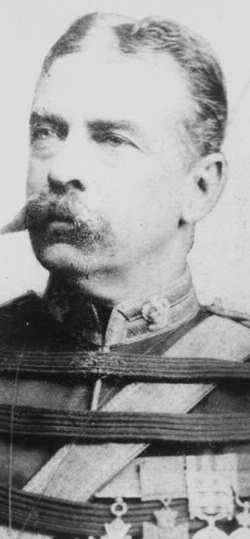
On the 25th of February, unbeknownst to Hodson, he would lead his final charge with his regiment. Just outside Jelalabad Fort, where Hugh Gough had been lucky enough to receive his first citation for the Victoria Cross in November, Hodson’s Horse met the rebels again, this time intent on destroying Outram at the Alambagh. Hodson’s Horse arrived just in time to avert a certain disaster, but the day was hardly a success. Although nearly a 1000 strong, much of the brigade was still untrained and undisciplined, composed mostly of new recruits from the Punjab who had followed “Hodson’s influence and the magic power of his name,” skilled horse riders but without the training to withstand the hammering the mutineer sepoys were about the give them.
The first charge went off well, and the sepoys moved off in the face of the oncoming cavalry without as much as a fight. With the capture of one gun, it seemed the affair was well nigh over as the sepoys were in full flight.
Unfortunately, things suddenly went wrong. The fierceness of the charge and the pursuit left Hodson’s Horse disorganised, and instead of forming up, they broke and scattered into individual parties. The sepoys, seeing the confusion, rallied around their gun and began pouring volley after volley of grape, followed by a sound thrashing of musketry and the disorganised ranks. The horsemen, though gallant enough in a pursuit or a charge, would not stand to be pounded in such a fashion. Ignoring the shouts of their officers, who were trying in vain to bring them into some order, it looked like Hodson’s Horse would retreat.
It was a little too much for Major Hodson to bear. Unable to watch the fiasco that was unfolding in front of him with his arm still in a sling, he managed to gather together 12 of the sowars and shouted at them to make a charge. At his side was Hugh Gough. Furiously, Hodson pushed forward straight at the gun and the sepoys, who, at near point-blank range, were making every shot count. Hodson’s horse fell, wounded, throwing him to the ground, and at the next moment, Gough’s horse reared straight up and came crashing down, dead. While Hodson, wounded by a sword cut to his leg, floundered about looking for a horse to replace his own charger, Gough managed to grab one whose rider had just been killed. He swung himself into the saddle and managed to rally up a few remaining men, while most providentially, up came the 7th Hussars and the Military Train, who now charged the gun and scattered the remaining sepoys. Gough, thinking he was well supported by his men, led them off in pursuit of the sepoys who were now running headlong towards a village, which was well covered by trees and low-lying jungle.
Unfortunately, Gough, in the “ardour of pursuit”, got so well ahead of his men, he was completely alone when he saw, barring his way, two sepoys with bayonets fixed. He decided there was nothing for it but charged the one directly in front of him, but the one off to his right shot Gough through the leg. The bullet passed straight through his thigh, through the saddle of his horse, killing her dead. For a second time, Gough found himself on the ground, and this time the sepoys were coming to finish him off. It was only luck that a trooper from the Military Train arrived in time to save his skin.
Gough was inclined to be more forgiving of the men of Hodson’s Horse. They were a newly raised regiment, he reasoned, their “funk” had been a temporary one, they had got out of hand, had been unable to rally after their first charge before having to face a heavy barrage of musket fire, something even the steadiest cavalry would have found hard. However, Hodson was less inclined to be forgiving. As soon as the regiment was back in camp, he grabbed hold of the native officers and, in front of Gough’s doolie, berated them soundly for causing Gough’s wounds. With the furious Hodson out of earshot, Gough forgave them for “they were really gallant fellows.”
Another person who was particularly displeased with the events on the 25th of February was Sir Colin Campbell. Having read the official report, which stated that the cavalry had been led by a colonel on his staff, “Sir Colin denounced Colonel’s ‘ leading’ as ‘an insufferable impertinence,’ called me up, and asked me before them all, ‘Were you present with your regiment on the 25th?’ and on my saying ‘Yes,’ he cried out, ‘Now, look here, look at my friend Hodson here, does he look like a man that needs ‘leading’? Is that a man likely to want ‘leading ‘? I should like to see the fellow who’d presume to talk of ‘leading’ that man!’ pointing to me, and so forth. I nearly went into convulsions: it was such a scene!”
With the wound on his leg and the old one from Shamshabad opened again after his exertions on the 25th, a bandaged-up Hodson was attending to regimental duties, unable to ride a horse. He was suffering from bouts of fever, and erysipelas was causing him no end of grief. To make matters worse, Hodson’s Horse was moved from the Alambagh to a position closer to Lucknow and the Dilkusha as Sir Hope Grant had placed them in charge of the line of communications with Jallalabad, the Alambagh and Sir Colin’s camp. Hodson was given the duty of arranging not only the safety of the road but for the myriad of convoys plying their way up and down it. Unable to ride a horse, Hodson was horrified that he had to visit the posts and pickets in a dog cart.
On the 9th of March, Hodson was again writing to his wife, trying to allay her fears for his safety. Lucknow, he said, was well invested, and the camps were at their farthest extreme, nine miles apart. She need not worry, when engagements occurred in one part, a day would elapse before the other part heard of it. He further wrote he had not been riding since the 25th as he was saving himself for emergencies. If anything of importance occurred, he would find a way to send her a telegram.
That night, he dined at the headquarters’ mess, where he was found by William Russell. Russell had never met Hodson before and could not help being impressed.
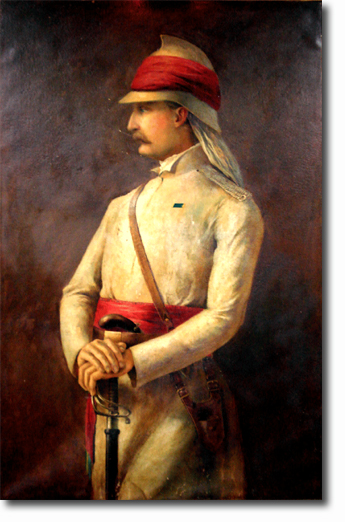
“A very remarkable fine fellow — a beau sabreur, and a man of great ability. His views, expressed in strong, nervous language, delivered with fire and ease, are very decided; but he takes a military rather than a political view of the state of our relations with India. I should like to see Hodson at the head of his Horse try a bout with the best Cossacks of the Don or Black Sea; not that I would willingly have the fight, but that if it must be, I should be sorry to miss the sight of it.”
The next day, with Bank’s House in the bag and arrangements underway for the taking of the Begum Kothi, Hodson was again writing to his wife. He had received, through the post, the news of his majority,
“The brevet has given general dissatisfaction. Some of the double honours are marvellous, but it should be remembered that these promotions are given sponte sud by the home authorities, no recommendations having gone from hence till lately. I am content myself, having no interest. It proves they perceive I have done something, or I should not have this beginning, and it is satisfactory to find that it is universally considered that I have been shabbily used. Better this by far than to have people lifting up their eyes and saying I had got too much.” He then turned his attention to another subject he was determined would be seen to and spent his last full day trying to secure the Victoria Cross for the Gough brothers.
On the 11th, he wrote a final letter to his wife, little knowing he would never see her again.
” Just as I sit down to write comes an order to move our camp towards Alambagh again, Jang Bahadur having at last arrived with his army and taken up ground between me and the enemy. … If anything occurs, I will get Colonel Napier or Norman to send you a service telegram.”
As fate would have it, Hodson met an old friend from his earliest cadet days, Captain Wilkinson. The two men sat together for a while in Wilkinson’s tent and it seemed to his old friend that Hodson somehow knew he was going to die, for he gave Wilkinson several things as keepsakes. When asked if Hodson was looking forward to some respite from all his work, Hodson replied, “Yes, Wilkinson, I shall be glad for some rest.” They then parted, never to meet again.
Hodson now rode out in his dog cart to see Hugh Gough, who was still recovering from his wound. After giving him some instructions, Hodson asked him if he would join him on a drive to Lucknow. Gough tried to get up but was unable to get into the dog cart, so Hodson set off alone. “He nodded a cheerful ‘goodbye’ to me as he drove off with his orderly, Nihal Singh. Little did I think for a moment I should never see him again.” He promised he would be back in time to march with the regiment to their new camp, but that would never happen. As such, Hodson rode over to the headquarters’ camp to find out how the day’s fight was progressing. Dr Thomas Anderson had asked him not to ride as the wound on his leg was not completely healed yet, and proposed that Hodson ride in the dog cart to Dilkusha and only from there take his horse. This he did, and the dog cart was duly sent back from Dilkusha. In the meantime, Hodson’s Horse had had their tiffin, struck their tents and sent on their baggage to the new camping ground, all waiting for Hodson to return. Gough waited until 5 o’clock and, with still no Hodson in sight, gave the order to march, as otherwise it would be dark before they reached the new camp. Just as they dismounted at their new grounds, in rode Nihal Singh, looking for Dr. Anderson. Hodson had been dangerously wounded, he said, and was asking to see the doctor. Until now, no one knew that Hodson had been at the Begum Kothi or indeed why he chose such a reckless path.
 Mutiny Reflections