The Final Controversy of William Hodson
Napier found Hodson, lying in doolie at Bank’s House. He immediately sent for Dr. Clifford, who dressed his wound and then waited for Anderson to arrive. Napier came back again to find that Hodson did not appear to be in much pain. After a few short words, Napier left to find Sir Colin Campbell, but as soon as his duties allowed, he returned to his side, where he remained until the morning.
In the meantime, Dr Anderson had been frantically searching for Hodson. It was already dark by the time Nihal Singh had found him, and now, proceeding along the road to the Dilkusha, Anderson was stopped by the Gurkha sentries who refused to let him pass. After convincing them he indeed did have business of some importance, he arrived at the Dilkusha, thinking, as it had been turned into a hospital, he would find Hodson there. After a fruitless search, and everyone he met telling him they had not seen Hodson, Anderson rode over to the artillery mess and learned Hodson was still at Bank’s House. At 10 pm, he was finally at his side. The bleeding had been so profuse, the doolie was soaked through, and as Anderson saw it, there was little hope Hodson would recover. The wounded man was perfectly sensible but very drowsy.
“He was very glad to see me and made me sit beside him and hold his hands. In a few minutes, I relieved the doctor who had remained with him, and made inquiries of him (the doctor) about the nature of the wound and the treatment that had been adopted. The wound was through the liver, the ball having entered between two of the false ribs in front and coming out between two of the same ribs behind, thus entirely avoiding the lungs. I found him very weak, but with a clear, firm voice, but cold hands and feet, and suffering a good deal of pain. The pain was much relieved by firm pressure of the hands, and I accordingly sat down beside him, holding his right hand firmly in mine and attending to keeping his feet covered, and every now and then giving small doses of brandy-and-water is his pulse showed he required it.”
Anderson lay on the ground next to him all night, holding his hand. Hodson finally fell asleep, and by daylight, he professed that he was feeling much better. His hands and feet were warm, and his pulse was good. As long as the bleeding did not return, there was a slight hope now that Hodson would recover. After drinking two cups of tea, Hodson proclaimed he was feeling much better and proceeded to tell Anderson what had happened. The story that Hodson now related was indeed quite different to the spirited account left by Forbes-Mitchell or, indeed, anyone else.
According to Hodson, he had fallen in with one of the storming parties and joined them, “as an amateur, but not leading or putting himself conspicuously in danger,” in going over through the breach. Hodson stated that the Begum Kothi had already fallen before he was wounded. When the soldiers were searching about for concealed rebels, Hodson had said to his orderly, “I wonder if any rascals are in there.” He then turned the angle of the passage and looked into a dark room which was full of sepoys, and one of them shot him. As he staggered back, a party of Highlanders, hearing who had been hit, had rushed the place and bayonetted every man in the room. The story was corroborated by Nihal Singh, who never left Hodson’s side.
It is possible that this telling of the story was deliberately told to avoid any blame falling on Robert Napier, who should have dissuaded Hodson from entering the Begum Kothi. By rights, Hodson had no business there; however, he was not the only man to go on an excursion that day, for Frederick Roberts, after seeing the arrival of Jung Bahadur, received permission to go and take a look at the scene of the day’s fighting, arriving only shortly after Hodson had been taken away in the doolie.
A cruel story soon circulated around the camp that Hodson had been shot in the act of looting, and it made its way to the papers of the day back in England. This was vehemently denied by Alexander, who would go so far as to challenge one Professor Bosworth Smith, the author of the “Life of Lord Lawrence,” who was still circulating this story in 1883. Alexander was so irate about the accusation, he publicly called out Smith in the St. James Gazette, the same year, demanding a public apology for slandering Hodson’s name. Smith would be repeatedly challenged by other witnesses to Hodson’s shooting, but he neither apologised nor retracted his statement. Forbes- Mitchell, who had been with Hodson, simply asserts,
“No looting had been commenced, not even by Jung Bahadoor’s Goorkhas. That Major Hodson was killed through his own rashness cannot be denied; but for anyone to say that he was looting is a cruel slander on one of the bravest of Englishmen.”
The Last Day
At 9 o’clock, Anderson decided to move Hodson to another room, which had been specially cleared for the purpose, to afford him some quiet. Unfortunately, shortly after the wound began bleeding again with such profusion, Anderson was at a loss for how to stop it. Applying what remedies his knowledge could afford, he saw that Hodson was rapidly becoming worse. The pain was becoming unbearable, and he was falling in and out of consciousness. During one of his waking moments, Anderson told him there was no hope left for him, and Hodson asked him to call Robert Napier.
Napier rushed to Hodson’s side. For the next quarter of an hour, Hodson feebly relayed to him his last wishes. He gave him his last messages to his wife and family, saying, “I feel that I am dying…”I should
like to have seen the end of the campaign and to have returned to England to see my friends, but it has not been permitted. I trust I have done my duty.”
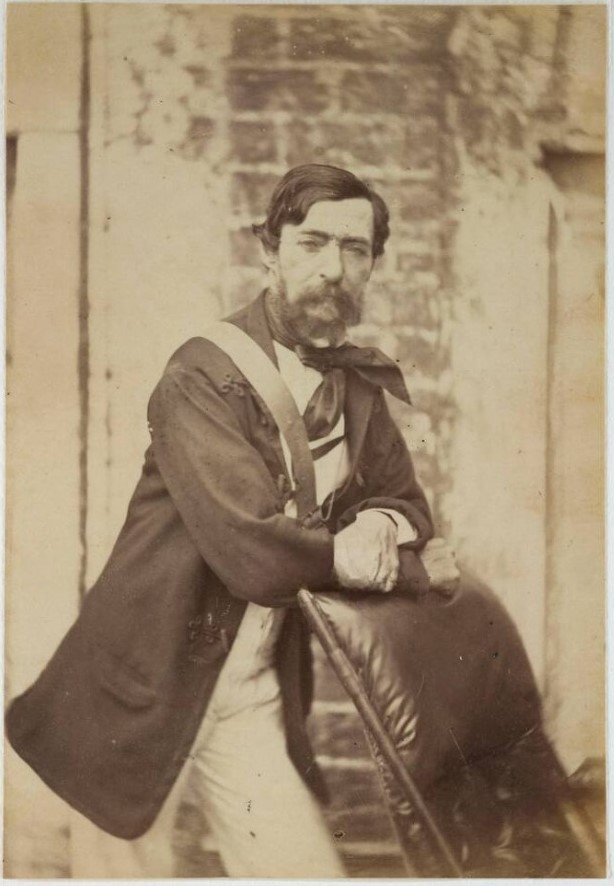
Napier assured him on the last point, saying that “everyone in the country proclaims it…” but could not say much more – Sir Colin Campbell was calling him, and he had to go. Before he could return again, Hodson was dead. As he stood by his bedside, Napier took the ring from Hodson’s finger and cut a lock of his hair to send to his wife.
After Napier left, Hodson became rapidly weaker but was still, with laboured breath, able to speak in short, disjointed sentences. ‘ My poor wife.’ ‘My poor sisters.’ ‘May God forgive my sins for Christ’s sake. ‘I go to my Father.’ “At one o’clock, I saw his end was rapidly approaching, and I asked him to say anything he wished. He said, No, he had no message to anyone, he had told Colonel Napier all his private affairs, but to send love to his wife and that his last thoughts were of her. These were his words. All this time, I was stooping by his bedside holding his right hand. He frequently grasped mine and, smiling, said,’Oh, what pain !’ I had my watch in my hand when he last spoke to me; it was a quarter-past one; it was a mere whisper, ‘Oh God!’ and in ten minutes more, at twenty-five minutes past one o’clock, the sad scene was over. He died most quietly, without a struggle; he merely ceased to breathe.”
The news of his death tore through the camp of Hodson’s Horse in a fury of grief. Everywhere, troopers, the strong, brave men of the Punjab, threw themselves to the ground and wept. Nihal Singh, who had carried Hodson in his arms, cried most bitterly, refusing to believe Hodson was dead. Captain Wilkinson met one of the Gough brothers, who, with tears streaming down his face, told him of their loss. Shocked, Wilkinson rushed over to the place where Hodson now lay, and found the doctors were still poring over his body, examining the fatal wound.
“As I mournfully gazed on his poor lifeless form, I could not help contrasting ‘the languor of the placid cheek’ with the animation and energy and manly vigour that had lit up his handsome and refined features only a few brief hours before, when he was in the zenith of his renown.”
Poor Hugh Gough took his death especially hard and, in part, blamed himself. “Had I been able to accompany him, it is possible events might have turned out otherwise; he would probably have remained to look after me, and thus avoided his fate: as it was, he drove into the headquarters camp, saw his friends, did what business there was to do, and I believe was actually in his trap to return when he heard the sound of the attack…and, naturally enough for a man of his soldierly and fighting temperament, returned to join in the fight or see the result. To me, his death was a sad loss—he had been a kind friend to me from the day I joined him at Delhi. I had been longer with him than any of the surviving officers, and I knew him better than most.“
In writing to Hodson’s wife, Napier, like Gough, took his share in the guilt. “I regret bitterly now that I did not insist on your dear husband going back, but you know how impossible it was to check his dauntless spirit. He lay on his bed of mortal agony and met death with the same calm composure which so much distinguished him on the field of battle.” He promised her would raise a wall around her husband’s grave and build a tomb over it.
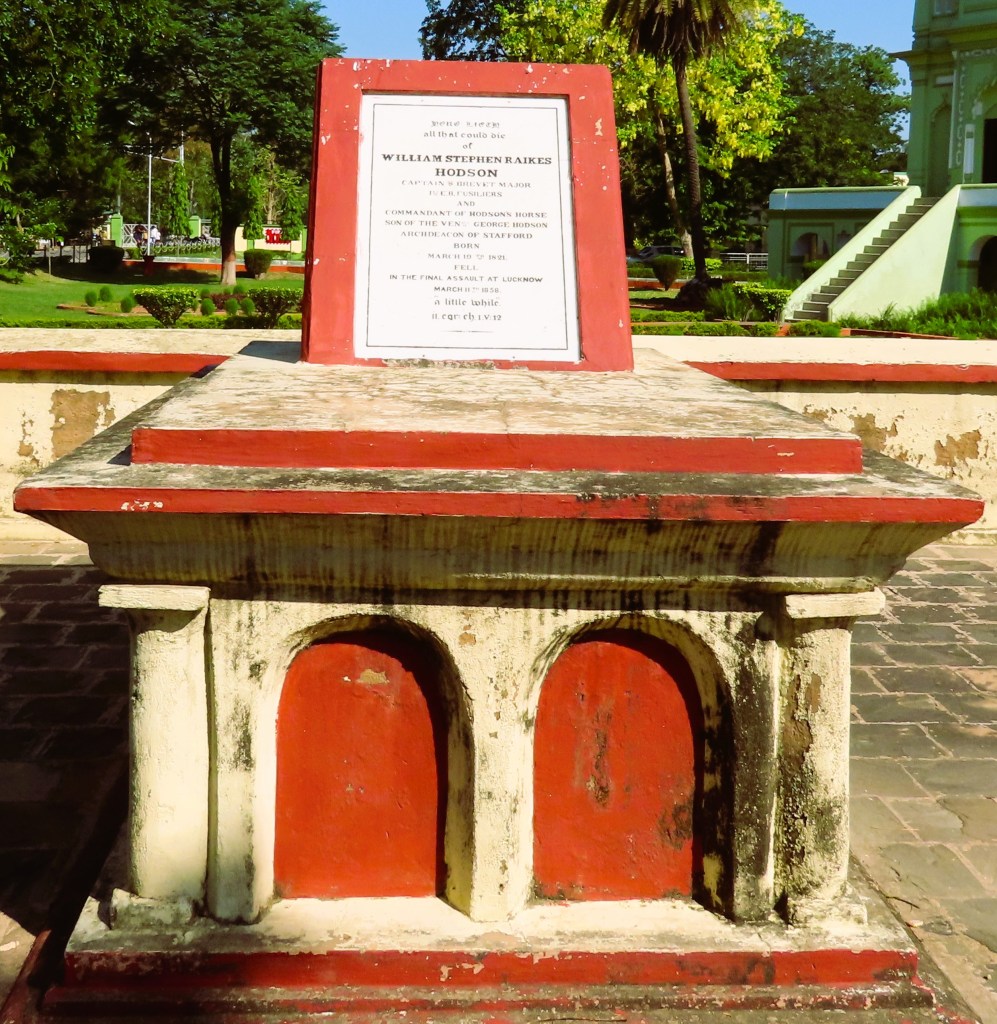
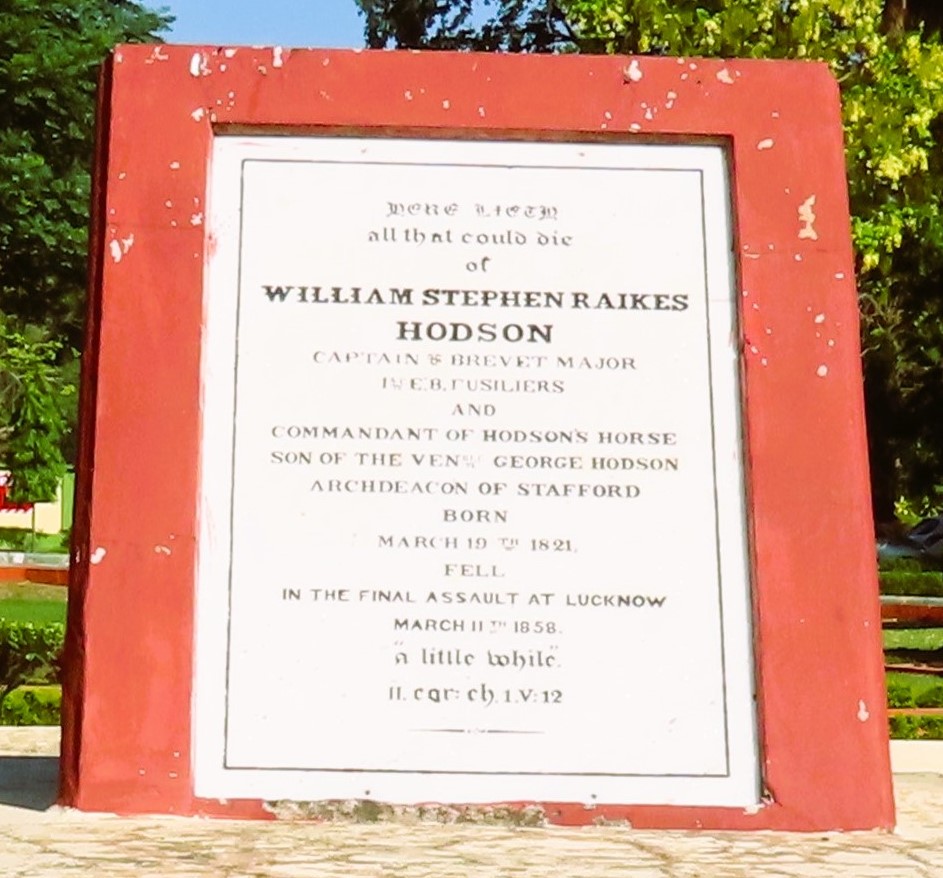
The funeral took place the same evening, on the 12th of March. He was carried to his grave at the foot of a clump of bamboos in the garden of the Martiniere College. Reverend Dr. H. Smith read the burial service to the assembly that consisted not only of every man of Hodson’s Horse but Sir Colin Campbell himself and all his staff. At the moment Hodson’s body was lowered into the grave, Sir Colin burst into tears. He turned to Robert Napier and said,
“I have lost one of the finest officers in the army.”
Sources:
Gordon-Alexander, W. Recollections of a Highland Subaltern. London: Edward Arnold, 1898.
Gough, Hugh. Old Memories. Edinburgh & London: William Blackwood & Sons, 1897.
Hodson, George H., ed. Twelve Years of a Soldier’s Life in India: Being Extracts from the Letters of the Late Major W. S. R. Hodson. London: John W. Parker & Son, 1859.
Roberts, Field-Marshal Lord. An Eyewitness Account of the Indian Mutiny. Delhi: Mittal Publications, n.d.
Russell, William Howard. My Diary in India, in the Year 1858-9. Vol. 1. London: Routledge, Warne & Routledge, 1860.
Trotter, Lionel J. A Leader of Light Horse: Life of Hodson of Hodson’s Horse. Edinburgh & London: William Blackwood & Sons, 1901.
Wilkinson, Osbourn, and Johnson Wilkinson. The Memoirs of the Gemini Generals. London: A. D. Innes & Co., 1896.
 Mutiny Reflections