The Day Ends
Meanwhile, the two wings had become muddled and confused, with small, intense fights commencing throughout the Begum Kothi complex. Any of the rebels who had not been caught on the tops of the roofs or out in the courtyards or in the passageways were still holding rooms throughout the complex – anyone incautious enough to burst open a door would be met with a barrage of shots from within. Before powder could be brought to blow up the room, the rebels had already moved into the next one through the series of interconnecting doorways.
“On emerging from the door where Hodson had been shot, I saw the body of a fine young private of the Grenadier Company, who had come in at the other breach, lying dead on his face in the first of one of these verandas exactly opposite to the door where Hodson was shot, but on the other side of the lane. As far as I could learn from another man of the Grenadier Company who had also wandered away from the right wing in our direction, no shots had been fired from the other room to our left as one looked into the veranda, but when the Grenadier had pushed at the door of the room to our right, a shot was fired which killed him on the spot. Ordering the men to stand back from any part of the lane where they could possibly be seen by the occupants of this dangerous room, I managed to get hold of the poor fellow’s leg, and we dragged his body out of the veranda into the lane .”
The Sikh Sappers found they had their hands full as repeated calls came from various officers for powder as they held their men back from entering the rooms. Others blocked up the corner gateway, which the Light Company had besieged, as they too waited for the powder to blow. As soon as the explosion came, they rushed in, bayonets in hand, and killed the last remaining rebels, some eighty in number, who had held out to the last. As for the work of the sappers, it was hardly over.
“As soon as the Sikh sapper arrived with the powder bag for me, he explained how I was to hold it in my left hand, for the door into which I was to throw it was on my right, with the long rope-like sausage containing the train with fuse attached coiled round my left arm. Looking round, he saw the door where Hodson had been shot on the other side of the lane, and made me understand that the moment I had thrown the bag into the room, I was to take shelter in that doorway, light the fuse and shut the door. His two comrades then crossed the door with a bound to the corner of the veranda opposite me and placed a crowbar under it, making me understand that, when they pressed the crowbar, the half of the door – for, though small, it was a folding – door- would come off its hooks, being only hung on, and fall inwards; then was my time with the powder-bag.” (Alexander)
With everything in place, Alexander was furious to see young Lieutenant C.W.Sergison (a hot-headed young subaltern) come bounding down the lane. He pushed his way past the sergeant Alexander had sent towards the courtyard to keep everyone out of the way until after the explosion, and rushed up to Alexander, asking him what was going on. Alexander quickly explained and ordered Sergison to stand back. The young man, exclaiming, “Oh nonsense!” dashed up the stairs of the veranda and swiftly kicked in the door. It broke just above the point where the Sikh had inserted his crowbar, and as it fell, a few shots rang out from the room beyond. One of them hit Sergison under the chin and came up through the top of his head, killing him instantly. The two Sikhs were left pinned into a corner on the other side of the now open door, but they quickly jumped over Sergison’s body before the rebels could reload, and ran down the veranda steps. This had now changed the tables somewhat. With the door open, the rebels could clearly see anyone who showed their face in their line of fire, making throwing the powder bag considerably more difficult, and Alexander would not throw it until he was absolutely sure Sergison was dead.
Meanwhile, taking advantage of this new situation, the rebels commenced firing out at the hinge of that half of the door which was still hanging, sending some bullets spinning out into the lane. Alexander ordered one of the privates to go and find Lieutenant-Colonel Gordon, as he could not rightly blow up the room without confirmation from a senior officer; that he could do so with Sergison’s body in the way. Every attempt to pull him out of the way was met with a barrage of shots, and it was decided to leave him where he lay. Lieutenant-Colonel Gordon quickly affirmed that Sergison was quite dead and Alexander could carry on, but the lieutenant still had his misgivings. He was now imagining the rebels would either fire at the bag and blow everyone up, or they would charge out while Alexander was swinging it with his left hand, unable to defend himself. As it was, they did nothing of the sort; Alexander tossed the bag, lit the fuse and ran for it.
When the smoke had cleared a little, the Highlanders came doubling back and charged into the room to bayonet anyone they could find still inside and take some revenge on the men who had killed a private, an officer and wounded several others. To their complete surprise, they found that the entire party in the room consisted of only two men, and they were already dead.
As it was, most of the rooms in the Begum Kothi were blown up, but it was finally decided that this sort of warfare also needed to end, as it was costing the lives of too many Highlanders, Punjabis, Gurkhas and Sappers. With the firing within dwindling, Alexander gathered up his company and moved them out. He was stopped by in the centre square by another officer who told him he was to remain where he was and take up a position in the central building itself to prevent any further destruction “of the furniture and fittings” for by now, the army had commenced looting.
“As the Oriental’s idea of a magnificent apartment is one of which the walls are covered with mirrors, and the ceiling hung with crystal chandeliers as close to each other as they can be packed, the effect of our people having passed through such a suite of rooms about an hour before, firing as they went, was decidedly suggestive of chaos. All through these state apartments, too, the floors were strewn with the shoes. of the flying junior Begums, just as we had before seen the fields strewn with the shoes of the flying fighting men.“
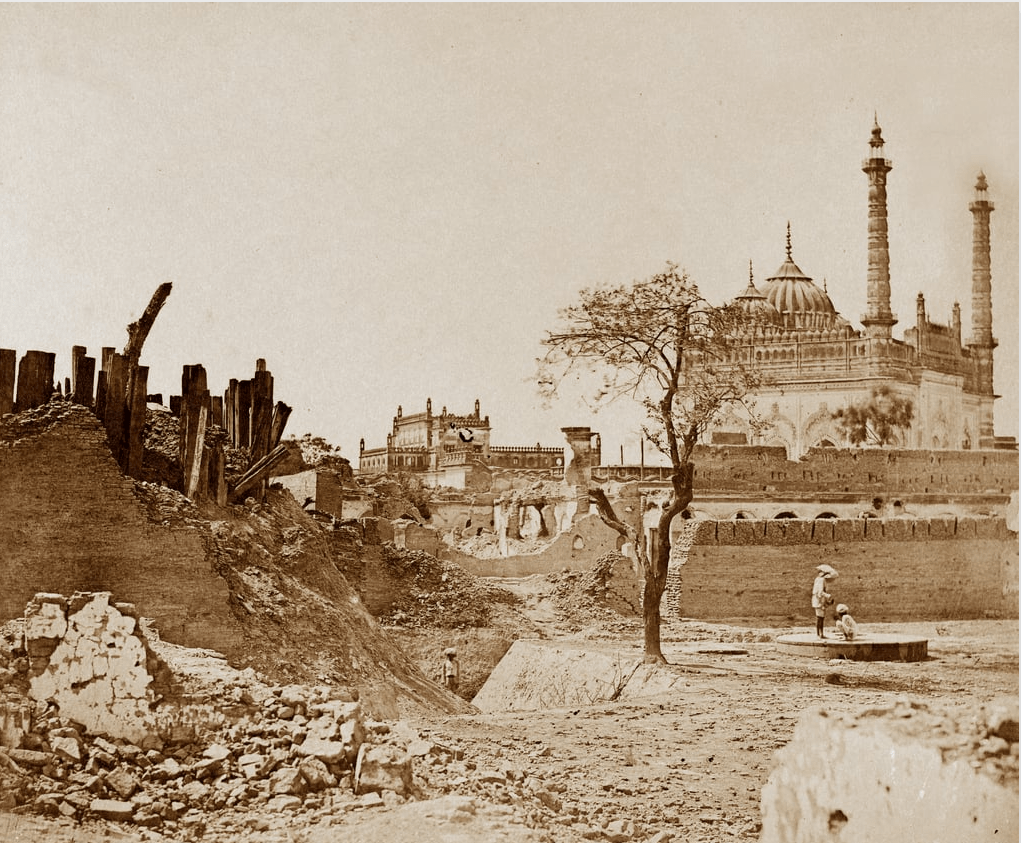
William Russell had planted himself atop the Martiniere to watch the fight with his spyglass. All through two hours it took to capture the building, he noted the rebels, who still could, were making their exit as fast as they could towards their last line of defence – the Kaiser Bagh, but he would not know until the next day, when the dead had been counted, 600 of their number had lost their lives.
Jung Bahadur and Sir Colin Campbell
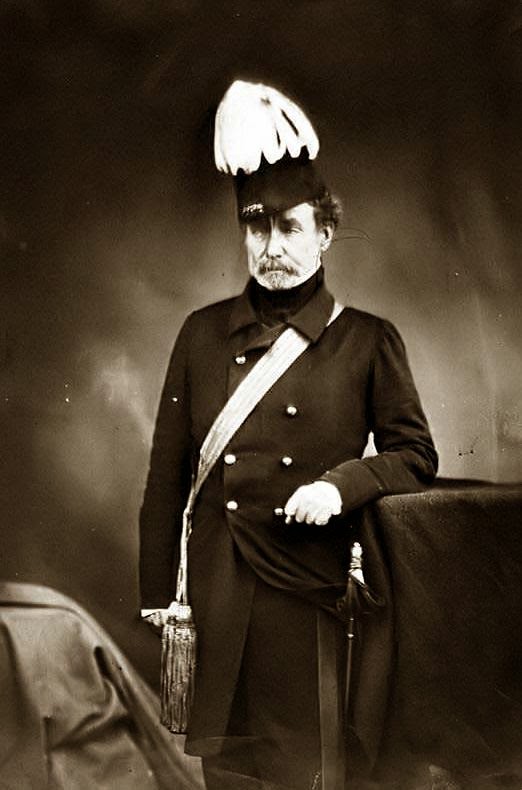
Sir Colin Campbell, too, had been watching the proceedings at the Begum Kothi with some interest when a message reached him that Jung Bahadur and his entourage had been spotted, making their way towards Lucknow from their camp just short of the city where they had arrived the day before. A generous portion of his Gurkhas had been sent post-haste to be at Sir Colin’s disposal for the attack on the Begum Kothi, while Jung Bahadur would arrive, with all ceremony, the next day. With the fighting well underway, it was a rather disgruntled Commander-in-Chief who descended the stairs and made his way to the grand canopy where the reception would take place.
His staff had been warned to be at the ready at 4 o’clock, in full dress uniform, and the final preparations were complete. Carpets had been laid on the ground, and the chairs and seats in the tent had been placed in a semi-circle around the room from the entrance, with a place for Jung Bahadur directly in the centre opposite the door. Outside, a squadron of 9th Lancers waited impatiently, the detachment of Highlanders shuffled about, their bagpipers ready for the word, while the Union Jack flew high on its flagpole, waving slightly in the breeze.
Inside the tent, Sir Colin Campbell paced to and fro. He was finding it difficult to keep his countenance as the sound of Peel’s guns rent the air. Jung Bahadur would, of all days, choose today to be late. At half-past four, the cannonading had stopped, and up rose the “heavy, rolling fire of musketry,” signalling the start of the attack on the Begum Kothi. Suddenly, there came the boom of the saluting guns, 19 salvos in all, marking the entrance of Jung Bahadur. The band began to play as the words, “Stand to arms” rang out, and everyone rushed to their places. The 9th Lancers, serving as the escort for the King’s final march into the camp, now came into view with Jung Bahadur, followed by his two brothers and 20 members of his staff.
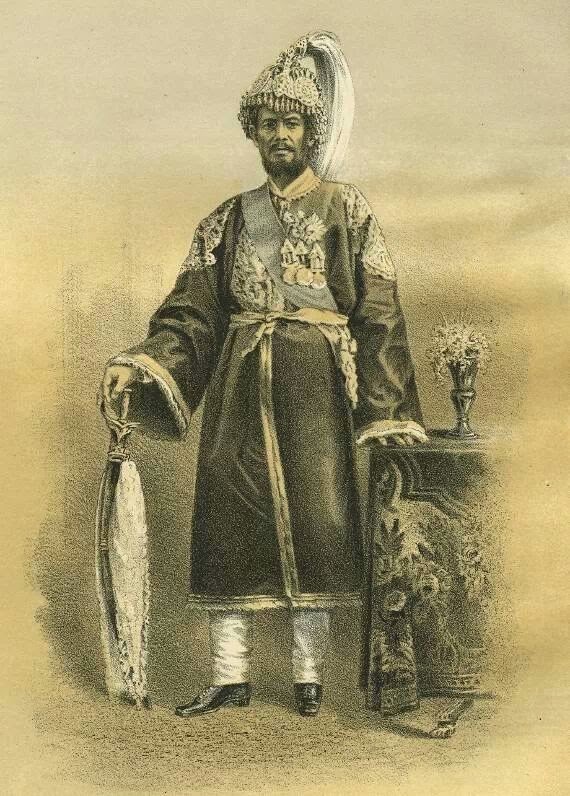
“He wore a jacket of red cloth covered with jewels, and the splendour of his brothers who accompanied him was hardly less glorious or conspicuous than his own. His well-knit figure and the dignity of his carriage and manner struck the eyes of the spectators. Closely attended by his suite, he slowly walked up between the stalwart line of soldiers.” Sir Colin Campbell stepped out from the tent to meet him as Jung Bahadur, with a “white kid-gloved hand raised to his glittering crest, above which nodded a plume of Bird-of-Paradise feathers, delicately beaded with emeralds and diamonds, advanced towards him and took his outstretched hand.“
Amid the clamour of the bagpipes, Sir Colin Campbell took the Maharaja by the hand and led him to his seat. The durbar could begin.
Profuse compliments were exchanged, with a good deal of bowing and salaaming, all ably translated by Captain Charles Metcalfe, who had accompanied Jung Bahadur as interpreter; introductions were made and “each party seemed to appreciate the goodwill of the other” as the staff on both sides eyed each other with curiosity and some distrust. Sir Colin Campbell, now the full diplomat, complimented the Maharaja on his timely arrival at a moment when he could be of most use to the British. Jung Bahadur replied he was ready to place his entire army at his disposal; Sir Colin just had to say when and where.
While the civilities continued, at the Begum Kothi, the Highlanders and the Gurkhas were deep in the heat of battle, within earshot of this curious assembly. Sir Colin Campbell quipped they had much in common, as they were both Highlanders, as the band of the 42nd began stalking up and down playing their martial pibroch, to startling effect.
Amid all this diplomacy, Captain Hope Johnstone, General Mansfield’s D.A.A.G., “a tall handsome man dressed in very becoming fight clothes”, covered in the dust and grim of battle, with his long sword clanking on the ground, walked in through the door. He marched up to Sir Colin Campbell and announced in a manner that was both very remarkable and quite theatrical, “I am directed by the Chief of Staff, sir, to tell you that we have taken the Begum’s Palace with little loss and are now in possession of it and the adjoining buildings.” Sir Colin turned to his guest with much vivacity and began relating the events, asking Metcalfe to inform Jung Bahadur that it was the 93rd Highlanders, his own regiment and the Gurkhas who had won the day. Obviously pleased with the news, Jung Bahadur stated these were the same Highlanders who remembered so well from his trip to Europe 5 years before, who had furnished his Guard of Honour on his visit to Edinburgh, and he “did not doubt but there must be many in the regiment who could recollect seeing him in their native land.” A few more compliments and much ceremony, the darbar ended. Sir Colin escorted Jung Bahadur to the entrance of the tent, where, to the sound of the bagpipes, the stately king mounted his elephant and returned to his camp.
So ended the 11th of March on this side of the Gomti. What Outram was up to on the other, is yet to be seen.
Sources:
Forrest, G. W. A History of the Indian Mutiny. Vol. 2. Edinburgh & London: William Blackwood & Sons Ltd., 1904.
Gordon-Alexander, W. Recollections of a Highland Subaltern. London: Edward Arnold, 1898.
Knollys, Henry, comp. Incidents in the Sepoy War, Compiled from the Private Journals of General Sir Hope Grant. Edinburgh & London: William Blackwood & Sons, 1873.
Lieutenant-General Sir James Outram’s Campaign in India, Comprising General Orders and Despatches. London: Smith, Elder & Co., 1860.
Mackay, Reverend. From London to Lucknow. Vol. 2. London: John Nisbet & Co., 1859.
Malleson, Col., ed. Kaye’s & Malleson’s History of the Indian Mutiny of 1857-58. Vol. 4. London: W.H. Allen & Co., 1889.
Mitchell, William Forbes. Reminiscences of the Great Mutiny. London: Macmillan & Co., 1894.
Rana, Pudma Jung Bahadur. Life of Maharaja Sir Jung Bahadur of Nepal. Edited by Abhay Charan Mukerji. Allahabad: Pioneer Press, 1909.
Russell, William Howard. My Diary in India, in the Year 1858-9. Vol. 1. London: Routledge, Warne & Routledge, 1860.
Verney, Edmund Hope. Shannon’s Brigade in India. London: Saunders, Otley & Co., 1862.
Watson, Edward Spencer. A Naval Cadet with H.M.S. Shannon’s Brigade in India: The Journal of Edward Spencer Watson. Kettering: W.E. & J. Goss, 1858.
 Mutiny Reflections