Sir James Outram Hands are Tied
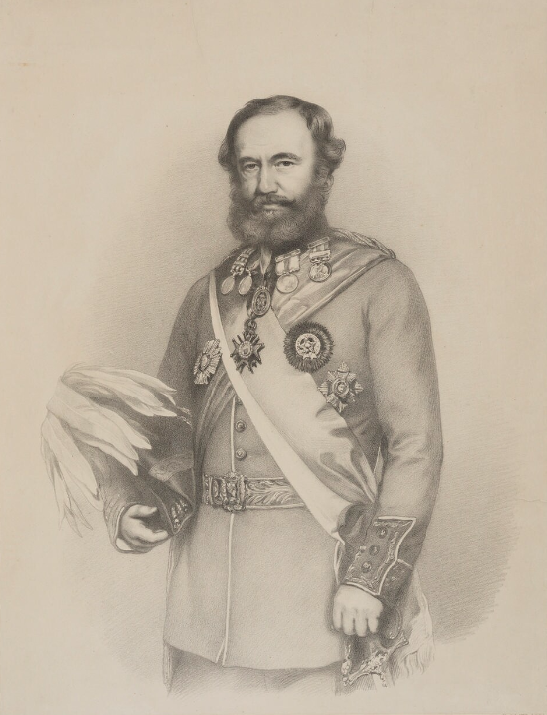
While the troops were busy plundering the Kaiser Bagh, Sir James Outram continued his enfilading fire on the rebel positions from the Iron Bridge. Shortly after noon, a message reached him that the Imambara and Kaiser Bagh had fallen, and as such, Outram now prepared to cross the river to take on the rebels who were now issuing in straggling numbers out of the complex and heading towards the river. His force of three infantry brigades was sufficiently strong to cut them off, and they could, with one fell swoop, take hold of not only the last of rebel defences, but rout them out of Lucknow altogether. With this one master stroke, he could not only assist Franks in his ongoing efforts but ensure that the rebels would become so disorganised, they would lose their opportunity of rallying again.
With quick thinking, Outram ordered the Horse Artillery to prepare for the advance, while the infantry rapidly fell in and opened a heavy fire on the opposite bank; the rebels still had enough wits about them to return the compliment with a heavy cannonade of round shot from the remaining defences they were still protecting. Amid this exchange, Lieutenant Wynne and Sergeant Paul of 4th Co., Royal Engineers volunteered their services to remove a barricade that Outram had ordered thrown across the Iron Bridge.
Advancing under the cover of the bridge’s parapet, they reached the barricade, where, without any hesitation, they began removing the sandbags one at a time, passing them to the line of men to their rear. However, the rebels were not as distracted as Wynne hoped, for after the first row was removed, they opened a hot fire on them. Heedless of the bullets that now flew about their heads, Wynne and Paul continued removing the bags, crouching lower and lower as each row disappeared. With all by the second-lowest tier gone, which the infantry could cross over with no trouble, Wynne and Paul jumped to their feet and ran back, unharmed through a shower of bullets.
Outram, convinced that Sir Colin Campbell would have no objection to his crossing the bridge, sent word, by means of a field telegraph, that he was ready to proceed. The answer he received would have thrown any man of a less masterly countenance into a fit of apoplectic rage. Written by that less-than-brilliant military mind of General Mansfield under dictation from Sir Colin Campbell, Sir James Outram was only to advance if he could do so without losing a single man. It was a thoroughly absurd and irrational request, and no one on his staff could understand what Campbell and Mansfield were playing at.
For Outram, the order was only too clear. He once again reconnoitred the position at the Iron Bridge, trying to find a way to comply with this most harassing order. He could have saved himself the trouble. The rebels were still sweeping the bridge at the far end with their 9-pounder; all they needed to do was rake his men with grapeshot as they advanced, and Sir James Outram would have found himself up to his neck in hot water for disobeying a clear order. Resigned, he turned to his staff and said, “I am afraid, gentlemen, you’ll be disappointed when I tell you that I am not going to attack today.”
With that, the victory of Franks at the Kaiser Bagh was only a half-hearted one; the rebels were allowed to escape, and the campaign, which should have ended on the 14th of March before Lucknow, would now be protracted for more than a year. The thousands of rebels who escaped Lucknow were thus able to spread themselves out in Oudh where they continued to occupy forts and strong positions from which they would only be driven out with hard fighting that would now continue until May 1859, causing, when all was counted, the needless deaths of nearly 1000 British troops to disease, heatstroke and fatigue, besides over 100 killed in battle. The loss Outram would have suffered at the bridge would, in the face of things to come, have been minimal. By the time Campbell was apprised of his folly on the 14th of March, it was too late for the cavalry he sent out in pursuit to affect anything of significance. This absurd order also left Campbell open to justifiable criticism, with some men concluding he was looking to extend the campaign to win even more laurels for himself.
With the day for Outram’s Force concluded, the men were sent back to their previous positions and
“Pulses slackened their racing speed to a respectable jog trot – the heavy firing died away into the usual occasional and uncertain popping, bursting out, however, now and again, into great loud angry volleys, which became less frequent towards as if the guns had been suffering from intermittent fever, from which they were slowly recovering; till at last we fell back into our primitive state of listlessness and were obliged to have recourse to our old amusement of accelerating the movements of timid natives…” (Majendie)
The day might have been over for Majendie but it was hardly finished on the other side of the river, where dreadful scenes were now playing out as the fall of Lucknow reached its ghastly conclusion.
Sources:
Forrest, G. W. A History of the Indian Mutiny. Vol. 2. Edinburgh & London: William Blackwood & Sons Ltd., 1904.
Gordon-Alexander, W. Recollections of a Highland Subaltern. London: Edward Arnold, 1898.
Lang, Arthur Moffatt. Lahore to Lucknow: The Indian Mutiny Journal of Arthur Moffatt Lang. Edited by David Blomfield. London: Leo Cooper, 1992.
Lieutenant-General Sir James Outram’s Campaign in India, Comprising General Orders and Despatches. London: Smith, Elder & Co., 1860.
Majendie, Vivian Dering. Up Among the Pandies: A Year’s Service in India. London: Routledge, Warne & Routledge, 1859.
Medley, Julius George. A Year’s Campaigning in India. London: W. Thacker & Co., 1858.
Rana, Pudma Jung Bahadur. Life of Maharaja Sir Jung Bahadur of Nepal. Edited by Abhay Charan Mukerji. Allahabad: Pioneer Press, 1909.
Roberts, Lord. Forty-One Years in India. Vol. 1. London: Richard Bentley & Sons, 1897.
Russell, William Howard. My Diary in India, in the Year 1858-9. Vol. 1. London: Routledge, Warne & Routledge, 1860.
 Mutiny Reflections