“In the fall and sack of great cities, an historian is condemned to repeat the tale of uniform calamity: the same effects must be produced by the same passions, and when these passions may be indulged without control, small, alas! is the difference between civilised and savage man.”
—’Gibbon’s Roman Empire,’ Milman, vol. vii p. 174.
Curious Events
On the 9th of March, a servant woman, carrying a bundle on her back, crept stealthily towards Sir Colin Campbell’s camp. Her mission was a singular one – to find a sowar who would then carry her bundle to the Commander-in-Chief. The man arrived promptly at a pre-organised rendezvous, and nervously she handed her charge over to the sowar. In case he was stopped, he was to say the child, for the bundle did contain a child, a little girl of no more than 5 years of age, whose hands and feet had been stained a faint nut brown colour, was suffering from smallpox, and he was taking her to the doctor in the camp. The ayah then fled into the darkness.
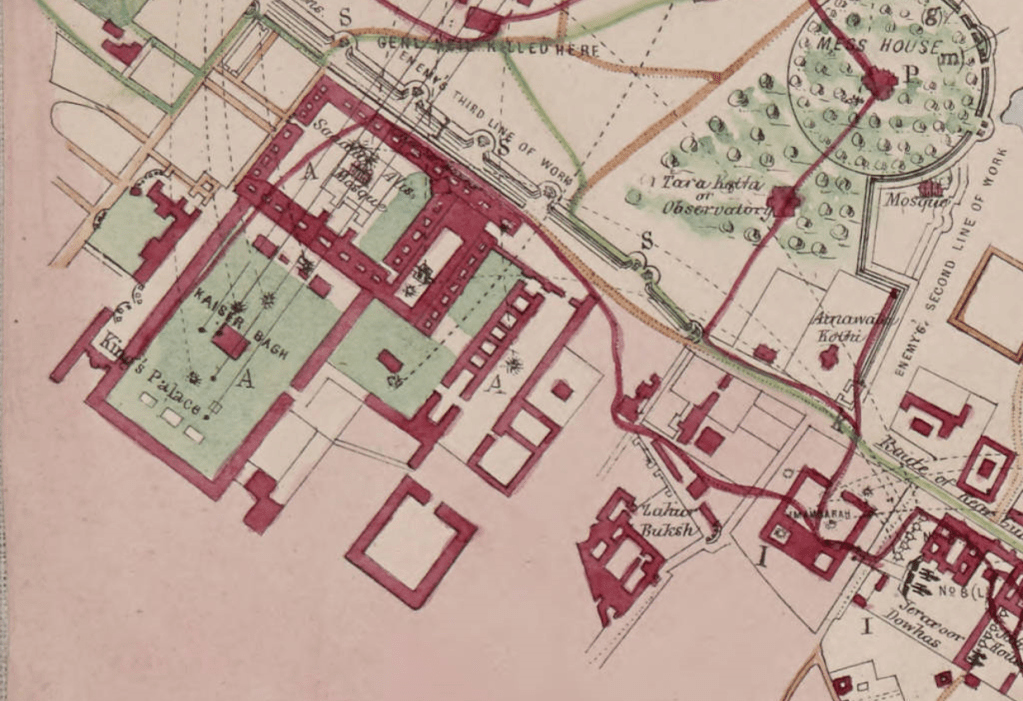
With the child seated securely before him, still covered in a blanket, he rode off towards the camp. He was stopped several times on the road, but the mere mention of smallpox sent inquirers scurrying away to a safer distance. Without any menace, he brought the child directly to Sir Colin Campbell. She was Louisa Orr, the daughter of Mrs Orr, who, along with Madeleine Jackson, was still being held captive in Lucknow, nine months after the mutiny at Sitapur. The kind intervention of Mir Wajid Ali had spared their lives, but with the British drawing their net around Lucknow, it was unclear how much longer he could protect them. If Mir Wajid Ali was going to save them, he needed to tell Sir Colin Campbell the ladies were still alive. For that, he organised sending little Louisa, a child who spoke both English and Hindi perfectly, and owing to her small stature, could easily be packed up in a bundle and smuggled out of the Kaiser Bagh on her ayah’s back. It was a plan hatched in desperation. During the final relief in November, Mir Wajid Ali had been unable to secret the ladies away to join the retreating force, prevented by other courtiers, who planned to keep them as their final bargaining chips for their own lives. Messages sent to Outram at the Alambagh had yielded similar results – Outram was willing to pay large sums in ransom for their release, but with no one willing to transport the ladies to his camp, it all came to nought. Mir Wajid Ali was implored upon by Outram to keep the ladies safe and above all alive – it would be the only way to save his own neck from the gallows when Sir Colin Campbell finally retook Lucknow.
Little Louisa sat before the astonished Commander-in-Chief, a cup of milk in her hands. He would save the ladies, but they would have to wait a little longer. As long as Mir Wajid Ali could be implored upon to continue in his valourous conduct, there was little reason to break off his plans to rush to their rescue. When it would finally be effected, it would be by Jung Bahadur and his Gurkhas.
The services of Jung Bahadur were proving to be invaluable. Unwilling to approach the British directly, several Indian chieftains, wavering in their loyalty to Begum Hazrat Mahal and uncomfortable with the Maulvi of Fyzabad’s machinations, had sent deputations to the Maharaja, begging him to intervene on their behalf before the Commander-in-Chief. The story was generally the same – they had been coerced, bullied and threatened to rebel, their people had risen against them; they had been unwilling rebels to start with and now feared for their lives. However, only one was of tangible interest to Sir Colin Campbell, and that was Man Singh of Shahganj. Duplicitous by nature, Man Singh had never thrown in his loyalty with any one camp. On one hand, he had supplied men, money and arms to the Begum; on the other, he had, during the latter stages of the Siege of Lucknow, sent letters to Sir James Outram, offering safe passage to the women and children trapped in the walls, provided his neck was saved from the noose. The British had written him off as a doubtful ally at best, and, as such, added him and Shahganj to their long list of recalcitrant rajas and nawabs who would eventually need to be paid an unsolicited visit. Now, in a last bid for self-preservation, Man Singh wrote to Jung Bahadur directly, requesting a secret interview, bidding the Maharaja, on his word of honour, not to hand him over to the British. With the oath in place, Man Singh was convinced to pay him a visit. The interview was brief, but it held sufficient promise that Jung Bahadur was able to convince Sir Colin Campbell that there was some merit in allowing Man Singh and his retinue to leave Lucknow and return to Shahganj unmolested. On the 14th of March, without as much as a parting shot, Man Singh turned his back on the rebel cause for the final time. From now on, such desertions would become increasingly common and the army of Lucknow, though still large enough to provide a stiff resistance, was beginning to crumble.
Meanwhile, the Gurkhas had been far from idle. On the 12th of March, at Sir Colin’s request, their camp was moved to the left, up to the canal, to take the positions which the rebels still held in front of the Alambagh. Without any fanfare, the Gurkhas captured three mosques at the cost of 200 dead. During one of these fights, just as the Gurkhas were beginning to lose ground, Jung Bahadur himself dashed forward. Placing himself before his men, he shouted out,
“Soldiers! Dislodge the enemy at any cost! Glorious will be the history of your entry into Lucknow in the annals of your country!” Their hearts fueled by his words, they took back their ground and put to death the entire garrison.
Another detachment, under Colonel Indra Singh, pushed forward, with a detachment of British troops, to secure one of the bridges over the Gumti and captured 400 rebels; however, for their part, 13 of their men ventured a little too far into rebel territory and were likewise taken prisoner. The next day, the 13th of March, the Gurkhas crossed the canal and diverted the rebels’ attention by threatening the suburbs to the left of Banks’ House, a necessary ruse to prevent anyone from paying too much attention to Robert Napier, who was swiftly sapping his way towards the Chota Imambara.
 Mutiny Reflections