The Capture of the Steam Engine House
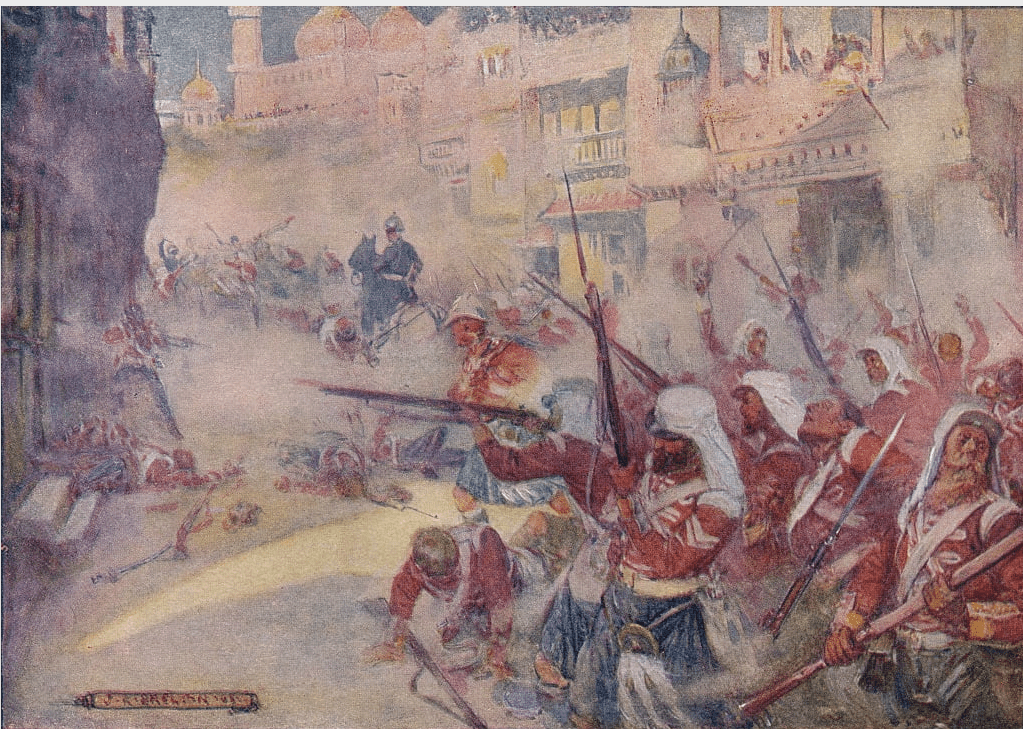
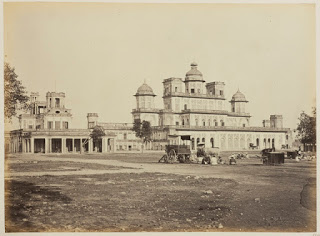
The Steam Engine House had already played a significant part in the story of Lucknow. Positioned as it was, during the relief in November, the Engine House had been the scene of desperate fighting when Sir James Outram had ordered it taken to facilitate his troops’ movements from the Residency towards the Moti Mahal to effect a junction with Sir Colin Campbell. Throughout the Siege, it had remained firmly in rebel hands, and they had used the position with skill, turning the guns placed in its compound to harass the men in the outer defences of the Residency. For a brief moment, they had lost it to Outram, but as soon as Campbell was well on his way to Cawnpore and Lucknow completely in rebel hands, the Engine House was strengthened as a forward position for the rebels 3rd line of defence.
Situated conveniently not only between the Kaiser Bagh and the river but squarely between the Chattar Manzil and the Moti Mahal, it was imperative on the 14th of March 1858 to capture it, thus removing yet another obstacle in the taking of Lucknow. Beyond the Steam Engine House was another rebel stronghold that was yet to fall – the Residency.

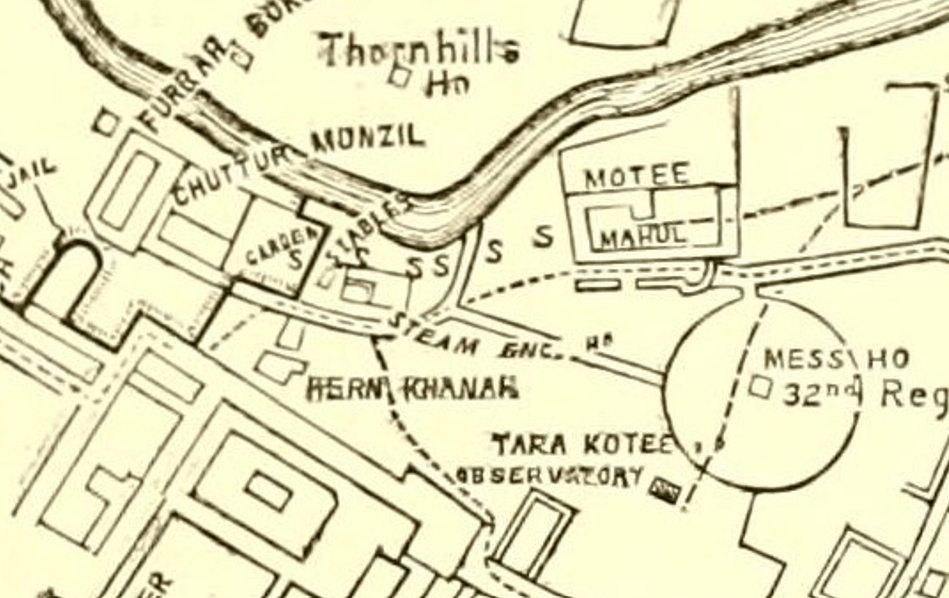
This somewhat dubious task was given over to a detachment under Major Radcliffe consisting of two companies of the HM’s 20th Regiment, supported by a further two of the HM’s 38th, who were to remain outside the building to cut off any rebels who attempted to flee.
Things should have started better than they did, but owing to the general architecture of Lucknow, comprising narrow, winding streets and impossible cul-de-sacs, it was little wonder that the men soon after starting their advance, lost their bearings. The detachment became muddled and divided, with the greater part of it entering the house by a narrow passage on one side of the house, and a smaller party followed Major Radcliffe to the other side.
The former party pressed on along the passage and suffered their first loss of two men killed by sharpshooters. As luck would have it, they stumbled, almost by accident, into a large room where, to their surprise, they found a “motley collection” of rebels. It appeared that detachments of just about every sepoy regiment in Lucknow had found refuge in the Steam Engine House as the blue and white uniforms of the Bengal cavalry mixed together with the redcoats of the sepoys of the Line, in stark contrast to the dark blue of the gulandazis (artillery) and the plain white clothes worn by the local zamindari levies. Their weaponry matched the nature of their uniforms, for they had everything their armoury had to offer – matchlocks, muskets, cavalry sabres of a bygone pattern, tulwars and pistols of both Indian and English make. What they did not have was a leader.
Taken aback by this sudden intrusion on what the men had believed was a safe hiding place from the horror taking place at the Kaiser Bagh, they did not stand and fight but rushed in a body into the next room, but they did not have time to either close or barricade the doors. The men of the 20th, having got over their own surprise, poured volley after volley into the open doorway, while the rebels within quickly organised their defence, stationing men well out of sight on either side of the doors, who stepped out to fire off a volley when the 20th were reloading.
With neither side gaining any ground and the situation rapidly turning into an impossible one to sustain any longer, Captain Francis ordered his men to load their weapons and rush the doorway, come what may. Before they had made ten steps, two men lay dead on the floor, shot, and two more were cut down by tulwar blows. However, the 20th pushed forward until they were squarely in the room, which would soon present a terrible sight. The rebels were standing, shoulder to shoulder, and there was barely any room for anyone to move. The 20th fell into the mass, bayonets at the front, with “blow succeeding blow – flash following flash in quick, deadly succession, till they had hewn for themselves standing room out of this mass of struggling, bleeding, panic-stricken mutineers.”
“It must have been an awful scene-a mob of friends and foes crowded into a few square yards, hacking and hewing at one another, reeking bayonets and reddened tulwar blades flashing high in the air- occasional pistol shots breaking in sharp and clear upon the hideous chorus of groans, curses, and shrieks, which resounded through the air.” The floor was soon covered in a slippery slick of warm blood, while under their feet, the men trampled the dead and the dying.
For those who still could, there was one escape, and that was to run the gauntlet of the 20th and flee to the main engine room itself, filled with a myriad of pipes, boilers, furnaces, cranks and engines. However, luck was hardly on their side. Just as they entered the room, they ran slap bang into another body of their comrades, trying to escape the equally relentless onslaught of Major Radcliffe and his men.
Hemmed in from all sides, there was nothing for it now but to stand and fight, but the sepoys appeared nearly paralysed with terror. There was no one to give them a rallying cry, set them in line or give them orders. They were on their own and leaderless, and the British were not about to hand out mercy. Very few stood their ground to fight; others simply sank to the floor and allowed themselves to be killed. From a doorway at the other end of the room, as the 20th poured a veritable rain of shot on their heads, the sepoys watched in horror as the British piled up the corpses of their comrades to form a barricade against the few ineffectual volleys they still had the strength to give in reply.
The shots soon became less frequent, as the soldiers of the 10th bayonetted their way through the remaining sepoys, or hunted out those who attempted to hide in and around the machinery. As if the scene was not horrible enough, a fire broke out in the building as the beams and door posts ignited from the constant discharge of leaden shot. The clothes of the sepoys, caught in the conflagration, burst into flames; the flames rapidly found fuel in the clothes of the dead and dying until the whole room resembled a charnel house. Mixed up among the corpses were sepoys who were still alive; they had hidden themselves under the bodies of their dead comrades, hoping against hope the bayonets of the 10th would miss them. Instead, they now found themselves caught in the flames. The less hard-hearted men of the 10th did take it upon themselves to put these poor men on a quicker way to their god rather than watch them burn alive. When all was over, and the flames had subsided enough to count the dead, there were no fewer than 300 corpses in the Steam Engine House. Outside, things had not gone any better for the 60 who managed to escape the slaughter indoors. They fell into the clutches of the waiting remainder of the 20th and 38th who had surrounded the building in its entirety.
Brigadier Franks had had quite enough for one day and ordered that the building adjoining the Steam Engine House was not to be assaulted – he did allow for shelling or even the use of fire to drive out a small band of rebels who were still holding their ground. The order was that no one was to approach the houses, and anyone seen doing so was to be severely reprimanded. Unfortunately, the lust of battle is not easily quelled, and it had taken hold of even the youngest member of the 38th Regiment, a young drummer boy. He had shown his mettle that morning at the Kaiser Bagh for which he had been rewarded by his officers with a pat on the back and a larger-than-usual dram of grog. Quite drunk, not just on battle, but on the thought that a Victoria Cross would look grand pinned to his chest, “the poor boy lost all command of himself and was seized with an uncontrollable desire to further distinguish himself. Drawing his small toy sword, for it was little else, he threw himself with a sort of a shout into the building the enemy occupied; his horrified comrades tried in vain to stop him; the rash act had been done too quickly and unexpectedly for any intervention to avail, and once committed, no human power could have saved him; hardly had he set foot within the house when he fell…”
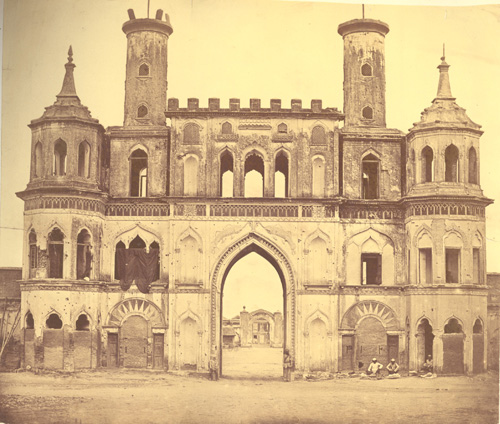
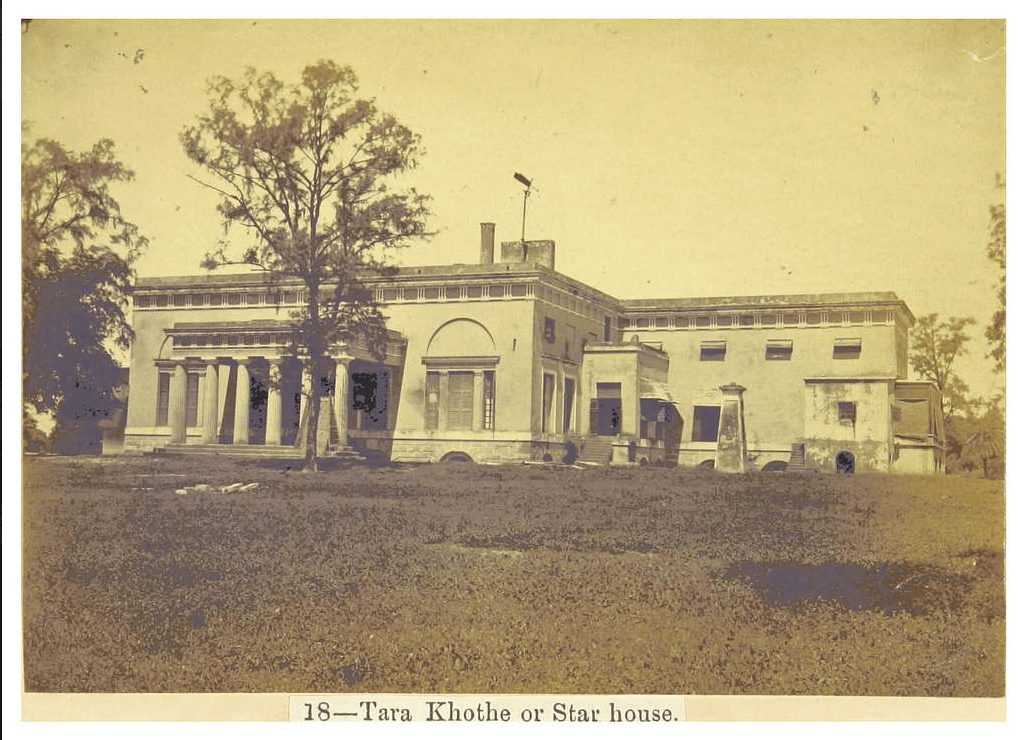
On the morning of the 14th of March, the rebels had held all the ground from the Shah Najaf to the Hazratganj; by midday, all that was left to them was ironically the very same ground that Havelock and Outram had held for nearly four months, an unbroken line from the Chattar Manzil to the Residency. Yet as the day progressed, their last two defensive lines had been turned, and their once proud garrison of over 40’000 men had either retreated to the last grounds left to them or had fled the city altogether. Before the day was over, the rebels had lost not only the Kaiser Bagh, but the Moti Mahal and the Tara Kothi, which had both fallen with comparatively little resistance. However, they were not quite beaten yet.
The Heart of Lucknow is Broken – the 16th of March
The 15th of March was a day of comparative rest for the Army of Oudh. Sir Colin Campbell had realised his mistake finally in not allowing Outram to pursue the rebels the day before and sought to make good his fault by sending the cavalry out in pursuit along the Sitapur Road, but it was too late. The rebels had scattered across the country and disappeared. A similar endeavour was made by Brigadier Campbell in the direction of Sandlia, but with the same results. It was another mistake on Sir Colin’s part – he should have taken the mistake for what it was; instead, he sent off the cavalry on a wild goose chase miles away from Lucknow, when he should have employed them in patrolling the outskirts of the city. With no one to check their departure through the unchecked exits of the city, many rebels took the opportunity to simply leave without the fear of being run down by the cavalry. By the time Sir Colin realised this oversight and recalled his cavalry, they were so far off that it would take them until the 17th to return.
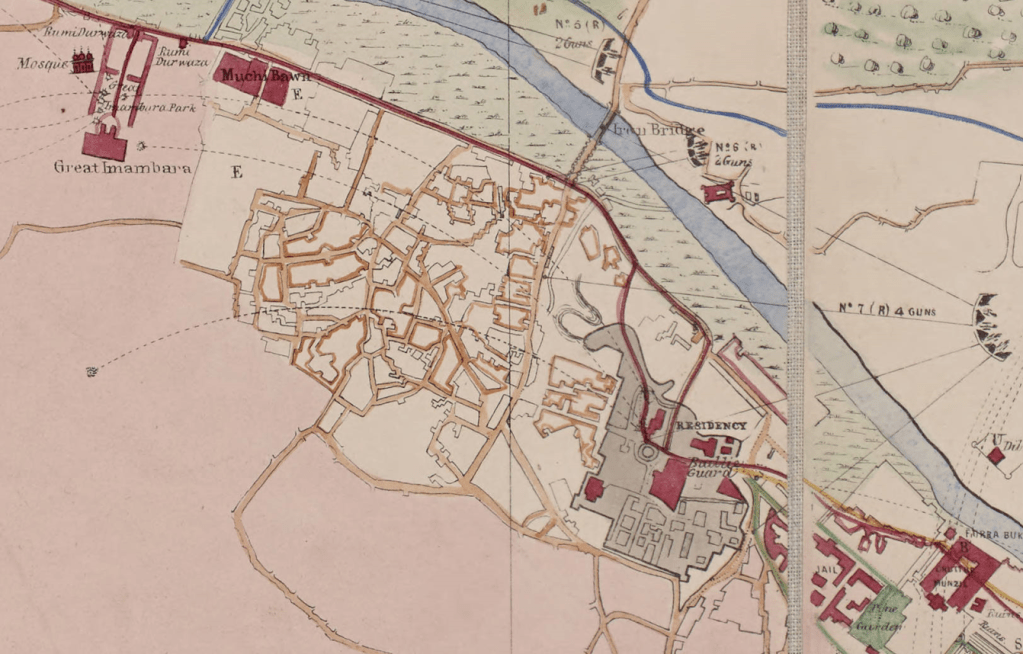
Things were about to get a little worse for Sir Colin Campbell. He had either been deceived or someone on his staff could not count; he had been led to believe all that remained in Lucknow was a paltry force of 1500 rebels when in fact there was still closer to 25’000. Those who now remained held not only the Residency and the Machchi Bhawan, but the very heart of Lucknow at the Bara Imambara. There was nothing for it; not willing or able to march his men off at what could very well turn to his disadvantage, Sir Colin resumed his bombardment of the city, this time directing much of the fire at the Residency itself.
Meanwhile, Sir Colin was still allowing Outram to stew on the other side of the Gumti. During the night, his men were astonished to hear the still defiant rebels, barely a stone’s throw away on the other side of the river, order their bands to strike up the old familiar tunes they had played when still in the pay of the EICo; this was compounded by “revellés and retreats” and the sound of marching. They still kept their old words of command and the routines they had been taught in better days – guards were posted, sentries relieved like clockwork through the night by their officers, and the cries of “hookum dar?” (Who comes there) breaking the darkness by the selfsame sentries as if they were sitting in a peacetime camp someplace else.
“All which duties they performed with as much noise and ostentation as possible; probably with the view of showing us not only that they were on the alert, but that though they might have forgotten many of the military habits which we had taught them -how to fight, for instance – they still retained and went through some of the old forms and ceremonies as in bygone days, when they served John Company.”
The next morning, Sir James Outram was ordered to cross the Gumti after all – there was work for him in Lucknow as the retaking of the Residency would be left to him. He crossed over on a hastily prepared bridge of casks opposite the Sikandar Bagh, and marching with him were the 1st Fusiliers, HM’s 23rd and the 79th Highlanders. Remaining to watch the two bridges was Walpole’s Brigade..
On reaching the Mess House of the 32nd, he was swiftly joined by HM’s 20th and Brayser’s Sikhs, who came along behind Sir Colin Campbell. He personally delivered his final instructions to Sir James Outram – to take the Chattar Manzil and capture the Residency. He then let Outram get on with it.
Outram advanced through the Kaiser Bagh, passing along an impromptu road made by the sappers and miners the day before and then, turning to the right, made his way towards the Residency. The rebels had been watching this spectacle with considerable interest, for no sooner was the force assembled, they opened a smart fire of musketry. However, they might have started with good intentions but the situation rapidly deteriorated and fell out of the rebels’ favour. The Chattar Manzil fell without barely a fight and now on the road to the Residency, Sir James Outram called out, “Charge!” With Outram at their lead, the regiments broke into a run with the 23rd reaching the Bailey Guard Gate first. In half an hour, it was all over and the Residency was back in Outram’s hands.
Alexander noted, quite sardonically,
“That is to say, that the post which, when defended by a handful of British soldiers, aided by a few
Asiatics, successfully held out for eighty-four days against overwhelming numbers of rebel Asiatics, was captured in thirty minutes by a handful of British soldiers and loyal Asiatics, led by British officers.”
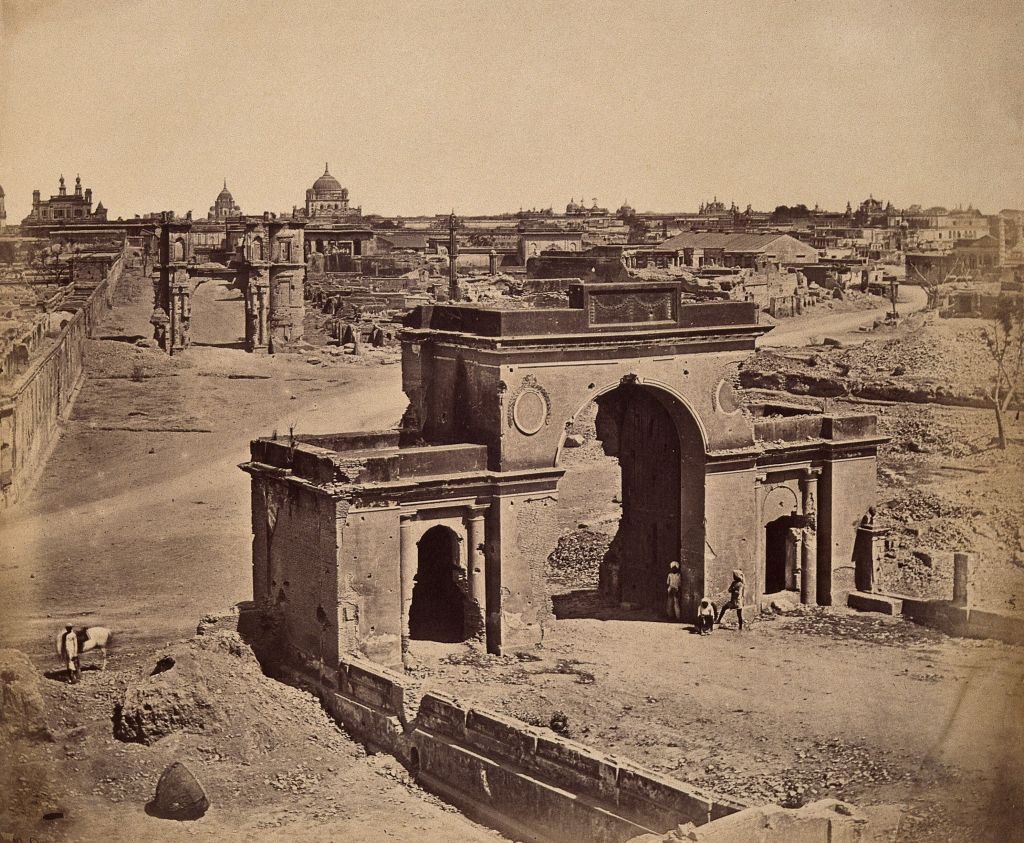
Brayser’s Sikhs took it on themselves to chase the rebels out of the Residency – when the final compliment had been delivered, two companies of the 23rd under Lieutenant-Colonel Bell, accompanied by Captain Gould Weston, who pointed out the road to their next objective, the 23rd advanced rapidly forward. No sooner did they hit the road than another volley of musketry greeted them. As if to drive the point home, the rebels now unveiled a carefully hidden battery and opened up with grapeshot. The 23rd was quite sure they were not going to take this particular insult lying down and charged the gun. Unable to load again, the gunners turned and fled, and the brass gun, which had so long hassled the Iron Bridge, was swiftly marked with the number 23.
Meanwhile, work rapidly proceeded at the Residency; the Madras Artillery installed their Field Battery and, under the command of Major Cotter, opened up heavy fire on the Machchi Bhawan; this was only a temporary arrangement – the Naval Brigade was on their way, hauling two 68-pounders with them to take the place of the Madrasis.
The Bengal Fusiliers were ordered to move towards the Iron Bridge together with Brayser’s Sikhs. “In all directions, the rattling of musketry was heard, and the bullets fired at a great elevation from distant houses whistled overhead, right and left.” One of those bullets found its mark at severely wounded Brayser himself, much to the fury of the Sikhs. However, they took the rebel river defences in the reverse, capturing not just the gun that commanded the Iron Bridge from the left bank but the batteries between the two bridges.
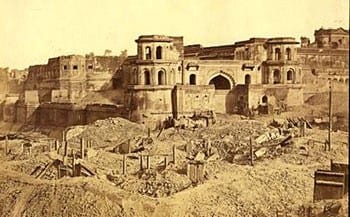
With the gun taken, the 23rd continued onwards through Lucknow’s labyrinth of streets, under the continued fire of musketry which rained down on them from the rooftops and loopholed walls. However, the advance continued unchecked all the way to the Machchi Bhawan. Had they had the nerve and a little bit of leadership, the rebels should have been able to keep them out, but what was becoming their signature move, the rebels abandoned the building without even the pretence of a fight and fled to the Bara Imambara.
“They dashed across the court so beautifully decorated with rich tessellated pavements, rushed up a noble flight of steps, and seized the great central hall, whose mirrors and chandeliers were said to have cost one of the most magnificent Nawabs of Oudh nearly a million pounds sterling.” Not that it mattered now; like everywhere else in Lucknow, glass did not stand a chance against battle-flushed soldiers.
Captain Salusbury pushed onwards with a company of the Bengal Fusiliers towards the Rumi Darwaza, and once again, after one volley, the rebels turned and fled, leaving their gun as a trophy for the Fusiliers.
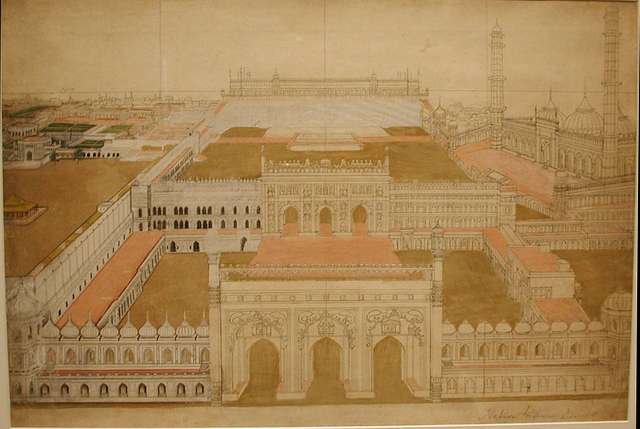
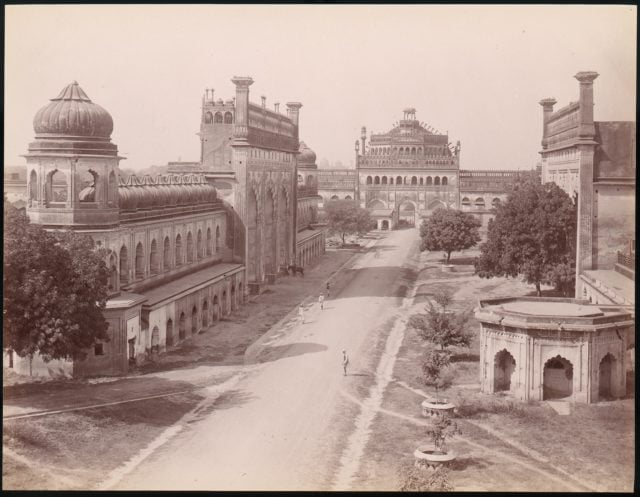
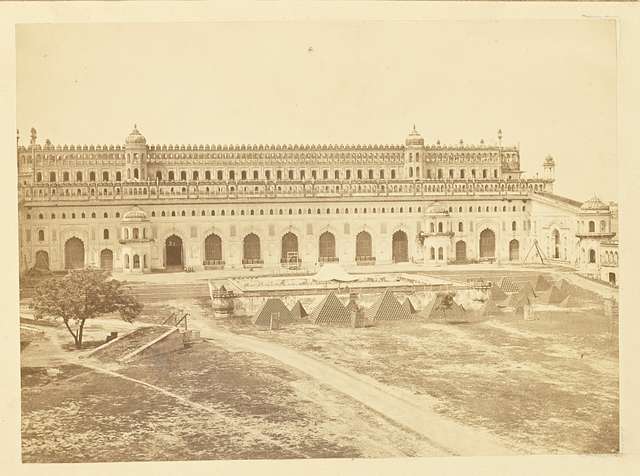
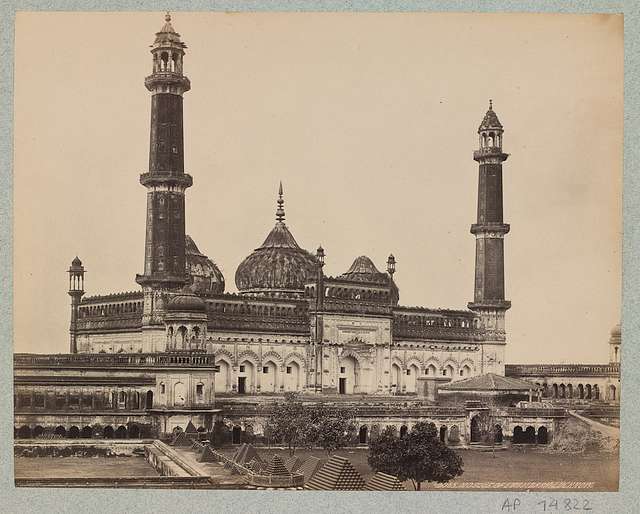
The 79th was now brought up to occupy the Imambara, and the remainder of the Bengal Fusiliers settled themselves at the Machchi Bhawan, where they were joined by the artillery and five 8-inch mortars. Together with the guns from the Residency, which were extended to include five 10-inch mortars, they opened a terrible fusilade on the city of Lucknow, which the artillery kept up through the night.
The day was not without its accidents. While proceeding up the road to the Imambara, an astute officer of the 79th noticed his men were marching, not on dust and dirt, but on loose gunpowder. This was but one of many such incidents that plagued the men at the taking of Lucknow.
“…all the company water-carriers were ordered to the head of the column, and directed to water the road in front of the battalion as they advanced. Unfortunately, in addition to the powder thus strewn along the road, quantities had been left in native earthenware water-vessels all round a very large well, into which doubtless large quantities had been thrown by the rebels before their flight. Some energetic head man of the 79th native water- carriers, having thrown one of these vessels down the well, it is supposed that it must have struck the brick sides of the well, and, emitting a spark, was the cause of a terrific explosion, in which the whole of the poor water -carriers were either killed or mortally wounded, entailing enormous inconvenience, and even hardship to the battalion, until their places could be filled up.”
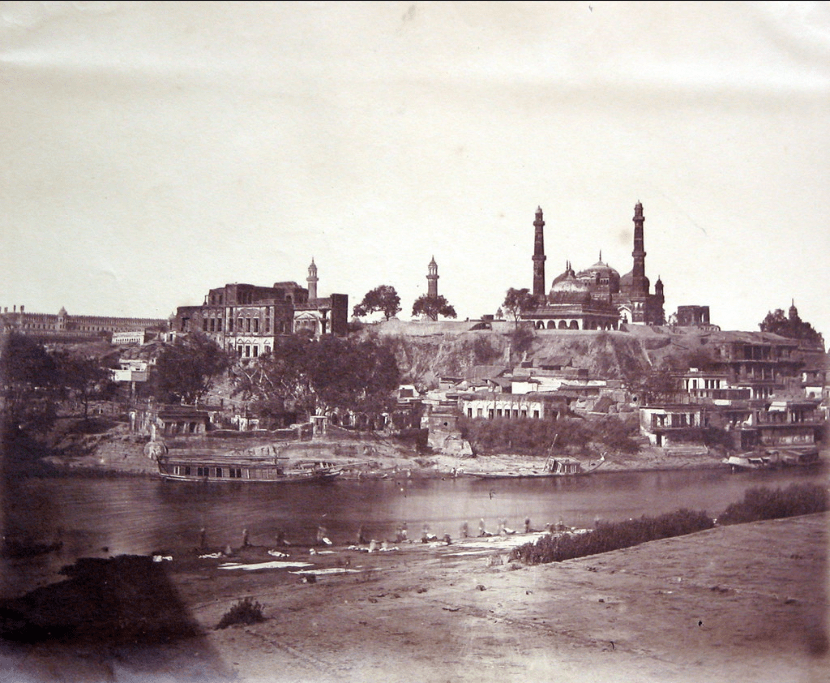
The rebels, however, did have one resounding success on the 16th of March. Thousands of them descended on the river to cross over the Stone Bridge. Gangs of them precipitously attacked Walpole’s pickets. Majendie and the artillery at the Iron Bridge quickly turned their guns on this new menace, while the riflemen kept up a hot fire from the roofs of houses. Not that it did much good – the range of 1000 yards was too great for Majendie or the riflemen to do anything but cause the rebels more than a momentary fright.
“It was highly ridiculous to see, now a body of infantry, now a horse artillery gun, and now a detachment of cavalry, scampering across the bridge as fast as their own or their horses’ legs would carry them, while the Enfields rattled out their sharp and never – ceasing volleys, and our field guns joined their harsh voices to the growing din and clamour. Some said that the enemy were flying, others that this movement on their part meant that they were about to endeavour to get on our right flank and attack us, and a dozen similar reports were current.”
As Majendie now had two field guns and one 18-pounder at the Iron Bridge, they continued to keep as heavy a fire as possible on the Stone Bridge, which the rebels continued to cross, but the artillery also set their sights on a few buildings on the other side of the river that were still in rebel hands. Their shot was replied, steadily by the remaining gunners on the left bank, accompanied by the general din that now rose from Lucknow. The men on the left bank watched as bodies of troops pressed forward along the streets, always driving the sepoys ahead of them. Smoke and flames shot up in the air from several quarters of the city as parts of it caught fire, adding yet another grisly dimension to the already “intensely animated and exciting” scene. The Stone Bridge was the height of confusion, as crowds of fugitives, interspersed with sepoys in every imaginable uniform, pressed forward; others, halfway along, changed their minds and tried to return to the city, pushing their way in desperation through the ever-moving crowds.
“Shot tearing with a crash through domes of temples and walls of houses, and showering bricks and stones into the street below; -shell bursting high and harmless in the air, or dangerous fragments of the same spinning whistling past;-the blazing sun overhead shedding a fierce glare and heat, which added to the smoke, and gunpowder, and noise, the wild confusion and excitement was enough to drive one mad.”
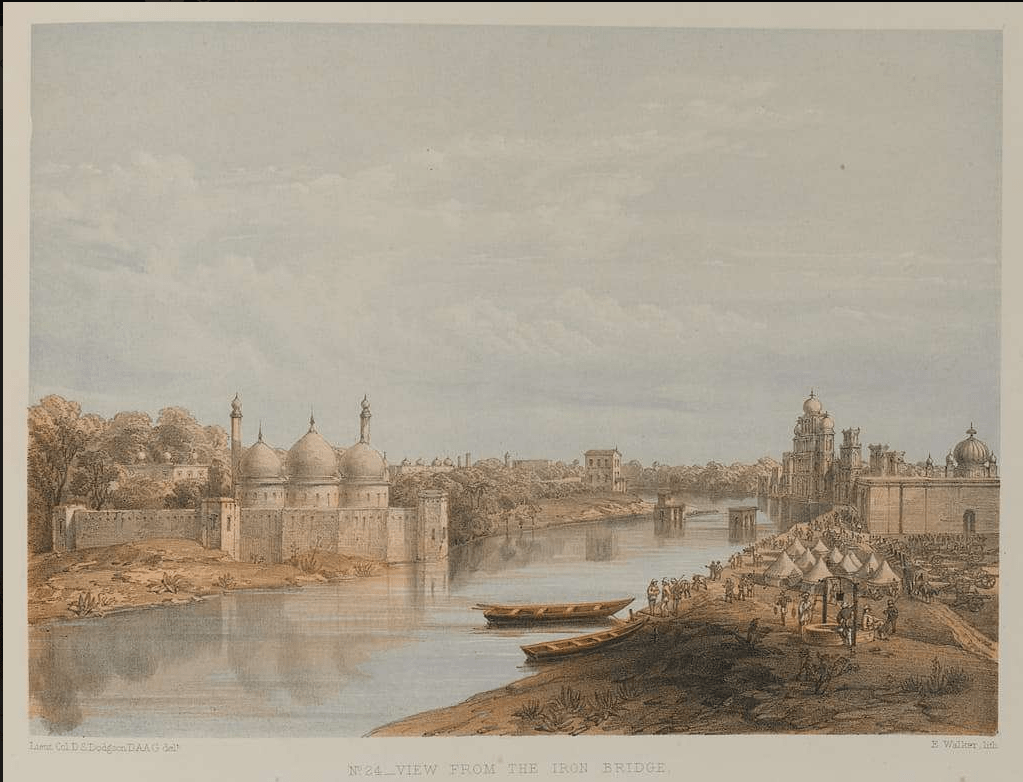
In the city, running fights were continuing through the streets as little knots of rebels desperately shut themselves up in houses and fought with such vigour and fierceness that every single position had to be besieged with some effort before they were driven out. At one house, close to the Iron Bridge, six sepoys made such a determined stand that it took the combined efforts of nearly 20 soldiers to storm it. When they finally managed to break through, three of the sepoys were killed outright; the others were brought out into the street, lined up in a row along the wall of the house and shot. It was a horrible scene.
“One man, hit in the chest, sank down in a half sitting position against the wall, and when I saw him life was not quite extinct; his dull eyes wide open, and stared horribly into vacancy, and his head turned in a slow and ghastly manner from side to side, as though mourning over his comrades whose bodies pierced with several bullets lay at his feet; the whole making one of the most terrible pictures I ever saw.” Majendie called a soldier hard by to shoot the man in the head to put him out of his misery. There was nothing he, nor any of the other officers, could do, when shortly after several sepoys were dragged from their hiding place and the soldiers, dispensing with the bullet, slit their throats from ear to ear.
In nearly every street in Lucknow, the same scenes played out, over and over again; by sunset, the city was nothing more than a smouldering charnel house, with bodies lying exposed in the lanes and mangled in the houses where the living men had put up their last desperate stands.
With the taking of the Bara Imambara, however, the very heart of Lucknow had been ripped apart. There was nothing left to take and nothing to gain. All that was left were smouldering ruins and a viciously victorious army whose only thoughts now were on plunder. There was little left to do, and Outram would take care of the Dowlut Khana, the Jamuniya Bagh and the Jama Masjid the next day, all of which fell without any significant resistance, but it would still come at a terrible cost.
The Maulvi of Fyzabad Leaves
All the rushing about at the Stone Bridge, however, served another purpose. Thus occupied and without any cavalry to speak of, 20’000 fighting men of Lucknow made their escape, mostly unobserved by fording the river further up from the bridge, wholly undetected by either the pickets, Walpole or indeed anyone else. Among them was the Maulvi of Fyzabad. He had a parting gift for the British when, much to their surprise, he ordered a final attack on the Alambagh.
Vincent Eyre and William Olpherts were not caught off guard and, immediately upon noticing a vast force forming up on their front, turned their guns on them at a moment’s notice. The Alambagh had been left severely undermanned; besides Eyre and Olpherts’ batteries, only 400 men and a small detachment of the 7th Hussars were watching the house. The leaders of this particular attack were evidently better versed than the ones who had led their men from one disaster to the next in Lucknow.
Directing a large body towards the front of the position, the insurgents attempted to now turn the left flank with their cavalry and artillery.
Their sowars came on boldly, but Olpherts took one look at them and ordered his gunners to fire. Meanwhile, Eyre, in the same cool manner he had employed at Arrah and Jagdispur, raked their infantry with volley after volley of well-directed grape shot until they retired to a respectable distance. Unfortunately, the insurgents had neglected to take into consideration the Gurkhas. Without hesitation, these now moved up to take the force in the rear – there must have been something menacing about their advance for the insurgents took one look at men from the North and gave up the Alambagh as bad business.
While it was presumed they would high-tail it towards Rohilkhand, which ultimately many of them would do, a determined number of 5000 insurgents decided they were not quite done yet. They swiftly occupied the Musa Bagh, a large building encompassing several courtyards, some five miles north-west of Lucknow.
It is said that Sir Colin – on the capture of the place, telegraphed thus: ‘I am in luck now.’ Hardly as good a despatch as that of Sir Charles Napier’s when he conquered Scinde, ‘Peccavi.’
The next few days would prove whether Sir Colin was indeed in Lucknow.
Sources:
Forrest, G. W. A History of the Indian Mutiny. Vol. 2. Edinburgh & London: William Blackwood & Sons Ltd., 1904.
Gordon-Alexander, W. Recollections of a Highland Subaltern. London: Edward Arnold, 1898.
Lieutenant-General Sir James Outram’s Campaign in India, Comprising General Orders and Despatches. London: Smith, Elder & Co., 1860.
Majendie, Vivian Dering. Up Among the Pandies: A Year’s Service in India. London: Routledge, Warne & Routledge, 1859.
Malleson, Col., ed. Kaye’s & Malleson’s History of the Indian Mutiny of 1857-58. Vol. 4. London: W.H. Allen & Co., 1889.
Rana, Pudma Jung Bahadur. Life of Maharaja Sir Jung Bahadur of Nepal. Edited by Abhay Charan Mukerji. Allahabad: Pioneer Press, 1909.
Roberts, Lord. Forty-One Years in India. Vol. 1. London: Richard Bentley & Sons, 1897.
Russell, William Howard. My Diary in India, in the Year 1858-9. Vol. 1. London: Routledge, Warne & Routledge, 1860.
 Mutiny Reflections