Death
“Sepoys who had been dragged from their hiding places lay stretched out in the open street, with their throats cut from ear to ear, and with every gaping wound exposed, by the nakedness of their bodies, in all its depth and breadth, and hideousness. Nearly every house had been the scene of some short but desperate tragedy, up every lane and turning lay two or three bodies; and frequently on entering a house did one stumble over, and start back from, the mangled remains of one of its miserable defenders.”
The dead of Lucknow were never, in any reasonable estimation, counted. Russell recalled crossing “a ramp of dead bodies loosely covered with earth” to enter the Kaiser Bagh. Dead sepoys and rebels were collected and dumped by the thousands in pits; for weeks after the city was taken, rotting corpses still laced the palaces, buildings and roads. Where these pits are now is anyone’s guess, but it can be said that under the streets of Lucknow lie their remains. If Russell had been disgusted by the dust of Cawnpore being mingled with the crushed bones of the dead, he could very well have said the same about every foot of ground he covered in Lucknow. He should have been wiser by the time he printed the following,
“…we passed on to a network of houses, through which we rode in single file; all was silent as the grave. ‘Just there,’ said one of my companions, ‘we saw a pitiful sight the day of our advance. A little boy of eight or nine years of age, very handsome and well dressed, had been struck by a grapeshot in the spine and was dying. Beside him was a cage, with a parroquet, which was screaming as if it knew what had happened. We let the poor bird go.’ It is horrible, but it is true, that our men have got a habit of putting natives ‘out of pain’ as if they were animals. They do it sometimes in charity.” The emphasis here should be on “sometimes.”

The fighting at Lucknow, for all of its viciousness, had taken on a new dimension. Discrimination between rebels and townspeople, sepoys and villagers, was discarded as barbarism took hold of the soldiers. In the streets between the Kaiser Bagh and the Residency, Russell came across dead bodies, many of them old women and men, who, to tell by their wounds, had been hit by shell fragments. While these were probably casualties of war that were sadly not preventable, Russell had less understanding for the behaviour of the Sikhs, whom he observed rushing through the lanes of Lucknow – their fury when their leader, Jeremiah Brayser, was wounded, knew no bounds.
“… his infuriated Sikhs entered the building, and taking out some men and boys whom they found there, placed them with their backs against the wall and shot them on the spot. Their cries for mercy were piteous. In a few seconds, they were lying below the blood-stained wall, a heap of palpitating, quivering bodies. It was necessary to proceed with great caution in this street-fighting, and our advance was gradual but sure. On every side were sights which I would fain have shut my eyes on, sounds which I would not readily listen to again…The dust, the heat, and the excitement were overpowering. Emerging from a street full of Sikhs, who were smashing open doors and windows and pitching the contents of the houses out of the casemates to their comrades or into the street…”
It was not just the Sikhs who had their share in it all.
“An old fakir, whom we had saved from some Sikhs who had discovered his hiding-place in a cellar, was lying with his brains out near the spot where we had, as we imagined, saved him. Many dead bodies, which we had not noticed at first, were now lying in the streets. After the Fusiliers had got to the gateway, a Cashmere boy came towards the post, leading a blind and aged man, and, throwing himself at the feet of an officer, asked for protection. That officer, as I was informed by his comrades, drew his revolver and snapped it at the wretched suppliant’s head. The men cried “ shame ” on him. Again, he pulled the trigger—again the cap missed; again he pulled, and once more the weapon refused its task. The fourth time—thrice had he time to relent—the gallant officer succeeded, and the boy’s life-blood flowed at his feet, amid the indignation and the outcries of his men.”
This was not the only incident involving an officer. Majendie pointed out an incident where two men were caught, presumably in the act of spying; no one contested that, not even Majendie, but he was disgusted that it was an officer himself who took out his revolver and shot the men dead. Majendie felt the officer who should have been a better example for his men, instead of acting like a common executioner.

“It was not as though an example of severity was needed-the men were ready enough, God knows, to shut their eyes to prayers for mercy, to kill and destroy whoever they might catch-perhaps too ready; and it was scarcely necessary for an officer to come forward as fugleman, and foster this thirst for blood among his men, and I think, when I used the word ” repulsive,” I expressed not only my own feelings on the subject, but those of the rest of us who were standing by when these men were shot.”
Again, from Majendie, he saw a few soldiers reap summary justice on an old man – he was accused of nothing in particular, except for being where he was. The discussion between the soldiers was whether they should shoot him, hang him or give him a “Cawnpore dinner” (a bayonet to the gut) – he was finally beheaded by one of the soldiers with a sword, after which the party repaired back to the card game they had interrupted for this and lit their pipes. A similar fate was nearly meted out to the cook of Jung Bahadur and his companion – the men were spotted, after dark, close to the Sikandar Bagh, probably engaging in a little evening looting. Unable to give an account of themselves, the officer of the day ordered them shot; it was only the timely intervention of a British officer serving with the Nepalese contingent who recognised them for who they were. The pair were sent off with a stiff warning to never cross this way again.
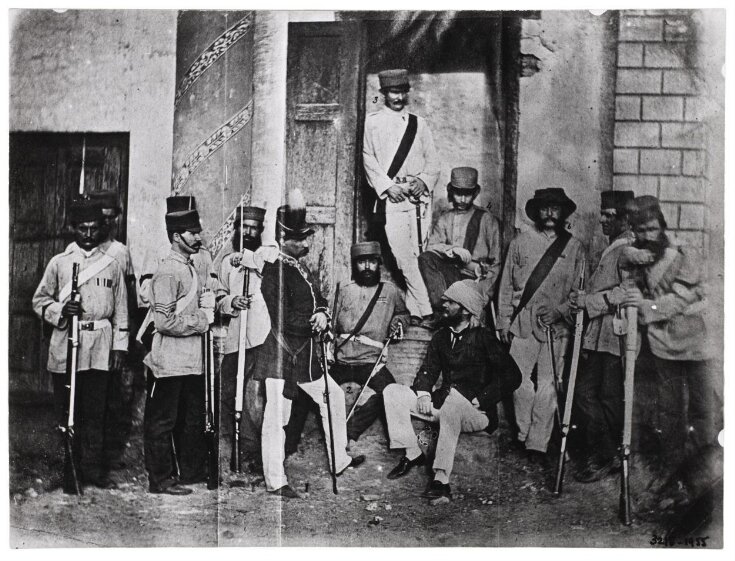
Majendie and his men turned everything into entertainment, even harassing servants of the officers by throwing “handfuls of stones at their feet, which…they readily took for showers of grape…If, at any time, some one of a bolder nature, or less suited for rapid movements by reason of obesity, a corpulent Khansamah or Baboo, for instance, thought fit to put on a stately and unruffled demeanour, as he stalked across, we immediately took stronger measures, and rolled swiftly towards his legs, a round, black, wooden pipe- bowl (used by the natives), which, while in motion, and especially to a mind in a high state of nervous excitement, bears a strong and terrifying resemblance to a cannonball, and which never failed to have the desired effect. Dignity was not proof against the pipe bowl-Bob Acres stood revealed; away went courage and corpulent khansamah at a rush, in a state of inconceivable dismay. It may be remarked that the amusement was considerably heightened if the missile was made actually to strike the shins of the victim, when he, of course, concluded that he was mortally wounded, and seemed much surprised, on arriving at the opposite side of the street, to discover that life was not quite extinct.”
Another incident rattled the men on picket at the Iron Bridge when they discovered an old woman acting most suspiciously. She had been observed a few days previously, but no one had paid her any particular mind until the morning of the 17th. Observed collecting various bits of rubbish and making small piles of them with “no particular object” and “hovering round” the men’s fires, it was finally decided she must be up to something. The men brought their fears to their officer, who, though he scoffed at their suspicions, told them to keep an eye on her nevertheless. She was to be kept away from the fires, but no one was to do her any harm. The men traced her to a hut where, to serve their narrative, they found she was already dead, but “..close to her hand lay a piece of cotton, like a candle wick, and partially burnt, while nearly hidden by the rubbish that appeared through the floor, close to where the woman’s hand rested, a bamboo containing a slow match…it was discovered that this bamboo led dow to an enormous mine of gunpowder piled on one another, and communicating with the extremity of the bamboo by means of a train of powder, carefully laid and prepared; and as if to make the whole affair still more miraculous, the slow match in the bamboo had been lighted and had actually burned half way down and then gone out.”
This was not the only incident of sabotage reported during the taking of Lucknow, but it still did not excuse the horrible retributions the soldiers offered the city. Russell noted that on one day, four friendly shopkeepers who were returning to Lucknow were shot dead while passing a picket for no reason other than being Indian. When people did begin to return to the city, and Russell noted, without any compassion, they were the “poorer sort of people” they had to take into account not only the wrath of the soldiers but the worst example of their behaviour – “we hear with regret that the women are sometimes ill used, and Hindoos commit suicide when they are dishonoured. Captain C. Johnson, who has been in charge of the parties employed to bury the dead, who are found all over the town, has told me some very affecting stories of the distress and misery he has witnessed.”

Reverend Mackay was troubled to find the men engaging in murder well after the fighting was over. The story was becoming somewhat monotonous in the telling – at the Dilkusha, he found a dead body behind the palace, close to a captured gun; the corpse was battered and bloody. After making some inquiries, Mackay found out he was a gharry wallah or cartman, who had injudiciously wandered around the guns after dark. When he was challenged by the sentry, he “did not answer,” and the man shot him dead. It never occurred to the sentry that the man did not understand his challenge, which was delivered in English and probably had no idea he was supposed to reply, nor what he was meant to say. Mackay thought the whole incident was “very rash…it is uncharitable to conjecture that the British soldier might have been frightened or groggy or both?”
Things were not helped when two officers – the baggage masters of the engineers and the artillery respectively – were found beheaded in the city, nor the story coursing through the camp that Patrick Orr, Mountstuart Jackson and Lieutenant Burns (who were being held captive in Lucknow) were blown from guns at the very moment that Campbell was relieving the Lucknow Residency in November. The story was widely believed, but far from the truth – they were executed in the Kaiser Bagh by a firing squad and their bodies were thrown into a ditch. When they were found in March, one of the corpses, incredulously, was still clutching a small Bible in his hands, highly unlikely if he had been blown to smithereens. As for the ladies, Mrs Orr and Madelaine Jackson, they were obviously in a distressed state after nearly nine months of captivity, but no violence had been offered to them throughout their imprisonment. They were indifferently fed, threatened, and it was even considered to make them over to subedars as their wives, but the stories of “dishonour” were untrue. The fate of Madeleine’s sister, Georgiana and the people in her party was established some time later, when it was ascertained they had been killed in retribution when Havelock reached the Residency in September. Their bodies were never found. However, like in Delhi, when discussing the fate of Miss Clifford and Miss Jennings, the men were too ready to believe horror stories, even when they were so obviously untrue. An indifference to human life had taken a seat in the morale of the army, and “potting Pandies” was seen as nothing more than a sport.
While some of Kavanagh’s exploits can indeed be taken with a grain of salt during the fighting, it is his insight into the days after the taking of the city, when it is most unlikely he had cause to exaggerate. He had a genuine regard for humanity and had not been driven into callousness by his own privations. While he could understand to some extent the looting of a rich man’s house, he had less understanding for the wanton destruction of property of the poor – their belongings were simply thrown into the streets and left for the camp followers to pick through, while they themselves were too afraid to protest. Kavanagh found himself in the difficult position of dragging women out of wells where they had thrown themselves to escape the wanton approaches of the soldiers; in one case, he pulled out three women and a man with the help of Captain Carnegie. Death was preferable to dishonour, but Kavanagh would not stand by to watch them drown. While Kavanagh claimed it was down to his powers of persuasion (and detachments of the 93rd Highlanders) that convinced “thousands” of people to return to Lucknow, a statement which we might want to disregard to some extent, his sympathy with the “aged and feeble” who died of “misery and want” should not be ignored. Unlike the other stalwart men who remained in Lucknow after the capture, Kavanagh notes with some disgust that little was done to prevent the camp followers from looting the returnees of what little of their possessions they had managed to save before their escape. When they were not being set upon by these gangs, the irregular native regiments persisted in breaking into houses, and “robbing, violating and sometimes murdering the unfortunate wretches whom I had brought back.” Kavanagh found, on the whole, the officers were trying to restore order, and regimental sergeants were hard at work flogging soldiers who persisted in their vicious behaviour, but it just never seemed to be enough. It was only after the inhabitants of the houses could be persuaded to protect their property themselves that the raids ceased, but this was far from the security they had been promised by Kavanagh and the others.
Perhaps it was William Russell after all who had the true measure of Lucknow when he said,
“War can never be purged of a dross of cruelty and barbarism. It is very well to talk of moderation in the hour of victory, but men’s passions do not cool in a moment, and in every army there must be ruffians who rejoice in a moment of licence when killing is no murder…Conduct warfare on the most chivalrous principles; there must ever be a touch of murder about it, and the assassin will lurk under fine phrases. The most civilised troops will commit excesses and cruelties, which must go unpunished…”

Sources:
Broehl, Wayne G., Jr. Crisis of the Raj: The Revolt of 1857 through British Lieutenants’ Eyes. Hanover, NH: University Press of New England for Dartmouth College, 1980.
Forrest, G. W. A History of the Indian Mutiny. Vol. 2. Edinburgh & London: William Blackwood & Sons Ltd., 1904.
Gordon-Alexander, W. Recollections of a Highland Subaltern. London: Edward Arnold, 1898.
Kavanagh, T. Henry. How I Won the Victoria Cross. London: Ward & Lock, 1860.
Lang, Arthur Moffatt. Lahore to Lucknow: The Indian Mutiny Journal of Arthur Moffatt Lang. Edited by David Blomfield. London: Leo Cooper, 1992.
Mackay, Reverend. From London to Lucknow. Vol. 2. London: James Nisbet & Co., 1860.
Mackenzie, A. R. D. Mutiny Memoirs. Allahabad: The Pioneer Press, 1892.
Majendie, Vivian Dering. Up Among the Pandies: A Year’s Service in India. London: Routledge, Warne & Routledge, 1859.
Malleson, Col., ed. Kaye’s & Malleson’s History of the Indian Mutiny of 1857-58. Vol. 4. London: W.H. Allen & Co., 1889.
Rana, Pudma Jung Bahadur. Life of Maharaja Sir Jung Bahadur of Nepal. Edited by Abhay Charan Mukerji. Allahabad: Pioneer Press, 1909.
Russell, William Howard. My Diary in India, in the Year 1858-9. Vol. 1. London: Routledge, Warne & Routledge, 1860.
 Mutiny Reflections
The destruction and retributions are horrible to read – so very sad
LikeLiked by 1 person
This was quite a terrible chapter of mutiny history and not am easy one to write – it was a tainted victory in many ways and was the capture of Lucknow was practically over the minute the first shot was fired. It is from here that one can say the mutiny was basically over.
LikeLiked by 1 person