The Destruction of Lucknow


Yet, all this aside, what was witnessed in Lucknow between the 14th and 27th of March 1858 was not just an army plundering a defeated city. The soldiers, it appeared, were not just after the treasure Lucknow held in its palatial walls, but were looking to raze the very buildings to the ground in near-senseless rage. At the Kaiserbagh, Lieutenant Medley of the Engineers could barely believe what he witnessed shortly after the troops had succeeded in entering the enclosure.
“Now, however, house after house was being plundered of its furniture, and miscellaneous contents, and swords, in rich scabbards, embroidered cloths, shawls, ornaments, and a most extraordinary and varied assortment of European articles of every kind and description, guns, clocks, books &c., were spread about in every direction. No order had been issued against plundering, and there was no doubt that an immense booty, in hard cash and jewels alone, was obtained that day.”
There was one man who had served longer at Lucknow than most, and that was Henry Kavanagh. He had been there before the mutiny, had served through the defence of the Residency under Inglis and then under Havelock; it was his madcap adventure with Kanoji Lal that had brought the papers to Sir Colin Campbell; Kanoji Lal had remained with Outram at the Alambagh, but Kavanagh had managed to find his place in Sir Colin Campbell’s army. Now, he was back in Lucknow for the final capture of the city in various employments, from guide to message runner, now a soldier and then a civilian. Kavanagh managed to put himself in front, quite regardless of the situation he found himself in. Between freeing a Christian drummer-boy who he found manacled in a cell in the Kaiser Bagh and had been 10 months in captivity, to helping himself to a little loot (a silver mug and the richly decorated seat cover of a throne – he lost the mug and gave the cover away to an officer of the Naval Brigade), Kavanagh provides a different outlook to Lucknow for “Glory, not plunder was my ambition…” He found it amusing to watch “the gallant fellows, so eager for a fight in the morning”, now carrying “clocks, vases, trunks, pictures and silver maces, others trailing rich silk quilts after them, many bound their heads and waists with gay shawls and satins…” He noticed how the European soldiers snapped up any article that took their fancy and ran off, but the Sikhs methodically tried every door and box, tore their way through bundles and ripped up the floors, and only stopped when they had found the silver and gold they were looking for. Into the chaos came the camp followers who came in the wake of the soldiery and ransacked the rooms again. He was disgusted by the camp followers who, for days after the city was taken, were still prowling through the empty houses, still destroying everything they could not carry away. Nor was he impressed with the Gurkhas, who, in his estimation, “carried even rags from the street, and it was on the want of carriage that prevented their taking away the very bricks of the buildings.” When Kavanagh was not taking part in the plundering or causing an uproar by his sudden appearances at the front, back or middle of attacking columns, he was trying to save the lives of the people of Lucknow and their property, to which we shall return.
However, Russell put another perspective on the scene at the Chota Imambara:
“What a scene of destruction meets the eye as we enter the great hall. It is no exaggeration to say the marble pavement is covered two or three inches deep with fragments of broken mirrors and of the chandeliers which once hung from the ceiling, and the men are busy smashing still. This mischief is rude, senseless, and brutal, but no one cares to stop it. I think of Kertch, and sigh and pass on.” Nor do things improve when he arrives at the Kaiser Bagh.
“Here and there, officers are running to and fro after their men, persuading or threatening in vain. From the broken portals issue soldiers laden with loot or plunder. Shawls, rich tapestry, gold and silver brocade, caskets of jewels, arms, splendid dresses. The men are wild with fury and lust of gold—literally drunk with plunder. Some come out with china vases or mirrors, dash them to pieces on the ground, and return to seek more valuable booty. Others are busy gouging out the precious stones from the stems of pipes, from saddlecloths, or the hilts of swords, or butts of pistols and firearms. Some swathe their bodies in stuffs crusted with precious metals and gems; others carry off useless lumber, brass pots, pictures, or vases of jade and china. Court after court, the scene is still the same.”
Coming across an open door, Russell and the officers with him found it led to a store room, and it was
“…filled with wooden cases, which were each crammed with nicely-packed China or enormous vases,
bowls, goblets, cups of the finest jade. Others contained nothing but spoons, hookah mouth-pieces, and small drinking vessels, and saucers of the same valuable material. I do not in the least exaggerate when I say there must have been at least a camel-load of these curiosities, of which Stewart and myself, and one or two other officers, selected a few pieces and put them aside near the well. It was well we did…
The scene of plunder was indescribable. The soldiers had broken up several of the store-rooms, and pitched the contents into the court, which was lumbered with cases, with embroidered clothes, gold and silver brocade, silver vessels, arms, banners, drums, shawls, scarfs, musical instruments, mirrors, pictures, books, accounts, medicine bottles, gorgeous standards, shields, spears, and a heap of things, the enumeration of which would make this sheet of paper like a catalogue of a broker’s sale. Through these moved the men, wild with excitement, “ drunk with plunder.” I had often heard the phrase, but never saw the thing itself before. They smashed to pieces the fowling-pieces and pistols to get at the gold mountings and the stones set in the stocks. They burned in a fire, which they made in the centre of the court, brocades and embroidered shawls for the sake of the gold and silver. China, glass, and jade they dashed to pieces in pure wantonness; pictures they ripped up, or tossed on the flames; furniture shared the same fate…By this time, twenty men—mostly English, but some Sikhs—were in the court. The explosion of their rifles, as they burst open locks and doors, had attracted stray marauders. More than one quarrel, which came nigh to blood-letting, had already arisen: things looked threatening: we could do no good; and, as a musbee sapper just happened to look in, we laid hold of him to carry our jade bowls, and got into the outer court, in which there was, on a larger scale, a repetition of the same scene as we had just left.”

An order to stop the plundering was not put into effect until the 15th of March but it did little good. Majendie, on the other side of the river, found the scenes of plunder a relief for his mind, tired of witnessing death.
“It was quite a relief to turn from these scenes to the English soldiers, who extremely dirty, dusty and hot, with their mouths black with powder, their faces radiant with triumph and wild excitement, were toiling along under heavy loads of loot, buried in silk and gilded clothes; a dozen chickens strung their firelocks, their haversacks full of pigeons or green parrots and leading a rebellious goat or two behind them… Sometimes a man, out of whose head all ideas of discipline had not been driven, would pass by and make a desperate effort to salute you from beneath his plunder, struggling to free a hand for the purpose, or in happy forgetfulness, bringing a cackling hen up to his cap with military precision.”
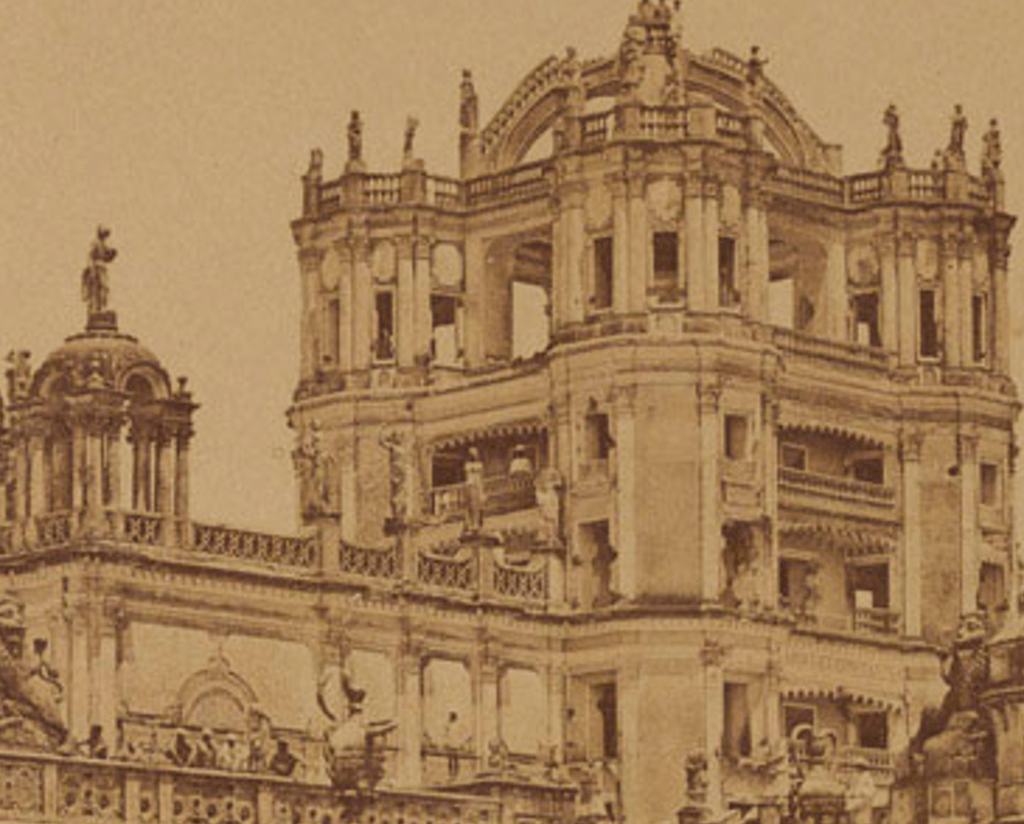
However, days after Lucknow was taken, Majendie saw for himself the wanton destruction these triumphant soldiers of England had wreaked on Lucknow. Like many others, he gives us his recollections of the Kaiser Bagh.
“No words can describe the scenes of havoc and desolation…never was a place more thoroughly turned out o’windows than this one. Smashed chandeliers, huge gilded picture frames, with the pictures which they contained hanging in tatters from them; magnificent mirrors against which our men had been having rifle practice, silk hangings torn to rags, rich sofas stripped of their coverings, and the very bowels ransacked in search for hidden loot…statues minus their heads, heads minus their noses, marble tables dashed to pieces…buggies with their panels smashed in, oil paintings through which half-a-dozen bayonets have been thrust in sheer wantonness, books with their backs ruthlessly removed…doors which had been broken through or torn from their hinges..Everywhere, on every side, appeared symbols also of that monomania for scribbling names and drawing faces, so peculiar to us English – no place was spared the infliction, the humble outhouse and the loft council chamber, the king’s stable and the Zenana alike bore on their walls the British soldier ‘hys mark’ done in the blackest charcoal and biggest characters, or scratched with the point of the bayonet, with a startling prodigality of capitals.”
With the fighting finally over, Jung Bahadur packed up his men and loot and made his way back to Nepal. He had, in his column, besides over 2000 sick and injured, a veritable contingent of 4000 carts, filled to the brim with the wealth of Lucknow.

The city itself had been devastated. The constant shelling had caused considerable damage to the buildings and the prodigious earthworks of the city’s defenders, for their three lines of defence had changed the landscape of the city. Hardly a road was passable, mines continued to be a problem, as did the prodigious amounts of loose gunpowder. Engineers like Lieutenant Lang would remain behind to begin the work of demolition to ensure certain positions could never again be used as military installations, and to some extent, begin reconstruction. They would be in charge of the initial cleaning up, but it would be years before Lucknow would recover from the ravages of the mutiny.

Another officer, Lieutenant Cracklow, with the Bengal Horse Artillery, wrote in a letter home,
“I can give you no idea of the destruction that has taken place. The beautiful buildings are very much battered by our shot. The palaces, which were all furnished in the most sumptuous and costly manner with enormous mirrors, chandeliers and pictures, and splendid furniture, have been ransacked by our troops. Not a thing remains entire. What the men could not carry away, they smashed, and the floors are covered inches deep with the payment. Property worth it is said, a million have been destroyed here alone. The Sikhs and Gurkhas were allowed to take what they liked, and this is the result; the Europeans were at all behind hand, as they quite equalled the other savages in the work of destruction. The whole city presents a most melancholy appearance. The roofs of the houses are nearly burnt off, and it has suffered severely from the shelling to which it has been subjected.”
As for the Martiniere College, it would be a year before it was habitable again. Shot, shell and bullets had scarred the walls of the buildings, and even the marble pavement had been dug up. If the devastation was sad to look upon from the outside, things were worse indoors. The library had been destroyed, the ironworks removed, and even the elaborate ornamented ceilings had been ruined with shot. To make matters worse, even Claude Martin himself, the erstwhile founder, had been dug up and his bones scattered about – a tomb was seen as good a place as any to look for treasure. The boys would not return to the school from their temporary accommodation in Benares until March 1859.


 Mutiny Reflections
The destruction and retributions are horrible to read – so very sad
LikeLiked by 1 person
This was quite a terrible chapter of mutiny history and not am easy one to write – it was a tainted victory in many ways and was the capture of Lucknow was practically over the minute the first shot was fired. It is from here that one can say the mutiny was basically over.
LikeLiked by 1 person