Major General Richard Charles Lawrence (1817-1896)
Although correctly, at this juncture, we should explore the lives of Henry and John; they will require more space than this post allows, and we shall turn our attention to the youngest of the Lawrence brothers, Richard.
Richard was born in England in 1817 – he would have been a mere toddler when his eldest brother, Alexander, left for India. Shortly after Richard completed Addiscombe in 1833 and set sail himself, things would change dramatically in the Lawrence family. Their father, in poor health, died in 1835. With his death, his pension ceased; his widow and two remaining, unmarried daughters would have been left penniless. However, her sons had not been remiss – Henry had set up, what would be called, the “Lawrence Fund” shortly after he arrived in India, but his own funds were barely sufficient to lay aside enough in the way of noteworthy assistance. However, Henry “rather dunned” John into taking it up. John, naturally cautious by nature, had not been convinced at first of Henry’s plan; however, he committed himself nevertheless to the scheme and put all “our other brothers to shame” with his zeal. Even Alexander, who was in far-off Madras, was commended for giving up his overpay, and George, though he does not mention it, would soon send whatever money he had to spare into the Lawrence Fund. Managed by John, who saw to the successive investments, the fund was sufficiently large to send a remittance to their mother when she sorely needed the assistance.
However, their father’s death was a sad blow for his sons, though a stern man, he had never been anything but a source of encouragement to his children; his stories of wars past had fuelled their imagination for the soldiering life, and his unceasing commitment to their futures had seen that they wanted for nothing. Yet distance and terms of service had not allowed for them to be at his deathbed, for only Alexander and Henry were able to return home before he died.
When Richard arrived in Calcutta on 1 December 1834, he would have been something of a stranger to his brothers, and they were far further afield than Calcutta, where he remained until March 1835, when he was posted as ensign to the 73rd Bengal Native Regiment. Richard would see his first fight in the 1st Sikh War, serving with his regiment at Sobraon; then, he secured a position as officiating second in command of the Ludhiana Regiment (15th Ludhiana Sikhs), raised in 1846. His position became permanent in 1847, and he remained with the regiment until 1849. Following his two-year furlough, he returned to India in 1852 to take up civil work as an assistant commissioner in the Punjab; however, this was followed quickly by a transfer as captain of the Police in the Lahore Division, a position he would return to after the mutiny until 1859. While still a young man with not many prospects, Lawrence married Ellen Youngson (youngest daughter of the late Lieut. Colonel W. Youngson) in Sylhet. Perhaps the ten years Henry had waited to marry were not altogether lost on Richard. They would have ten children in their long marriage, four of whom they buried as infants in India.
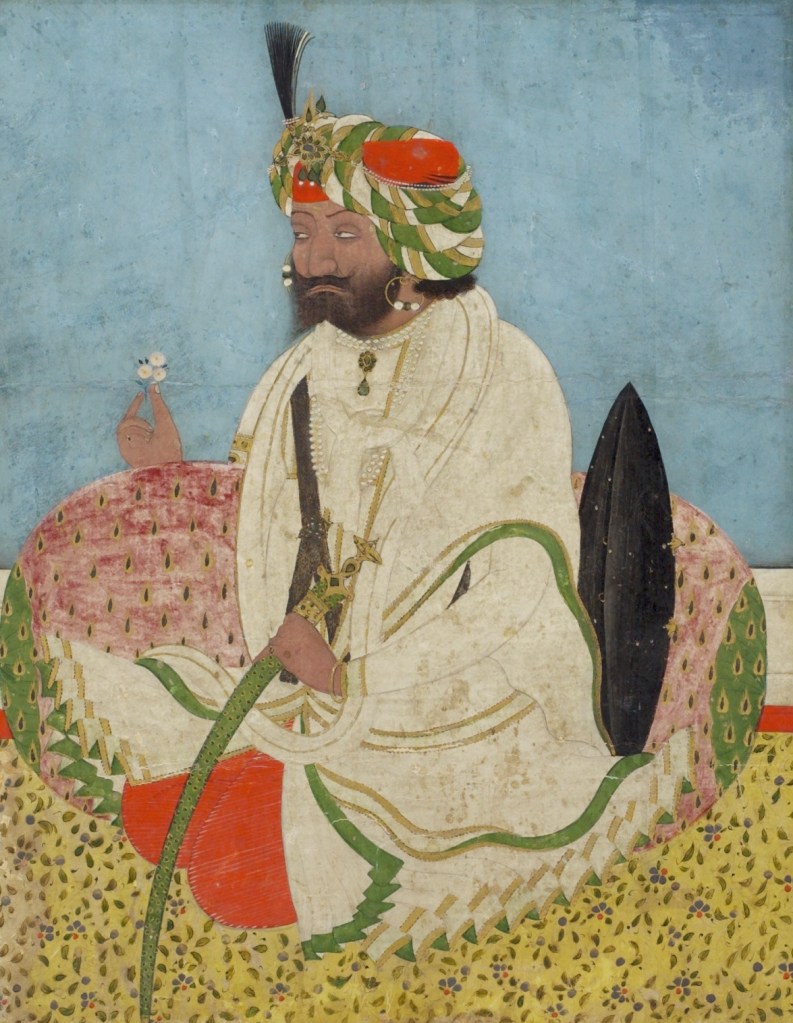
When the mutiny broke out in 1857, there was certain apprehension that the revolt would spread to Kashmir and the leader, Gulab Singh, would transfer his loyalty to the mutineers. While none of this proved true and Kashmir remained loyal to the British even after Singh’s death in August 1857. According to the terms of the Treaty of Amritsar signed in 1846, Maharaja Gulab Singh had been under no obligation to send troops to aid the British; it stipulated he was to give such assistance only when its troops “were employed in the hills or in the territories adjoining its provisions.” Yet Singh decided to take a different route -facing mounting criticism from the British for his mismanagement of Kashmir, the unpopularity of his rule and the very real threat that the British might just decide to boot him out of Kashmir, Singh decided he needed to take a side.
With forces desperately needed for operations at Delhi, John Lawrence was called upon by the government to persuade every loyal native Prince in the Punjab to send troops to Delhi. The only one Lawrence did not trust was Gulab Singh – he had proved himself duplicitous in nature and elusive in diplomacy, something Lawrence had experienced quite closely during the 2nd Sikh War. Cautious to the last, and knowing full well that if Singh chose to he had the means to start his own little war against the British, it took some wrangling on the part of Lawrence to convince himself that Singh could be trusted. Interviews with Singh’s Diwan followed, and Lawrence strongly pointed out the advantages Singh would reap if he sent a select body of hillmen to Delhi. The Assistant Commissioner of Peshawar, Lieutenant Urmston, who happened to be in Kashmir at the time and took up further negotiations with the Diwan, urged Lawrence to accept whatever aid Singh chose to give.
“It is said that when the news of the Mutiny reached Gulab Singh, he prophesied that ‘well, it will give the
British some trouble, cost them a good deal of money, but in a few months they will be alright again’. In a letter to British authorities, which conveyed a willingness to assist them during the course of the Mutiny, he wrote that ‘assistance may include in whatever manner possible, troops, material, and money. Moreover, strong forts and fortified castles as lofty as the firmament, such as those of Mongla Fort and others wherein the troops of the English Government could take shelter would be made available also. He also lent a loan of six lakh rupees at six percent interest to the Punjab Government when money was much wanted in the Punjab and the soldiers were in arrears.”
As such, any mutineer entering Kashmiri territory and expecting shelter was disappointed. Singh handed over 120 of them to the British and ensured that the remnants of the 55th NI who made a desperate bid for asylum never arrived in Kashmir. Another group of Sialkot mutineers were likewise dispensed with.
Swiftly, the Kashmir state raised a new artillery unit called Bijli Topkhana (later the famous 1st Jammu and Kashmir Battery who would win accolades in WWII); the Ragunath Battalion of Infantry under the command of Anant Singh added to the force, until Singh had accumulated a contingent of 2600 infantry, six horse artillery guns, 24 swine guns and 150 cavalry troops. Although rumours were circulating that these men would never march past Amritsar, and if they did get to Delhi, they would undoubtedly switch sides, John Lawrence paid no heed to the stories but he was practically wild with fury at the actions of General Wilson on the Ridge. In a letter to Herbert Edwardes, he wrote,
“General Wilson’s letter does not give me a favourable idea of his capacity or fitness for the post. First, it was said “Send the Jummoo troops;” then “we will not have them;” then, “send them, by all means; let them come quickly;” and now they begin to hedge. I feel rather sick of such vacillation.” It was only after Gulab Singh’s death in August that the force was finally ordered to march from Jammu under the command of Captain Richard Lawrence. John Lawrence personally inspected the men at Jallandhar to “convince himself of their trustworthiness.”
“At Jalandhar, Lawrence presented khillat to the officers and offered the troops a marching allowance like what was enjoyed by the British regular native troops. The offer was, however, politely declined by Diwan Hari Chand, claiming that the Maharaja had already promised them an increase in the pay of 25 percent up to the river Sutlej and of 50 percent after crossing that river. The Chief Commissioner, nevertheless, promised a bounty of five thousand rupees and pensions to their heirs should they fall while fighting for the British cause. Gratuities called zukhmeana were also promised in case of getting wounded.” His problem remained General Wilson.
Wilson must have been something of a stout man to refuse the words of the Chief Commissioner of the Punjab, a man with the reputation of putting fear into the hearts of men with a single telegraph. He sternly wrote to Wilson that he was to ensure “not to render them useless by putting them to duties which they could not perform, or positively harmful by showing his suspicions of them.’In a letter to General Wilson, he assured him the trustworthiness of the contingent and advised him that: If by [the time the force gets to Ambala] and that time my brother [Lieutenant Richard Lawrence] has no reason for distrusting them, I would say, by all means, have them sent on to Delhi, and let them aid in the attack. If on the other hand, he finds ground for doubt, I would send them over to Meerut to put down rebellion and sedition. My own impression is that they will behave well. They are Hillmen, who have no sympathy with the Poorbeas.”
Yet he gave the English officers accompanying the force a different piece of advice – they were never to forget that Dewan Hari Chand and his officers commanded the Jammu troops, and they were to remind the English officers at Delhi of the same. “The latter will go into action with them and will assist their officers by their example and advice, but no more.”
Richard Lawrence led them to Delhi. He would be with his men when they formed part of the 4th Column under Major Reid; despite the distrust and suspicion they incurred on their arrival, they proved their worth during the siege – unfortunately, the 4th Column was the only column on that day that did not reach its objective but it was not through the fault of the Jammu troops.
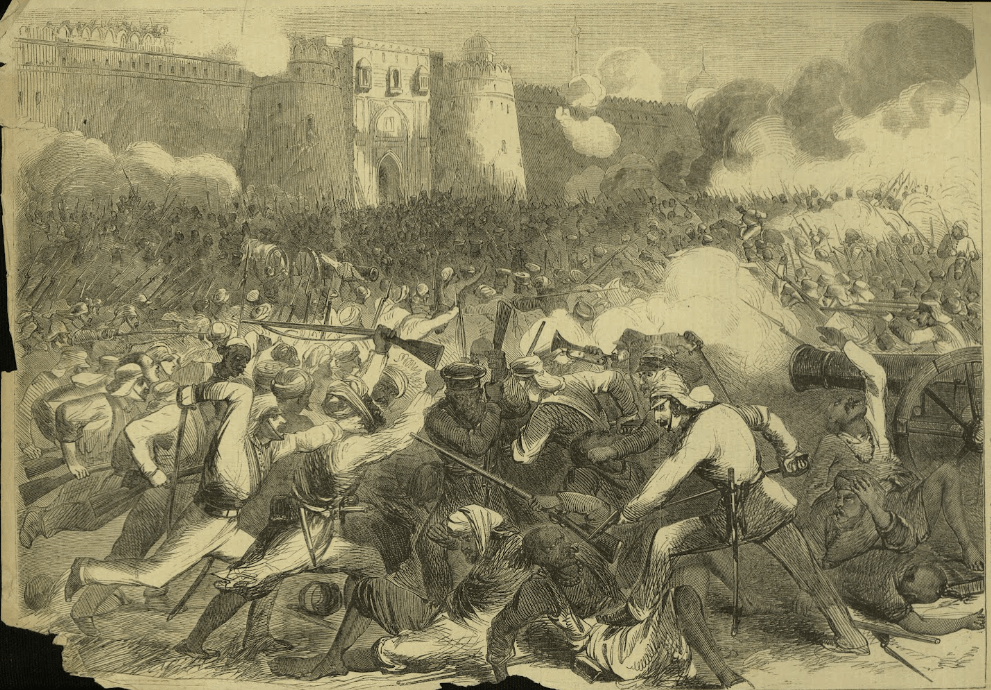
“It is said that the mutineers on whom the fourth column was planning to attack had the support of heavy artillery, together with the formidable defense of high walls. On 14 September, a portion of the Jammu contingent, which had been sent to make a diversion at Idgar, prematurely engaged with the enemy. As a severe musketry fire was poured by the mutineers from loopholes in the wall, confusion was created within the ranks of the column. The panic-stricken Jammu troops forced their entry into the main column, resulting into the increase of disorder and made it difficult for the troops to distinguish between ‘friend and foe’. Captain Muter, who had assumed command in the wake of the chaos, ordered the troops to retreat.”
The Jammu troops were sadly unprepared and unused to this kind of warfare, and their reaction was hardly a surprise; their losses on 14 September were considerable. Somewhere in the mélee, Richard Lawrence was wounded.
The remainder of Lawrence’s career would be very much a stable march up the ladder. He returned to his duties with the Police in the Lahore Division when he was sufficiently recovered. After his furlough in 1860, Lawrence transferred to the Staff Corps in 1861 and served as district commissioner for the Simla Hill States until 1862. His final position would be one his brother Henry had occupied many years before him – Resident to the Nepal Court, where he remained until 1872. He then returned to India to serve with the forces of the Maharaja of Jammu and Kashmir. Attaining his local rank of Lieutenant Colonel in the corps in 1875, shortly after, Lawrence returned home, a Companion of the Bath, and died with the final rank of Major General in 1896, in Biarritz. His wife died four years later.
In the final post, we shall explore the lives of the best-known Lawrence brothers, Henry and John. Two men so unlike in temper and character, and both would leave their impression on the history of India.
Sources:
Life of Sir Henry Lawrence, Vol I – H.B. Edwardes / H.Merivale (London: Smith, Elder & co., 1872)
List of Officers of the Bengal Army 1758-1834, Part III – Major V.C.P. Hodson (Phillimore & Co., Ltd. 1946)
Forty-Three Years in India – Sir George Lawrence (London: John Murray, 1874)
Lawrence of Lucknow – J.L. Morison (London: G. Bell & Sons Ltd, 1934)
Lord Lawrence – Sir Richard Temple (London: Macmillan & Co., 1889)
Lone, Amir Sultan. “PROFESSOR P.S. GUPTA MEMORIAL & PROFESSOR J.C. JHA PRIZE PAPER: REVOLT OF 1857 AND THE JAMMU AND KASHMIR STATE.” Proceedings of the Indian History Congress 79 (2018): 437–47. https://www.jstor.org/stable/26906277.
 Mutiny Reflections