Alexander, George and Richard
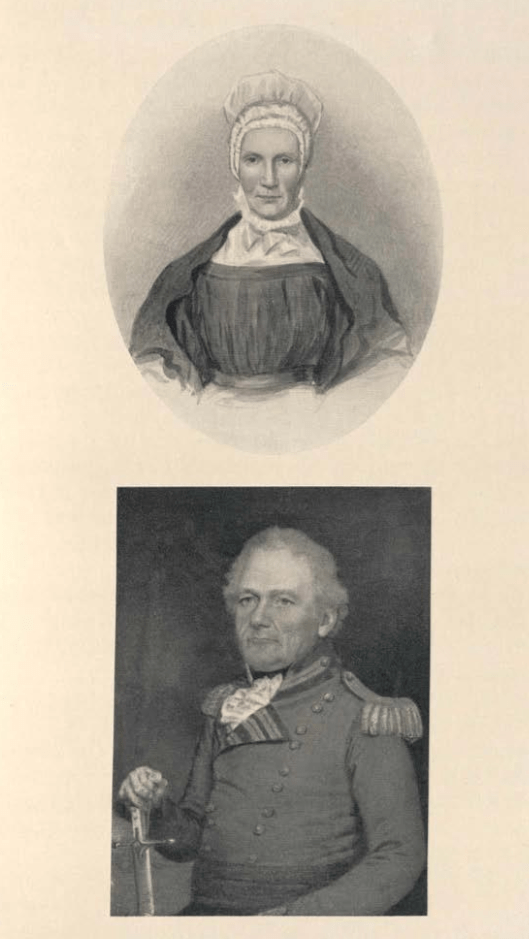
The story of the Lawrence brothers starts in India; yet it was built on the trials and disappointments of another – their father, Colonel Alexander Lawrence.
The son of a mill-owner of Coleraine in County Derry, who died in 1776, leaving behind seven children, of whom five were boys. Three brothers left home shortly after their father’s death to seek their fortunes in America with only their inheritance in their pockets: all three disappeared in that wide land and were never heard from again. Alexander remained at home, cared for by his two elder sisters, who, as the years went by, were at a loss; what were they to do with this active, daring and impatient boy? One brother, named William, had taken his place in the navy as a surgeon, but for Alexander, there were but few prospects. Yet, he was quick to shake off his sisters’ care, and for a bounty of £5, Alexander joined his brother on board the cutter “Nimble” as a volunteer. He served on board until the war with America ended, and he received his discharge in 1783. Only a day after his discharge, still only 16 years old, this daring young man embarked on the EICo ship, the Stormont and set sail, once again a volunteer, with the HM’s 36th Regiment of Foot.
It was the custom of the day to take on as volunteers young men of good families but financially unable to buy a commission. They were treated as officers but drew no pay and had to live on their own resources. When a vacancy opened up among the regular ensigns, these young men were promoted as “acting ensigns by the commander-in-chief in the field” and, should the rank be approved by the War Office at home, they would be confirmed to the rank and become regular ensigns. So Alexander Lawrence, appointed by the Commander-in-Chief General Sir John Burgoyne as an ensign in the 101st Regiment, went off to fight a bitterly long campaign under Colonel Fullerton, happy in the knowledge that once it was over, his days as a volunteer would be over.
It was not to be. He was horrified to find that “the commission not confirmed at the Horse Guards, from it not having been stated in the recommendation that he was actually serving in India,” and the clerk who had made this error had further neglected to mention how the vacancy had come to pass. So Alexander Lawrence, instead of being a full-fledged ensign, was still a volunteer. He was rejected for a second recommendation, which was given instead to a half-pay officer in England. In 1787, he was finally gazetted, but only after he paid the full price of commission. A year later, he was promoted to lieutenant in the 77th Regiment.
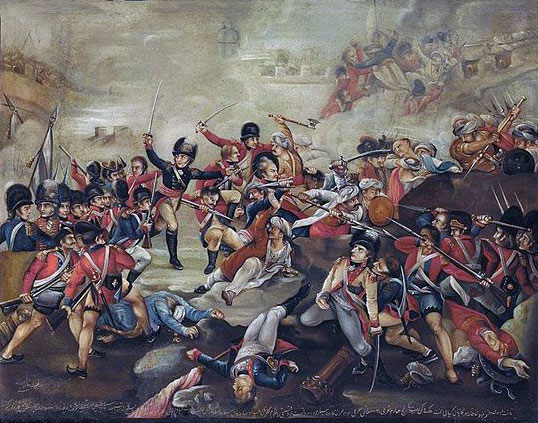
These were very warlike times in India, and Alexander would go through the brunt of it, from the fall of Cannanore in 1790, Cochin in 1795 and Colombo in 1796. It was, however, at the final assault on Seringapatam in 1799, that Alexander unveiled his full mettle.
“In the same year he commanded the Grenadier company (of the 77th Regiment) the whole of the (second) siege of Seringapatam, the captain being left sick at the top of the Ghaut; ” in the course of which siege he twice distinguished himself; once on the night of the 22nd April, when two companies of the 77th, under his command, repulsed with great loss a sortie of the enemy; and still more conspicuously on the 4th May, when he was the only survivor of four lieutenants who, at their own request, were appointed to cover the Forlorn Hope at the memorable assault of that fortress; on which occasion he received two severe wounds, one by a ball in his left arm, which is still lodged there, and the other in his right hand, which carried oft one finger and shattered another into several pieces. The first ball hit him just as his party reached the top of the glacis, where they found that the storming party (Sergeant Graham’s) had formed and commenced a fire instead of rushing in. Lawrence, wounded as he was, ran from right to left (of the rear-rank of the Forlorn Hope), hurrahing to them to move on; but at last was obliged to run through the files to the front, calling out, ‘Now is the time for the breach! ‘ This had the desired effect. At the foot of the breach, he received the second ball, but even then “ did not give it up till he saw the few remaining men gain the breach; then, fainting from the loss of blood, he was removed to a less exposed place.”
Lawrence was saved by a soldier of the 77th, who, later in the day, as he strolled over the battlefield, recognised that this officer was not dead. He heaved Lawrence over his shoulder and staggered with his burden, who stood 6’2″ and “stout in proportion”, back to camp.
Barely recovered from his wounds, Alexander was back in the field to join the siege and assault on the fortress of Jumalabad; after this, his regiment was ordered, at the height of the monsoon rains, the proceed up the coast in open boats to Cochin. A dreadful gale wrecked the boats close to Cannanore, but it was Lawrence, once again, who stayed on the beach until every man was safely ashore, swimming out in the rough waters to bring them in. It would take him nearly a year to recover the use of his legs. As soon as he was well, he transferred to the 19th Regiment and joined them in Ceylon. In 1808, sick with rheumatic fever and liver disease, Alexander packed up his family and set sail for home. He arrived back in England broken in health to yet another disappointment. He had been superseded, yet again, for the majority, this time in his own regiment. His old Colonel, however, took some interest in Alexander’s fate and introduced him to the Duke of York, who enthusiastically offered him a promotion in 1809 to major in the 19th Foot and ordered him to Yorkshire to enlist recruits.
“Three years later, his Royal Highness, ‘convinced of the ample manner in which this promotion has been earned by long and faithful services,‘ appointed Major Lawrence to the Lieutenant-Colonelcy of the 4th Garrison Battalion at Guernsey; whence, in 1815, the regiment was ordered to Ostend, and Colonel Lawrence commanded the garrison there, consisting of four regiments and artillery, throughout the Waterloo campaign.”
It was his last campaign: when returning to Ireland in 1816, Alexander suffered from a burst abscess in his liver and was given up for dead while onboard the ship. However, whatever was left of his constitution did not desert him. Bidding his wife Catherine, to “stand aside!” he wrapped his cloak around him and walked, with a firm but shaky step, leaning heavily on his walking stick, onto the quayside. It was the end of his career.
“He had served his King and country with indefatigable zeal for thirty-five years and with many a hard struggle had reached that rank which might have been of service to his sons. All this must now be sacrificed. He could ‘safely say that he never made a guinea by the service’ and if he died, the value of his commission would be lost to his wife and children. So he sold out for their sakes, dragged slowly through a long sickness into a shattered convalescence, and found himself, after a life given to his country, with £3,500 (the price of his commission), and a pension from the Crown of £100 a year for his wounds, which, with some bitterness and much truth he said, “would do little more than pay his doctors.” He had made sure, under the rules of the King’s service, of getting a pension of £300 a year, and his disappointment was keen.”
With the hoped-for pension not forthcoming and only a letter of condolence from the Prince Regent’s secretary, who “did not feel at liberty ” to advise the Prince to do more for Alexander, he took up his case with the East India Company’s Board of Directors. These were resounding in their support of the battered colonel and awarded him a 100 guineas, a pension of £80 a year for life, which they generously raised to £130 as a mark of their respect for his services, which were, ultimately, on their behalf. Two years later, he once again applied to the War Office for the full pension which he considered was his by right – their reply was to say His Majesty would generously raise to £220 a year, “being, with the pension allowed you by the East India Company the rate assigned to the rank you hold.” The money secured after such trials would have to suffice for his large family, for when Colonel Lawrence sailed home from Ceylon, he had six children, and a further five followed shortly thereafter in England. In all their years in India, the Lawrences had only lost one child to illness, and one would die, aged 18, in the West Indies.
Colonel Lawrence, once a determined young man who had fought for his King, was now equally determined that his sons would not follow in his footsteps into this thankless service; instead, he would put them in the service of the East India Company.
Three of the Lawrence brothers were born in Ceylon: Alexander in 1803, George in 1804 in and Henry in 1806. Henry. Of the twelve Lawrence children, the eldest son, George (born 1799 in Cochin), died in Ceylon, aged only two. His death sadly occurred on the same day his sister Letitia was born in 1801. The shock of losing her son nearly cost their labouring mother her life. In all, Lieutenant Colonel Lawrence would send five sons to India, two of whom would reach startling prominence in the history of not only the East India Company but India under the Crown.
The first formative years back in England would not have been easy ones for the family, constrained by income and growing in size, they would shift from residence to residence as means allowed, until finally settling in Clifton. While money might have made up his father’s woes, the old soldier was determined it would not pass to his children – he insisted on their education, and four of his sons passed through the doors of Foyle College, then under the headmaster Reverend James Knox, his wife’s brother. While Reverend Knox might have been a kindly man with fine principles, the school as such was hardly a good one, and the boys left it barely better educated than when they had arrived. In 1818, Alexander secured a nomination to Addiscombe for his eldest son, also named Alexander and thus the first Lawrence boy left the fold, destined for India. George followed in 1819, and Henry was sent to Mr. Gough’s School in College Green, Bristol. Shortly after, John joined him.
With these words, we can now begin the lives of the Lawrence brothers.
Major General Alexander William Lawrence (1803-1868)
Alexander was the first son to set sail for India; having left Addiscombe in 1819 with good prospects, he was destined for the Madras Cavalry, where he would remain throughout his career. There is very little known about Alexander as such; he married Rosanna Lyster, the daughter of the late William Thomas Lyster, Esq., in 1828 in Sholapore. Their only son, Alexander William Knox Stewart, died in London at just 19 years old in 1848. Lieutenant Colonel Lawrence would serve in the Mutiny, albeit in the force of General Whitlock, commanding the Madras Light Cavalry. Alexander died, aged just 64, in Biarritz Basses, Aquitaine, France, on February 21 in 1868, with the final rank of Major General and Colonel-in-Chief of the 2nd Cavalry H.M.’s Indian Army, Madras Presidency.
 Mutiny Reflections