Major General George St Patrick Lawrence (1804-1884)
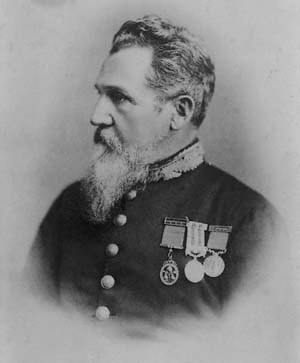
Leaving Addiscombe in 1821, George followed Alexander’s footsteps into the cavalry, as a cornet in the Bengal Establishment. He arrived in India in September of the same year and was immediately posted to the 2nd Regiment, Light Cavalry. His career did not start, perhaps, on the footing any young man would have expected.
“I remained six weeks in the Cadet Barracks in Calcutta. The chief incidents during my stay there were my getting a severe fall the first time I mounted a horse in my cavalry uniform, from, I fancy, using my spurs unnecessarily. I was picked up senseless and taken into a good Samaritan’s house in Chowringhee.”
The next was a dinner at Lord Hastings’ residence, where the Governor-General admonished him for neglecting language studies and bade him to “Mind, you study the native languages, sir!” Advice Lawrence would find most beneficial later in life. His next adventure was of a more manly nature when he attempted to save the life of a fellow cornet who had injudiciously waded too far out in the Ganges, and being unable to swim, was soon caught in the current and carried off. George, seeing young Bradford’s distress, valiantly jumped in to his rescue, only to find he was well out of his depth. It would take the very bold efforts of George’s khidmatgar to save both their lives. A shaken but very much alive George Lawrence joined his new regiment in Keitah in Bundelkhand and nine months later was in charge of a troop. Two years later, he was promoted to lieutenant and appointed adjutant of his regiment, a position he resigned in September 1834.
His early years in India were not broken up by war or strife. He went on sick leave to Simla in 1827 where he was given an interview with Governor-General Lord William Bentinck. While the interview itself was not in any way spectacular for George’s career, it certainly would have an effect on his younger brother Henry.
“On entering his room, My lordship addressed me with, ‘Well, sir, what do you want ?’ ‘Nothing, my
lord, for myself,’ I replied. ‘Well,’ said the Governor-General, ‘you are the first man I have met in India who gave me that answer; but you must want something?’
‘Yes,’ I answered, ‘for my brother Henry, an artillery officer. I wish your lordship to be good enough to nominate him to the Revenue survey, for which he is qualified. For myself, I want nothing, as I am adjutant of my regiment, and perfectly content.’
‘Well, sir, I never promise, but go to my military secretary, Benson, who will put your brother’s name down, and I will see what can be done.’ I thanked his lordship and retired, and in six months thereafter, my brother received the appointment he desired.” How this one interview would change the course of Henry’s life will soon be told.
In 1838, his regiment was ordered to join the Army of the Indus, then collecting at Ferozepore on the Sutlej for service in Afghanistan. By now a married man (1830 to Charlotte Isabelle Browne), George had had the sense to pack off his wife and their three children to England before proceeding on active service, so he was spared the “worry and disappointment such events were causing to many others in our camp.” With his regiment, he was present at the storming of Ghuznee on 23 July 1839, and in the attempt to capture Dost Mohammad Khan in his flight in August through the Bamyan pass.
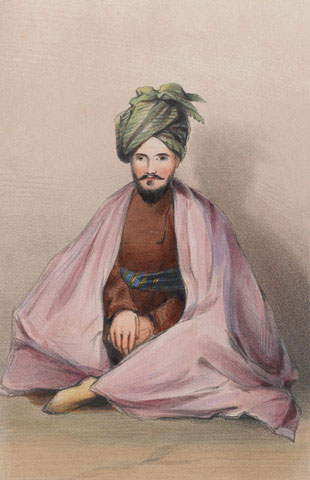
Coloured lithograph after Lieutenant Vincent Eyre, Bengal Artillery, 1842
When he returned to Kabul in September 1839, Lawrence now found himself as political assistant to Sir William Hay Macnaghten, the envoy to Afghanistan – he remained at Macnaghten’s side until his death, as his military secretary. It was not a position Lawrence had coveted nor indeed requested. However, the British, secure in their belief their tenure in Afghanistan would be long one, had decided to send for their families who were waiting for them in India – while Lieutenant Conolly was despatched to escort the ladies to Kabul, Lawrence was nominated in his place as political assistant and commandant of the envoy’s escort and even Lawrence had to admit, “The transition from purely regimental to civil duty was sudden and complete, and at first not a little embarrassing.” For a short time, with no chaplains available, George Lawrence even took on the role of impromptu chaplain, conducting divine service every Sunday for the Kabul Garrison.
If the British thought for a moment they could hold Afghanistan, they were sorely mistaken, and by 1840, the Afghans were doing their best to get them out. While we shall not dwell on the murder of Macnaghten on 23 December 1841, who the Afghans believed was double-dealing them, it nearly cost Lawrence his life.
Macnaghten ill-advisedly agreed to a conference with the Afghan chiefs, held 300 yards outside the cantonment close to the river.
“The Envoy dismounting, reclined on the slope, and Trevor and Mackenzie sat down beside him. At first, on dismounting, I stood behind him; but on being importuned by Mahomed Shah Khan to be seated, I knelt on one knee, the escort being drawn up a short distance in the rear. I had, on first arriving, remarked to Sir William the unusually large number of armed Afghans congregated around us, and suggested his requesting Akbar Khan to send them to a distance, as the meeting was confidential. The Envoy, in consequence, mentioned the subject to Mahomed Akbar, who said, 4 Oh, we are all in the same boat, and Lawrence Sahib need not be the least alarmed.’ Scarcely were the words uttered when my pistols were snatched from my waist, my sword drawn from the scabbard, and my arms pinioned by Mahomed Shah Khan, who raised me up from the ground, saying, ‘If you value your life, come along with me.‘ I turned round and saw the Envoy, with his head down the declivity, struggling to rise, and his wrists locked in the grasp of Mahomed Akbar, horror and consternation being apparent in his face, Trevor and Mackenzie, I noticed, also in the same predicament as myself. Comprehending at a glance that resistance was useless, I said to Mahomed Shah Khan. ‘Lead on; I will follow you.’ At the same moment, swarms of Afghans, armed to the teeth, sprang up all around, yelling and demanding that I should be given up as a ‘koorban’—a sacrifice—to their vengeance.”
Lawrence and Mackenzie were both saved, but Trevor and Macnaghten were both dead. Macnaghten’s head was presented to the population of Kabul on a pike. As such, the stipulations placed on the British for their withdrawal from Afghanistan were the taking of hostages – four officers were offered up, and George Lawrence was one of them. By now, Lawrence believed no one would ever see India again, and when released from captivity, he was placed in charge of the ladies and children on 6 January 1842 at the start of the disastrous retreat from Kabul. Two days later, he was given up again as a hostage to Akbar Khan; Lawrence initially refused.
“Major Pottinger then offered to take my place, as he was wounded and could he of little or no use, whereas it was important that I should remain to take charge of the mission establishment, and he hoped that by his going, Akbar Khan might he satisfied with fewer hostages. Pottinger then proceeded to join Mahomed Akbar, but in about half an hour, he sent a note back stating that I must join him at once, as the Sirdar insisted on my being given over to him as a hostage. On my showing this note to the General he said he was sorry to lose me, but go I must, I therefore started in company with General Shelton, but had not proceeded beyond our own pickets ‘ when another note from Pottinger reached me, saying that Mahomed Akbar had agreed to dispense with General Shelton, and would be satisfied with Pottinger and myself, and a third officer, whomsoever Pottinger might select. He accordingly had named Captain Colin Mackenzie.”
They were by far not the only hostages for the wily Afghan who offered to protect the married officers and their families and the wounded officers, all the way to Jellalabad. Their march would be over the bodies of the dead comrades who had fallen on the road, shot by Afghan bullets or died from cold.
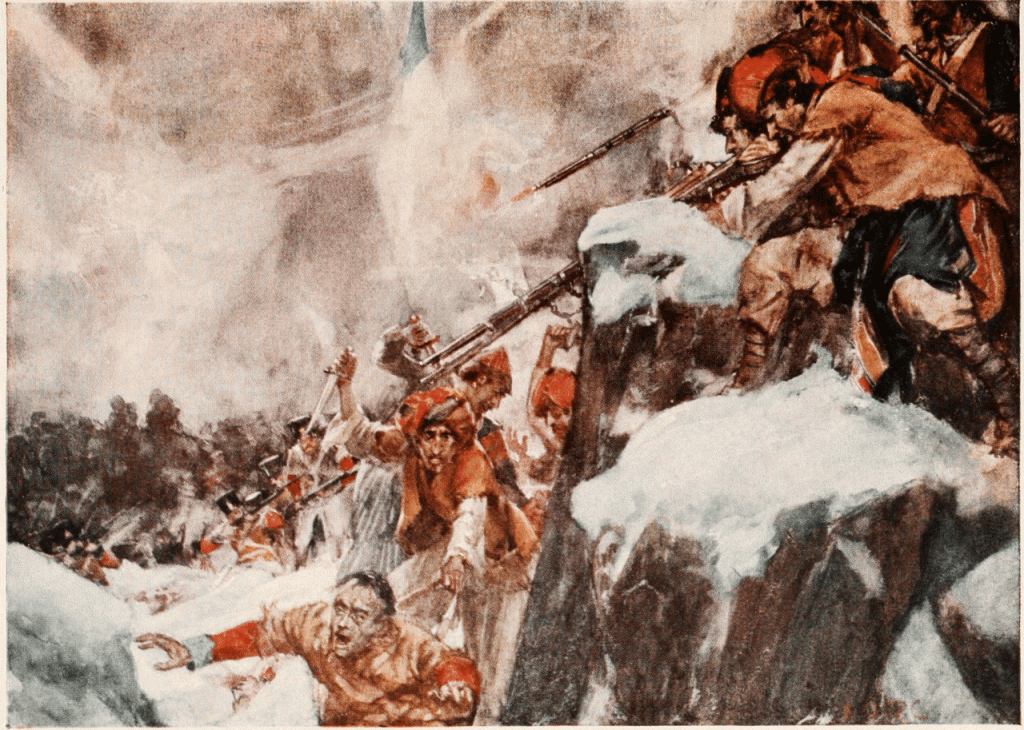
Painting by Arthur David McCormick, 1909, depicting British troops trying to fight their way through the pass.
“I recognised the body of the venerable old subalular of the Envoy’s escort, Appurnbul Singh, lying on the road by the side of his dun horse. It was told me that the Afghans offered him his life, for he was well known to them, if he would go over to them. ‘No,’ replied the grand old soldier, ‘ for forty-one years I have eaten the Company’s salt, and I will now show myself ready to die for them.’ For sixteen miles, we passed through these scenes of horror…” Things did not improve when, on the 13th of January, they passed through Jugdalack – the last two miles were strewn with the bodies of Europeans and Indians, all stripped of their clothes, among whom George recognised his friend Major Skinner.
“I saw hundreds of miserable sepoys and camp followers huddled together on the sides of the hills on each side of the road. They begged us with the most heartrending supplications to assist them, but alas! no aid could we afford; and indeed, had it been otherwise, they were beyond all human help, for the Afghans having stripped them of all their clothing had left them, to perish of cold and hunger, and the greater number of them were then, from the effects of the frost on their limbs, quite incapable of moving. I could not even do anything for them by supplicating Mahomed Akbar on their behalf, as otherwise I would have done, for the Sirdar had warned me not to come near him unless he sent for me, and I was surrounded by a guard of his own retainers.”
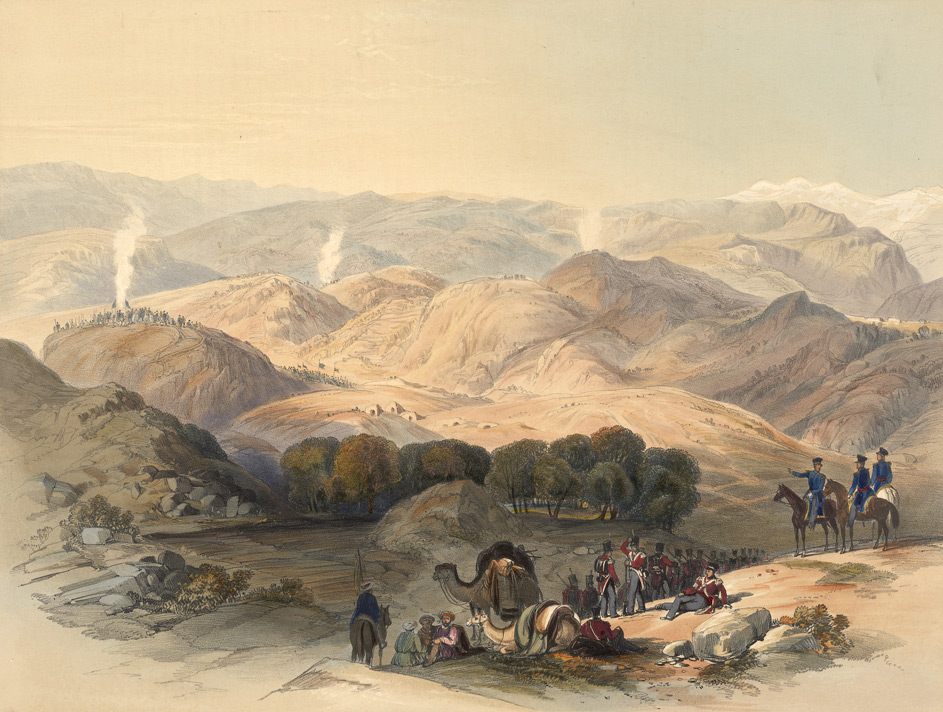
The Kabul Army was destroyed nearly to a man, sacrificed, “to the incompetency, feebleness and want of skill” of their military leaders – a handful of sepoys and Dr Brydon were the only survivors; George Lawrence and the other hostages would remain in captivity until September 1842.
It hardly seems comprehensible that Lawrence was thrown straight back into his duties following his release from Afghanistan. On reaching Ferozepore, he appeared as a witness in several court martials of officers who had not been hostages but prisoners in the hands of the Afghans – to his relief, the men were acquitted. Then he was sent to join his regiment, the 11th Light Cavalry, in Cawnpore.
While in Cawnpore, however, his robust constitution finally broke down. Following a serious illness, Captain Lawrence was sent home to England on furlough, where he remained for three years, recovering his health. In September 1846, he returned to India.
George Lawrence now found himself appointed assistant political agent in the Punjab, but it was not all paper and pens. In the autumn of 1847, he led 2000 men against the hill tribes on the Swat border, defeating them in two separate actions; on the outbreak of the 2nd Sikh War, it was only due to Lawrence’s personal influence at Peshawar that his regiments remained faithful for a time, but eventually they broke and joined the Sikhs. Possibly no man in history has had so much experience with captivity – on 25 October 1848, he was handed over to Chuttur Singh as a prisoner, this time with his wife and children. They would remain his prisoners until 22 February 1849, following the Battle of Gujrat. Both houses of Parliament and the Governor-General took the time to thank Lawrence for “remaining at his post with such devotion.” Since Lawrence was proving himself rather useful in the Punjab, on 7 June 1849, he was promoted to brevet lieutenant-colonel and appointed deputy-commissioner of Peshawar. In his capacity as a political officer, he accompanied General Bradshaw’s force to Yusufzai country and was present at the capture of Pulee on the Swat border. Early in 1850, Lawrence, in command of militia, proceeded with Sir Charles Napier in the forcing of the Kohat Pass and acted as a guide through the defile.
Struck down again with a serious illness and realising he would most likely be sent against the Afridis again and back up Kohat, Lawrence practically begged Dalhousie to remove him from the Punjab. For once, Dalhousie appeared to be solicitous.
“In conferring this appointment upon Major Lawrence, Lord Dalhousie wrote to him the following gratifying letter:
I have considered the claims of the several officers who have applied for the appointment of the Meywar political agency, and I regard your claims as superior to any others which have been proposed. I feel sure that the office is one which will be satisfactory to yourself, and that you will fill it to the satisfaction of the Government. I shall be heartily sorry to lose you from the Punjaub, where you have played your part so much to my satisfaction, as well in peace as in war. But as that was to be from the first, I am glad to have it in my power to offer you this public mark of my satisfaction with the past.
(Signed) Dalhousie“
For the next seven years, Lawrence occupied himself peaceably in Mewar, but on 13 March 1857, his brother Henry, who had been Chief Agent for the Governor-General in the Rajputana States, handed the reins of the entire province over to him. Henry was sent to Lucknow, and George took up his seat in Mount Abu. His successes and disasters in Rajputana in 1857 have been amply described. In May 1860, Lawrence was created a Companion of the Order of the Bath and one year later gazetted Major General. In 1864, he resigned his position in Rajputana and left India after 43 years of service. He received his good-service pension of £100 per annum and on May 24 1866, was created Knight Commander of the Order of the Star of India and Companion of the Order of the Durrani Empire. He retired from the army on full pay on 29 October 1866 and was advanced to honorary lieutenant general on 11 January 1867. George Lawrence died in London on 16 November 1884, aged 80.
 Mutiny Reflections
