What Jhansi Wasn’t
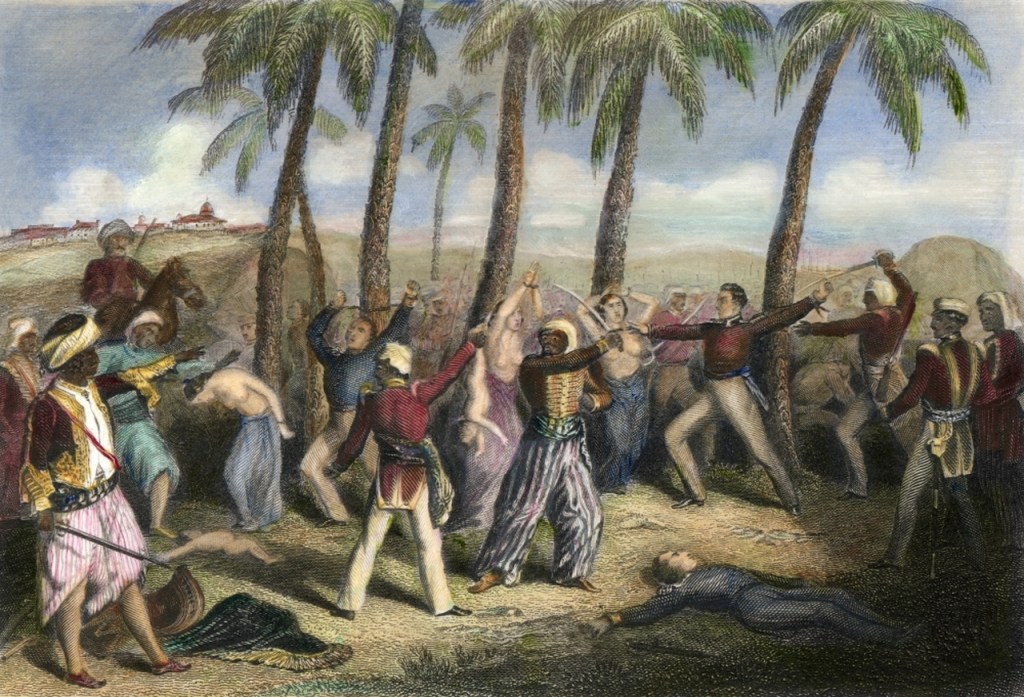
This highly fantastical, and very inflammatory painting served a fiendish purpose – to enrage Victorian morality, reiterate the stereotype of the “lascivious heathen”, and feed an ever-increasing public appetite for horror and fuel the cry of revenge. Every aspect of the scene is wrong as if a truthful account simply wasn’t bad enough.
Gordon’s servant witnessed the scene:
“Captain Browne’s sister begged very hard for her life. She said she would remain whereever they told her and held the hand of the sepoy, but they would not spare her, and she was killed too.” Mrs. McEgan, the wife of the doctor, threw her arms around her husband – the sepoys beat her and tore her away. When the doctor’s lifeless body lay on the ground, she threw herself over his corpse and was killed shortly after.
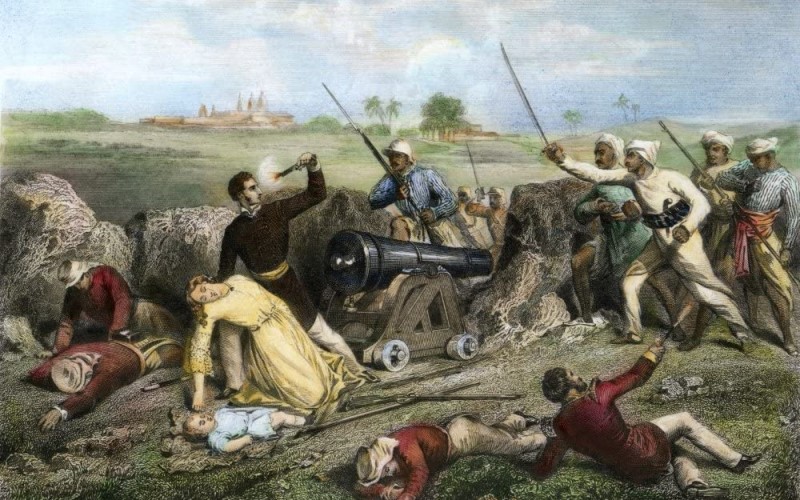
This, of course, is the famous picture of the death of Captain Skene and his wife. Suffice to say, it was anything as romantic as Rossetti or as straightforward as the writer of the letter, – known as R.G. – had envisioned, or the painter of this picture, for that matter.
Christina Rossetti was not the only poet who eulogised Jhansi.
“How They Died at Thansi” by Louisa Annie Murray – strikes all the right notes – bravery, heroism, sacrifice and rolls it up in a Scottish blanket of pride. Essentially, there is nothing wrong with that – but like Rossetti, it is just unfortunate that poets allow themselves so much liberty with other people’s fates.
What Happened to the Rani Of Jhansi
After the Doctrine of Lapse came into place, the Rani pleaded and petitioned the case of her adopted son to no avail – it is highly unlikely that even after it became clear that Jhansi had been illegally annexed, the Rani was not holding a very large grudge.
However, even after the massacre on the 8th of June, she still had supporters among the British. It could not be established whether she had ordered the massacre, had been threatened by her own people to do nothing to stop it, or if she simply turned a blind eye. Her letters to Major Erskine had the desired effect, she wrote the following:
Translation of Khureeta of the Ranee of Jhansee to the address of the Commr. and Agent Lieutenant Governor, Saugor Division dated (supposed) 12th June 1857.
After compliments. States that the Govt. forces, stationed at Jhansie, thro’ their faithlessness, cruelty and violence, killed all the European Civil and Military Officers, the clerks and all their families and the Ranee not being able to assist them for want of Guns, and soldiers as she had only 100 or 50 people engaged in guarding her house she could render them no aid, which she very much regrets. That they the mutineers afterwards behaved with much violence against herself and servants, and extorted a great deal of money from her, and said that as the Ranee was entitled to succeed to the Reasut, she should undertake the management since the Sepoys were proceeding to Delhi to the King.
That her dependence was entirely on the British authorities who met with such a misfortune the Sepoys knowing her to be quite helpless sent her messages thro’ the Tehseeldar of Jhansie, the Revenue and Judicial Seristadars of the Deputy Commissioner’s and Superintendent’s Courts to the effect that if she, at all hesitated to comply with their requests, they would blow up her palace with guns. Taking into consideration her position she was obliged to consent to all the requests made and put up with a great deal of annoyance, and had to pay large sums in property, as well as in cash to save her life and honour.
Knowing that no British Officers had been spared in the whole District, she was, in consideration of the welfare and protection of the people, and the District, induced to address Perwannahs to all the Govt. subordinate Agency in the shape of Police &c. to remain at their posts and perform their duties as usual, she is in continual dread of her own life and that of the inhabitants.
It was proper that the report of all this should have been made immediately, but the disaffected allowed her no opportunity for so doing. As they have this day proceeded towards Delhi, she loses no time in writing.” (British translation from the original Persian)
Erskine was completely convinced of her innocence and requested her, in his letter, to assume control of Jhansi, until a new superintendent could be sent. She took up the reins quite willingly and proved herself a strong and competent leader. With the mutineers now gone from Jhansi, she set about ruling her domain.
Nothing happened.
The British were suddenly nowhere in sight and the Rani was left on her own. She successfully kept the mutineers at bay when they attempted to put the nephew of her husband on the throne, and then she defended herself against attacks by Orchha and Datia (the erstwhile friends Gordon had tried to convince to come to his aid) who now, though still loyal to the British, wanted to carve up Jhansi between themselves.
Her intention appears to have been to hold Jhansi for the British – but in the meantime, the wind had turned against her, and they were no longer so convinced that she wasn’t responsible for the massacre after all. All her requests for aid went unanswered.
When they finally did come to retake Jhansi, by any means necessary, in March 1858, she issued a proclamation: “We fight for independence. In the words of Lord Krishna, we will, if we are victorious, enjoy the fruits of victory; if defeated and killed on the field of battle, we shall surely earn eternal glory and salvation.”
Following the Siege of Jhansi which started in March 1858 and ended on the 3rd of April, the Rani would eventually be forced to throw in her lot with Tatya Tope, the Nawab of Banda, and Rao Sahib, (brother of the Nana) – the British force came with such a vengeance with no quarter given, leaving Jhansi in ruins and countless numbers of its citizens killed. Such brutality has seldom been seen in the records of man, and for the sake of 55 people, dead nearly a year, it was a horrifying display of brute vengeance.
The Rani, with her son and loyal retainers, fled the city under the cover of night and joined the rebel forces, which included Tantya Tope, at Kalpi. It was easier for her to throw in her lot with them now – she had grown up in Bithur, where her father had worked for Peshwa Baji Rao II, and she counted among her childhood friends Nana Sahib and Tope. United with old friends, they now set their sights on a common goal. This brief respite ended on the 22nd of May when the British forces attacked Kalpi, and the forces which the Rani herself now commanded were defeated. Fleeing to Gwalior, it would again prove to not go as planned.
On the 17th of June, she once again met Sir Hugh Rose’s force in the field. It was to be her last fight.
The Rani of Jhansi was killed in battle, while facing a squadron of the 8th Hussars and thus passed into legend.
Generations may argue her innocence or condemn her as guilty. It is unfortunately a debate no one can win with any satisfaction. There is no question she proved her prowess in battle and she was a strong leader – but she was not a ringleader. She did not start the mutiny, instigate it or even play a very large role. Her concern first and foremost, had been Jhansi itself. Her actions must speak for themselves.
Sources:
Ball, Charles. The History of the Indian Mutiny: Giving a Detailed Account of the Sepoy Insurrection in India. 2 vols. London: London Printing and Publishing Company, 1858.
Blunt, Edward. List of Inscriptions on Christian Tombs and Tablets of Historical Interest in the United Provinces of Agra and Oudh. Allahabad: Printed by W. C. Abel, Offg. Supdt., Govt. Press, United Provinces, 1911.
Chick, Noah Alfred, comp. Annals of the Indian Rebellion, 1857-58. Calcutta: Sanders, Cones and Co., 1859.
Edwardes, Michael. Red Year: The Indian Rebellion of 1857. London: Hamish Hamilton, 1973.
Forrest, George W., ed. Selections from the Letters, Despatches and Other State Papers Preserved in the Military Department of the Government of India, 1857-1858. Vol. IV, Jhansi, Calpee, Gwalior. Calcutta: Superintendent Government Printing India, 1912.
Hibbert, Christopher. The Great Mutiny: India 1857. New York: Viking Press, 1978.
Intelligence Branch, comp. The Revolt in Central India 1857-59. Simla: Government Monotype Press, 1908.
Lebra-Chapman, Joyce. The Rani of Jhansi: A Study in Female Heroism in India. Honolulu: University of Hawaii Press, 1986.
Malleson, G. B. The Indian Mutiny of 1857. London: Seeley and Co., 1891.
Scot, P. G. Personal Narrative of the Escape from Nowgong to Banda and Nagode. Edinburgh: Thomas Constable, 1857.
Links
https://www.copsey-family.org/~allenc/lakshmibai/
The illustrated London news v. 31 (July/Dec. 1857). https://babel.hathitrust.org/cgi/pt?id=njp.32101059281194&view=1up&seq=452&skin=2021&q1=Jhansi
 Mutiny Reflections