As for the Massacre
“…they were seized by the rabble and conveyed to Jokhun Bagh, where they were separated into three lines, one comprising all adult males, another all adult females, and a third all the children. Then commenced the horrid massacre, the daroga of the jail first raising his sword and killing Captain Skene. Then all hands were raised and an indiscriminate slaughter took place, the males were despatched first, the females next, and the murder of children closed the brutal scene.
Poor Captain Skene before he received the finishing stroke exclaimed to a sepoy who was standing beside him “that it was idle for the mutineers to hope that England would be denuded of all her bold sons by the destruction of the handful of men that were now at their mercy”, and poor Mr. Carshore’s eldest son before he was murdered begged in Hindee that his life might be spared as he hoped that the vengeance of the mutineers had been satisfied by the blood of his father and mother. (Narrative of a Bengali clerk , of the Jhansi Customs Collector’s office.)
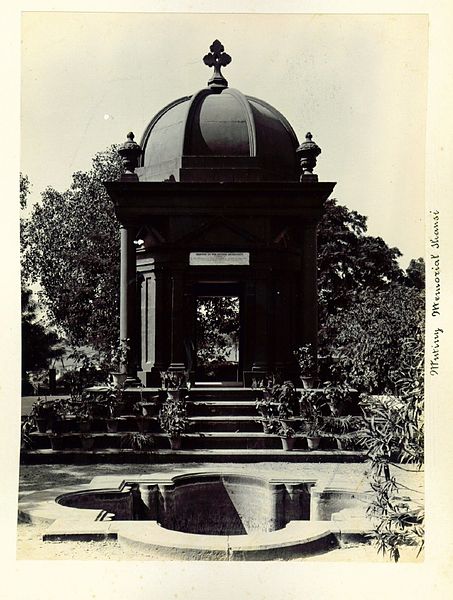
Jhansi
Those killed at Jhansi
- Mr. T. Andrews, Principal Sadr Amin. Jhansi
- Mr. Robert Andrews, Collector and Magistrate, Mrs. Andrews and four children
- Mr. Bennett, Sub-Assistant Revenue Surveyor
- Mr. D.T. Blyth, Asst. Revenue Surveyor, Mrs. Blyth, her mother and four children
- Mrs. Browne, wife of Captain Browne, Deputy Commissioner at Jalaun, one child
Miss Browne, sister. They had been sent to Jhansi for their safety. Captain Browne would make his escape to Hamirpur and eventually join Havelock’s camp at Cawnpore. - Lieutenant Francis Jaques Burgess, Revenue Surveyor, Bundelkhand, son of F. Burgess, barrister-at-law and Chief Commissioner of Police for Birmingham. Born in 1822, he joined the service in 1842.
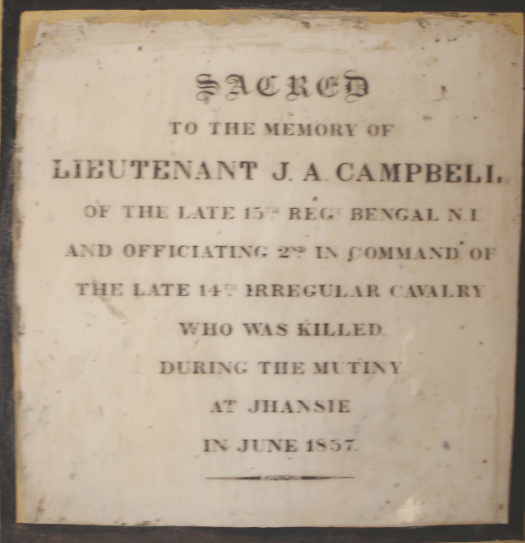
- Lieutenant J. A. Campbell, Commanding Detachment of Irregular Cavalry – killed on the 5th of June
- Mr. William Samuel Carshore, Collector of Customs, aged 55
- Mrs. Mary Jane Franklin Seyers Carshore aged 28 and four children. Mary Seyers was born in Calcutta, the daughter of Thomas Seyers, an apothecary. She had spent her whole life in Bengal and the North West Provinces, mostly schooled at home. In 1850, she married William Carshore, 15 years her senior, the son of an indigo planter. Mary left behind a book of poetry in which she stated, writing of herself in the third person, ‘cannot boast an extensive or intimate acquaintance with the literature of the West, and her only object in publishing the following tales and songs has been, to give a more correct idea of native customs and manners, than she has yet observed Europeans to possess’. She only published one book of verse in 1855, called Songs of the East.
- Arthur Carshore, aged 4 – the little boy who begged for his life
- Herbert Carshore, aged 8 months
- Violet Carshore, aged 2
- Clara Carshore aged 3
- Captain Dunlop, 12th B.N.I., commanding at Jhnasi
- Mr. D.G. Elliott, Clerk, Deputy Comissioner’s Office, with his mother and father
- Mr. Fleming, killed in Jhansi. He was discovered hiding in an Indian clerk’s home, dragged outside and killed.
- Mr. Gabriel
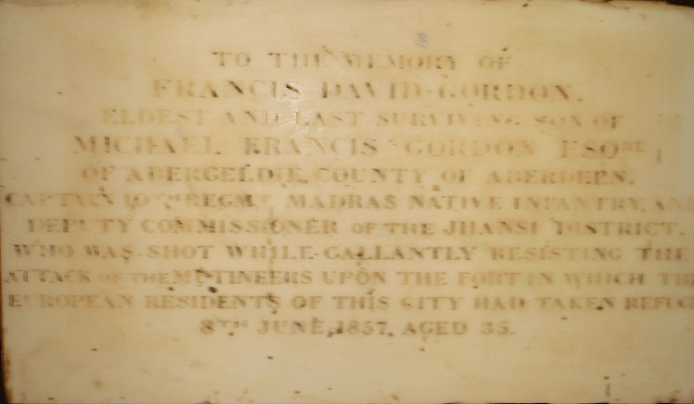
- Captain Francis David Gordon, 10th Madras N.I., Deputy Comissioner Jhansi, aged 35. Eldest and last surviving son of Michael Francis Gordon, Esq, of Abergeldie, County of Aberdeen. Born in 1821, he was a descendent of Sir Alexander Gordon, second son of the 1st Earl of Huntley.
- Dr. McEgan, wife and sister
- Sergeant H. Millard, Sub-Assistant Revenue Surveyor, wife and three children
- Mr. Munrow, Sub-Assistant Revenue Surveyor
- Mr. Mutlow, Clerk, Superintendent’s Office
- Mr. Mutlow, brother of above
- Mr Newton, Quartermaster-Sergeant, wife and 2 children
- Mr. Orr, Superintendent of Customs, wife, and mother
- Mr. Palfreyman, Apprentice
- Mr. G. Purcell, Clerk, Head Clerk, Superintendent’s Office
- Mr. J. Purcell, Clerk, Deputy Commissioner’s Office
- Lieutenant Powys, Irrigation, Mrs. Powys and one child
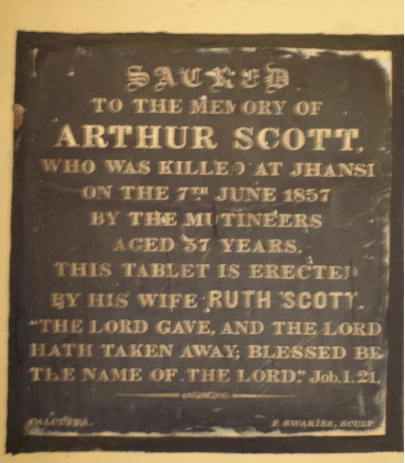
- Mr. Arthur Scott, Head Clerk, Deputy Commissioner’s Office, husband of Ruth Scott who was not at Jhansi
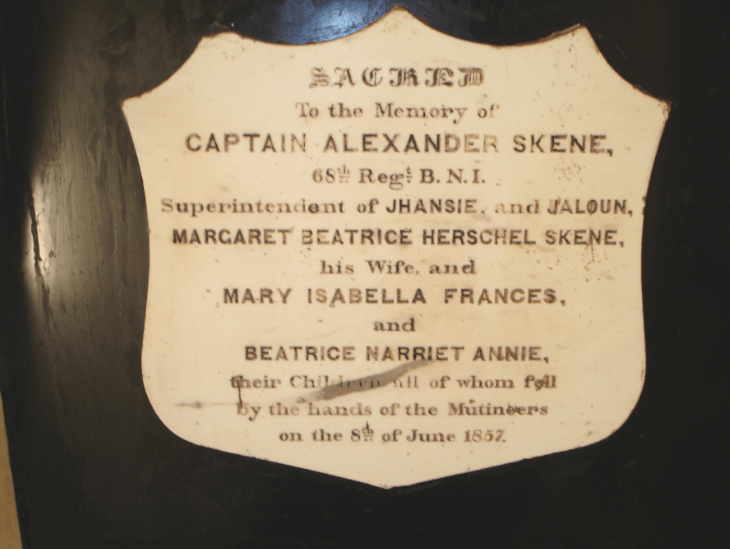
- Captain Alexander Skene, Superintendent. Son of Dr. C. Skene, born 1817 in Aberdeen. He joined the service in 1837.
- Mrs Margaret Herschel Cumberledge Skene, born 1834, and 2 daughters
- Mary Isabella Skene, born 29th July ,1854
- Beatrice Harriet Annie Skene, born 11th December, 1855
- Ensign S.B. Taylor, 12th BNI.
- Lieutenant Turnbull, Assistant Revenue Surveyor, Bundelkhand – – killed on the 5th of June. ” So warm-hearted and anxious to do good..” He had been with his brothers shortly before the mutiny broke out, and had hastened to return to his post at Jhansi.
- Mr. J. Young, Sub-Assistant Revenue Surveyor, Mrs. Young
- Mr. G. Young, Apprentice
- Mr D.C. Wilton (or Wetton or Winton), Patrol, Mrs Wilton and one child
- 2 sisters of Mrs. Wilton
Mssrs. Andrews, Scott and both Purcells had left the fort on the 7th in disguise, hoping to get an interview with the Rani. They were denied an audience and killed outside the palace.
THOSE WHO ESCAPED
Mrs Mutlow and her two children – although they were present in the fort when the party surrendered, as Anglo-Indians, Mrs Mutlow was able to disappear into the crowd of onlookers with her children.
Lieutenant W.C.L. Ryves, 12th BNI. He was on detachment with the corps, sent out from Nowgong, when they mutinied. His party robbed him and forced Ryves to march with them towards Jhansi – however he seized an opportunity and rode off at full speed, throwing off his pursuers. Ryves made his way to Agra via Gwalior and thus to safety.
- Mr. Crawford, clerk
- Sergeant Ryley or Reilly, Overseer, Public Works – escaped
Crawford and Reilly, both Anglo Indians, escaped from the Fort on the 7th. Crawford went towards Samthar and Cawnpore, while Reilly went to Burwa Saugor.
Mr. Newton and family – this is a mystery. According to Scot, they escaped the final massacre and eventually reported themselves to the 3rd Europeans, however, their names are listed on the memorial at Jhansi. We can only hope, for the sake of life, the memorial in this case, is wrong.
 Mutiny Reflections