Here is Christina Rossetti’s Indian Mutiny poem, first published in her Goblin Market and Other Poems (1862):
In the Round Tower at Jhansi
June 8, 1857, Christina Rossetti
A hundred, a thousand to one; even so;
Not a hope in the world remained:
The swarming howling wretches below
Gained and gained and gained.
Skene looked at his pale young wife:?
'Is the time come?' 'The time is come!'?
Young, strong, and so full of life:
The agony struck them dumb.
Close his arm about her now,
Close her cheek to his,
Close the pistol to her brow?
God forgive them this!
'Will it hurt much?' 'No, mine own:
I wish I could bear the pang for both.'
'I wish I could bear the pang alone:
Courage, dear, I am not loth.'
Kiss and kiss: 'It is not pain
Thus to kiss and die.
One kiss more.'?'And yet one again?
'Good-bye.'?' Good-bye.'
A footnote appeared in 1875: ‘I retain this little poem, not as historically accurate, but as written and published before I heard the supposed facts of its first verse contradicted.”
Rossetti wrote the poem in September 1857 and was probably inspired what she had read either in the Illustrated London News or in the Times, before the Times revised their version of events.
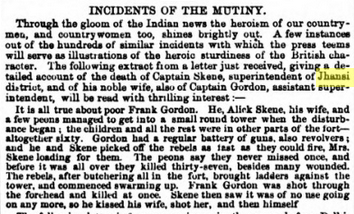
However, this account was soon contradicted by a number of other eyewitness accounts, and on September 11, the Times printed a new letter, with some corroboration from surrounding letters, reporting that Skene, his wife, and the other Europeans had surrendered and voluntarily left the fort, under assurances of safe passage. They were subsequently all killed, according to these new accounts, “by the sword.” She chose to go with it anyway – and published her poem in 1859 and reprinted it, in 1862 with an extra stanza, in the volume “Goblin Market and Other Poems.”
I will not present you, dear readers, with a dissertation on the merits of and the obvious untruths of Rossetti’s poem. However, it does further prove yet another instance of stories, already quite horrible, being given a sheen of romanticism which they hardly deserve. As a poem, I will let it stand as it is and in my heart, it is the end I can imagine the Skenes themselves would have preferred. Their deaths were anything but so picturesque. Why it took Rossetti 13 years to write a footnote is somewhat befuddling but perhaps she was so far removed from the level plain to be concerned with earthly truths? At least she did not try to convince anyone her poem was true though she still speaks of “supposed facts.”
The events at Jhansi are, even in this century, much disputed and by presenting them here, with this humble effort, I would like to stress to my readers that I am taking a non-partisan stance. The discussion of whether Lakshmi Bhai was coerced or a willing participant, a saint or a sinner, is not my objective. It can be discussed until every side shouts themselves hoarse and there would still be no definitive answer. I will not entertain anyone who wants to portray her as the pan-ultimate heroine, yet in the same vein, to vilify her as a demon. We must always look back at the times before anointing anyone with lofty titles. We will never know her true motivations, but suffice to say, her actions had very unpleasant consequences for a rather large group of people, and the repercussions were still being felt long after the massacre at Jhansi.
 Mutiny Reflections