Events at Jhansi 1st to the 8th of June, 1857
The Mutiny at Jhansi reads, from beginning to the end, like some terrible, slow motion unravelling of a grotesque horror show. Any number of learned writers can put their own spin on it – I choose, in this case, to let the witnesses speak.
The ruler of Jhansi, Gangadhar Rao died in 1853 with no natural heir; his adoptive son, Danodar Rao
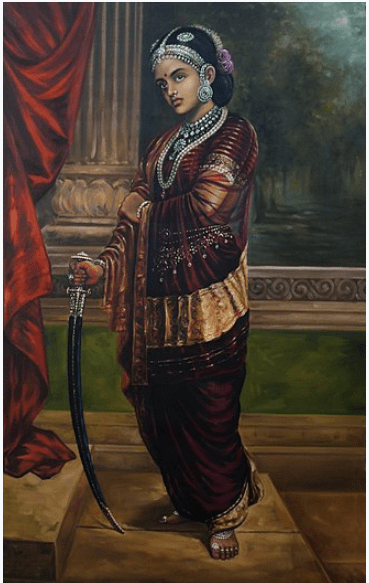
(adopted in 1851) was denied his right of succession. Gangadhar Rao’s wife, the energetic Rani of Jhansi, Lakshmibhai, sent appeal after appeal to the EICo but with no effect. She was accorded a pension of 60’000 pounds per annum, permitted to live in the palace, while being placed outside the jurisdiction of EICo courts and police. The troops at Jhansi were dismissed, and sepoys of the left wing of the 12th BNI were deployed to garrison the fort.

He died at Indore in 1906.
Only aged 41, Captain Alexander Skene, political agent at Jhansi, was not particularly worried when news reached him of the outbreak at Meerut. He had complete confidence in his men, and there was the Rani. He simply refused to believe that anything was wrong in Jhansi. Not that he hadn’t been warned – in May, a report reached Captain Skene that the Rani was very much in league with the troops and was planning treachery. However, when the Rani asked Skene’s permission to raise a troop for her own defence, he did not object.
On the 1st of June, one of the signs of mutiny appeared – arson. Some officers bungalows were burnt to the ground – Captain Dunlop, the commander at Jhansi, wrote it off as an accident. Pre-monsoon India is hot and dry and bungalows with thatched roofs could just quite suddenly catch fire? Two days previously, some sepoys had seized the Star Fort which housed not only the treasury but the magazine. However, the rest of the troops still appeared loyal, even though appearances could be deceptive, and as part of the 12th BNI and a squadron of the 14th Cavalry rose up in mutiny, Captain Dunlop and two other officers were shot dead on the 5th of June.
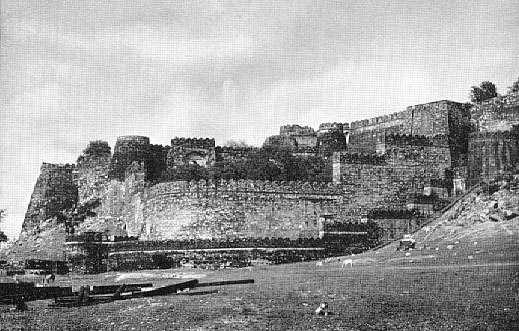
Suddenly it seemed as if the time had come to actually do something – Captain Skene ordered the rest of the British and Eurasians to take refuge in the town fort and only now, in vainly prepared to defend themselves. Here they stayed until the 8th.
Gordon sent messages to the chiefs of Datia, Tehri and Gursarai, all of whom had professed their loyalty. When no help came, he then tried to elicit aid from the tehsildar of Jhansi and several Thakurs. Once again, he was met with silence. A force from nearby Nagong was thwarted in their effort to provide relief to Jhansi. It became rapidly clear to Skene that no one was coming. His only hope now lay with the Rani.
His own orderly, Sahibuddin, gave the following statement in 1858:
“I have been in Major Skene’s service for the last three years. On the 5th of June, about 3 p.m., muskets were fired near the magazine, and a loud cry was raised that the dacoits had attacked the station. Major Skene came to his house from his cutcherry and, placing his wife and children and Miss Brown in the carriage of Captain Burgess, who had come to see him, sent them all to the fort with Captain Burgess. In the meantime he ordered his carriage, which being brought to him, he drove to the Jokhun Bagh, where Mr. Gordon met him. He was also taken into the carriage. Both these gentlemen went to the fort. I remained at the bungalow. I had sent the mussalchee and khitmutgar to the fort. At 7 p.m., having dressed dinner, the cook and I went to the fort. All the officers that were present dined together. During the night, I remained in the fort. Ahmed Hossein, tahsildar of Jhansie, the next morning came to see Major Skene in the fort. I told him to send us coals, wood, fowls, and eggs. He did so. He also sent some men, seven or eight in number, with sweetmeats; breakfast was then served. Memsahib and Mr. Gordon asked for tiffin without delay. There was no khitmutgar present, all had gone to the bungalow.
I, Dildar chaprassi, and Captain Brown’s khitmutgar assisted in serving the tiffin, which being done, the superintendent ordered me to remove all the silver from the fort to Akheychund treasurer but to keep as much as was required. I obeyed his orders and packed up all the things in two boxes, which I, in company with Mungul Khan and Khodabux, chaprassis, took to the house of the treasurer, While I was leaving the fort, Mr. Gordon called me back, and impressed upon me the necessity of making some arrangement that they might be put to no trouble for their meats. I went to the treasurer, gave him the two boxes, and told him to examine the contents, which he refused to do, stating that there was no need for that. I locked up the boxes, keeping the keys in my possession.
I went towards the bungalow, taking with me some rice, potatoes, two sheep, and four geese. Gholam Mahomed chaprassi was with me. On reaching Ashan Allee Sheristadar’s house, we heard a loud noise and firing of guns. It was about 2 o’clock. Near the city gateway, we saw that the Adjutant was galloping hard, and two sowars were following him. The Adjutant dismounted and went into the city through the wicket. The sowars took his horse and, pelting and kicking us, told us that we were going to feed the officers. We were arrested and taken to the kotee. Our houses were plundered. The sowars and the sepoys went to the jail and liberated the prisoners, who set fire to the bungalow of Andrews. A few sowars, prisoners, jail burkundauzes, and men from the town, both Hindoos and Mahomedans, commenced plundering the house of the superintendent.
I and Bissram Sirdar taking advantage of this opportunity ran to the garden, Busis Allee, jail daroga, made his burkundauzes carry two boxes from the superintendent’s bungalow to his house, The same day some other boxes were carried off by Moroo Bulwant alias Mama Sahib, Ranee’s father; Goolzar Khan, jail burkundauze, took three bullocks and one cow. This man with his followers came to the garden, asked the gardener where we lay concealed. He pointed out our hiding place. Goolzar Khan caught me; his two men drew swords and pointed their muskets towards us asking where was Major Skene’s treasure. I told him that the money was always kept in the treasury, which was plundered. They then took all I had on my body. The sirdar was then plundered of all his wife’s ornaments that he had with him at the time. I was then set free; I remained in the same garden.
On the morning of the 7th of June, I went towards the fort with two bottles of milk and four loaves of bread. I remained outside the fort near a hay rick. Mr. Gordon, who was walking on the fort wall, saw me, Major Skene also came to the same spot; they dropped a rope to which I tied the loaves and the bottles of milk. I at the same time, informed him that the house was plundered. I was told that I could not get access to the fort, but that I should try if I could furnish them with provision in the same way, While returning from the fort I was arrested by Choonee, a relative of Jharoo Koar, and some other men from the town whom I can recognise, but whose names I do not know, and was taken to Mama Sahib, because I had supplied the officers with food. Mama Sahib ordered his men to take me to Jemadar Lall Bahadoor and the ressaldar to be murdered or to be blown from a gun. The jemadar and the ressaldar first ordered me to be shot, then they recalled their order and kept me confined.“
It was a small, and sadly pathetic force, made up of 55 people including many women and children: only four of the men were soldiers or had had any military experience at all. They had nothing but ill-luck in abundance.
“The sowars there severely wounded with pistols or carbines Lieutenant Campbell of the 15th Native Infantry, the only officer present with the 14th Irregulars. He escaped to the city fort pursued by sowars, some of whom were wounded by the officers inside it. Lieutenant Turnbull of the artillery employed in the revenue survey failed to reach the fort. I suppose he was on foot; he took refuge in a tree, he was seen to climb it, and was shot down. Lieutenant Burgess of the revenue survey department and some of his English and Eurasian subordinates had been living for sometime in the city fort. On the evening of the 4th of June he was joined by Major Skene, his wife (and I believe two children); Captain Gordon, Madras Native Infantry; Dr. McEgan, 12th Native Infantry, and his wife; Lieutenant Powys, 6th Native Infantry, canal department, and his wife and child; two ladies from Orai, relatives or guests to Captain Browne; and the English and Eurasian employees in the civil and canal department and salt excise.
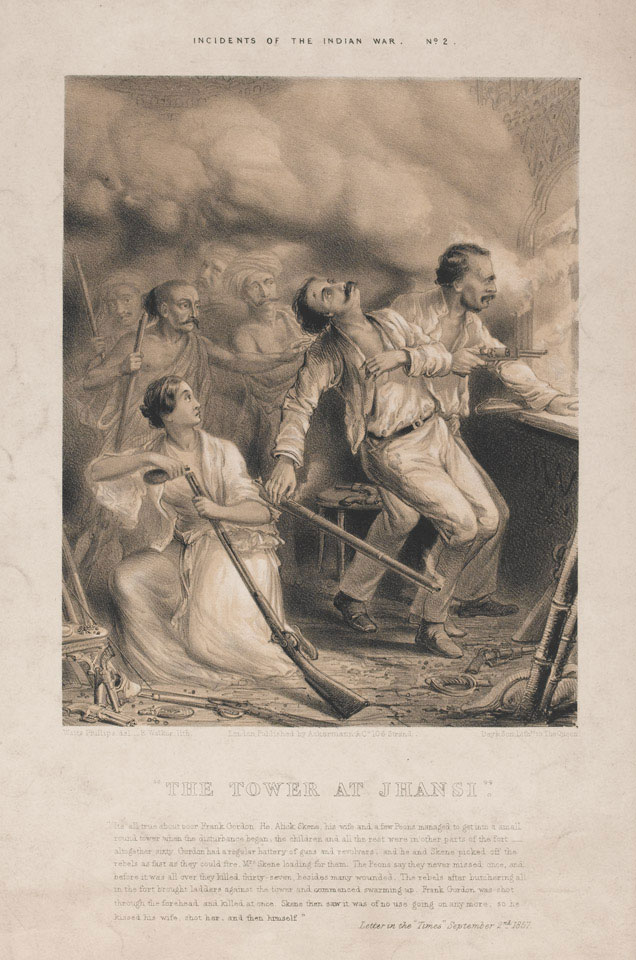
They employed their time until they were attacked on the 7th in getting provisions and ammunition, and fire-arms into the fort; they piled stones behind the gates to prevent their being opened. They appear to have made great havoc among the assailants with rifles and guns, only one of their number being killed by those outside Captain Gordon; he was shot through the head when he exposed himself at the parapet. A native who was in the fort said he was kneeling over pulling up a bucket, some syce in the lower enclosure had filled with wheat. A native who was in the city at the time said he was firing at the assailants, but both agreed that he (Captain Gordon) was shot in the head when exposing himself at the parapet; they all agreed that Lieutenant Powys was killed by Mussulmans inside the fort.
The native who was inside the fort says that Lieutenant Powys was found by Captain Burgess and others lying bleeding from a wound in the neck, and was able to say that four men beside him had attacked him; the four were immediately put to death, one was a ressaldar (?) moonshee, another a jemadar, and two chaprassis: all four were employed in the revenue survey; the informant who was in the city said that Lieutenant Powys saw a khitmutgar of Captain Burgess attempt to pull down the stones that closed the fort gates and shot him, that this man’s brother cut Lieutenant Powys down with his tulwar, and was instantly shot down by Lieutenant Burgess.” (P.G. Scot)
Interestingly enough, the Skene’s vakil had a different account of Captain Gordon’s death – “after making a most gallant resistance, finding the place no longer defensible, and preferring death to surrender, shot himself through the head, putting the muzzle under his chin and pulling the trigger with his toes…”
On the 8th of June, the sepoys offered to bargain with Skene – the lives of the besieged in return for the fort. They were given an offer of safe passage and would allow Skene and his party to leave unmolested if they laid down their arms. Sceptical, Skene demanded a letter from Rani herself. Mrs. Mutlow, a pregnant Eurasian woman who, with her small son, would be one of the only survivors of the fort, gave the following statement about the capitulation:
“..that regiment subadar wrote to Captain Skene to come out of the fort, saying, ‘We will not kill any of you, we will send you all to your own country’ so Captain Scene wrote to the Ranee to tell the sepoys to take their oath and to sign her name on the letter. All the Hindoos took their oath, “If any of us touch your people just as we eat beef;” and those Mussulmans took their oath, “if any of us touch you just as we eat pork;” and the Ranee signed her name on the top of the letter, and it was given to Captain Skene. As soon as he read the note everyone was agreed to it..”
Oaths Mean Little
Oaths mean little to men whose will is set to treachery.
The party left the fort – and with no hesitation on the part of the sepoys, were immediately taken prisoner. Shahibuddin continues:
” About 4 or 5 p.m., it was reported that the officers were coming down from the fort. I also went to the gateway. When my master with memsahib and other officers came down, I saluted him and could not help weeping. The sowars and sepoys pelted us with stones and obliged us to separate. All the officers went to one side, and their servants joined me. The mutinous sepoys and Ranee’s men took the officers to the Jokhun Bagh, and all the servants, including myself, were sent to the pultun. The ladies and officers were murdered near the garden. All the people of the town were with the sepoys. After perpetrating this inhuman deed, Bukish Ally, the jail daroga, sowar, sepoys, and the Ranee went to the pultun to the ressaldar. Bukish Ally observed that he had killed the burra sahib with one stroke.
Then the subadar, the ressaldar, and the Ranee’s men came to the parade ground and ordered that the prisoners should be set free. We were, in consequence, liberated. The next morning, I went to the garden of Jokhun Bagh and saw that the bodies of the officers, ladies, and children were lying unburied, without clothes. The third day, I was told that the bodies were buried in a pit, but by whom is not exactly known; when I had gone to see the dead bodies, I wrapped memsahib in a piece of cloth which was tied to my head. One day before the murder of the officers, it was proclaimed in the town by the beat of drum that “the country belonged to the king, the Ranee held the rule, and that the officers will be killed tomorrow.” After the murder, no proclamation was issued.”
Mrs. Mutlow and her children owed their survival to being able to slip away, unnoticed. She left a statement of her escape.
“As we came out of the fort, the sepoys came and put their guard around them. I was out of the guard with my ayah; they did not take notice of me. I told my ayah to take me to her house; she said they would kill her; she brought and left me in the Jokhun Bagh, where a Hindoo grave is made like a house. I remained there about a month. I gave my earring to that gardener to get something for me to eat; he brought chunna flour and made rotie, so I lived on mowah and chunna for some time, and Dowlutram came from Saugor and heard of me; he came to me that very evening, and prepared everything for me, and saved me from those sowars who came from Saugor. From the month of July this man gave me to eat; he used to get me wheat and rice, ghee, and when not able to go to the bazar, he used to give me ready money, and he gave me a female to do every business for me, and used to give her a rupee per month and four annas for house rent every month; and I sent Dowlutram twice to Saugor; he was caught twice on the road; those letters came to Jhansie to the Ranee, and she was looking out for me and Dowlutram. So Dowlutram hid himself and me and two children. “
Mrs. Mutlow remained in hiding with her children, finally writing, “I suffered a great deal in this Jhansie, lost my husband and brother-in-law, and all my property, and turned as a beggar, only to save my two children. Now its master’s will to do some good for me and two children. I have no one in this world just now, except master. I have one sister in Rangoon in the 84th regiment, Mrs. Susan Leary, and one sister was in Nagode in the 3rd Native Infantry, Mrs. Agnes W. Karard. But l don’t know where they are now. My father-in-law and mother-in-law is in Vellore, Queen’s pensioner, Mr. Mark Mutlow.”
 Mutiny Reflections