Sirsa, May 29th, 1857
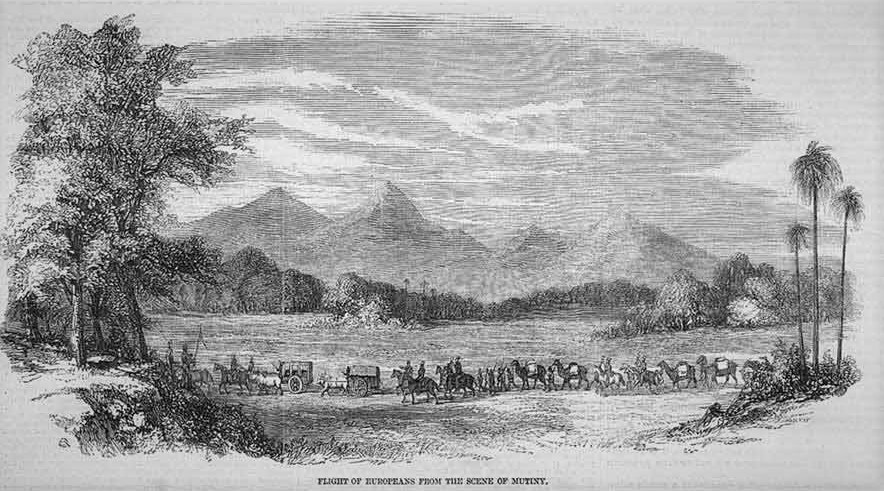
Excerpts from the narrative of Dr. P.A. Minas.
“On the 29th of May, about 4000 budmashes collected at a neighbouring village, for plundering Futteabad. It was considered advisable by Capt. R. Robertson, superintendent of Bhutteeana, that a small military force should be sent out for the protection of the same; under the command of Lieut. T.H. Hilliard, a company of Hurrianah light infantry battalion and fifty sowars belonging to the detachment of the 4th irregular cavalry were accordingly sent out. They marched at 1 am on the 30th of May. At about 5 a.m. of the same day two letters were brought, one for the subadar of H.L. infantry battalion, the other for the rissildar of the 4th irregular cavalry, by two camel sowars from Hissar, containing information of the massacre, of the native infantry regiments and Jhujjur troopers, of all the European inhabitants of Hansi and Hissar, and urging these men at Sirsa to adopt the same course. The treasurer of Sirsa – Futteh Chand Khazanche – immediately afterwards confirmed the dreadful news by cossid from his brother in Hissar.”
With such worrying news at hand, it was deemed prudent to send the women and children as far away from Sirsa as time allowed. The village of Sohuwalla was decided upon, some ten miles distant. Thus unencumbered, the gentlemen resolved to stay behind.
“When however, the infantry had taken possession of the treasury, the troopers were preparing for an attack – although it was until then believed, that the greater portion of the latter with the native officers were “staunch to the backbone” – and a large number body of customs peons, who were brought in by the collector of customs, for the protection of the town, refused to open the gates. By 9 a.m., the gentlemen considered it prudent to fly for safety, and this was affected by leaping over a ditch which was more than half full of water, the only safe outlet, and they afterwards joined members of their families who were anxiously and impatiently waiting for them.”
At this junction, Captain Robertson bundled his family together and they fled in the direction of Fazilka, only to face immeasurable danger from pursuit and attacks – they persisted for 40 miles after which it became obvious they would be unable to reach their planned destination. Robertson turned off to Ferozepore instead.
The rest of the fugitives, some 20 in number, decided their best hope lay in reaching the territory of the Patiala Raja, little realising what their flight would entail. The news from Sirsa was hardly encouraging as “a detachment of cavalry had left Sirsa, in pursuit of Europeans in different directions; and that the customs peons were plundering the town. The men of the police battalion – or jail guards – joined them, after setting the prisoners free.” It was with no little haste they left Sohuwalla.
Leading the party was Mr. Donald the assistant superintendent. His intention had been to make as swift an escape as possible and he struck out with haste towards Patiala. Perhaps, in hindsight, they might have considered leaving some of the property behind. The cart of Mrs. Bowles things could not keep up with the pace and was summarily plundered at the first opportunity by villagers at the first village they passed through. Without stopping, Mr. Donald urged his party onwards – but by 2 a.m., on passing another village, the inhabitants “came out yelling and screaming, they followed us for upwards of 2 miles, but retired when a few random shots were fired at them.” At 3.30 in the morning, exhausted, the party reached Rori “where at first the lumbardars, police establishments and other villagers gave every assurance of safety, but as the day began to advance, they began to change their tone very rapidly. By 3 p.m., preparations were being made by them for attacking us. At 5 p.m., these horrible scoundrels surrounded us on every side; they were armed mostly with very long spears, gandasses &c.“
Mr. Donald had not been so naive as to believe his luck would hold. Having sensed the villagers were becoming surly, he had quickly purchased whatever gunpowder he could find from a local shopkeeper.
It was further in their fortunes that Rori had an old mud fort – though not a perfectly defendable position, it had high, loop-holed walls and large bastions. Hastening inside, they closed the gates – only to realise that while they had gunpowder (and the villagers had none), they had neither a well for water inside nor brought in any food. It could have ended here for Mr. Donald and his party, but friends can be found in strange places, and one Baba Janki Das, a local fakir, brought them the supplies of water and flour under cover of darkness, slipping the provisions under the fort gates. (In Dr.Minas’ account, the party had purchased the provisions themselves, and there is no mention of a fakir, however, I will leave both scenarios as possibility) Mr. Donald was able to get a letter off to the vakeel of the Patiala Raja at his fort in Dhoodal, imploring for help.
“It is curious to remark that seeing the determination of the villagers, the whole of the police establishment deserted us, except Bejoo Singh, the thanadar, with whom four or five persons remained faithful, and who by his courage, watchfulness and activity, kept the whole mob at a distance. To his vigilance and adherence, we owe our escape from this place.”
On the 2nd of June, their letter was answered by the arrival of 100 horsemen sent by the Patiala Raja’s vakeel. It would take another 8 days to reach Patiala -“where, thanks to the kindness of the Maha Rajah, we were allowed to put in that spacious garden, built by his father, called Bara-Dwaree. He treated us sumptuously and generously; his reception of us was friendly, and his manner, when he visited us, was extremely courteous…For about a fortnight, we enjoyed the hospitality and protection of the Maha Rajah. All the ladies were sent from hence to Kussowlie, and the gentlemen returned to Sirsa on the morning of the 30th of June.” Dr. Minas and the others had been lucky and fortune had smiled on them.
Not so for Lieutenant Hilliard.
We had left him, on the 29th of May, riding out with his detachment to deal with the reports of suspected plundering. At the village of Jodhka, Lieutenant Hilliard called for a halt so he could see Mr. J. Goulding of the customs patrol of the place. While gathering information, he was joined by his brother-in-law, Mr. Fell of the Durbee assistant patrol.
It was Subadar Ranjit Singh however, who told Lieutenant Hilliard that Sirsa was up in arms – news of which caused Hilliard to gather up his detachment and proceed back to the station, Mr. Fell accompanying them. Respectful to the last would be the same subadar, as night began to fall, would present the two men with Rs. 150 and desire them to “go where ever they wished.”
Leaving the detachment, as there was obviously no use trying to change their minds from mutiny, Hilliard and Fell naturally made their way to Sohuwalla, unaware their families were no longer there. “…but being late, they enquired which direction they had gone to, and where they intended to follow, but a demon son of lumberdar of Chuttereeah (Chatryan) persuaded them to pass by his village, where they were cruelly murdered by the infamous mob collected there.”
With both civil and military gone, Sirsa fell into anarchy. “The district villages created unheard of mischief; after plundering the houses of the European residents, they ransacked the town of Sirsa and ultimately commenced fighting amongst themselves. For about seventeen days, groups of villagers visited this and carried off cartloads of plundered property, not a single fold of a door, posts &c., was left untouched…On our return, no trace of any living being was to be seen at Sirsa, its city deserted and homes tenantless. The compounds of our houses were spangled with relics of broken glasses and plates, the remains of our fractured house gear, and within the houses nothing remained, save bare walls.” To avoid the fighting, those residents who could fled to Bikaner. The tahsildar of Sirsa, the local revenue collector and the Kotwali were all murdered by the mob.
Names of Those Who Perished
Hansi
Mrs. Mary Anne Milne, (wife of Major Milne), and her two children, Emily and James. Murdered in the Sikandarbagh (Skinner’s Garden)
Sergeant Fitzpatrick, overseer Canal Department and child
Mrs. Malllowe (Malone) and two children
Mr. Joseph Williams, Superintendent of Customs, and daughter
Murdered on the road to Hissar
Sergeant-Major Murphy, Haryana Light Infantry, killed near Mungalee
Mr. John Paul, HEICo Civil Service, son of Lt. General Paul. His wife, Jane and their six children, Anny, Letitia, Alice, Agnes Thomas and Evelyn. Murdered in Sartoy, ten miles from Hansi.
Hissar
John Wedderburn, Collector and Magistrate, wife Alice and son John James
Lieutenant E.W. Barwell, Adjutant Haryana Light Infantry and wife, Margaret
Mrs. Phoebe Hallet, wife of Mr. J.E. Hallet, Customs Department
Mrs. Mary Anne Smith, aged 31, wife of E.C. Smith, 2nd Clerk, Collectors Office, and 5 children
William Edwin John, aged 12
Henry Edward, aged 10
Thomas George, aged 7
James Charles, aged 5
Anne Margaret, aged 7 months and 23 days
Mrs. Jeffries, wife of Mr. Jefferies, Head Clerk, Collectors Office
Mr. David Thompson, Tuhseeldar, brother of Mrs. Hallet
Sirsa
Lieutenant J.H. Hilliard, second in command, Haryana Battalion
Mr. J.W. Fell, Assistant Patrol, Customs Department
Murdered on the 30th of May at Chartryan, Sirsa District
Names of Those Who Escaped
Hansi
Captain William J. Fitzmaurice Stafford, wife and child
Dr. Scott
Mr. Tapsell, Collector of Customs
Mr. Vaughan and two children
Mr. Rich
Mr. Blewitt, sister-in-law and two children
Mr. Scarden, wife and three children
Mr. Warren, wife and three children
Mr. Jews
Mr. Herdon, and wife
Mr. Hickie
Mrs. Tapsell, son and daughter
Mr. A. Skinner
Hissar
Dr. Waghorn
Mr. Daniels, wife and child
Mr. Hallet
Sergeant Shields
Mr. Taylor
Mr. Jeffries
Sirsa
Mrs. Hilliard wife of Adjutant J.H. Hilliard, and infant, one week old
Mr. Wrottesley and wife
Mr. A.J.S. Donald, wife, infant and three daughters
Mr. P. Minas, wife and infant
Mr. T.W. Moore
Mr. W.H. Bowles, mother and two Misses Bowles
Sources:
Ball, Charles. The History of the Indian Mutiny. Vol. 1. London: London Printing and Publishing Co., 1912.
Chick, Noah Alfred. Annals of the Indian Rebellion. Calcutta: Sanders, Cones, and Co., 1859.
Gupta, Jugal Kishore. History of Sirsa Town. New Delhi: Atlantic Publishers & Distributors, 1991.
Kumar, Rakesh, and Sheetal Mehta. “The Uprising of 1857 in Sirsa District.” International Journal of Creative Research Thoughts 6, no. 1 (January 2018): 871–74.
List of Inscriptions on Tombs or Monuments in the Punjab, N.W. Frontier Province, Kashmir and Afghanistan. Vol. 2. Lahore: Government Press, 1910.
Muir, William. Records of the Intelligence Department of the Government of the North-West Provinces of India During the Mutiny of 1857. Edited by William Coldstream. Edinburgh: T. & T. Clark, 1902.
The Anglo-Indian Almanack. London: Indian News Office, 1858.
Wedderburn, Alexander. The Wedderburn Book: A History of the Wedderburns in the Counties of Berwick and Forfar. Vol. 1. Printed for Private Circulation, 1898.
Links:
hisar.gov.in/culture-heritage/
http://haryanaheritage.blogspot.com/search/label/1857
Lives Retold, the Short Life of John Wedderburn, http://www.livesretold.co.uk
 Mutiny Reflections