Hissar, May 29th, 1857
It was late morning on the 29th of May in Hissar when the four sowars from Hansi arrived. Their first visit was to the kutchery, which was just closing for the afternoon. The office assistants were the first to realise it was not going to be an ordinary day; as they drove off to their homes, they were fired upon. Turning their carriage around, they drove with haste back to the kutchery – Mr. John Wedderburn, the collector and magistrate, was still there, waiting for his buggy to be brought around. Heeding the warning of the assistants, he quickly retreated back towards the building, calling on the guard to protect him. Their reply was to shoot Mr. Wedderburn in the head.
The four sowars were not waiting to let the grass grow under their feet – they made their way to the Kotwali (police station), where they found and killed the tehsildar and Mr. David Thompson. It was not as straightforward as they would have liked – Mr. Thompson had had enough time to lock himself in the building, but his own peons murdered him instead.
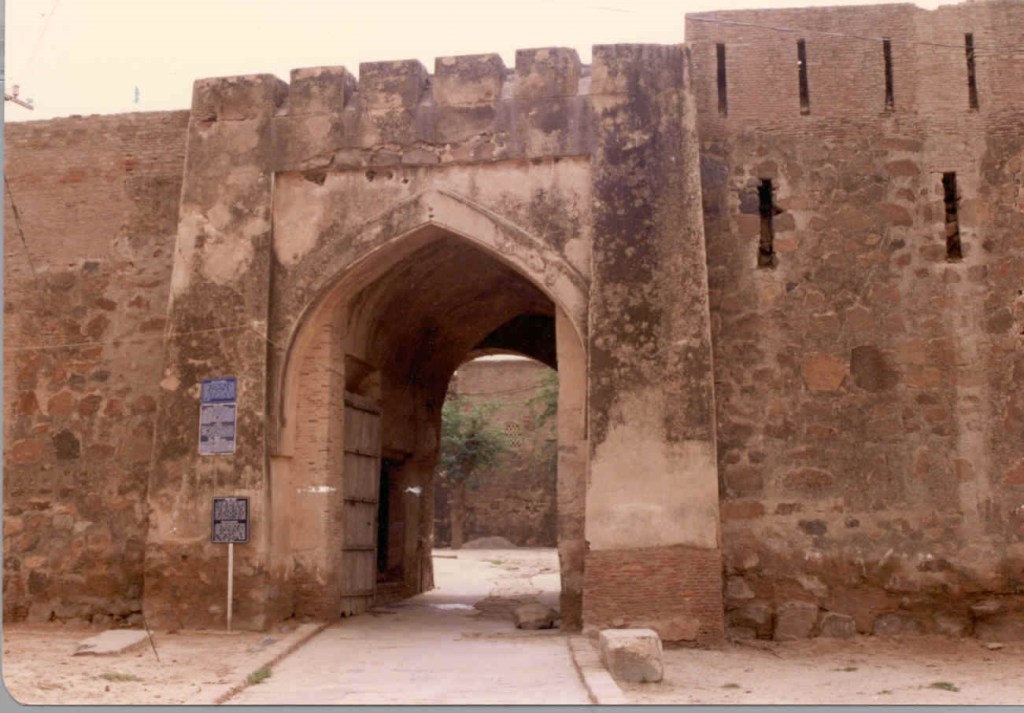
It was still only 1 p.m. By now, they had found their way to the fort – it was the encouragement the troops needed, and Hissar broke out in open mutiny.
The Narratives of Mr. Hallet and Mr. Taylor
“On the 12th of May last, the usual dak from Delhi was not received here, which caused excitement in the station, but the cause was not known. On the 13th, the news of the fall of Delhi into the hands of the mutineers and the great massacre of European lives reached Hissar. Mr. Wedderburn, Collector, transferred the treasury from its old place near the Collector’s kutchery and deposited it in the fort, and he himself left his house, which was formerly occupied by Mr. Dumergue, and used to live with his family in the fort with Mr. Taylor. The treasury was guarded by 100 sepoys of the Hurrianah Light Infantry. Lieutenant and Mrs. Barwell, Adjutant of H.L.I., stopped with Mr. Wedderburn, and eighty more sepoys came from Hansi to join the Hissar sepoys; one hundred sowars of the Nuwab of Dadree, under Shah Noor Khan Ressaldar, being picketed in the fort garden; the newly employed twenty sowars of the irregular regiment were picketed outside near the western gate of the fort. There was a guard at the tehseel as also at the kutchery. These arrangements were going on for the safety of the town and the quietness of the district till the 28th of May.
For fifteen days previous to the outbreak, neither sepoys nor chuprasees showed any signs of disaffection. These men were inside the fort avowedly for its protection. Meanwhile, a rumour gained ground that the assistant patrol at Ladwa, a Shahzada, had incited the men of the customs to revolt. Still, no change or incivility was observed.
For further security, Mr. Wedderburn obtained from the Dadree Nuwab the services of fifty sowars, who afterwards showed themselves, traitors. He also tried to raise a corps of irregular horse; about ninety men and horses were entertained, but these were of no use, as they were kept outside the fort, while the sepoys were inside with the gate locked night and day. And besides were placed on the opposite side of the fort to that from which an attack was supposed could be made.
On the morning of the 29th, the gates of the city and fort were closed, as bodies of Khanjurs had been seen concealed in the Bheer. Mr. Wedderburn went to office at 10 a.m. At about 1 p.m., Mr. Taylor and myself, who had been playing at chess, were roused by a servant rushing in to say that some Delhi sowars were outside the city gate and that Lieut. Barwell had gone down to see what was wrong. I immediately took up my pistol and went outside the verandah, calling Mrs. Hallet as I passed her room. When Mr. T. and myself got into the verandah, we saw two sowars ride up to the sentry and, after giving him some instructions turn round and dash off. Mr. T. and myself then went down to the gate, and I passed through the wicket, I then saw that Mr. Taylor had no arms and told him to get his gun. He was then inside the wicket, and on turning, a volley was fired at us, one ball striking Mr. T. in the hand, another knocking my hat off. The wicket was immediately slammed to by the sentry. On seeing the wicket closed, I entered the garden outside the fort and endeavoured to get into the house by the garden postern but found it locked.
The two sowars (Dadree) on sentry at this gate drew on me, and their comrades, who were picketed in the garden, rushed to the spot. I gave up all hope of being able to effect my entrance into the house, where I might have rescued my wife. I accordingly made for the city wall and had to shoot one sowar, which checked the others for a few minutes, during which I managed to scramble over the wall and dropped in the canal, over which I waded into a tank overgrown with rushes in which I lay concealed till 8 p.m. when I struck through the Bheer for Jheend, which I reached the day after.
I will give Mr. Taylor’s escape in his own words:—‘I ran from the gate through a volley of bullets, and thought I heard you fall close behind me, as we both turned on hearing the first shot from the guard-room. The last I saw of your poor wife was standing at the railing; she screamed as she saw a fellow jump out of the rabbit house at me with a sword. I had just time to get into the house and seize either your’s or Barwell’s sword and cut the fellow down, and going to the back of the house to get time to tie up the wounds on my left hand, from which there was a stream of blood, the brutes fired at me again from the top of the office steps, but a pillar of the verandah saved me. I was hid for three days in the Bheer near Tulwundee, came to Thaneysur in disguise, reaching the border of Puttiala, the first night came on to Umballah and joined the company of volunteers.’
Mrs. Halett had indeed been left to her fate and was murdered in her house. Her remains would never be found.
Mr. Hallet continues:
“Lieut. Barwell entered the garden two minutes after me and tried to get in by the garden gate; he was cut down by the Dadree sowars. The force in Hissar, at the time of the outbreak, was two companies, Hurrianah’s, inside the fort, ninety-six sowars of the irregular regiment we were raising, picketed outside the fort, and about eighty Dadree and Jhujjur sowars, fifty of them being picketed in the fort garden. There was a guard at the Tehseel as also at the kutcherry. The treasure (1,70,000) was in the magazine in the fort. I heard most of the particulars of the loot and massacre from the brutes who came down to bathe about twenty yards from where I was concealed. They stated that sowars were out hunting for those who had escaped, who were to be brought in to be burnt in the houses.
It appears that Serjeant Shields received notice of the outbreak at half-past eleven, he tried to get into the fort to give us the intelligence, but could not, as the gates were closed. He then went round to Dr. Waghorn’s, and they tried to get a letter in, but it never reached us. They waited till the firing had commenced and then got off with the camels.”
There were other victims.
Mrs. Mary Ann Smith, the wife of the second clerk at the Collector’s office, was at home with her five children. The sowars, on their tour of blood, were not long before they arrived at her gate. She was not slow to act; gathering up her children, she ran out the back of her house and hid herself and them in a garden, not 150 feet from their residence and waited. At the gate, the gardener told the sowars the memsahib was already at the fort, but if it would suit the men, they could plunder and burn the house instead. The answer seemed to satisfy the sowars, and they moved off. Mrs. Smith and the children might have been safe, but the human heart can be so cold.
The next visitor to seek out Mrs. Smith was a chowkidar name Bolee Bux- her husband had shown the man some good turn, saving him from starvation, and he was, if anything, in Mr. Smith’s debt. Appearing kindness itself, the poor gardener told the chowkidar where to find Mrs. Smith. After all, the chowkidar had no reason to wish her ill, proclaiming he would save her and the little children. “But his object was far otherwise. For, no sooner did he find them, than he slew everyone, not even sparing the children.”
Mrs. Jeffries, the wife of the head clerk in the Collector’s Office, was the next stop for the sowars. They at least made quick work of shooting her, but it was her servants who hacked her to pieces.
24-year-old Mrs. Alice Wedderburn and her 6-month-old son John James, with Mrs. Margeret Barwell, had been living with their husbands for some weeks in the Fort, in the house of the superintendent of the Hissar Cattle Farm. Hearing the chaos in the town, the ladies hid for some time at the top of the building. Not that it really mattered. One of the ladies, perhaps unaware of the danger they were in, was most unfortunately seen from below – they were forced down from the roof and murdered, with no mercy for the infant, their bodies thrown outside the ramparts.
In a letter to his parents, Mr. Hallet wrote,
“My dear father and mother – Through the mercy of God, I have escaped the awful fate of many of our countrymen out here. My poor Phoebe has, however, been murdered by these savages. I had heard some rumours of a rise in Delhi and left on sick leave to Hissar two days before the Delhi massacre. Mr. Thompson, Mrs. Thompson and my two sisters were murdered in Delhi and my brother-in-law in Hissar. I am quite sick of everything – my child in November (he alludes to the untimely death of his firstborn) and then my poor little wife: it is very hard. I am laid up with chronic bronchitis. It was very fearful – walking one hundred miles without a hat, in the blazing sun, and have to wade through water up to my neck. I trust I shall get over it, and then what next? When I was lying concealed in the rushes, and the sepoys were firing all round about to see if anyone was concealed in the tank, I made a vow that if I escaped, I would serve my God….I shall, as soon as this rebellion is over, save up, and as soon as I have sufficient to take me home and bring me out again, I shall come home and endeavour to be ordained by Mr. Villiars to go out as a missionary. I am a beggar now; only two shirts on my back and one hundred rupees sent me by the Lahore relief fund. Excuse more, as I have not the heart to write. Holt and Ruth are safe in the fort at Saugor. God bless you all.”
Theirs had been but a short marriage. J.E. Hallet married Phoebe M. Thompson, daughter of Reverend J.F. Thompson at Delhi on the 9th of May 1855. Mr. Hallet kept his promise and returned to India in 1859 as a missionary, but it was but a short stay – in 1860, he gave up his post and he fades out of history.
Sir John Wedderburn second baronet of Balindean, had had a long and exalted career of 30 years in the Bombay Civil Service, having arrived in India in 1807. His eldest son, John, born in Bombay on the 9th of May 1825, would follow in his father’s footsteps. After completing his education in Edinburgh at the Loretto School and the Edinburgh Academy, John graduated from Haileybury and went out to India in 1844, not to Bombay like his father but to Bengal. He quickly gained a reputation for himself as a civilian of promise, having been one of the few selected for an appointment to the newly annexed region of Punjab in 1849, first in Multan and shortly after as the Deputy Commissioner of Lahore.
After ten years, John Wedderburn went home on furlough for the first time. He was 30 years old, his career in the service was secure, and like many civilians, one of his objectives on his long leave would have been to find a wife.
John met and married Alice Bell (daughter of the late Dandeson Coates Bell of the Bombay Medical Board) in January 1856. Alice herself had been born in Bombay in 1833. Their son, John James, was born in Edinburgh on the 15th of November 1856, shortly before the happy family travelled to India. They would arrive in Hissar in the spring of 1857.
As Magistrate and Collector at Hissar, John Wedderburn would have been placed in a severely precarious position. Although bordering on the Bikaner desert, Hissar had been singled out for exceptionally high taxation under the assessment of the land revenue officials – which, considering the barrenness of the land, seems absurd. Mr. Wedderburn had the unfortunate task of demanding the taxes which were deemed due. Under such a premise, he had little chance of securing the trust of the local landlords, nor was he familiar with the people, and he had no choice but to believe in promises of fidelity pro proffered by the Haryana Infantry.
With the post becoming irregular and the news from Hansi hardly reassuring, Mr. Wedderburn did what was in his power to secure his station. Removing his family and the government treasure to the fort, Mr. Wedderburn quickly raised a regiment of irregular horse and procured 100 troopers from the Dadri chief. On the 26th of May, he wrote one of his last letters to the government secretary at Agra. He was all too aware that his position was untenable.
Hissar, Tuesday, 26th May
“Sir, — The police reports are now full of cases of petty plundering on the roads, and even on a larger scale, one village driving off a number of cattle belonging to another village, and so on. In some of these the robbers have been seized, and the police hold their own pretty well, but in others they are obliged to content themselves with recording, and taking proofs of the cases for future consideration. No confirmation of the state of things in Rohtuk yet, but the dak is stopped ; we are consulting Post towards about a reconnaissance in force with our horsemen in that direction, stopped. I am advancing money for the use of the new levies under Mr. Barwell. Nothing has reached me from Agra yet; there is a capital dak from Lahore via Gogaira, Fazilka, Sirsa to this, and Post open to I have today laid eight camels on the road to Kurnal, — thus we shall have a double line there, and the Bhewani-Seekur one besides; it is to be hoped all will not fail; letters for the Lieut. -Govr., Agra, and Mr. Secy. Edmonstone, Calcutta, were forwarded from the Punjab by to-day’s dak via Kurnal ; a second heavy despatch went by Rhewary. The C.-in-C. has ordered the 57th N.I. and remnant of the 45th to be turned out of Ferozepore without a fraction of pay; they will increase the plunderers in our rear, even if they don’t come down in a body.
It is now a fortnight since we heard of the outbreak, and a dreadful one of suspense it has been; we look for brighter tidings soon. There certainly has been something wrong at Rohtuk, tho’ by whom or to what extent still uncertain.“
The very men that Mr. Wedderburn had entrusted with the safety of Hissar proved faithless. Caught in his office building, unable to flee, Mr. Wedderburn called on the sepoys and the Dadri troopers to protect him, instead, they shot him dead. Unbeknownst to him, his wife and son would soon be dead for “Lovely in their lives, in death they were not long divided, and each was spared the agony of knowing the other’s fate.”
When Hissar was retaken, all that could be found of Mr. Wedderburn was his skull, and a few bleached bones of his wife and son. They were buried together in Hissar with the remains of the other victims of the 29th of May.
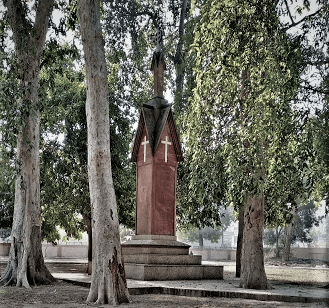
Although he may not have approved, John Wedderburn survived well into the 20th century in Hissar as a Muslim saint. The monument had been mistaken by an elderly villager as a tomb of a “pir” – and in her desperation to secure a positive outcome for her son’s upcoming criminal trial, she offered a prayer at the monument. Following her son’s acquittal, she brought offerings of wine and fruit and lit a clay lamp as thanks.

Hearing of her apparent success at the tomb of the good Pir Sahib, others soon left gifts of their own at the monument – mostly small bottles of whiskey, since such spirits would be more agreeable to an Englishman than country-made arrack, and eggs (something that apparently the British enjoy the most) all in the hope of gaining the favour of Pir John Wedderburn.
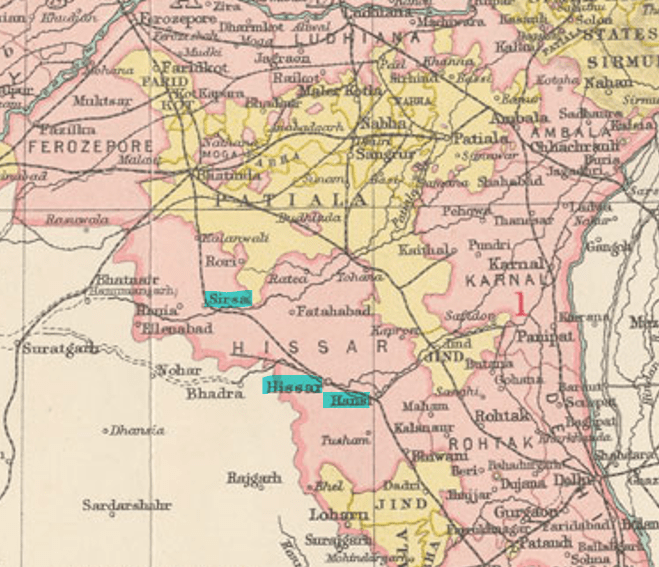
The final station to face the wrath of the mutineers would be Sirsa. Before the day was over, all semblance of Company rule would be wiped out.
 Mutiny Reflections