Seaton’s Movable Column
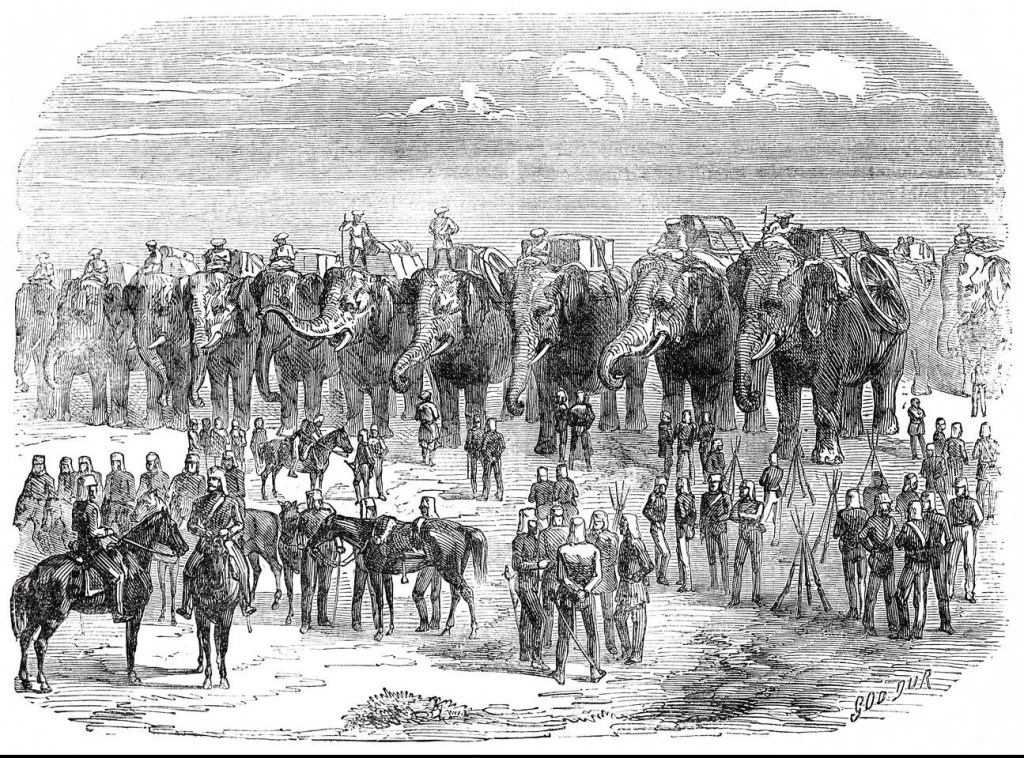
It was a considerable enterprise – he would be escorting not just grain and stores, with cattle and camp followers but an assortment of goods, from ammunition and guns to clothing and equipment, through the Doab – the country between the Ganges and the Jumna. The country was barely “settled” as the terminology of the day allowed, and his convoy was hardly inconspicuous.
He found once it had all been collected together it would consist of 80 elephants, 16’000 bullocks, 800 camels, 1500 camp followers, and 4500 carts of four or six bullocks each. The carts alone would stretch for 18 miles. The troops to escort it all were a 9-pounder field battery, three heavy guns and 2 mortars, a squadron of dragoons, two weak infantry regiments and 2 companies of sappers – in all 1900 men. When the baggage and the tents of the troops were added, Seaton estimated he could easily add another mile to his already over-extended convoy. He was expected to deliver everything to Sir Colin through a dangerous country without any knowledge of the rebel movements, but knowing full well bands of armed men were roaming through it, with infantry, cavalry and artillery. Realising the undertaking was well near impossible, Seaton decided the only way to move forward was not in one go – he would move from place to place, each time leaving the convoy under a small guard while he would take the rest of the troops in the advance to disperse whoever happened to be lurking ahead of him before moving ahead. Yet he still had a problem gathering the intelligence he would need for his plan to succeed.
His request to General Penny was a surprising one.
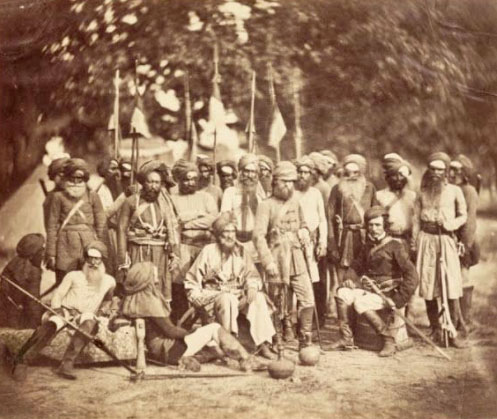
“The first and most important was that I might have Major Hodson his regiment of Horse, instead of the cavalry corps that, had been detached for that duty. “ But,” said the General, “Hodson’s corps is not so, strong as —or anything like, so well mounted.” I know that sir, quite well, but as the safety of the convoy—the whole success of the expedition—will depend mainly on getting accurate information of the enemy, I wish to have Hodson, for I know well that if any man in the world can get it he is the man. He is indefatigable—a soldier of the highest class; I have unbounded confidence in him, and would rather have him than five hundred more men.”
Following the shooting of the princes at Delhi, Hodson was not a man anyone was requesting by choice – indeed, most of the army was avoiding him. There was something of the pariah attached to his name; rumours of his dealings during the siege, his questionable actions outside the camp, and even his intelligence gathering had put him more in the league to lead “Italian banditti” rather than in the company of “honourable” men. That Seaton would want a man he sincerely liked, admired and trusted, regardless of what anyone else believed, for an impossible task, seemed to be one way of dealing with the problem of William Hodson. Penny quickly agreed. Until now Hodson had been kept busy with Brigadier Showers’ Column in the southwestern areas around Delhi but in November, he was in Ambala, waiting to see what would happen next to him and Hodson’s Horse. On the 2nd of December, he was on his way to meet his old friend, Colonel Thomas Seaton.
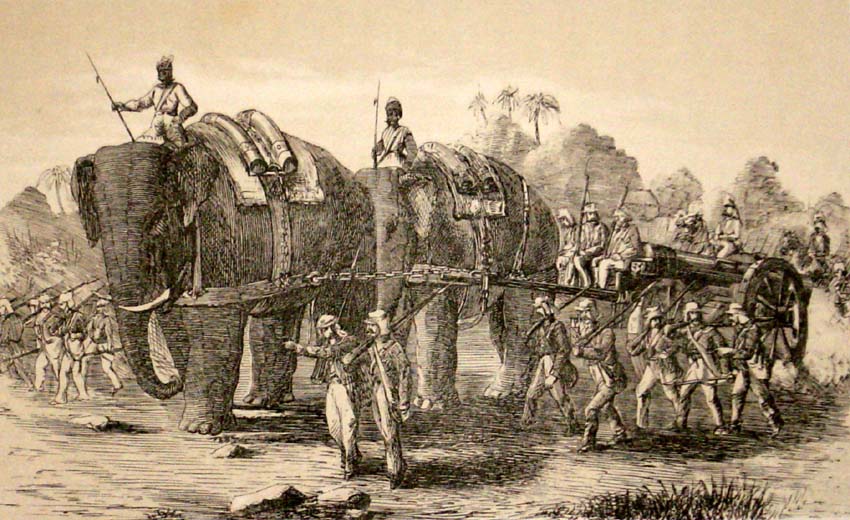
Seaton’s second request was far less outrageous – he wanted draught-gun bullocks in addition to the elephant teams for the heavy guns. While he knew elephants were at their best while dragging the guns, they were nearly impossible to handle in action. The last thing he needed was rampaging pachyderms disturbing any sudden call to fight. We shall see next just how right Seaton was.
Sources:
Behan, T. L., ed. Bulletins and Other State Intelligence for the Year 1858. Part 2. London: Harrison and Sons, 1859.
Hodson, W. S. R. Twelve Years of a Soldier’s Life in India: Being Extracts from the Letters of the Late Major W. S. R. Hodson. Edited by George H. Hodson. London: John W. Parker and Son, 1859.
Malleson, G. B. History of the Indian Mutiny, 1857–1858: Commencing from the Close of the Second Volume of Sir John Kaye’s History of the Sepoy War. Vol. 2. London: William H. Allen and Co., 1879.
Neave, E. R. Mainpuri: A Gazetteer. Vol. X of the District Gazetteers of the United Provinces of Agra and Oudh. Allahabad: Government Press, 1910.
Seaton, Thomas. From Cadet to Colonel: The Record of a Life of Active Service. 2 vols. London: Hurst and Blackett, 1866.
Trotter, Lionel J. A Leader of Light Horse: Life of Hodson of Hodson’s Horse. Edinburgh: William Blackwood and Sons, 1901.
Vibart, Edward. The Sepoy Mutiny as Seen by a Subaltern: From Delhi to Lucknow. London: Smith, Elder and Co., 1898.
“
 Mutiny Reflections