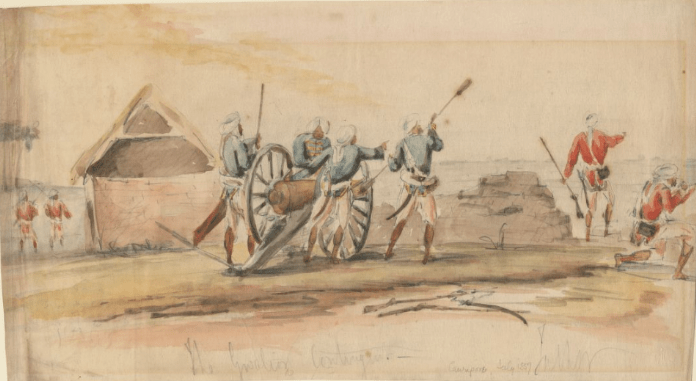
By the first week of April, Seaton had made up his mind to attack the rebels at Kankar. Considering the stifling heat, the 22 miles he was intending for his men to march in, it was certainly far enough. For the plan to work, however, Seaton needed absolute secrecy. He knew full well the rebels were sending spies into his camp with regularity, and while he tried to keep strangers away from the fort, what with the bazaar in such close proximity, it was nearly impossible to watch everyone. So he kept his plans to himself, then, on 6 April, after all visitors had been sent out of the Fort and the gates were shut tight, he called his brigade major to his rooms. He was to go around to all the commanding officers and request each one to meet him at the bridge head at 11pm with a “certain indicated number of men, plenty of ammunition and three days’ provisions.” The brigade major was so surprised by Seaton’s orders that he left without saying a word; Seaton was hoping that if that was the reaction of one man, the rebels, whom he would have to pass three miles outside Aliganj, would be equally surprised when he pounced on them at Kankar.
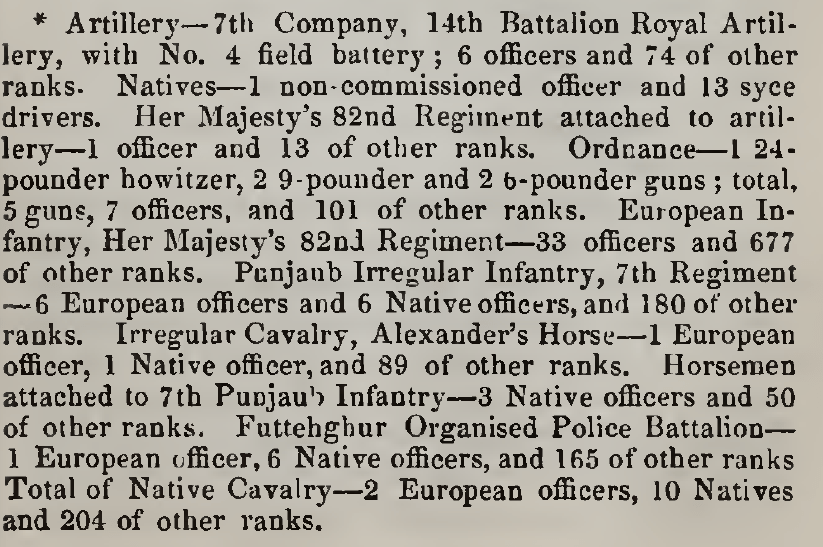
His force would consist of Major Smith’s nine-pounder battery, 600 men of the HM’s 82nd under Colonel Hale, 100 of the 7th Punjab Infantry under Captain Stafford, 350 cavalry under Lieutenants St. John and De Kantzow; Messrs Power, Vansittart and Captain Bradford made up the political office.
At exactly 11 pm, the troops, who had turned out in absolute silence and without the sound of a bugle, were assembled at the bridgehead. Then, just as quietly, they filed over the bridge – the night was tremendously hot and the road, unmetalled, choked them soon in fine dust. Riding ahead, Seaton anxiously looked out for his spies – three miles outside Aliganj, they reported the town was quiet, and the rebels suspected nothing.
After another few miles of marching, and well out of earshot of the rebels, Seaton called a halt to rest the men and horses. After an hour, they were back on the march and just as day began to break, a shot fired at Seaton’s advanced guard “announced the enemy.” Seaton formed up the 82nd into line with loosened files, with the 7th Punjabis in the second line and the artillery on his right front. The rebels who had taken it on themselves to meet Seaton on April 7 were not a rag-tag band of stragglers – they numbered no less than 800 sowars, amongst whom were 100 of the ex-Oudh Military Police Cavalry, 1800 infantry who counted in their numbers the 10th and 41st BNI, and a detachment of the Gwalior Contingent, cavalry, infantry and artillery.
The rebel position was formidable but not, in Seaton’s estimation, insurmountable. They had taken a walled grove of trees situated between two villages – on the right was low, swampy ground along the whole front of an old river bed, which then turned to Seaton’s left. As soon as they came in sight of the camp, “there was a shouting and noise in the enemy’s camp, and the hubbub and confusion were wonderful. In a few minutes, out from behind the left village, came two splendid bodies of cavalry, the finest and best mounted I had yet seen.” One of these quickly advanced to Seaton’s right, and the other swung around to his left. There was no time to lose.
Seaton called Major Smith to cover his advance on the grove and to “bestow some of his favours on the cavalry moving toward my right…” In rapid marching order, he moved quickly towards the grove of trees, directly at the rebels, who had, just as quickly, opened fire on him with three of their guns. Unfortunately, they had had little time to sight them, and Seaton’s force was now at a run – the balls flew over their heads. The rebel cavalry on the left had ridden straight into the old river bed, following the bend to the left, and obviously intended to take Seaton in the flank.
“Believing themselves perfectly safe from our fire, for their heads were not visible, they moved along leisurely, supposing that our rapid advance would soon expose our flank, when they would be down on us; but the hollow was wide, the banks shelving, and their tail spears, with bright points, showed their position distinctly as they moved along at a distance of 700 yards.”
Seaton rode up to Colonel Hale and requested him to “draw out two of his companies, the best shots” to see if he could not discomfit the cavalry. “This was speedily done, and the men, loosening their files, commenced firing calmly and deliberately, the musketry instructor having the number of yards to fire at. In a few minutes – before three rounds had been completely fired – there was terrible confusion amongst the spears; and as Colonel Hale’s hearty voice was heard encouraging his men to fire steadily with good, and deliberate aim, out bolted the whole of the cavalry as hard as they could, and were followed by our horsemen, and by shouts of derision from the whole line.”
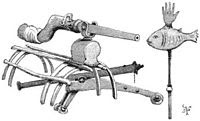
With one body of cavalry routed, Seaton recommenced his advance. Major Smith turned his guns on the cavalry on the right and just as rapidly silenced all three guns. The troops now charged and stormed not only the two villages but the grove of trees; it was a little too much for the rebels, who “fled in all directions,” leaving behind everything they possessed. A few held out in the village on the left, but to no avail. The infantry set fire to the thatch, and those who did not rush out of the huts into the 82nd’s bayonets instead burned inside them. Seaton ordered the captured ammunition blown up, and while the force rested under the trees they had just captured, the civil officers rummaged through the captured baggage for papers and then proceeded to examine the prisoners. After an hour, the cavalry returned from the pursuit, bringing with them several standards and a curious, small gun or zumbooruk, without its rack, which would normally be mounted on a camel, as their prize. Of prisoners, there were none – neither Alexander’s Horse nor De Kantzow’s Fatehgarh Organised Police Battalion were known for giving quarter.
Seaton moved into the grove of trees, he placed videttes all around it and bivouacked his men in the shade, while they breakfasted and rested through the heat of the day, he half-expected the rebels would attack; a body of some two hundred horsemen put in an appearance, apparently to see what had happened to their compatriots at Kankar, but they kept themselves at a respectful distance. “Three or four well-planted shots from Major Smith-s guns gave them all the information they required, and off they went.” By the time Seaton was ready to return to Fatehgarh, the news of the fall of the Kankar post had spread through the rebel lines – at Aliganj, they rapidly broke up their bridge and removed all the boats to their side of the river; over the next few days, they continued to withdraw their outlying parties and retreated from Badgaon to the other side of the Ramganga and zamindars, who had previously held themselves aloof from Seaton and Fatehgarh, now declared themselves his friends.
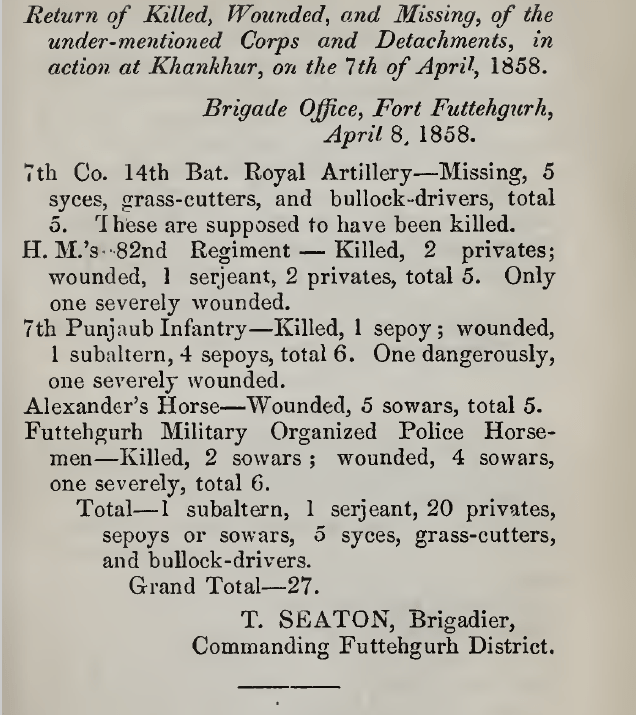
While Seaton makes no mention of the rebel losses, his own were, considering the small size of his force, fortunately, few. The 7th Punjab Infantry added Lieutenant W. H. Johnstone, slightly wounded.
The first time the brigade-major came to me on business, he entered my room laughing and looking highly amused. I asked him what was the joke.
“Do you know, sir, what the soldiers are calling you?” “
No, I don’t, but I hope it is nothing very outrageous.
“Oh, no, they call you the Kunkuring Hero.”
Kunkar was the largest of the two villages we had stormed.
Two weeks later, Sir Colin Campbell arrived in Fatehgarh, and, “On seeing me, he shook his fist at ‘that little flourish of yours, sir,’ as he was pleased to term our dash at the rebels; but there was a kindly smile on his honest, weather-beaten, sagacious-looking face.” For Seaton, his time at this abominable post was nearly over, but the war was far from won.
Sources:
Behan, T. L., ed. Bulletins and Other State Intelligence for the Year 1858. Parts 2 and 3. London: London Gazette Office, 1860.
Cosens, F. R., and C. L. Wallace. Fatehgarh and the Mutiny. Lucknow: Newul Kishore Press, 1933.
Jervis, Thomas Best. Historical Record of the Eighty-Second Regiment; or, Prince of Wales’s Volunteers. London: W.O. Mitchell, Military Publisher, 1866.
Malleson, G. B. History of the Indian Mutiny 1857-1858, Commencing from the Close of the 2nd Volume of Sir John Kaye’s History of the Sepoy War. Vol. 2. London: William H. Allen & Co., 1879.
Seaton, Thomas. From Cadet to Colonel: The Record of a Life of Active Service. Vol. 2. London: Hurst & Blackett, 1866.
 Mutiny Reflections