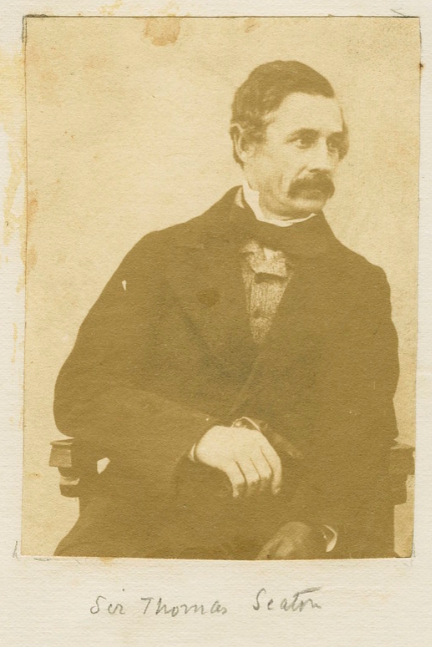
In January 1858,Colonel Thomas Seaton was appointed Brigadier and posted to the 3rd Brigade in Campbell’s Army of Oudh – a just reward for his efforts to bring supplies to Fatehgarh. With a gladdened heart, Seaton was blissfully making plans to accompany Sir Colin Campbell to Lucknow. However, he had not reckoned with the plans of the Commander-in-Chief.
Sir Colin, finally convinced he needed to retake Lucknow before he could tackle not only Rohilkhand but the entire Oudh province, was finding himself in something of a quandary. He had a bevvy of officers, many of whom had but recently arrived in India and were looking for employment, preferably where the fighting would be the thickest, but he found he could not use them. After the near-disaster presented to him by Windham in December, where, as an experienced Crimea officer, he had nearly lost Cawnpore due to a lack of “India” skills, Sir Colin was wary of unseasoned European officers. This left him with a problem of who would take over Fatehgarh when he was gone, and his decision fell on Seaton. On 22 January, he called Seaton to his tent to tell him the galling news.
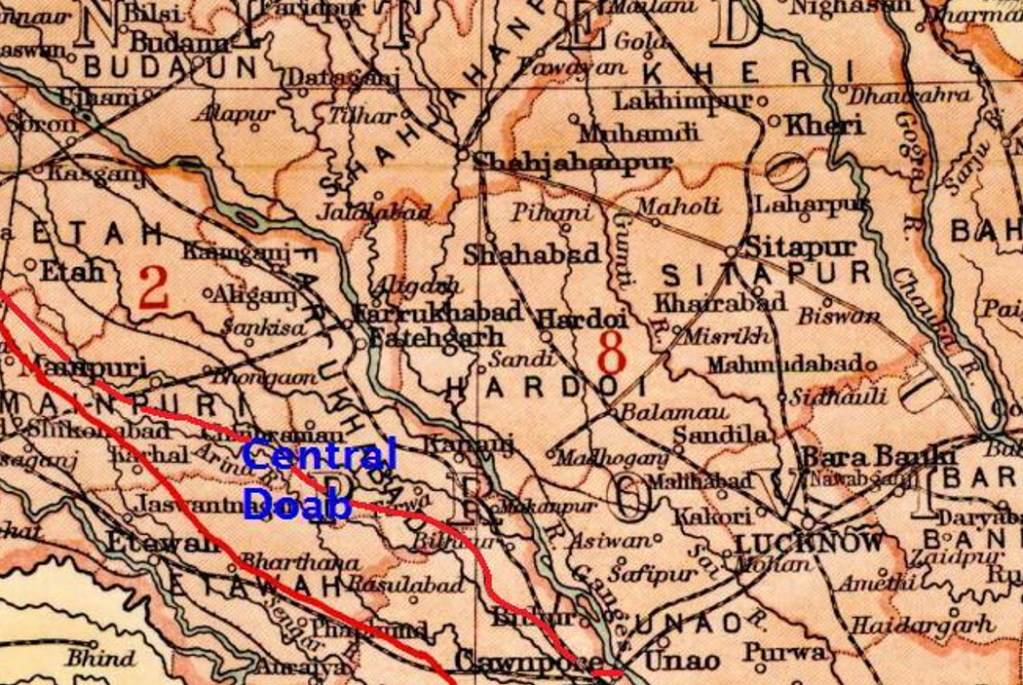
In his usual brisk manner, Sir Colin informed Seaton he planned to “form a district to be called Futtygurh District. It was to comprise Futtygurh, Mynpooree, Etawah and Meerunka-Serai on the
Grand Trunk Road, and as I was the only brigadier he had who could speak the language and
manage the natives, he was obliged to appoint me to the command, &c.” Crestfallen, Seaton, with “bitterness in my heart”, decided to look on the disappointment with as much “patience and resignation” as he could find and tried to find something positive in being given an “abominable command, ” in “a district as large as four ordinary English counties to protect from rebels, and to keep in order a river-front to the east, along which were aligned large bodies of mutineers, who might at any moment cross and set the whole country once more in a ferment.“
He would also have the dependents of the former Nawab of Fatehgarh to contend with, who were stirring up revolt to the north of the district, and then, if that was not enough to deal with, Seaton had the whole line of the Jamuna River towards the west, which consisted of “one huge network of ravines – a perfect maze, the usual biding place of all the ruffians and outlaws in the district.” While he could have dealt with ruffians and a band of revolted sepoys at Koochla on the Ganges, Seaton was more concerned with the 15’000 rebel and the remnants of the Gwalior artillery and cavalry, who had made their way to Aliganj, barely seven miles from Fatehgarh; if intelligence served him correctly, they had constructed a practical bridge of boats there to cross uninterrupted into the country between the Ramganga and the Ganges and if they were so inclined, wreak havoc across the Doab. If the fates were on their side, they could even take back a portion of the Grand Trunk Road, the only communication line open with Delhi and Agra.
Optimistic by nature, Seaton might not found even these difficulties insurmountable, but to add to his disappointment, Sir Colin Campbell was leaving him holding the fort without enough men to even keep the gates closed.
In his generosity, Sir Colin Campbell was leaving behind HM’s 82nd Regiment, the 7th Punjab Infantry Regiment, a field battery of nine guns under Major Smith of the Royal Artillery, and some 350 horsemen, all raw levies, who also happened to be at Mainpuri. A small body of civilians was being trained up as cavalry at Fatehgarh, but the only horsemen Seaton had at his immediate disposal were his own personal escort of six men of Hodson’s Horse. A few engineers completed Seaton’s Fatehgarh force.
“On talking over the command with Sir Colin, he said, in reference to the large body of troops at Alagunge, that he should ‘do something’ about them, but, for some reason best known to himself, he did nothing at all, though he could have driven them to the four winds in two hours. The day before he marched, Sir Colin said to me—’ You’ll be mobbed, my dear friend, as soon as I leave, but you must hold out till I come back. You must push on the repairs of the fort, and the defensive measures that are in progress outside, and indent at once on Agra for ammunition for your guns.’ “
Of course, what Sir Colin meant by “mobbed” was not lost on Seaton – the Commander in Chief expected Seaton to be besieged at Fatehgarh as soon as his back was turned. Seaton looked at the situation pragmatically – if the rebels crossed the river and besieged Fatehgarh, he could not be blamed; if he managed to keep them at bay and made a success of the defence, the credit would be his. Afterall, Seaton was no stranger to sieges – he had survived Jallalabad during the Afghan war and had gained valuable experience from it – Fatehgarh did not seem impossible. Provided Agra sent on the ammunition promptly, there was no reason why he could not hold out.
However, Sir Colin Campbell was not a fool – he understood Seaton’s position would be precarious in the extreme; to provide him some relief, although it would be slow in coming, Sir John Lawrence agreed to raise a force, the Roorkee Field Force, under Colonel Jones (60th Rifles) whose main duty would be enter Rohilkhand from the northwest and occupy the rebels attention away from Fatehgarh, however, they would not be ready to march until the first week of February. Sir Colin Campbell could no longer delay taking Lucknow – by 23 February, the last of the Army of Oudh, with Seaton’s dear friend William Hodson in tow, had left Fatehgarh, and Seaton was well and truly on his own.
Considering the size of this new district he had to protect, besides all the river crossings, Seaton dispatched two companies of the 82nd under Lieutenant Colonel Watson to Mainpuri to keep open communication with Agra; they were also held in readiness to relieve the 3rd Europeans, who had been ordered to escort the Agra civilians, mainly women and children, to Allahabad. This particular duty was completed on 18 February – the 82nd then returned to Mainpuri, having in their turn been relieved by the Rifle Brigade. This detachment of the 82nd would become part of a small moveable column, with a squadron of Alexander’s Horse and the 7th Punjab Infantry.
The Battle of Anutram – 7 February 1858
If Seaton did not have enough work to do, he received, amid his concerns for the defence of Fatehgarh, a letter from Captain Alexander, commanding the Irregular Horse at Etawah and another from Allan Hume, magistrate of that station, requesting his instructions. Rebels had once again put in an appearance close to Etawah, and Hume was understandably concerned. It was their sincerest hope that Seaton would sanction their plans to attack them. Seaton, aware that if the venture went badly, it would be a serious loss to his already thin force and as such, sent a letter in return, stating that under no circumstances were Hume and Alexander to begin launching attacks of their own.
Allan Octavian Hume was something of a force to be reckoned with. He had held on at Etawah during the early days of the mutiny until circumstances had finally forced him to retire to Agra – here he had remained, fighting with some note as an artilleryman at the Battle of Sucheta on 15 July, and continued to do so until cholera gave him other worries. When he was sufficiently recovered, Hume began drafting plans to return to Etawah; however, with the mutiny in full swing, it would not be until December 1857 that Hume, accompanied by his deputy, Mr G. B. Maconochie and an escort of 50 men of the 2nd Punjab Infantry (under Lieutenant Sherriff) to retake Etawah. It was with some relief that this was accomplished without any losses, and Hume was soon back in his old position as Magistrate. However, the mutiny, as he knew well, was hardly over; calling on his friends among the local zamindars, Hume raised a decent local army of his own, comprising 200 infantrymen and 150 cavalry, with five guns and fifty gunners. By the end of January, they were drilled into a reasonably efficient fighting force. Strengthened shortly after by a detachment of Alexander’s Horse (later, 1st Bengal Cavalry), Hume felt he could hold Etawah. However, the rebels were quick to show they were not impressed with Hume’s return, and after one attack on Etawah, Hume decided something had to be done; fortunately, help was at hand.
Captain William Alexander, like Hume, had spent much of the mutiny in Agra Fort. Around the end of October 1857, he had been ordered to raise a levy of cavalry for duty in the Agra District; he had little trouble recruiting; by December, now called Alexander’s Horse, they were 500 strong, and consisted equally of Hindus, Muslims and Sikhs. However, Sir Colin Campbell, instead of taking Alexander’s Horse to Lucknow, ordered them to Etawah. Detained for a time at Mainpuri to keep roving bands of insurgents in check, Alexander could hardly ignore the messages from his old friend Hume and, taking a detachment with him, Alexander rode to Etawah, to find Hume was right to be worried.

If the intelligence was to be believed, the rebels were amassing 25 miles from Etawah – as such, both Hume and Alexander wrote to Brigadier Seaton, firstly to apprise him of the situation and secondly to request his instructions. They then allowed a day or two to pass for his answer – when none arrived, they decided to take matters into their own hands. Alexander rode out to his outpost at Bukewar and ordered the 30 rank and file of his regiment and 80 sowars of the Etawah Local Horse to proceed with him, Hume and Mr Maconochie (Deputy Magistrate, Etawah) to Anutram, where it was believed the rebels had set up camp. It was with some relief that the first men they met on the road were not sepoys, but 700 matchlock men in Hume’s employ. They were contributed from various local Zamindars and Rao Jaswant Rao, who thoughtfully also provided a 13-pounder brass gun with a compliment of gunners.
“We moved on at once to the enemy’s position, which was about a mile from Anuntram, and found them very strongly posted, stronger than we were led to believe from reports. Their right resting on the Cawnpore road, occupied a large tope of mango trees with a wall of six feet all round, and a small ditch in front; their left on a village (Phoolpore), and every grove and field between occupied by them. Their right was the chief position, and looked most formidable, the enclosure swarming with the enemy, and one gun facing down the road towards us.“
Being singular men of action, both Hume and Alexander decided that since the rebels had seen them, they felt that it would be bad form if they retreated now without “attempting something,” and that something was quite simple – they would attack the enclosure before the rebels could come to the same conclusion. Alexander formed up the cavalry into three troops; his own men he took to the opposite, right rear of the enclosure and called a halt at 300 yards; one troop he then directed to go off to the right, and the third was to remain to support their only gun. In all, their force was 440 men of all arms.
For their part, the rebels were quick to their feet and concentrated themselves in two enclosures, sending out some 100 men as skirmishers into the field immediately surrounding their main position.
“As the banks surrounding the enclosure were not less than six feet high from outside, as there were no entrances, and the branches of the trees came down to within two feet of the top of the bank, Captain Alexander, finding that his cavalry could not attack them with any reasonable chance of success, halted them… After consulting him, I posted the Local Horse, and then leaving them there with orders to cut up any fugitives, drew the men up in a sort of line, with the gun in the centre.”
The 700 matchlock men were not very convinced that Hume had all his marbles in order; when he called the advance, which was uncompromisingly straight towards the entrenchment, only 350 marched forward – the rebels opened up a “smart fire”, and the battle began. Hume’s matchlock men “were no cowards; they fought bravely, a little later, hand to hand, but they were new to the system of going straight a-head at our enemy, were immensely outnumbered, and were obliged to advance under a very heavy fire, which, as they could, under the most favourable circumstances, see only the heads of their opponents, they could not return with any effect….By degrees, taking advantage of a number of small ridges intervening between us and the point which I had chosen for the attack, I pushed the men on to within twenty yards of the entrenchment, keeping up, as we advanced, a fire from the Rao’s gun in answer to that of the enemy. I then ran the gun up to the little knoll, which, distant about five yards from the entrenchment, gave me the command of the interior.”
For reasons only known to them, some 300 rebels ran out the opposite side of the enclosure and directly into the waiting swords of Alexander’s men. “The word ‘charge’ was given by me, and in a few seconds we were in the midst of them, sweeping round the rear of the entrenchment to the village on the enemy’s left. Many of the enemy escaped owing to the great height of cultivation and the villages, where it was impossible for cavalry to follow, and, had the Local Horse acted on the right, when they saw my troop coming round, the victory would have been most complete; but they rendered no assistance at first.”
The problem with the Local Horse, in Hume’s estimation, was their lack of a European officer at their head, and they were waiting for Hume’s instructions. Hume was, however, rather busy. He had managed to get the upper hand of the entrenchment.
“…we fired one round, and, all the men lining that particular portion of the ‘moorcha’ beginning to run, the matchlock men made a rush, and to the number of 150 or 200 got in. Just as they did so, the enemy fired their gun in our faces, doing, however, no damage, and then, for the most part, throwing away their guns, both parties went at it with swords. In less than a minute, the main body of the enemy, some 600 strong, ran out… a few still stood by the gun. These, in a very short time, were dispersed, and, as I thought, either cut up or driven out; but in this I was mistaken (without uniform it was difficult to distinguish foes from friends), and we had not proceeded fifty yards in pursuit, when we were stopped by shouts from the rear, and found that the enemy had retaken and loaded the gun. We retook it, however, before they could fire it. Lutchmun Sing and I then pushed on with some half dozen sowars, but the rebels were too far ahead, and we picked up only a few stragglers. Captain Alexander then returned from the pursuit; the Local Horse came up at last, the enemy was pursued some three miles, and a number more accounted for; one and all, however, fighting to the last. Nine prisoners were also taken, of whom six were hanged. I ought to add that the enclosure was evacuated directly we took the gun.”
It was ascertained that this force of 440 men had in fact attacked a rebel force of no less than 1200 men; their losses were 125 killed, along with their gun and its limber. In their flight, they left behind their entire baggage, which included not just their spare clothes but a collection of matchlocks, swords, ammunition and their baggage ponies. On the side of Hume and Alexander, the losses were negligible.
Killed—12 matchlock men.
Severely wounded—2 sowars. Alexander’s Horse.
Severely wounded—3 horses. Alexander’s Horse.
Slightly wounded—1 horse. Alexander’s Horse.
Slightly wounded—1 sowar of Local Horse.
Severely wounded—4 horses of Local Horse.
Wounded—15 matchlock men.
Missing—2 horses
By nightfall, having ridden 50 miles and fought a battle in just over12 hours, Alexander and Hume were back in Etawah, ready to write their reports to Seaton – during their absence, his reply had indeed arrived. Whatever Seaton might have privately thought of their action, his official observation was carefully measured to elicit only the highest praise.
“The despatches speak for themselves, and I need not bring to the notice of his Excellency the great gallantry and judgment displayed by Messrs. Hume and Maconochie, or Captain Alexander’s nerve in consenting to the attack against such odds.
I think Captain Alexander could not have received a letter I sent him, prohibiting an attack on these people; but, as it has turned out, the victory will be most useful and tend in a great measure to ensure the tranquillity of the Etawah district.”
During the next six months, Allan Hume would be kept busy chasing rebels escaping from Oudh, fighting two more actions in April and May; by the end of the year, the Etawah District was reported to be free of mutineers and, as the language of the day was wont to say, “pacified.” Hume resigned from his duties to the government in 1882 – the same year he formed the Indian National Congress.
Back in Fatehgarh
Back in Fatehgarh, Seaton had, in February, set the engineers to work. While they had been successful in blasting bits of the Farrukhabad Palace to their heart’s content, they now had the daunting task of setting the ramparts and parapets of the old Fatehgarh fort into a serviceable state. The fort itself had a circumference of 1500 yards, ten bastions and a dry moat. Built by the founder of Farrukhabad, Nawab Mohamed Khan, in the early 1700s, by 1777 had fallen into disrepair, and as the nawab of the time had no use for it, it was converted into a magazine and eventually an arsenal by the British. Fatehgarh Fort would go on to supply Lord Lake’s Grand Army for the 2nd Maratha War and would continue as a magazine for nearly a century. During this time, it also gained other uses – the Cawnpore Timber Yard was moved within its walls as was the Gun Carriage Factory – the main portion of the Fort was occupied by these long, narrow factories or workshops, which included blacksmith’s shops and even a steam engine. Even the mutineers, after they ousted the British from Fatehgarh in July 1857, made ample use of the fort to manufacture cartridges.

While all of this was certainly practical, it was of no use to Seaton, who had to face the very real problem of being besieged at Fatehgarh. On closer inspection, it was found that the fort, though formidable enough at first glance, was hardly built for defence.
“The ramparts and parapets were all out of repair; the interior of some of the bastions could be seen from the high ground outside, being seven or eight feet lower than the others; the parapets were all too low, and far too thin to resist even a nine-pound shot; there were no platforms for the guns, and to some of the bastions there were no ramps. On the river-face of the fort, there was neither rampart nor parapet —nothing but the high steep bank of the river, on which the fort was built.”
Outside the fort, between it and the city, was a large grove of mango trees, coming to within one hundred yards of the fort. This grove was in turn enclosed, “by earthen walls of such thickness that half an hour’s labour of a few men would have turned them into batteries and trenches.” The men of the HM’s 82nd were formed into fatigue parties and, armed with axes and other implements of destruction, were set to work demolishing the grove and the walls.
The bazaar too had encroached up to the southern walls of the fort, and was filled with strong, well-built houses, all in easy musketry range. “At the back of this bazar there was a deep wide ravine running into the river parallel with the south face of the fort, and as it was within easy musket-shot, and would form a grand parallel and place d’armes for an enemy, it had to be opened out as much as possible, and all the houses on its bank knocked down and levelled. Then there was no accommodation for the soldiers, so the vast carpenters’ workshops and store-rooms belonging to the gun-carriage manufactory had to be converted temporarily into barracks.” The bazaar was only partially levelled – without much ammunition to spare, much of the work had to be done by hand as the engineers were loath to waste their powder on levelling houses.
However, Seaton was not so short-sighted as to concentrate his efforts on making the fort defensible. He wisely moved the Bridge of Boats from its place near the city and rebuilt it under the very walls of the fort; he then ordered all boats twelve miles up and downstream of it to be brought in and anchored under the walls. While this would have been exceedingly uncomfortable for the rebels had they decided to make use of Seaton’s bridge, he was equally at a disadvantage – having no parapet or rampart on the river face, he could not make use of his seven heavy guns on that front. The rebels would most likely leave off attacking the fort directly, as Seaton believed, and could comfortably shell him from the other side of the river, a distance of 1700 yards, and there was very little he could do about it. He hoped the ammunition he ordered from Agra would arrive sooner rather than later – if the rebels did mount an attack on Fatehgarh Fort, they would soon realise he currently only had 20 rounds of ammunition for his heavy guns.
Seaton ordered 100 men of the 82nd to be trained up as gunners. When the ammunition finally arrived, to his relief, the rebels had not. The new gunners were instructed with blank ammunition, and finally, when the report of their progress was deemed sufficiently advanced, Seaton allowed them a ” little ball practice.” It was, thanks to this, that he made a startling discovery.
“On the farther bank of the river, and exactly opposite the fort, was a small village, and outside, towards the north, a large white boundary pillar. I made the mark for our heavy guns. Then, selecting a day when the wind was blowing from the fort towards the rebels in Alagunge, I sent a party of horsemen across the river, turned the people out of the village for a couple of hours, and commenced, first with the 12-pounders, going on in crescendo style, and ending with the 32-pounder. Of course, we took care to note the range of the guns and the elevation required. Next day, at ten o’clock, a man walked up to my quarters with a 32-pound shot on his head and dropped it at my feet.
“Huzoor, your highness, cherisher of the poor, your slave was working yesterday in his field (naming a village about two miles off), and whilst your highness’s guns were firing, your slave heard something rushing through the grass, and immediately the ball jumped over his head and lodged in the bank. I am a faithful ryot of the Sicar Angrez, and I have brought the ball to your highness.”
“Very well, ” replied Seaton, “You shall have a present, but tell me, do you think the rebels at Alagunge heard the sound of our guns?”
“Your highness, yes, their livers melted with fear, and half of their army ran away last night.”
Seaton soon found that the man, despite his embellishments of livers turning to water, had told the truth. A sizeable number of men had joined the rebels the previous morning but had decided against the venture and promptly disappeared as soon as Seaton’s guns opened fire. Spies had been actively at work reporting Seaton’s actions at Fatehgarh to the rebel camp, and they were well aware that the Agra ammunition had arrived. The ball practice had served to scare off anyone interested in the rebel cause, but for reasons known only to themselves, the rebels still did not attack Fatehgarh.
By the end of February, the news of their movements was giving Seaton considerable anxiety. They had sent a small party to take up a position between the Ramganga and the Ganges and began “to forage around.” By March, their numbers at Aliganj had increased and “they foraged about with great boldness, and from day to day, assumed a more threatening attitude.” Spies informed Seaton, on 10 March, that the rebels at Koochla Ferry, close to Khasganj, had finally crossed the river, but they had been read the riot act by General Penny, then marching down from Delhi. Meanwhile, reports arrived in Fatehgarh that the elusive Nana Sahib had tried to make a dash for Central India; however, Seaton was more concerned about the small parties that continued to elude his posts on the river and were making their way into Rohilkhand. The rebels at Aliganj, while seemingly disinterested in Fatehgarh, sent a body of troops to Bangaon, three miles from the Ganges ferry crossing and 24 miles above Fatehgarh – Seaton sent a detachment of the 82nd and the 7th Punjab Infantry under Lieutenant Mason to keep an eye on them. Their orders were to prevent them from crossing and to send daily reports. Unfortunately, “Headquarters” got wind that Seaton had sent a detachment out into the field, and he was ordered to immediately withdraw it. With much reluctance, Seaton did so, but he sent a few police horsemen in the vicinity of the ferry so he could still receive daily reports of the foraging rebels. The withdrawal elicited the reaction Seaton had hoped to avoid – as soon as the detachment was out of sight, rebel sowars began crossing the river; they visited a few villages and then returned to Bangaon. Rumours, when they finally reached Seaton’s ears, all said the same thing – his inaction and the sudden withdrawal had emboldened the rebels, and they, with Tej Singh, the rebel Rajah of Mainpuri in their camp, had finally decided to bring the stalemate to some sort of conclusion.
Seaton was in a bind – he could not send troops back to the ferry, nor could he pack up house and home and encamp opposite the rebels “waiting their good pleasure”; he was also not at liberty to call for reinforcements from Mainpuri without plunging that district into considerable discomfort. However, he also could not allow the rebels to cross the river: Sir Colin Campbell had finally decided to open the Rohilkhand Campaign, and he would hardly be pleased if the whole country from the Ganges to the Jamuna was full of mutineers. He would be considerably angrier if Seaton lost the Grand Trunk Road. If Seaton was going to do something, it would have to be now.
Seaton ascertained correctly that the rebels held three positions – Aliganj, seven miles from Fatehgarh; Bangaon, three miles from Ganges ferry and 24 miles above Fatehgarh and a third at Kankar, 22 miles away. He knew he would eventually have to move against the rebels; however, Seaton was not about to show his hand in haste. He ascertained correctly that Aliganj was too well defended for his small force to handle successfully, and Bangaon was too far to reach in a night’s march. As Kankar was situated opportunely between the two, if he “knocked out the middle post, the upper one would collapse on the lower.”
How he knocked down the posts, we shall now see.

Sources:
Behan, T.L. – Bulletins and State Intelligence for the Year 1858, Part II & Part III (London Gazette Office, 1860)
Jervis, Brevet-Major – Historical Record of the Eighty-Second Regiment or Prince of Wales’s Volunteers (London: W.O. Mitchell, Military Publisher, 1866)
Malleson, Col. G.B., History of the Indian Mutiny, Vol II (London: William H. Allen & Co., 1879)
Pitt, F.W. – Incidents in India and Memories of the Mutiny, with some Records of Alexander’s Horse and the 1st Bengal Cavalry (London: Kegan Paul, Trench, Trübner & Co., Ltd, 1896)
Seaton, Major-General Sir Thomas – From Cadet to Colonel, the Record of a Life of Active Service, Vol II (London: Hurst & Blackett, 1866)
Wallace, C. L. – Fatehgarh Camp 1777-1857 (Lucknow: K. D. Seth, 1934)
Wedderburn, Sir William, Bart. – Allan Octavian Hume, C.B., ‘Father of the Indian National Congress’ 1829-1912 (London: T. Fisher Unwin, 1913)
These stories are always so amazing.
LikeLiked by 1 person
Things are about to get quite interesting, in 1858.
I have finished reading “Under Canvas” and have all sorts of ideas of how to bring his story into mutiny reflections. It is an amazing book and I am so happy to have been able to find it.
LikeLiked by 1 person