The Peaceful Life
Mr Stone Spencer had only allowed the union if the groom promised he would never take Frances to India. Although Ewart had been appointed as ADC to the Queen shortly after arriving home, his duty was still with the 93rd. His leave was drawing to a close, and his regiment was still in India. Connections are a pleasant acquaintance; a Lieutenant Colonel of the 78th Highlanders was as anxious to remain in India as Ewart was to stay in England – a few letters later, an agreement was come to, and they traded places. On the 30th of September 1859, their exchange was gazetted, and Ewart was now Lieutenant Colonel of the Ross-shire Buffs. It was not so much the wishes of his father-in-law but an advancement of his career. The corps with which he had “… t must be borne in mind that in India a battalion has two Lieut. Colonels and I was only the junior, whereas now I had the sole and independent command of a regiment, one second, too, to none in the army.” He met his new regiment shortly after they arrived home from India, at Fort George in Scotland.
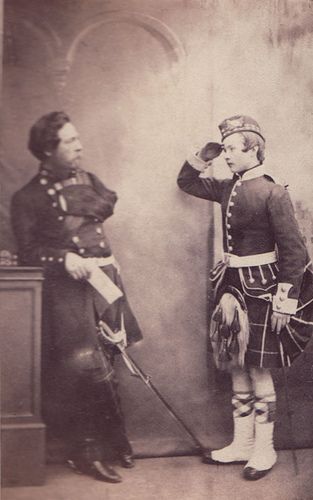
For Ewart, his time with the 78th was short-lived. In 1864, his in-laws were still adamant that their daughter never set foot on foreign soil, and he was urged to retire on half-pay. Major MacIntyre succeeded the command of the 78th in Ewart’s place as Colonel, without costing him the price of the step, something which Ewart believed MacIntyre heartily deserved. All Ewart now had were his duties as ADC to the Queen, which consisted of attending “levees and drawing rooms with an occasional review.” He lost his appointment in 1872 when he was promoted to Major General, but the Queen did not forget Ewart – she granted him a pension of £100 per annum for his meritorious and distinguished service. He settled well into civilian life, but his wife died in 1873, and in 1877, Ewart found himself back in India as commander of the Allahabad Division. It was not by any means a hardship posting; Ewart found he was more concerned with the sanitary arrangements of the troops than anything else; besides the inspections he was expected to carry out at the stations in his division, the work was hardly taxing. The railway had made great leaps in the last 20 years, and for his visit to Cawnpore, he settled himself in for a long, unbroken ride by rail.
It was a strange return.
Cawnpore was no longer the shattered town he had left behind – Wheeler’s Entrenchment had been pulled down and a beautiful memorial church built, the Bibighar was gone, and over the well, Marchiotti’s Angel now held watch. He visited the compound where his arm was buried and hoped the jackals had been kind enough to let it rest. Although a “sad desolation” still prevailed, with many of the bungalows still deserted and in ruins, the buildings where he had been struck by the cannonball had disappeared – over the spot now ran the Oudh and Rohlicund Railway.
“On the 1st October 1877, in consequence of the Royal Warrant directing the retirement of all general officers over seventy years of age, I found myself suddenly promoted to the rank of Lieutenant-General. As divisions in India are commanded by Major-Generals, this promotion had the effect of considerably shortening my period of command; for although the Minister of War was good enough, on the recommendation of his Royal Highness the Field-Marshal- Commanding-in-Chief, to sanction my retention of the command until the 30th November, 1879, this permission only enabled me to hold the appointment for two years and eight months, instead of the full period of five years; a serious loss in a pecuniary point of view. It is, however, as the old proverb tells us,” an ill wind that blows good to nobody,” and doubtless my successor rejoiced…It is always pleasant to return home, but it was with a feeling of regret that I saw my flag hauled down and listened to my parting salute of thirteen guns.“
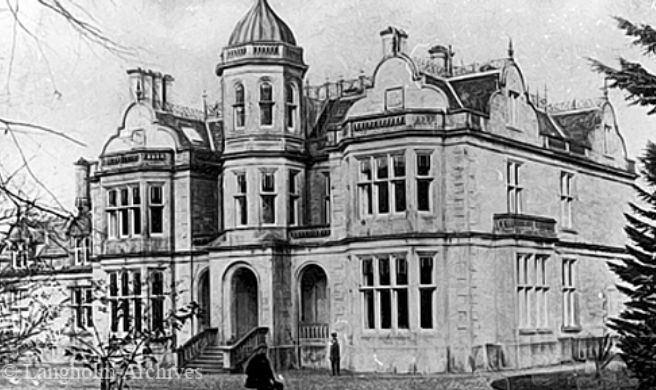
https://langholm1915.org/diary/january/
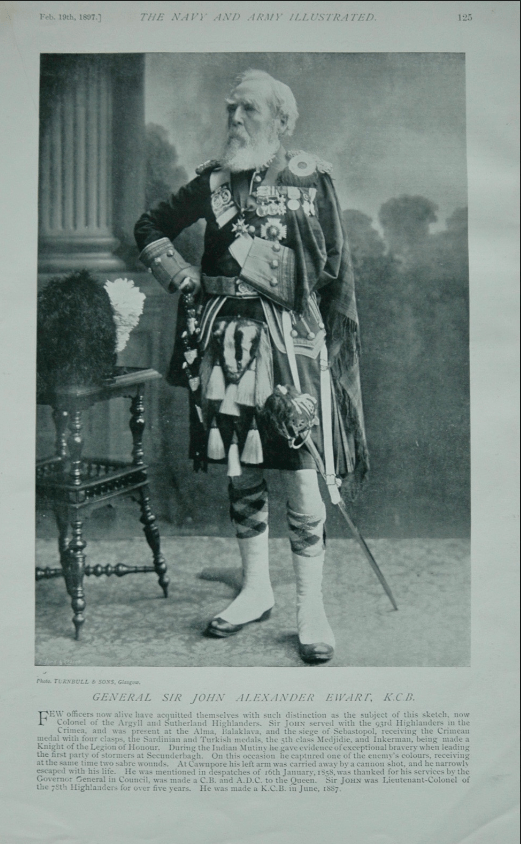
Ewart’s own narrative ends here, but his life was hardly lived in quiet retirement. On the 12th of January 1884, he became a Full General on the active list, having previously been appointed Colonel of the Duke of Edinburgh’s Wiltshire Regiment. the same year, with a colonelcy vacant in the 92nd Gordon Highlanders, Ewart transferred. A year later, he transferred again, this time to the colonelcy of the Argyll and Sutherland Highlanders (the old 91st and 93rd). In 1887, on the occasion of the Queen’s Jubilee, he was created K.C.B. In 1890, he was settled comfortably at Craigcleugh House, near Langholm, Dumfriesshire, serving as Justice of the Peace for both Dumfriesshire and Staffordshire. He died at home on the 18th of June 1904. Two days before his death, he was promoted to G.C.B.
Sources:
Ewart, John Alexander. The Story of a Soldier’s Life; or, Peace, War, and Mutiny. 2 vols. London: Sampson Low, Marston, Searle, & Rivington, 1881.
Gordon-Alexander, William. Recollections of a Highland Subaltern: During the Campaigns of the 93rd Highlanders in India, under Colin Campbell, Lord Clyde, in 1857, 1858 and 1859. London: Edward Arnold, 1898.
Munro, William. Reminiscences of Military Service with the 93rd Sutherland Highlanders. London: Hurst and Blackett, 1883.
Roberts, Frederick Sleigh. Forty-One Years in India: From Subaltern to Commander-in-Chief. Vol. 1. London: Richard Bentley & Son, 1897.
Links:
https://trove.nla.gov.au/newspaper/article/14623846
http://www.kirkcudbright.co/historyarticle.asp?ID=267&p=19&g=4
http://www.kirkcudbright.co/historyarticle.asp?ID=265&p=19&g=4
https://theesotericcuriosa.blogspot.com/2011/10/romance-of-sixteen-quarterings-union-of.html
 Mutiny Reflections