To Calcutta and Home
In January, Dr McAndrew, the Indian Medical Officer, paid a visit to Cawnpore on his way to Delhi from Calcutta. He recommended Ewart return home. Around the 20th of January, Ewart was finally able to stand but only by holding onto a strong stick and supported by his servant on the other side – three days later, the medical board appeared in his room, and he was recommended for 18 months’ leave of absence – he could leave as soon as he liked. How he was to manage this was his own business – there was no assistance forthcoming from the authorities, and Ewart was left on his own to figure out how to get to Calcutta, a distance of 628 miles. As for Henry Ouvry, he, too, left Cawnpore; however, his book, “Cavalry Experiences and Leaves from my Journal”, mentions neither Ewart nor the house. By the 31st of January, however, he was in Allahabad waiting for his wife.
For Ewart, the desperation to leave Cawnpore was so great that he asked his servant to procure any kind of conveyance, it mattered little what it was, as long as it had wheels and any kind of animal to pull it. His servant was fruitful – the same day, he procured not just a carriage but a driver to go with it.
At ten o’clock in the morning on the 24th of January, Ewart finally left Cawnpore, after “54 days of suffering and anxiety.
His carriage was a garry with two seats, one facing forward, the other backwards and drawn by one horse. The luggage was placed on the roof. John Donaldson travelled with him inside, while his Madrasi man, Cheney, perched on the box next to the driver.

“My spirits rose wonderfully as I felt myself once more on the move. We passed close by the spot where I had lost my arm, and as I took a farewell glance at General Wheeler’s ruined intrenchment, I thought of my poor murdered cousin and his wife and child. Well, I had done my best to avenge their death, and I felt that I could do no more.” In 20 years, Ewart would return, but it would be to a very different Cawnpore.
Some miles out of the town, Ewart fell in with the 7th Hussars and the 79th Regiment, marching up from Calcutta. They had set up their camp, and Ewart decided a halt was in order. With the help of his stick and his servant, he managed to reach the Cameronians and met many of his old friends from Crimea. They offered him a bowl of soup and news of the mutiny. After half an hour, Ewart was back on his way – he crossed the 72 miles to Khaga railhead with one change of horses, in just over 12 hours from Cawnpore, arriving after 10 pm. A large tent had been erected for waiting passengers, and Ewart would stay here, grateful for the rest, until the train arrived the next day at 2 pm. It was only a four-hour journey, but in the meantime, the rebels had burned the 1st class carriages, and Ewart found himself mercilessly shaken, disembarking in Allahabad somewhat worse for wear. His carriage had only been contracted to Khaga; unable to find another, he was obliged to walk the 3-quarter mile to the fort, leaning heavily on Cheney and Donaldson, seeing to the baggage. To his delight, he fell in with 2 wounded officers of the 93rd who gave him some dinner and then pointed him to a surgeon to dress his wound. He remained in Allahabad for 5 days while Cheney rustled up another carriage; Donaldson had been called up to his regiment, so Ewart would now travel with Cheney, a driver and a syce. Travelling through the night on the 30th of January, they arrived safely in Benares the next morning. He would not travel again until the 3rd of February. Ewart might have been on the mend physically, but the gloomy thoughts that had so pursued him in Cawnpore had not left him yet.
“From Benares, my companions were still only three natives, namely, my Madras servant, the driver, and syce, and I had now to get through the celebrated Dunwah Pass, a most gloomy portion of the Trunk Road, with jungle extending for miles on each side. On my bearer I placed full reliance, as he had attended me most faithfully up to the present time, nursing me carefully through my long illness; but of the various drivers and syces who succeeded each other, of course, I knew nothing, and it was easy for them to lay a plot with others to kill me and plunder my baggage. I had determined to keep awake all this night, and saw that my sword was handy, for besides the risk of being attacked by disbanded mutineers or other natives, there was the chance of a tiger taking a fancy to a wounded Highlander: two wolves I had already seen. The fatigue I had undergone was, however, too much for my present debilitated condition, and in spite of all my endeavours, I fell fast asleep, waking up to find we had got through the Pass in safety.”
He needn’t have worried – the men he suspected of having intentions on his baggage brought him safely to Raniganj on the 7th of February and into the arms of friends; the 35th Regiment, having been ordered to Dinapore, were encamped at the small station. Their doctor took care of Ewart’s stump, and he spent the rest of the day with his old friends. The train left at midnight for Howrah; six hours later, he was on a small steamer crossing the Hoogly to the capital. In his pocket, he had carefully kept a clipping he had taken from a newspaper he had received in Cawnpore – it intimated that a house had been fitted at 1, Little Russell Street, Chowringhee for any wounded officer seeking a room in Calcutta. Securing a palanquin for himself and a cart for his baggage, Ewart set off.


Today, 1 + 2 Little Russell Street, Chowringhee houses the Kenilworth Hotel (the colonial property & a modern building next to it) – it appears at least a part of it remains in its old glory. This building, however, was constructed in 1879, swallowing up the older house, which is most likely where Ewart stayed. It was a “capital house” where everything had been done to ensure the officers could live in comfort. The room was large and airy, with several beds – “beautifully clean…In addition to a capital dining room, we had a large sitting – room, filled with sofas and easy chairs, the table being covered with newspapers; in fact, the authorities at Calcutta had forgotten nothing; and for only two rupees each a day, we were provided with a good breakfast, an excellent tiffin, or luncheon, and a splendid dinner.” Everything was looked after by an efficient matron, and Doctor Ligertwood was on call to attend to the sufferers.

There were in all 14 wounded officers – three, including Ewart, were minus an arm, one had lost some toes, another 16 teeth; “one poor fellow had been shot in the stomach,” another in the neck, and several were lame from their wounded legs. Nine of them would shortly travel home, but more would soon arrive. Ewart shared a room for a time with a young ensign named Dyce of the Rifle Brigade, who had lost nearly all of his teeth by a musket shot that had penetrated through both his cheeks while fighting under Mansfield at the Subadar’s Tank. Poor Dyce travelled home but died shortly after. As for Ewart, he would have to appear before a second Medical Board, unfathomably, who would decide if he could leave India or not. It would not be until the 9th of March, on board the Candia, that Ewart would finally sail back to England.
“Amongst the passengers, those I remember best are Mrs. Couper (now Lady Couper); Mrs. Aitken, who was very pretty and nice; Mrs. Anderson; Mrs. Fenwick (wife, I think, of Lieut . Colonel Fenwick, of the 10th Foot ); Major Alison (now Sir Archibald); Major and Mrs. Boileau; Major North, 60th Rifles; and Paymaster Roche, of the 34th, who kindly took charge of some of my things as far as Southampton. There were, I recollect, no less than nine ladies who had been rescued at the relief of Lucknow. But for the kindness of Alison, who, like myself, had lost an arm, I should have been in rather a bad way, being without a servant of any sort. He had, fortunately, brought one with him from India, who assisted me daily in dressing my stump .”
Not a man to complain, Ewart was somewhat dumbfounded when he was expected to pay his own passage to England. He had hoped a free passage would be offered by the government for wounded officers, but he was to be disappointed. Two wounded officers angrily demanded assistance from the Relief Fund and obtained part of the sum; however, Ewart believed the fund, having been conceived for the assistance of actual residents of India and not for men such as himself. “It was, however, I consider rather shabby of the Government not to grant free passages to all those obliged to return home on account of severe wounds.” Ewart was a man of independent means – this could not be said for every officer, and the £85 he forked out for a passage on the Candia as far as Alexandria would have told dearly on the pockets of men without his good fortune.

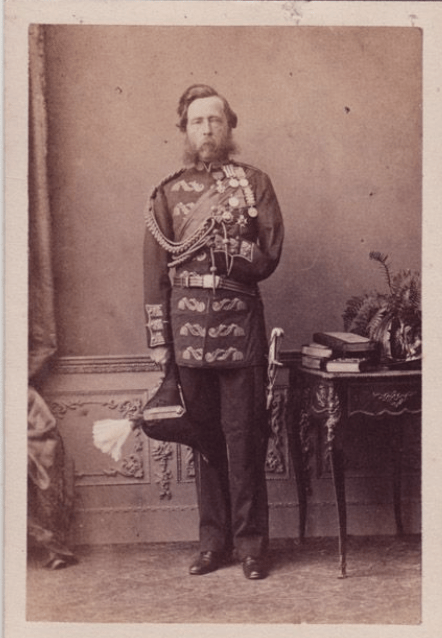
Hand-coloured albumen print
At Alexandria, Ewart, while reading some late English papers, found he had been appointed Commander of the Bath, a pleasant surprise after a dreadful journey across the Isthmus to Alexandria. Only part of the railway was complete, and he had been obliged to complete the journey by omnibus, a trying ordeal for a man still suffering from a sore wound.
Ewart took the overland route back to England, crossing by steamer to Trieste and then proceeding up through Europe; he called in on his Prussian relations in Carow. His grandfather, Joseph Ewart, had married the eldest daughter of Count von Wartensleben, Hofmarschall to the King of Prussia. Elizabeth was a Lady in Waiting to the Queen, and the marriage at the time was frowned upon. Their son was John Frederick, born in Berlin, the father of our Lieutenant Colonel John Ewart. For cousins who had never met him before, it was certainly an odd meeting – a one-armed Englishman arriving at their doorstep late at night, requesting to see the Count, but they greeted him hospitably, allowing him to extend his planned stay of days into a few weeks. When he finally arrived in Dover, it was the beginning of May 1858. He married his intended bride, to whom he had proposed before embarking for China, young Frances Spencer Stone, on the 16th of November, the first anniversary of the storming of the Sikandarbagh.
 Mutiny Reflections