The 11th Regiment Irregular Cavalry
Raised 1846
Honours for Punjab, Multan and Guzerat.
The 11th Regiment of Irregular Cavalry was stationed at Berhampore at the beginning of the mutiny, with detachments at Madarigunj and Jalpaiguri. As it was well known that dissatisfaction was rife in their ranks, on the 3rd of August, during a surprise visit by the HM’s 90th at Berhampore, the 11th was disarmed. Under the rifles of the 90th, the sowars were deprived of their horses, arms and ammunition. The detachments in the districts were, however, spared.
The Irregulars had been wildly concerned about news that European troops were on their way to disarm them, which was untrue, but without officers to tell them otherwise or quiet their fears, the men of 3rd and 4th Troop at Jalpaiguri simply deserted. Colonel Sherer, for his part, had not, following the events at Dacca, lost faith in the 73rd, still under his watchful eye. On the 4th of December, the 4th troop of the 11th Irregular Cavalry went off with their horses, arms and accoutrements – as their lines were far off from the infantry, they managed to leave unnoticed. Sherer, who only found out 2 hours after they were gone, decided not to pursue them as their lead was too great, and he could not risk his men on what could prove to be a worthless chase. One sowar was captured the following day and duly blown from a gun. The 3rd troop followed their brethren on the 5th of December, but the 73rd Regiment turned out, fired a volley at the runaways and then stood fast. For Sherer, it was yet another example of the admirable conduct of his men.
The men of the 11th Irregular Cavalry, those who had managed to evade Sherer, would meet George Udnay Yule on their flight- they had strayed into his territory, and Yule was having none of it. When they were within 27 miles (ca. 43 km) of Kishenganj, and although certain the irregulars would strive to avoid him, Yule rode out to meet them.
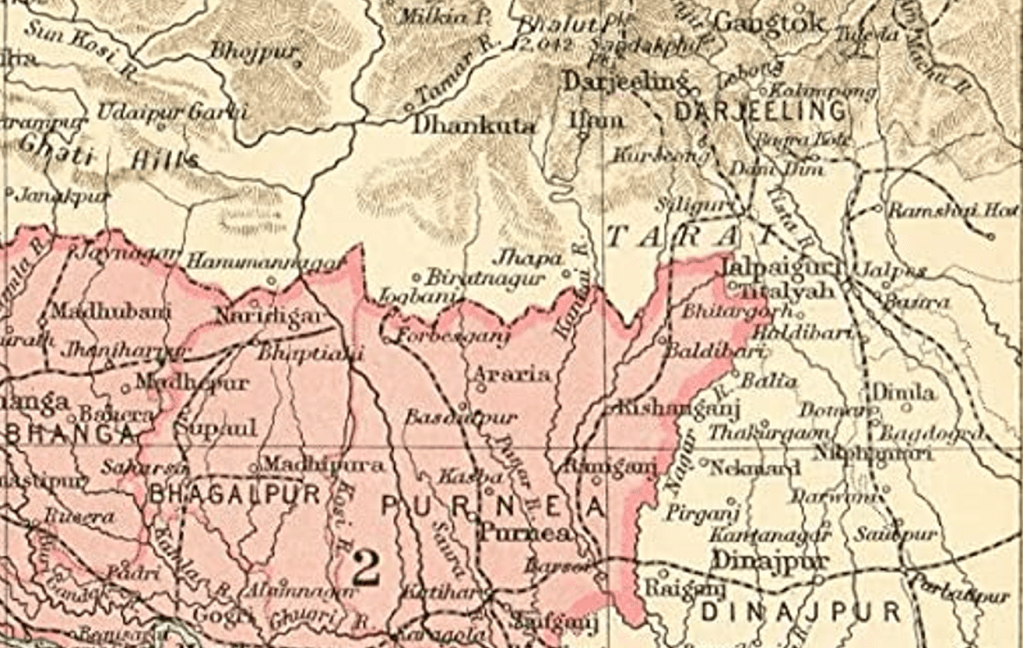
“I started at sunset with the soldiers and sailors on elephants, and the guns on carts drawn by four bullocks each, and fitted up for the purpose at Kishengunge, and agreeing with Captain Burbank and Lieutenant Chapman that it would be advisable to proceed first to Purneah, we marched straight for that station, which the soldiers reached soon after sunrise, but the sailors, detained by the guns, not till the afternoon. I found the residents in considerable alarm, the treasure and magazines removed to the jail, where some of the residents slept, &c. No correct news of the movements of the mutineers could be had that day, with the exception of its being ascertained they had extorted money and supplies at Raneegunge; the residence of a once wealthy family, six miles on the other side of the Mahunuddee, but it was reported they had crossed that river. Next morning (10th) they were seen coolly marching towards the bazaar, and only a short distance from it, evidently, it would seem, unaware of our return from Kishengunge. We immediately went out leaving 20 men for the protection of the jail, unfortunately we were just ten minutes too soon, or we should have caught them in a spot where escape to most would have been impossible, as it was, shots were exchanged by the advanced guards with a fatal result to a poor villager only, and the mutineers rapidly retreated to the eastward by the road they came, and, after remaining near the town till we had made a wide exploration on horseback, to see that the scoundrels had not hidden in the extensive jungles in that direction, the soldiers and sailors returned to their barracks. At night scouts sent out by us returned, having ascertained where the mutineers had pitched for the night; and Captain Burbank, Lieutenant Chapman, and I, immediately determined to try a night surprise as the only means of getting near them. We accordingly started at 2 a.m. on elephants, our party consisting of fifty sailors under Captain Burbank (the remainder and the guns being left to protect the station) forty-eight of Her Majesty’s 5th Fusiliers, under Lieutenant Chapman, and nine volunteers, under the guidance of Mr. Burford, to whose thorough knowledge of the country the success of the expedition must be ascribed, we proceeded across country to a spot about a mile and a half south of the road where the mutineers were encamped; here we halted for some time, in the hope that Captain Burbank, who, remaining in the rear to push on stragglers, had lost his road, would come up, but the dawn beginning to break, we could afford to wait no longer, and, the men having dismounted, the order to advance was given, the elephants being left in a bamboo jungle to await our return.”
When Yule and his men arrived within half a mile of their camp, they sighted the irregulars, numbering no more than 100 men, and they were all mounted and ready to set off. The 5th were ordered to advance at the double to take a small hillock that stood between Yule and the Irregulars – as soon as the 5th were on top, they formed line and fired a volley. The Irregulars, momentarily surprised but hardly cowed, realised Yule had not brought up his guns and, seeing how small his force was, came down in a charge, “gallantly headed by a native officer who alone touched our bayonets.” The 5th received the brunt of it but managed to form square and fired again, this time at close quarters. The Irregulars turned and passed them on the left. They then scattered over the field in small bodies and kept themselves at a short distance, somewhat less than 500 yards. Meanwhile, the sailors had formed square and now brought the Enfields into play. Man after man fell until a dense fog spread over the scene of battle. This did not deter the Irregulars. Twice, they managed to use the fog and a line of trees close to the hillock to their advantage and managed to catch the 5th unawares, but both times, they were repulsed. “For nearly an hour they hovered round us, occasionally creeping on and firing, but always ineffectually.” The fog that hampered Yule and the others, however, proved to be a saving grace for Captain Burbank and three men of the 5th who managed to find their way into the squares, uninjured. This state of affairs continued through the night, but by sunrise, after a few more shots, the Irregulars moved away, carrying with them their wounded and some of their dead. Six sowars were found dead close to the squares, and several wounded men managed to hide in the nearby fields, but they were soon brought out by villagers. Yule, for his part, did not continue the pursuit – concerned the irregulars might consider wreaking havoc on the Purneah Bazaar, he rapidly changed course and returned to guard the station.
The 11th Irregulars were last seen heading north, and for a short distance, the 5th Fusiliers kept up the pursuit- some made their way to Nepal, and a small portion found their way to Oudh. Together with the 1st and 2nd Light Cavalry and the 13th Irregulars, they would be defeated by Lieutenant Forbes in the Etawah District on the 6th of December 1858.
With the Irregulars out of his district, Yule turned his attention to the Dacca Rebels – the 73rd. They had unsuccessfully tried to reach Jalpaiguri and had taken, for a time, a short respite in Bhutan. Then they tried to make their way off again, only to be spotted by George Yule.
 Mutiny Reflections