“In his ‘Maymansingher Itihas’, Kedarnath Majumdar says that the great panic which had overtaken the city of Dacca in the month of November 1857, had also seriously affected the town of Mymensingh. Most of the inhabitants of the Mymensingh town were Hindus, who were afraid that the mutinous Sepoys of Dacca might come down there and plunder them. The rumour that the Sepoys had killed all the Europeans at Dacca and were about to reach Mymensingh was floated about in the air for sometimes and the people became so panicky that at the slightest rumour about the approach of the Sepoys they would leave the town and run away to the villages. Many had put their money in iron safes under the ground. A number of English schools were set up there, and whenever the students heard any noise or tumult, they would get alarmed and run away from the school. According to one report, there was a teacher who went to repeat the phrase, “I say” meaninglessly, every now and then. One day while passing by the class, he saw another teacher whose name was Pramananda, and he called out, “I say, Pramananda Babu”. This threw the students into a panic who began to run away from the school crying “aisey” “aisey” meaning: “they have come, they have come.” At last, the Sepoy really came down to the district of Mymensingh, but they passed on by the north-western road through the Bazaar of Sambhuganj leaving the towns of Mymensingh and Jamalpur aside.” (Professor Dr Muinuddin Ahmad Khan)
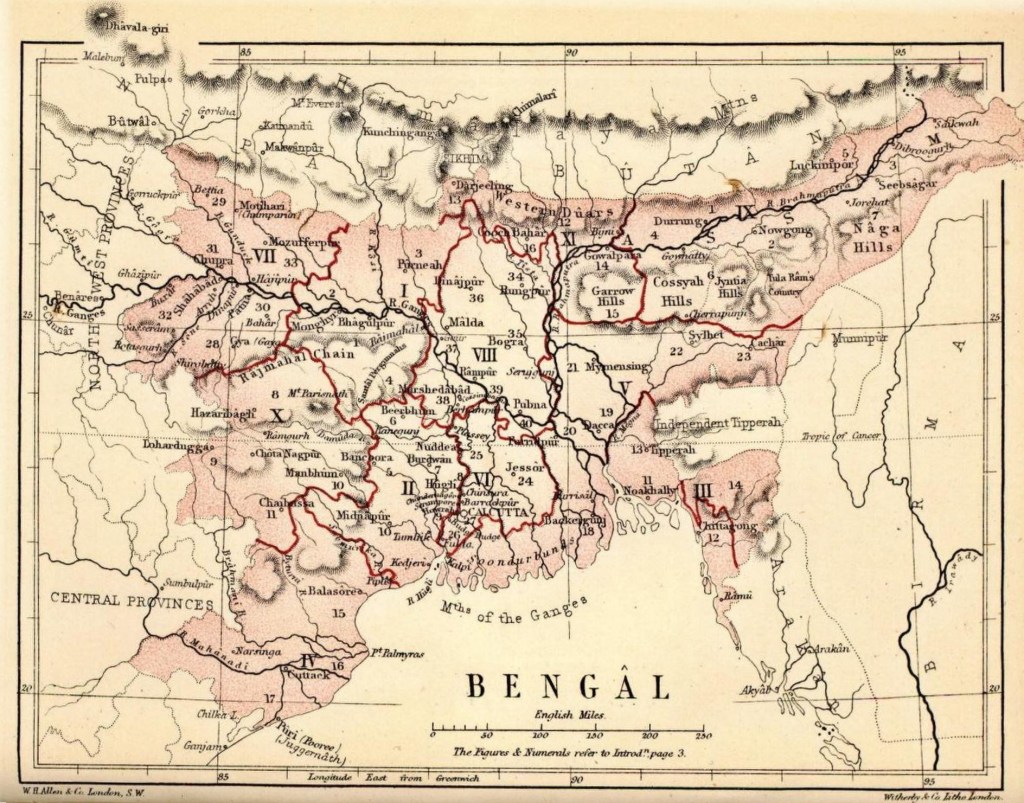
The two companies of the 73rd, so disgracefully treated at Dacca, were now in full flight, but their direction was confused, to say the least. Twelve men were arrested within the first week following the raid by Lieutenant Lewis, of which not a few had voluntarily given themselves up.
- Subadar Sheik Magdoom Bux
- Naick Ramlall Paree
- Sepoy Durga Tewari
- Sepoy Kallika Singh
- Sepoy Mattadeen Tewari
- Sepoy Buldeeram
- Sepoy Probhoo Ojhah
- Deen Ali
- Sepoy Elahu Bux Khan
- Naick Hossein Bux, artillery
- Drummer Hossein Bux
- Sepoy Shankar
The first six men were committed for trial without any delay, and not surprisingly, C.F. Carnac took little time in finding the four sepoys guilty. They were hanged the day after their trial on the 26th of November. As for the Subadar Sheik Magdoom Bux and Naick Ramlall Paree, Carnac had them hung the following day. In all, 20 men of the 73rd were captured in November, ten were hung and the rest transported for life, which was nothing but a death sentence, albeit much slower in the passing.
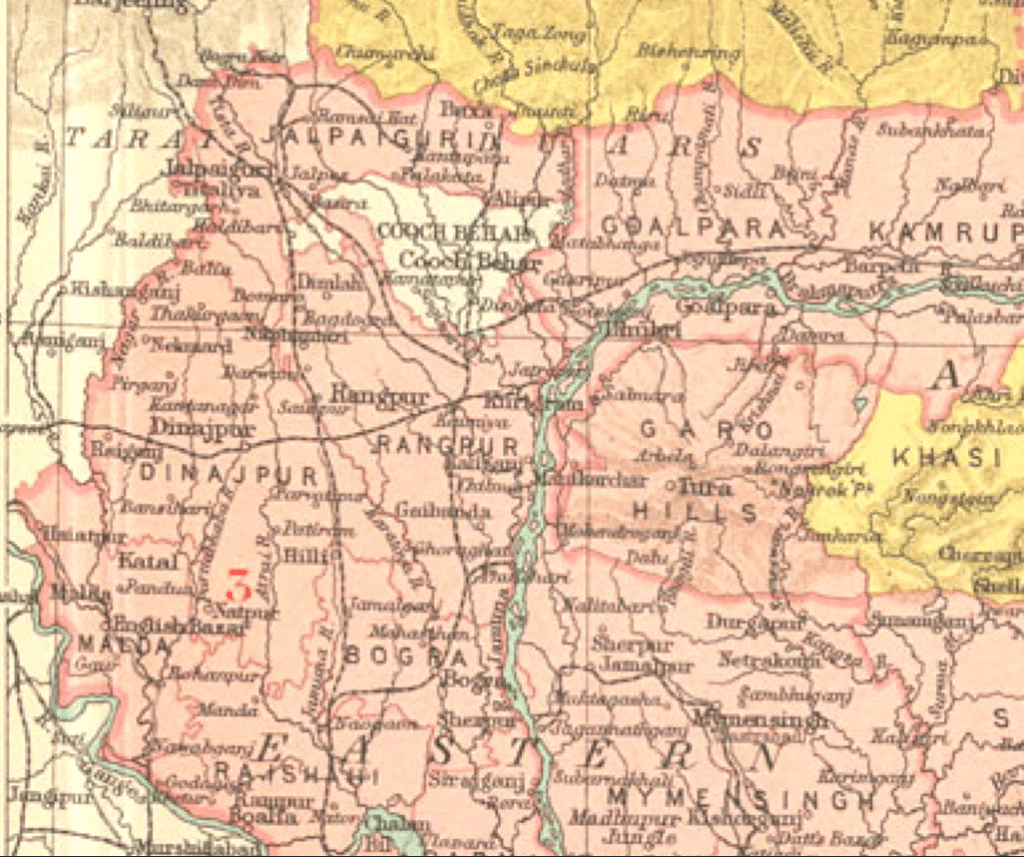
After leaving the neighbourhood of Mymensingh on the 25th of December, the Dacca rebels (as they were called) were seen 2 days later at Jamalpur and then at Bhowaniganj, where they attempted to cross the Brahamputra River. Here, they failed as the watchful landlord had carefully secured all the boats on the other side. On the 30th, however, they managed, 14 miles northwards at an unguarded crossing. On the 5th of December, they were again sighted at Rangpur on the road to Bhutan. Without supplies or support, the men resorted to plundering shops and bazaars as they came across them and even shot a policeman who tried to stand in their way. A detachment of the 73rd, with a troop of the 11th Irregular Cavalry and some Gurkha recruits, was sent out from Jalpaigori to intercept them, while Captain Ernest Curzon, with a small party of Europeans and Gurkhas, arrived to reinforce Colonel Sherer.
Whether the Dacca rebels were planning to convince the remainder of the regiment to mutiny or throw themselves at Colonel Sherer’s mercy, one will never know — not a man of them ever arrived at the headquarters. The terrain they had to cross was treacherous — through winding hills, over scant plains broken by irksome rivers and endless jungles — and they were watched the entire way. On the 12th of December, they were spotted by Captain E.G. Curzon of the 52nd Light Fusiliers close to Jalpaigori, thwarted by the river. As such, with only 50 Europeans and 40 Sappers, Curzon took the fight to them.
“The information that I have received led me to believe that their position was 15 miles off, on the bank of a nullah, deep but not more than 200 yards in breadth. My intention, therefore, was to surprise them if possible by daylight, to keep up a heavy fire from my side, and if successful, and the result warranted it, to cross over the European part of the force (under cover of the Ghoorkas) and disperse them. I arrived opposite the position of the mutineers a little before the break of day, after a march of nearly 25 miles, and on reconnoitering the place, discovered the nullah to be f of a mile broad, with two separate streams, the opposite bank being at least 20 feet higher than the bed of the river, and perpendicular; their position a very strong one with only one flank open and heavy jungle close up to their rear. I also discovered a sand bank about 250 yards from the opposite hank which would afford shelter; and as, under the circum¬ stance, to attack them on the flank was impossible, I determined to make a rush for this, and see if I could do them any damage with my fire. This we accomplished, but finding, after about 20 minutes firing, that very little could be done, and that close quarters was out of the question, I retired across the bed of the Nullah to my own side, and after halting some time, in the hope of their following, we marched back to this place, and arrived at 8 p.m., having accomplished a march of little short of 50 miles, in 24 hours.” Curzon’s losses were two men wounded.
Her Majesty’s 10th Foot.—No. 2911, Jeremiah Haly, slight contusion of hip.
Her Majesty’s 5th Foot.—No. 3138, Richard Chagar, slight contusion of leg.
The Dacca rebels managed to find their way to Bhutan but that was not what they had intended. The men, by this time, most probably wanted to go home and that lay further away, in Oudh.
Enter George Udny Yule, Esquire
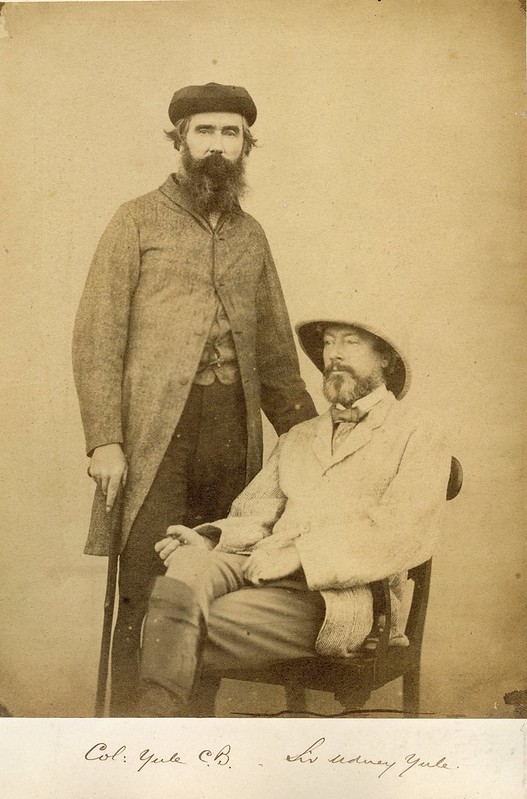
Unlike his brothers Robert and Henry, both of whom would serve in the army, George Yule, after completing his education at Haileybury, joined the Bengal Civil Service. Arriving in India in 1832, George quickly established a reputation for himself as a “good specimen of a manly, true-hearted gentleman. He was essentially a man of action. His even-handed justice had gained for him – what was rare in those days – the confidence alike of the native ryot and the European planter. Both classes alike trusted him and were prepared to obey his orders without hesitation or murmur.” In 1857, this trust was essential, for his task as a civilian was hardly a joyous one. George Yule was Commissioner of Bhagalpur, a division in eastern Bihar. His headquarters was 200 miles from Calcutta, and under his charge was a population of six million inhabitants.
Yule had trusted from the first he could hold his district without European troops, and he did so, with his assistants and the help of English planters until the Dinapore mutiny. Then, realising his position could now become precarious, Yule waylaid 140 men of HM’s 5th Fusiliers – 90 he kept at Bhagalpur and the rest he sent to garrison Manghyr. It was much to Yule’s credit, while Dinapore went up in flames and Patna ran riot, Bhagalpur remained quiet. The 2 native regiments – the 63rd at Barhampur and the 32nd at Bansi had made no signs of rising. While the 5th Irregular Cavalry at Rohini had made some attempts to murder their officers, their commandant, Major MacDonald, was having none of their nonsense, and their grumblings were quickly quashed.
Yule remained watchful and, with a small party of Europeans, continued to maintain the peace in his division. The uprising in Dinapur, however, forced his hand in so far that he now needed to secure the route on the Ganges, both at Bhagalpur and Manghyr. Although he did not trust the two native regiments in any way nearing the infatuation their officers had, Yule could at least have been somewhat satisfied when the 5th Irregulars failed to induce either the 63rd or the 32nd to mutiny. While the 5th would not believe that Eyre had defeated their brethren at both Arrah and Jagdispore, the 32nd at Bansi at least were convinced of it – at least for a moment, nothing would induce them to mutiny and throw in their lot with what looked like a very poor choice. Yule had sent a special messenger to their commandant, Colonel Burney, that the 5th Irregulars were marching on his station and that Burney, a man of considerable talents and remarkable linguistic ability, could hold the 32nd together. When the 5th arrived on the 16th of August at Bansi, they were received by the 32nd with bullets and bayonets – their hopes destroyed, the 5th rapidly retreated and continued their dissolute march to destruction to Arrah via Rohni.
Amid mutiny, a dreadful famine caused by the long prevailing drought visited the areas around Manghyr, causing a significant rise in dacoity and civil unrest. As such, while Yule was still able to hold his position, he was increasingly concerned about the state of the troops at Jalpaigori – should they mutiny, their route of march would cross through his division. A Bengal naval detachment, then wending its way towards Purneah, was due to arrive at Bhagalpur at the end of November – Yule, still concerned by the state of affairs, received consent from the Calcutta government to march with the 5th Fusiliers to Purneah and await the naval brigade. He was not a moment too soon.
 Mutiny Reflections