Upon leaving Chittagong, the mutineers of the 34th Regiment, Bengal Native Infantry, crossed over the Fenny (Feni) River. As the river flows southwest, it marks the boundary between the Chittagong Hill Tracts, and to the west, it separates Chittagong from Tipperah (Tripura), before eventually, after passing through the plains, falling into the Bay of Bengal. The 34th decided they would take the westerly direction, into the lands of the Tipperah Raja – Maharaja Ishan Chandra Manikya – with some idea that, with his help, they could secure safe passage back to the northern provinces of India. As plans go, it was not the worst, but unfortunately for the 34th, they had underestimated the raja they had planned to solicit.
As it was, no one was quite sure where the 34th was headed. That they had crossed the river was clear, and the messages received from the Tipperah Raja stated they had proceeded towards his residence at Agurtollah, but his men had intercepted them at Sankolha on the 2nd of December, preventing them from marching onwards through his territories. Their march had given Mr. Sandys, the Magistrate of Tipperah, such a fright, he packed his bags and fled to Dacca. His sudden departure was met so dimly by not only Calcutta but the Commissioner of Chittagong; Sandys would face suspension for dereliction of duty. However, upon presenting himself at Dacca, it was decided to let the matter go.
Forced to turn off from their road, the 34th proceeded westward, back into EICo dominions and were making their way, albeit in some haste, towards Sylhet. By this time, things had not been going well for the 34th. They had lost their three elephants, and much of the treasure they plundered had to be abandoned. Most of their baggage was gone. With the help of the local tribesmen, the Kukis, they had been receiving not just ample provisions but also guides who cut paths through the jungle for them. However, the forced marches were taking their toll on the 34th — by the 2nd of December, 110 men had been captured, brought in as prisoners by zamindars and local villagers.
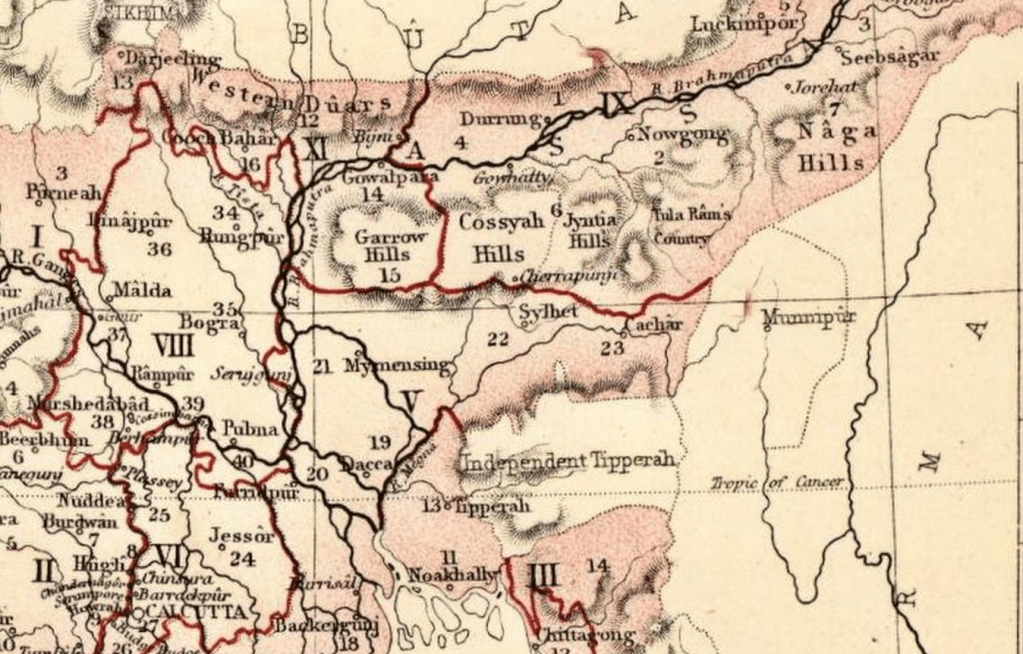
Thwarted in Tipperah, the 34th turned back into EICo territory and emerged from the jungles just southeast of the Sylhet District. Their intention was to turn south towards Cachar and into Manipur. Until now, Assam had mostly been untouched by the mutiny, due mostly to the vigilance of the civil and military authorities, who had been very busy since the news of the outbreak had reached them.
Mr. Allen, of the Board of Revenue, had taken himself off on a lengthy visit to the Khasi and Jaintia Hills. The exaggerated stories of the fall of the British Government had even reached these far-flung corners; the Khasi chiefs were “much excited”, and the ex-Raja of Jaintia took advantage of their worries to attempt his own uprising: by soliciting their favours, he hoped to overthrow the British and regain his lost possessions. Mr. Allen, acting with more prudence than most, decided the intriguing of one disgruntled former raja was hardly worth creating a fuss over – so he contended himself with ordering the man to remain at his residence in Sylhet where the military could keep an eye on him. The Khasi chiefs, for their part, soon recovered from their excitement and until the 34th made their appearance, affairs were, for the most part, restored to some normalcy.
 Mutiny Reflections