Major Charles Burton – the Ghost of Kota
There have been through time, tales linked to the mutiny – stories of houses in Meerut where the doors would not remain closed and dogs would not venture inside; others of stalwart men in uniform plodding thoughtfully through graveyards only to disappear when they reach their own grave; of shrieks and screams ringing out in the dead of night at places where murder had happened in 1857; there are further tales of haunted roads and eerie sights on the Delhi Ridge which oddly include the ghost of an English gentleman, armed with an old-fashioned rifle strolling through the shrubbery and a headless soldier on horseback, who menacingly brandishes a sword as he chases down unsuspecting visitors. The less said about the Lucknow Residency, the better; needless to say, a visit after dark was not recommended (and not even possible nowadays, seeing as it closes at sunset). The remains of the entrenchment at Cawnpore left this writer reeling with horror – not by what was seen but what was not, that unsettling feeling of never being quite alone, of being watched from corners by someone just out of view.
While some of this could be put down to overactive imaginations and urban legends, the story of Kota remarkably has stood the test of time and the former home of Major Charles Burton and his family, now the Brij Raj Bawan Palace Hotel, has some odd tales to tell. As we have addressed the mutiny at Kota and the untimely death of Burton and his sons in Major Burton is Dead, we shall not look into great detail into the events. Needless to say, the Burtons were killed in the house they had called their home for 13 years, with all the appalling circumstances his widow would believe were caused by callous betrayal.
In the 1930’s, a young lady, Iris Portal, arrived at the residency with her father, who at the time had been lent what is now the oldest section of the hotel, the building, as his headquarters while he conducted land settlement in Kota. She had been given a room on the first floor, which had one side with “four isolated entrances, including one from the from an upstairs balcony and two leading to the roof…” With feelings of discomfort and dread, Portal remained but one night in the room, asking her mother the next morning to move her to another room. It was only when she returned to Delhi that 17-year-old Iris learned of the fate of the Burtons and that she had slept in the very room where the Burtons had made their last stand. The stories of the haunting of the Kota residency, however, do not end with Iris Portal. It would be substantiated by the Crown Princess of Kota in the 1980s ( whose family lives in the original portion of the building), who stated,
“As far as we know, he (Major Burton) is an elderly man with white hair and a walking stick. I have seen him myself because he was murdered in the first-floor bedroom, which is now my study. The trouble with Major Burton is that he never goes off duty. He wanders around the palace, and if he catches a servant asleep, he gives him a quick slap on the cheek. He is the only restless soul around in summer, when it can be like a furnace in Kota.”
Curiously enough, it is the same room where Iris Portal had spent a terrified night fifty years earlier. Today, the staff are reluctant to mention Major Burton and as can be expected, there is officially no mention of any hauntings. Whether Burton still marches about keeping an eye on recalcitrant watchmen, who, in a further telling of the tale, relate that Burton admonishes them with the words, “Don’t sleep, no smoking!” before giving them a tight slap, or if it is his footsteps people have reported hearing tramping along the marble floors, is a matter of much conjecture. However, the story was still alive and well in 2023. (https://scaresagas.com/the-brij-raj-bhavan-palace-haunted-by-ghosts/).
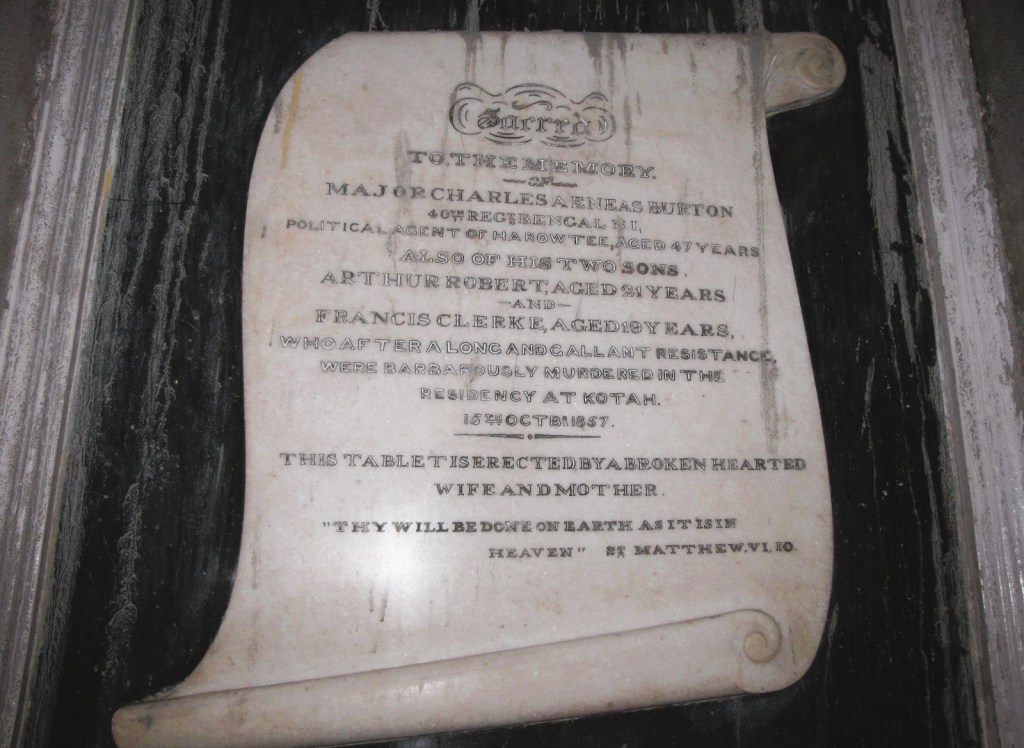
The Burtons were buried with full military honours in the Kota cemetery. The plaque which marked their graves is sadly missing; however, it once read:
“Sacred to the memory of Brevet Major Charles Aeneas Burton, 40th Regiment Bengal Native Infantry, Political Agent, Harowtee, aged 47 years and of his two sons, Arthur Robert, aged 21 years and 1 month and Francis Clerke, aged 19 years and 8 months. Three defenceless Englishmen who, on the 15th October 1857, the year of the Indian Mutiny, were barbarously surrounded in the Residency by the bloodthirsty soldiers of the Maharaja of Kotah. For five hours, these gallant men, a father and two sons, kept the whole of the miscreants at bay, when alone and unaided, they were finally overpowered and foully massacred. This tablet is erected by a broken-hearted wife and mother.
“Vengeance is mine, saith the Lord. I will repay.”
Sadly, Cecil Morton, the twin of Arthur Robert, never recovered from the shock of losing his father and brothers. Until well after the mutiny was over, he was noted to be a haunted young man, singular in his thoughts of revenge. He would die in Jullundur in 1889, and his grave would bear a sobering inscription:
“God shall wipe all tears from their eyes.”
Perhaps it was meant as much for Cecil as for his father and brothers.
Sources:
1. Agra, 26th September 1857, p 116, Records of the Intelligence Department of the Government of the North-Western Provinces of India during the Mutiny of 1857 – William Muir
2. Narrative of Events in Rajpootana, No. 107A, dated Aboo, 27th July 1858, from Brigadier General G. St. P. Lawrence to G.F.Edmonstone – Mutiny in India of 1857-58, Vol II, 1881, p 282
3. Tragically, Mac Mawson was killed by the rebels and his lifeless body was cruelly displayed by hanging it upside down on a tree near the fort’s gate. The news of his death and the horrific manner in which his body was treated spread rapidly, creating a stir among the local population. Upon learning about the incident, Thakur Kushal Singh took it upon himself to ensure that Mac Mawson’s last rites were performed with dignity and respect. https://amritmahotsav.nic.in/district-reopsitory-detail.htm?22417
https://hauntedindia.blogspot.com/2013/08/myths-legends-of-brij-raj-bhavan-palace.html
 Mutiny Reflections