Unfortunately, 1857 was a time when the press was allowed to run rampant with tales of horror and savagery. News was chaotic at best, first-hand accounts were few and verification of these horrible events was unheard of. It was only after the mutiny had concluded that enquiries were held and questions asked in regard to supposed atrocities perpetrated during those troubled years. Nor does it help that many of the stories found their way into authoritative works of the day, without any thought of substantiating them, which leaves certain books replete with horrifying details which the authors took no effort to verify. Nor has the passage of time softened the tales – in fact, it appears to have made them even worse.
Monck-Mason’s Head
Born 1825: son of Captain Thomas Monck Mason, R.N.: joined the 74th Bengal N.I., 1842 : Assistant A.G.G. in Rajputana, 1847: Political Agent at Karauli :Resident at Jodhpur, 1857: when the Jodhpur troops mutinied he arranged for the safety of the Europeans, and, on his way to join Sir George Lawrence (q.v.), was shot dead by mutineers, Sep. 18, 1857 (Dictionary of Indian Biography)
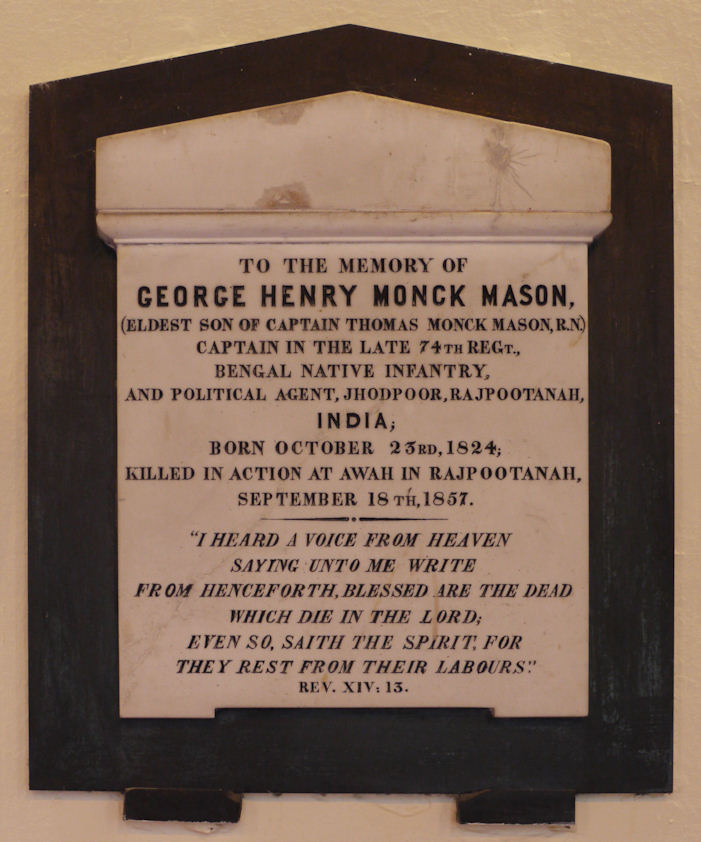
“Thakur Kushal Singh beheaded Jodhpur Political Agent Captain Monck Mason and hung his head on the ramparts of Auwa Fort.” (The Morung Express, https://morungexpress.com/rajasthan-govt-to-reach-out-to-uk-govt-to-find-names-of-24-martyrs-of-1857-revolt)
“Monck Mason, arrived at Auwa with a few men. In the fierce engagement, he was killed. His body was hung upon a tree opposite the gateway of Auwa.” (https://www.rajputcommunity.in/t/marwar-and-the-uprising-of-1857/195)
“According to local legend, Monck Mason was beheaded and his head displayed on the Thakur’s fort.” (BACSA, Chowkidar, Vol. 12, No. 4, Autumn 2021)
“The head of Monck Mason was cut off and placed over the gateway of the Fort of Awa.” (The Political Movements and Awakening in Rajasthan -1857 to 1947 – K.S.Saxena (1971)
“The wave of dissatisfaction was not so much against the Maharaja of Jodhpur as it was against the British, because, while the head of Captain Mason was hung at the gate of the Auwa Fort, that of Anar Singh was not.” (Rajasthan’s Role in the Struggle of 1857 – Nathu Ram Khadgawat, 1957)
Curiously, the only source cited for the final two quotations above is none other than Captain Charles Showers.
“The disaster was aggravated by the loss of the Political Agent of the district (the chivalrous and lamented Monck Mason), who, having ordered to meet General Lawrence before Ahwa on a fixed day, found on arriving there that the force he expected to find had retreated, when he fell into the hands of the rebels, was killed, his head cut off and placed over the gateway of the fort.” (A Missing Chapter of the Indian Mutiny” — Captain Charles Showers, p. 108)
Showers — who, at that very time, was irritating the inhabitants of Nimbahera with his impossible and positively outrageous demands that provoked them to open fire on his head — is hardly a reliable witness to the fate of Monck Mason. He further fails to mention in his exhausting narrative where he heard this from, which is an interesting departure for a man who was obsessed with providing sources for his accusations against George Lawrence. What exactly happened to Monck Mason remains uncertain.
The scenario presented by George Lawrence to William Muir at Agra (who then transmitted the details):
“ The casualties were trifling, only one artilleryman killed, and 5 or 6 Europeans wounded, with about like number of natives; 2 guns disabled. But I am concerned to state that that excellent political officer, Monck Mason, was killed close to Lawrence’s force in attempting to join it. He had pushed in from Pallee, and on reaching the jungle, which his camel could not penetrate, had dismounted, and made on foot for our force, when some of the Joudhpore Sowars came across his path, and he was killed by 2 shots from them.”
“ I was not even aware,” says Lawrence, “ of his being anywhere in the neighbourhood; he must have been scarcely 300 yards from me at the time. The body has not yet been recovered, but I am endeavouring to get it.” 1
And once again, from George Lawrence:
“Our loss was one officer, Captain Monek-Mason, Political Agent, Jodhpoor, one European, and one Native killed, and two or three natives wounded. Captain Mason had arrived (according to my instructions) from Jodhpoor to join me, but he appears to have mistaken the bugles of the Jodhpoor Legion for ours, and following the same, was shot down by some of the Legion sowars.” 2
There is no mention, until Thakur Kushal Singh’s trial, except by Showers, that Monck Mason was beheaded. That he was shot was without any question. George Lawrence failed to retrieve his body, so it cannot be ascertained if the alleged beheading occurred after Lawrence had left the area, although he did remain in the area for a full three days following the battle. At the Thakur’s trial in 1860, the accusation that Monck Mason’s body was beheaded, and his head hung on the gates of the fort, could not be substantiated, and it was further believed, the body was not mutilated. What could be ascertained was that Monck Mason’s corpse was found the day after the battle, and the Thakur himself ordered the unfortunate political agent buried. It is unlikely the Thakur would have permitted a dead body to be displayed “hanging upside down from a tree” 3 outside his compound in such a disgusting manner, and certainly not with George Lawrence still in waving distance of his fort. This is further substantiated by The Proceedings of the Rajasthan History Congress, which states,
“Monck Mason arrived in the neighbourhood of the fort. He dismounted from the camel and proceeded a short distance on foot. Lawrence’s force was then engaged with the enemy and artillery firing was going on. It appeared he enquired of someone he had met, the direction in which the Brigadier General was to be found and went off towards the spot indicated. Before he had gone a few yards, he was fired at from behind the bushes and was wounded, and almost immediately, a charge was made by a large body of rebel horse upon the wounded officer, who was immediately cut down and killed. There is no mention of any ill-treatment to the dead body of the Political Agent.”
If there had been any doubt in George Lawrence’s mind that the Thakur was indeed guilty of such an insult, he would undoubtedly have levied this against him. Instead, Kushal Singh was cited for giving protection to the men who had killed Monck Mason and for inciting rebellion against the British. As he was acquitted of all charges, it is highly unlikely the Thakur beheaded or dishonoured his corpse. Unfortunately, the Thakur’s name is still directly linked today with the beheading of Monck Mason, which seems an odd way of honouring a contemporary hero.
While we may never know the true fate of Monck Mason’s head there is likewise little sense in spreading the word of Captain Showers through history, a man who would go to amazing lengths to throw mud at George Lawrence – taking that into consideration, it is likely Showers used it to show Lawrence as incapable of taking care of his own, for by allowing Monck Mason’s head to be displayed on the walls of the fort, it was a sign of a failure in the character of George Lawrence, the man Showers blamed for his subsequent fall from grace. Whether the tale was true or not is only known to Showers.
The story, however, takes a strange twist.
Monck Mason as a Saint
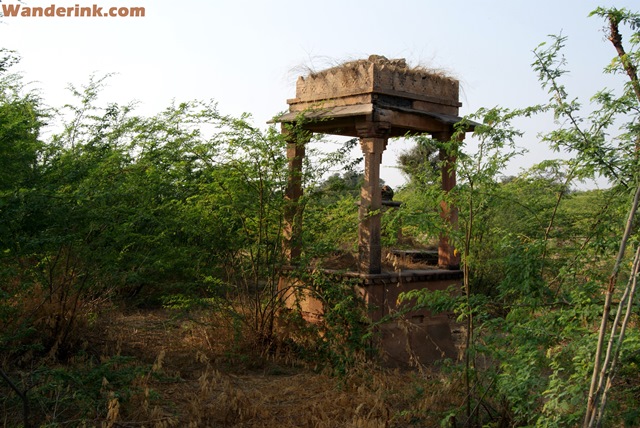
According to the article at Wanderlink:
” The eldest of three generations of Auwa thakurs, Surendra Singh says the killing was an ‘act of war’ but condones the brutality of the manner with which it was carried out. “Kushal Singh ji not only deplored the assassination but the Captain was also given a proper Christian burial right in the village itself.” The cenotaph of Captain Mason is just one of the historical gems strewn around Auwa village. Though mauled aggressively by thorny babuls from all sides, the rustic villagers have built a small shrine next to it where most evenings a lamp is lit.” The cenotaph is located a “couple of kilometres” from the fort close to an artificial lake, and this coincides with the article from BACSA which states,
“In the Rajasthani village of Auwa, ‘faith triumphs yet again over reason, ‘ reports Rohit Parihar in India Today. A group of camel-breeders from the Rabari community gather regularly to worship at the tomb of Captain George Henry Monck Mason of the Bengal Native Infantry, who was Political Agent at Jodhpur during the Mutiny.
A Jain trader is said to have constructed a small shrine on top of the grave, and at some point, the Rabaris began offering prayers here on festive occasions. Today, the grave is covered in marigold garlands, and incense is burnt, and prayers offered. Folk songs are sung here too, praising the British: ‘The English brought an iron cart that could run on rails without bullocks. Oh, Britons, your skills were too great!’ What Monck Mason would have made of all this, we will never know. “ (BACSA, Chowkidar, Vol. 12, No. 4, Autumn 2021)
 Mutiny Reflections