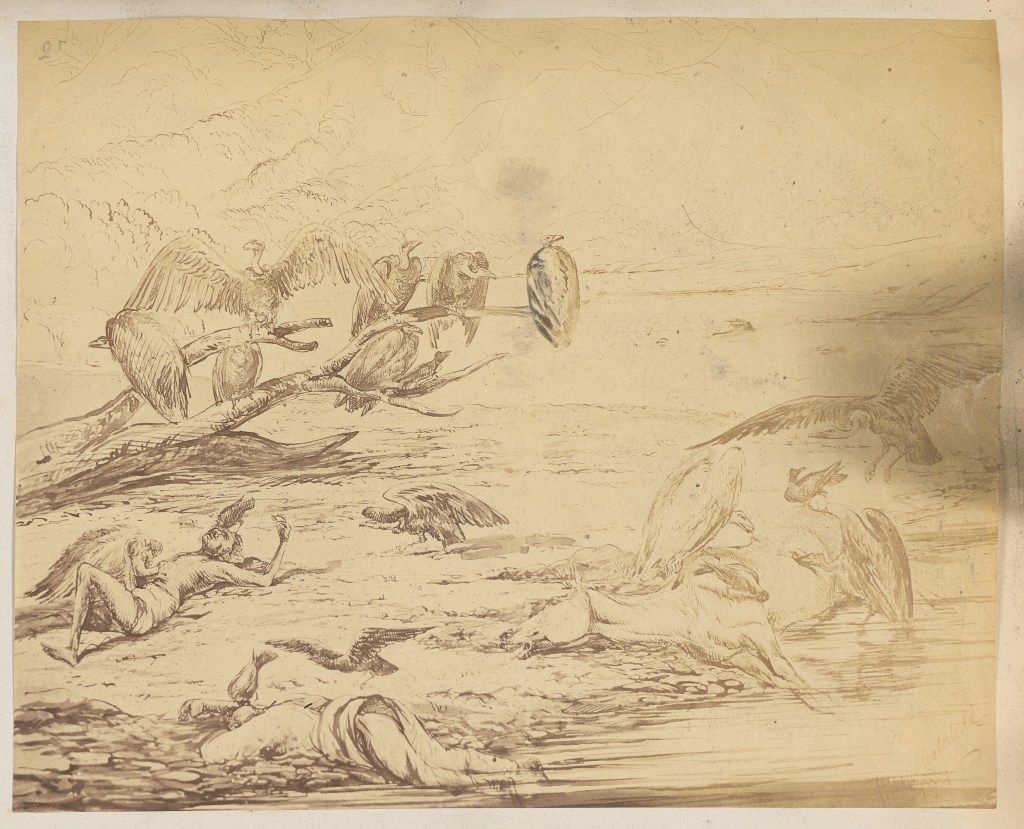
“ A battlefield immediately after an action is no very inviting scene. More than one sense is sickened by the objects around; the air is tainted, and death stares you in the face in the most hideous forms; swollen and bloated carcasses cover with vultures or being torn to pieces by pariah dogs; corpses lying drawn up in a heap burnt to a cinder; some without a vestige of clothing, others lying peacefully as they fell; the village was almost too foul to pass through; almost every house had its inmates of dead in some ghastly form or other – what the sword had commenced fire had ended.”
After the battle at Goraria, when the village had been burned to the ground, several old persons were found hiding in the fields, shell-shocked, terrified, many of them injured, others too frightened to move. They were the ones “too feeble to fly” and now were passed by, by the men of the Malwa Contingent, with hardly any regard to their welfare besides treating their injuries. A little girl was found on the field. She had ridden with her father, the daughter of a sowar of a detachment of troops sent by the Jaora Nawab, but how she had ended up on the field of battle, no one could tell, but Surgeon Lowe treated her shattered leg. The casualties of the Joara Nawab troops are unrecorded.
Surrounding the village, they found the much and varied plunder looted and collected by the insurgents but too cumbersome to carry away by those who had managed their escape from the flames of Goraria.
“All over the maidan were scattered English books, papers and envelopes, ladies’ silk dresses, bonnets parasols, elegant drawing room chairs…(the) nullahs were filled with broken furniture, cattle, and men; black heaps of ashes lay here and there with charred corpses in their centres; the air was laden with sickening gases in which vultures, kites, and crows circled and screamed…wretched camp followers were prowling among the corpses and the ruins — turning about mangled bodies, diving into wells and tanks, climbing trees, and breaking down grain stacks…”
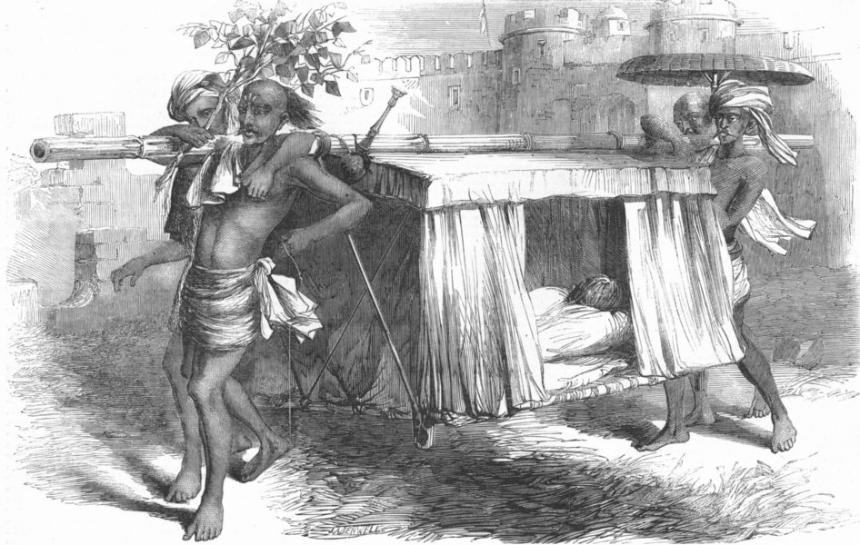
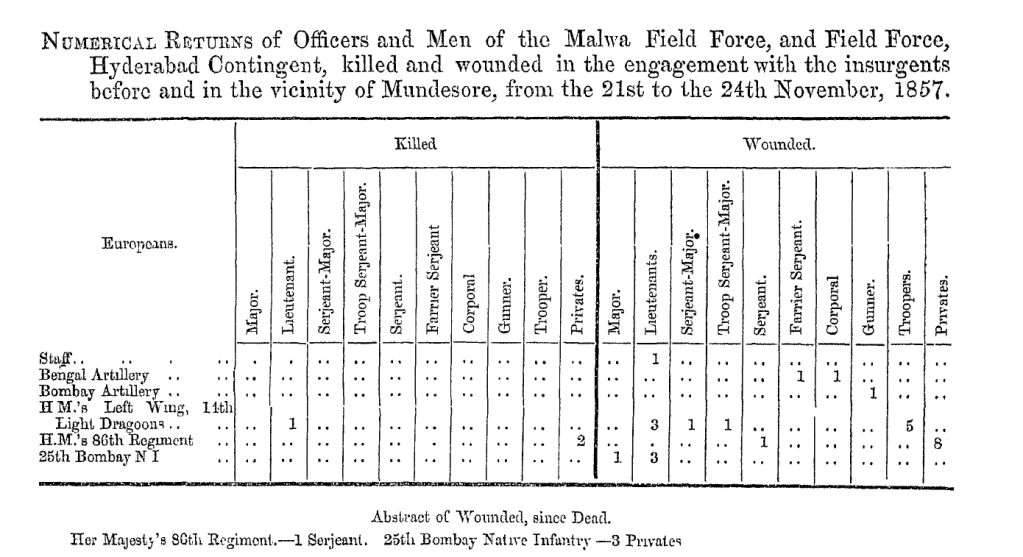
Away from the horrible scene in the village and the surrounding countryside was the even more dreadful field hospital. Surgeon Lowe and that small contingent of medical men were taking care of the wounded and writing off the dead. The sepoys of the 25th Bombay Infantry had suffered terribly, and they came into the hospital, “suffering from every description of wound — arms and legs shattered by round shot, limbs, and body perforated by musket balls and flesh wounds of no slight nature.” They sat or lay down in the sun, patiently waiting their turn on the butcher’s table. For one, when it came, and whose “blood was welling away profusely from a wound near the shoulder joint,” was offered a little brandy and water before the inevitable amputation. “Give it to my brother first,” he said, for he was sitting next to him, groaning in fearful pain. He then drank, looked at Lowe and said, “Never mind my wound, the Government will not forget me!” Lowe had never seen men, who, in action, were “cool, gallant and intrepid,” and when faced with the knife, for there was no chloroform, they displayed remarkable courage and fortitude. The names of these brave men were not written in despatches or mentioned in books of deeds and battles. Their losses by injury, as can be seen below, were the highest of this final thread in the history of the Malwa Field Force.
These final days of this first campaign in Central India were not the only battles fought and these too, shall be included here.
Neemuch
23rd of July
83rd Regiment of Foot
Privates
Maddison, William – wounded
Mason, Thomas – wounded
12th of August
83rd Regiment of Foot
Sergeant John Clifford – wounded
Privates
Boyle, Patrick – wounded
Chambers, Robert – killed in action
Siege of Neemuch
21st Bombay Native Infantry
Lieutenant R.F. Williams – severely wounded in the forehead, 9th of November
Ensign W.V. Davenport – slightly wounded, 10th of November
71st Regiment of Foot
Private William Thompson – killed in action, 9th of November
Jiran, 23rd October 1857
2nd Bombay Light Cavalry
Captains
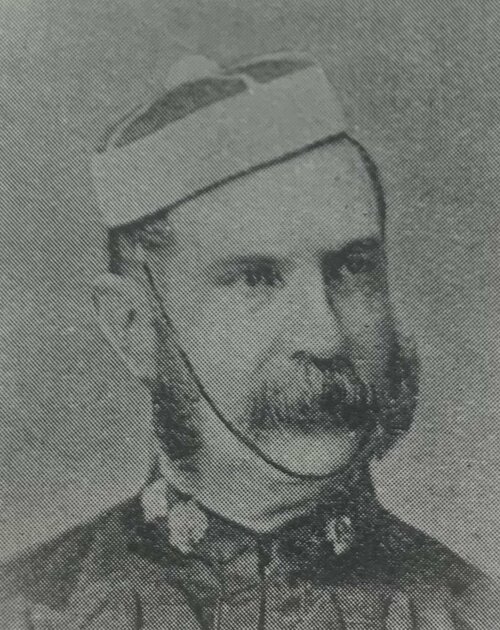
Blair, James – severely wounded in the right arm
Simpson, E.H. – dangerously wounded in the head by two sword cuts
Tucker, N.B. – killed in action. His head was subsequently found in Mandsaur
Lieutenant Willoughby E. Le Geyt – bullet wound to the groin
Trooper Gunnoo killed
83rd Regiment of Foot
Captain Samuel Read -killed in action
Privates
Fitzpatrick, William – severely wounded in the left thigh
Ryan, William – severely wounded in the left thigh
12th Bombay Native Infantry
Captain M.J. Soppitt – severely wounded in the leg.
Private, Appa Foollasker, bullet wound on the right leg, slight.
Peerajee Moitag, bullet wound, right buttock, slight.
Luximon Davee, bullet wound, back of head, severe.
Davee Deen, puncture from a lance, slight.
Lucnac Puttanai, bullet wound, left leg, slight.
Purwanee Burreye, wounded near the stomach, severe.
Nooro Khan, wounded in the thigh, slight.
Madras Artillery
Lieutenant Crump – killed in action
Staff
Captain Lawrie, a sword cut on left ear and back, and spear wound in upper part of left side of the
chest, but not severe.
Surgeon Barteman – killed in action.
One Syce, severe sword cut in the neck, and two other slight wounds.
Total killed: 3.
Wounded: 15.
Mahidpur, 8th of November 1857
The Malwa Contingent
Lieutenants
Brodie, Francis Walter Brodie – murdered at Malhargarh, 7th of June
Mills, George L. – mortally wounded and subsequently killed in a dhoolie. Attached from the 14th Bombay Native Infantry
Hunt, Charles John – murdered at Malhargarh, 7th of June. Attached from the 4th Bengal Light Cavalry
Sergeant-Majors
Manson – murdered at Mahidpur
O’Connor – murdered at Mahipur
25th Bengal Native Infantry
Captain Charles George Brodie – killed in action
Assistant-Surgeon Henry Thomas Cary – killed in action. Born 27 July 1833.
The Killed and Wounded of the Malwa Field Force
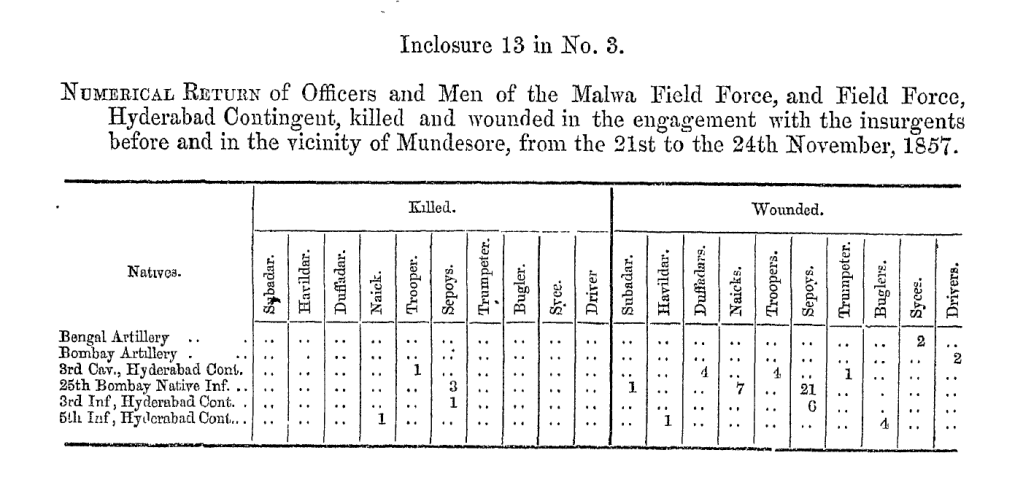
Action at Piplia 27th of October
2nd Hyderabad Contingent Artillery
Gun driver Syed Hussein – struck by a roundshot from one of their own guns, died a few hours later. The same shot took off the leg of a bullock.
3rd Hyderabad Contingent Infantry
Subadar Sooba Oopadia -severely wounded
Sepoy Sheik Ali – severely wounded
Action at Dhar 22nd-31st of October
14th Light Dragoons
Troop Sergeant Major Daniel Grainger — wounded in the right wrist and head, 31st of October
Private G. Huddleston – wounded, 22nd of October
Bengal Horse Artillery
5th Brigade, 3rd Troop
Bombadier Patrick O’Sullivan – severely wounded, 31st October.
Gunner Thomas Wiliams – shot in the eye, severely wounded, 31st October
Bombay Horse Artillery
Gunner James Docherty — killed in action
Rawal 12th of November
The Hyderabad Contingent
Lieutenant Frank Samwell – severely wounded, shot in the abdomen. Attached to the Hyderabad Contingent from the 6th Madras Native Infantry. Staff Officer to the Hyderabad Contingent Field Force.
The bullet carried with it a quantity of Setwell’s clothing and his watch chain into his stomach. The doctors were forced to probe the wound for “foreign matters” with Setwell awake during the examination. “The surgeons were quite angry” with Setwell as he could not tell them how many links there were on his watch chain! As such, Harry Prendergast recommended all officers write the number down in their notebooks, and noted down for himself, “I have eight long links and ten short ones, so if I get shot, and six long links and eight short are left outside me, and two long and two short links have been extracted from the wound I need not trouble the surgeon to look for more.”
It was reported that the losses suffered were 100 men, killed and wounded.
Action before Mandsaur and Goraria
21st November
Madras Engineers
Lieutenant Harry Prendergast – severely wounded, shot in the chest.
The bullet was deflected by a rib and went out through his back. Being dangerously close to his heart, the surgeon had been obliged to cut it open from both sides. Following the surgery, the wound refused to heal and began to slough. Treatment, by the application of “bluestone” or copper sulfate, had been proposed by a ” keen amateur veterinary surgeon.” The timely intervention of a medical officer who noted that Prendergast was not a horse and bluestone would most probably have killed him, applied lunar caustic instead as a cauterising agent. (Silver nitrate, shaped into sticks, was called “lunar caustic”) .
Writing of his experience, Prendergast notes,
“A wound in action is like any other wound – the severity depends upon its locality; a poke in the ribs with a finger does not hurt much, but a poke in the eye is a different matter. A man who is shot is generally more frightened than a man who is cut; that is, the nerves are more affected by the shock. I have seen brave men cry about bullet wounds and others laugh at sword cuts, probably quite as severe. When I was shot in the body at Mundsore, I felt the same sensation as if a man had hit me hard with a stick; it was not very painful, but the wound was close to my heart, and I was very anxious to know whether it would kill me.”
22nd November
14th Light Dragoons
Lieutenant James Leith — slightly wounded
Bombay Artillery
Gunner Patrick Kirby — slightly wounded
23rd of November
14th Light Dragoons
Lieutenants
Gowan, L. St. P. — slightly wounded
Martin, C.- severely wounded — gunshot to the knee. Attached from the 3rd Bengal Cavalry
Redmayne, Leonard — killed in action. He was mortally wounded and then hacked to pieces by the insurgents. His corpse was brought back from the field, but was so disfigured as to be unrecognisable. His horse and all his accoutrements were stolen before his body could be recovered. The horse, his accoutrements – sword, pistol, watch, etc.- were recovered at the capture of Rahatgarh Fort by Sir Hugh Rose.
Troop Sergeant Majors
Clarke, T.H. — wounded
Whittaker, Samuel — wounded
Privates
Buchanan, J. – slightly wounded
Cooper, G. – slightly wounded
Harris, J.- slightly wounded
O’Neill, John – dangerously wounded “…by a musket ball in the right side of the chest; the ball entered posteriorly at the inferior angle of the scapula, five inches above the spinous processes of the vertebræ, apparently between the eighth and ninth ribs, and was cut out immediately after from the right nipple. It had broken a rib at its exit. He went some distance on his horse from the field and bled considerably; at the time, his respiration was almost gasping, his countenance anxious, and pulse very feeble. He was almost in a state of collapse and was thought to be dying.” He survived his ordeal and was back on duty on the 8th of September 1858. At the time of his injury, he was 29 years old.
Remington, J. – slightly wounded
25th Bombay Native Infantry
Major Follet – died of cholera on the march. Buried at Burhanpur in July
Major G.H. Robertson — slightly wounded
Lieutenants
Forbes, John Foster — slightly wounded
Jameson, Charles — severely wounded
Young, David Butler — slightly wounded
3 Privates killed, 33 wounded
86th Regiment of Foot
Sergeant John Kelly – mortally wounded. Died of wounds
Privates
Anthony, Robert – slightly wounded
Brennan, Michael – killed in action in Goraria village, 24th November
Corcoran, John – dangerously wounded. Arm amputated
Cowan Thomas – slightly wounded
Curtis, John -severelye wounded “…by a musket ball, which entered three inches below and a little internal to the anterior superior spinous process of the ilium, and made exit over the trochanter. June 28th, 1859.- Fracture of the left femur at its upper third; bone united; limb three and a quarter inches
shortened; some loose, dead bone can be felt through the unhealed wound of exit; has now a very good, useful limb, and can walk well. June 29th, 1859.-Invalided.” He was 35 years old at the time of his injury and had served for 14 years.
Fayes, Patrick – severely wounded
Rafferty, William – severely wounded
Remmington, Patrick -killed in action
Wheelan, Richard – severely wounded
Bengal Field Artillery
Farrier Sergeant Robert French (2/6) – slightly wounded
Corporal Michael Sinnott (2/6) – slightly wounded
The Hyderabad Contingent
The numbers, according to their history are:
3rd Cavalry – 1 trooper killed, 4 duffadars, 4 troopers and 1 trumpeter wounded
3rd Infantry – 1 sepoys killed, six wounded
5th Infantry – 1 Naik killed, 1 havildar and 4 buglers wounded
For them, there were some rewards.
Honours of the 3rd Cavalry Hyderabad Contingent
Risaldar Ahmad Bakhsh Khan & Risaldar Muhammad Hussain Khan were promoted to Risaldar Major.
Troopers Abbas Ali Khan, Walidad Khan & Muhammad Hasan were promoted to Duffadar.
Risaldar Major Ahmad Baksh Khan was admitted, by special grant, to 1st Class of the Order of British India with the title Sirdar Bahadur as of 21st November 1857. Risaldar Major Baksh Khan had secured himself something of a reputation – he was “a fine sportsman, and speared many a boar and bear during his long and distinguished service.” In 1883, upon his retirement, in further recognition of his services, he was granted the title of Nawab. At the age of 90, he continued accompanying officers on pig-sticking expeditions at Mominabad, where he had taken up his residence. When the book A History of the Hyderabad Contingent was published in 1905, he was still alive at the age of 94.
Sources:
Behan, T. L. Bulletins and Other State Intelligence for the Year 1858. Part I. London: Harrison & Sons, London Gazette Office, 1860.
Burton, Reginald George. A History of the Hyderabad Contingent. Calcutta: Government of India Central Printing Office, 1905.
Great Britain Parliament. Further Papers (No. 6) Relative to the Mutinies in the East Indies. London: Harrison and Sons, 1858.
Intelligence Branch, comp. The Revolt in Central India 1857-59. Simla: Government Monotype Press, 1908.
Lowe, Thomas. Central India during the Rebellion of 1857-1858. London: Longman, Green, Longman & Roberts, 1860.
Malleson, G. B. History of the Indian Mutiny, commencing from the close of the 2nd Volume of Sir John Kaye’s History of the Sepoy War. Vol. III. London: W.H. Allen & Co., 1888.
Narrative of the Indian Revolt, from Its Outbreak to the Capture of Lucknow by Sir Colin Campbell. London: George Vickers, 1858.
Sylvester, John Henry. Recollections of the Campaign in Malwa and Central India under Major General Sir Hugh Rose. Bombay: Smith, Taylor & Co., 1860.
Tavender, I. T., comp. Casualty Roll for the Indian Mutiny, 1857-59. Polstead, Suffolk: J. B. Hayward & Son, 1983.
Williamson, George. Military Surgery. London: John Churchill and Sons, 1863.
 Mutiny Reflections