Gerrard’s Column
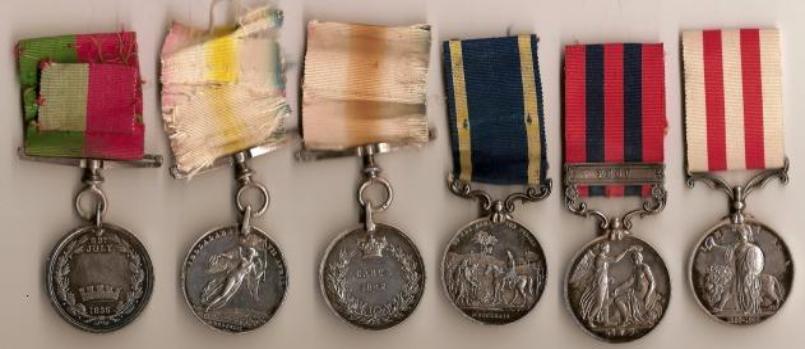
Born in 1808 in Calcutta to Major John Gerrard of the 5th Bengal Native Infantry and his wife Harriet (née Holt), Gerrard had been educated in England but arrived back in India in 1826, receiving his appointment as ensign to the 1st Bengal European Regiment in 1827. He served as A.D.C. to Brigadier Abraham Roberts, commanding the 4th Brigade of the Army of the Indus in 1838, saw action in the First Afghan War with a medal for Ghazni, was at the defence of Jalalabad in 1841 (a medal) and at the defeat of Akbar Khan by Sales’s force the following year. Gerrard was at the re-occupation of Kabul under General Pollock, thus adding another medal to his growing collection. His first command was of the 1st Jezailchie Regiment for Shah Shuja’s army in 1841, and it would hardly be his last. He saw action against the hill tribes in Sind in 1845, served during the Second Sikh War – Ramnagar; passage of Chenab and Sadulapur (Medal). Between 1850 and 1854, he was in charge of the Hissar camel and cattle farm, but this unusual posting did not take him from active service – 1852 found him fighting in the Second Burma War as major commanding a detachment of the Bengal European Fusiliers and a medal for Pegu. In 1856, he transferred to the 34th BNI as Lieutenant Colonel and barely two months later, in May, to the 14th BNI, but in 1857, he was back with the 1st Bengal European Fusiliers, and in September, this well-respected and much-beloved officer was appointed their commander.
On 9 November, Gerrard took command of another mixed column, which would bring the Jodhpur Legion to their final fight. The column was composed of the 1st Fusiliers under Captain Caulfield, the 7th Punjab Infantry under Captain Godby, 3rd Brigade Horse Artillery under Captain Colin Cookworthy, a heavy battery of 8-inch howitzers and 18-pounders under Captain Gillespie, while Captain Kennedy commanded a portion of the Corps of Guides and the Multani Horse under Captain Lind. They amounted to 1200 men of all arms but would be reinforced on the way. They marched at 1 a.m. the next day.
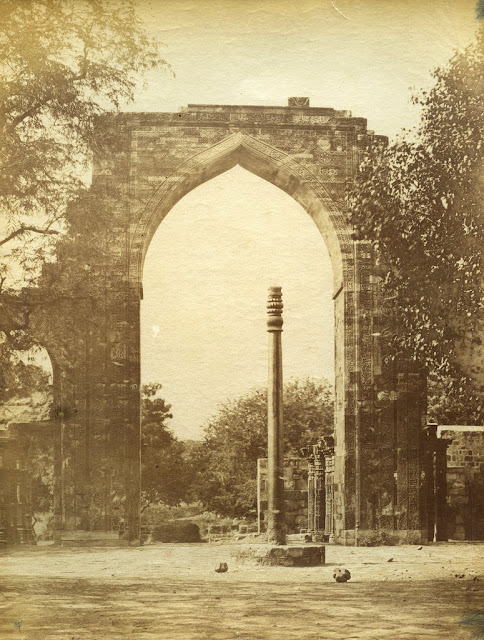
Their first stop however was barely 12 miles from Delhi, at the Qutb Minar where the men were at leisure to visit the “beautiful pillar erected in the memory of some swell, I forget his name, and also a wonderful well, which of course I went to see.” (Lieutenant Wynyard Warner).
The rest of the march would hardly be as relaxing. For the next three days, they would struggle on to Riwari, over terrible roads of heavy sand and Lieutenant Warner had hardly anything nice left to say.
“It is no joke marching 18 and 20 miles beginning at 1 or 2 in the morning… At 1 a.m., the bugle sounds, and you are pretty soon woken up by the horrible noise of camels and the row the bearers kick up, stacking the tents and loading them. Well, you have to turn out of your warm bed and dress shivering with cold and have a cup of coffee and cheroot and then the regiment marches off in total darkness and up to your ponies knees in sand…” The men, he noted, were very distressed, with “one half of them hardly recovered from their wounds and sickness.” Their first stop was Gurgaon, and the next morning to Pataudi.
“We arrive on the camping ground about 9 where we get under some trees if there are any and (wait) for the mess doolies containing some cold breakfast… Directly, it appears there is a general rush at it, and as we are awfully hungry, we seize the 1st thing we can get hold of and don’t wait for knives and forks. After breakfast, we wait patiently till the camels come up with the tents and as soon as they are pitched, I generally turn in and have a good sleep.” (Warner)
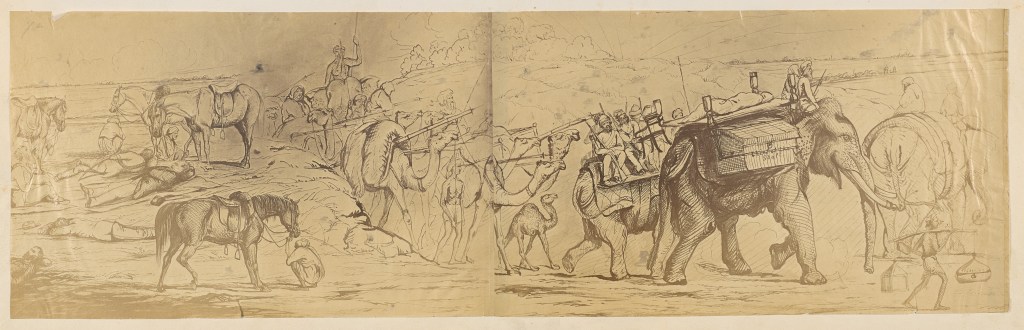
On the 13th of November, Gerrard and his men arrived at Riwari and quickly turned out the fort – it was taken without any opposition, which was fortunate for him as the fort itself was formidable enough, consisting of thick mud walls that would have put up stiff resistance to cannon shot and a deep ditch. Here, a rendezvous was made with the two squadrons of the Carabineers who had ridden out from Meerut, covering 88 miles in four days.
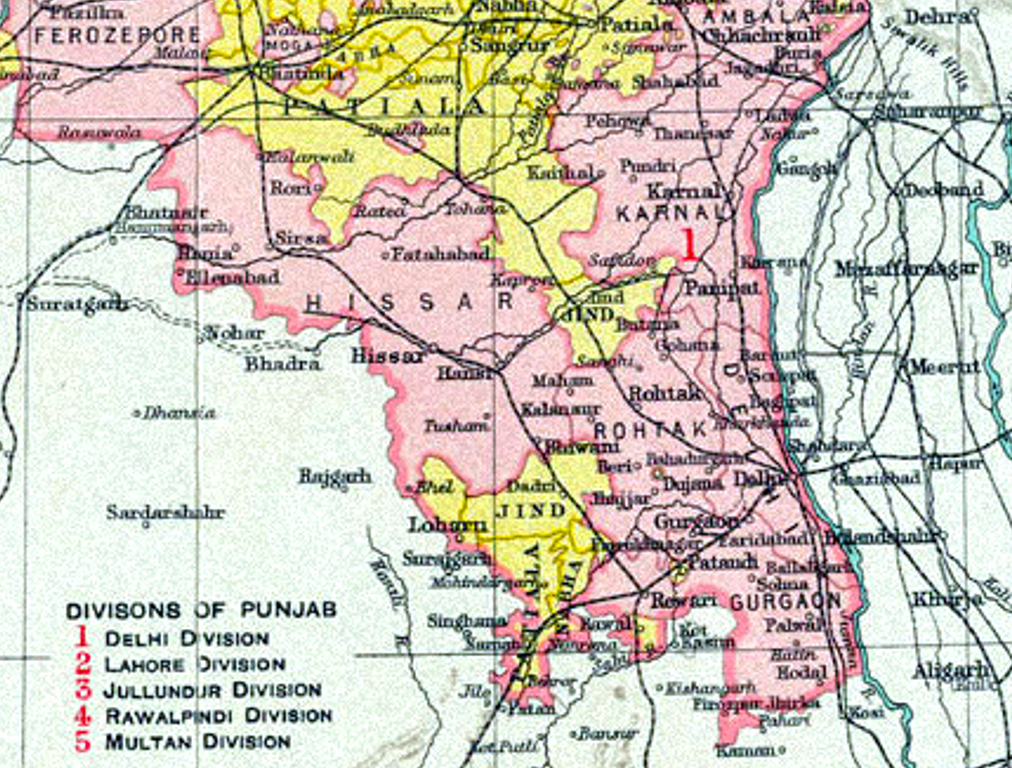
“From Rewarree, we marched to Nemboot, where there was a most unpleasant encamping ground; we
were located among sand-hills, and the slightest breeze covered bed, table, and papers with dust. We were not sorry to march next morning to Kanoude…” (Blackwood’s Magazine)
At Kanaund, they met a detachment of Van Cortlandt’s Hariana Field Force consisting of 70 sabres of the Punjab Mounted Police, Esakhel Horse – 90 sabres, Tawana – 90 sabres, four 6-pounders, 500 men of the 23rd Punjab Infantry and 620 men of the Patiala Infantry, all under Captain Stafford. Captain Bloomfield would miss the rest of the march and was left sick at Kanaud, so the command of the 23rd Punjab Infantry devolved on Lieutenant Hunt. The column had now swelled to 2500 men.
Intelligence reached Gerrard on the 15th that the Jodhpur Legion was in fact only 18 miles away, at Narnaul, and he was ready to meet them.
‘Never was there a stronger exemplification of the harmlessness of lions, when the lions are led by asses.’
“Narnul was a very strong place. It lay under a hill about four hundred feet high, which formed part of a ridge extending some miles to the southeast. It was covered in front—the front facing the road by which the British force would have to advance—by low walls, forming admirable defensive cover. A large and well-filled tank with steep banks, standing much above the surrounding plain, distant only about two hundred yards from the village, and commanding the road to it, afforded another strong position, which infantry might advantageously have occupied. The ground to the left was broken and uneven, but the plain in front was level and broad, admirably adapted to the movements of cavalry, in which arm the rebels were very strong.” (Malleson)
General Samad Khan, a relative of the Nawab of Jhajjar, was well aware of Gerrard’s Column. He had every advantage up his sleeve – a local population that heartily agreed with his cause, but he sent out no spies and made no effort to reconnoitre. With no vedettes posted or scouts sent out, it appeared Khan, even with his formidable cavalry, was relying purely on what his own eyes could see. So he waited for Gerrard to appear, and he expected him bright and early in the morning.
Meanwhile, Gerrard was struggling – the narrow streets of Kanaud proved difficult for the artillery from the start, and then the heavy sand plains proved a misery for his men to march through, while his guns needed to be dragged and then pushed by hand. The infantry had to be halted time and again to wait for the guns to come up; ten hours were lost in marching just 12 miles, and his men were becoming angry, chafing that the delay would allow the rebels to escape. And Narnaul was only 14 miles away.
Patiently, Khan waited. At ten o’clock in the morning, with no Gerrard in sight, Khan gave up for the day and retired to his camp to a dilapidated fort, two miles in the rear and gave his men the order to dismount and cook their lunches. The British, he surmised, would not be coming to Narnaul on the 16th of November. He was wrong. Gerrard was merely delayed.
Despite the grumbling of his officers, Gerrard finally managed to coax his column to Narnaul at 11 a.m., expecting to find a well-entrenched enemy – to his surprise, there was no one there. His men were understandably tired, and like Khan, Gerrard ordered a halt so his men could drink their dram of grog and eat a little food. They had hardly completed their small repast when “a slight cloud of dust was seen to rise over a gentle swell of the ground to the left in front…” It was Samad Khan, and he wanted his position back without realising he had given it over to Gerrard.
Unlike Khan, however, Gerrard knew exactly where his adversary was. The scouts of the Guides Cavalry informed him that the rebels numbered 1000 infantry and 2500 cavalry; they had eight guns, but only five were mounted, and the whole force was encamped off to the left of the village of Narnaul, on the other side of a wide nullah. The battle that would take place would defy imagination and cost Gerrard his life.
 Mutiny Reflections