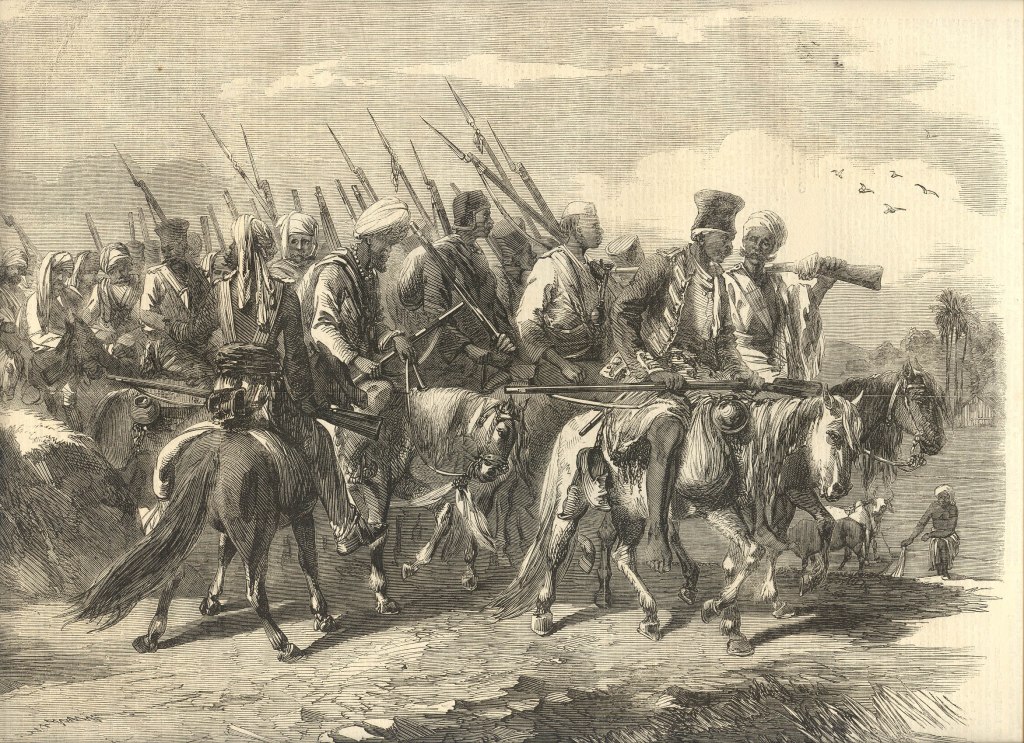
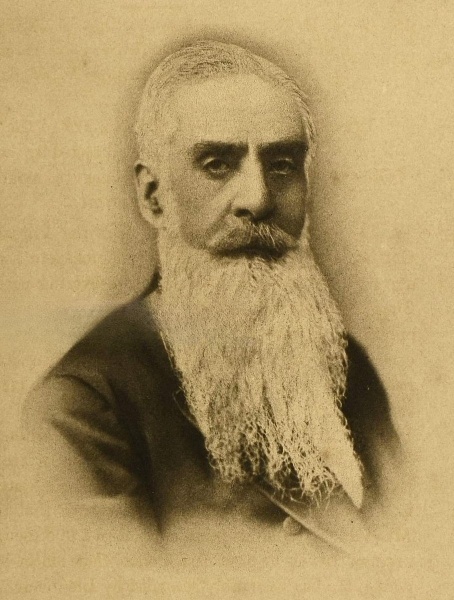
Although Delhi was taken, the districts surrounding the city were hardly peaceful. General Henry Charles Van Cortlandt, who had already made his name in the court of Maharaja Ranjit Singh, whom he served in several military campaigns in the Punjab – on the Maharaja’s death, Van Cortlandt openly joined the British. During 1848 Multan, he supported Herbert Edwardes -following the annexation of the Punjab, he took up service for the British as a civilian employed as the Deputy Commissioner of Gugera.
On the mutiny outbreak in 1857, Van Cortlandt was instructed to raise companies of Sikhs for service in the Haryana District, a task which he delegated to Captain C.C. Bloomfield (The corps would subsequently become the 31st NI in 1861, the 31st Punjabis in 1903 and the 2nd Battalion, 16th Punjab Regiment in 1922. Upon partition in 1947, the regiment was allocated to Pakistan).
While raising the corps might have been with Bloomfield, Van Cortlandt led them in battle, defeating the rebels at Onda, Khrya-Kee, Mungalee and Jamalpoor in the northwestern areas around Delhi. On 23 August 1857, a quiet day on Delhi Ridge, Colonel Keith Young wrote to his wife: ‘All is quiet as possible, and there has not been a letter in from any direction that I have heard of except from Hissar, where General Van Cortlandt has been thrashing some of the rebels well; but as he corresponds direct with Lahore, you will, I have no doubt, see an account of the business in the Chronicle ere this reaches you. I know little more than that a large party of scoundrels, both horse and foot, have been well punished.’
At the end of October, Van Cortlandt was gazetted “temporary Colonel of the Army” so he could continue commanding the irregular levies he had raised, but by this point, it was somewhat superfluous. Van Cortlandt had been so successful in the Rohtak district that by the 26th of September, the roads were open, and it was possible to re-establish civil authority, who even found it possible to collect revenue.
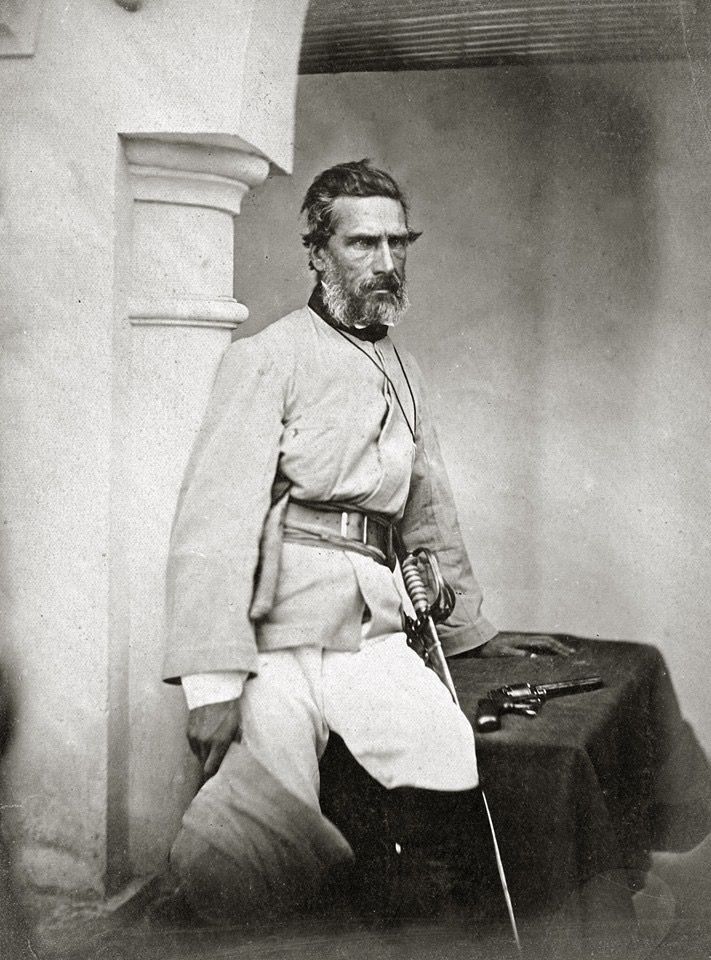
With Van Cortlandt busy on one end, Brigadier St. George Daniel Showers, the commanding officer of the 2nd European Regiment, was despatched on the 2nd of October with a column to clear the districts to the west and southwest of Delhi. It was a very mixed column, consisting of a portion of Hodson’s Horse, the Guide Cavalry, a field battery and two heavy guns and mortars of the 2nd European Regiment, 2nd Gurkhas and a regiment of Sikh Infantry. Their first stop was to be the fort of Jajjhar, but their march took them through Riwari, where the fort was taken without any opposition.
The Nawab of Jhajjar
Nawab Adbur Rahman Khan of Jhajjar had thrown in his alliance with the Delhi court, but he had joined the rebellion with some reluctance, having been given little choice in the matter by the rebels and had, at the same time, been paying lip service to the British. Now that the tide had turned, he allowed Showers to take Jajjhar without any opposition on the 18th of October.
“In actual fact, the Nawab had no nerve to take an open stand against the British. Nor did he dare to displease Bahadur Shah. Thus, throughout be played a double game, paying lip allegiance to the latter while extending help with money, men and materials to the former. But this pleased neither of the parties. The British in particular viewed him as their enemy.” (Yadav)
The Nawab would be transported to Delhi and tried, and the charges brought against him were the following:
1) aiding and abetting rebels and others waging war against the British government in places at that time under martial law
2) furnishing troops with money, food and shelter to the rebels
3) entering into treasonable correspondence with them.
The circumstances of his trial remain suspect, the evidence vagueAlthough his defence was very strong, the motive of vengeance by one Charles Theophilus Metcalfe, who claimed, in his testimony, he had been maltreated by the Nawab, is all too stark.
The court found the Nawab guilty and sentenced him to death by hanging, and the sentence was carried out on the 23rd of January 1858.
The March Continues
The next morning, the Fort of Kanaund, in the same district, surrendered to the Carabineers and Hodson’s Horse, who had marched 41 miles in 15 hours to take possession of 14 guns and 5 lakh rupees in treasure. Showers then returned to Delhi, having in all occupied four forts, burnt too many villages, captured 70 guns, £80’000 in treasure besides much in the way of ammunition and horses. Two princes had surrendered to him, along with the “notorious partisan” Hakim Abdul Haq, chief of Gurgaon. He had expected to find the Jodhpur Legion at Kanaund – the latest intelligence had placed them nearby.
The Jodhpur Legion and its supporters had been making their way toward Delhi since the 10th of October, albeit at no great pace. They had put the Jaipur troops to task, who had refused to fight, and those who could had switched sides and joined the Jodpur Legion — and now they had come to a stop in the Haryana District, as close to the great city as they would ever get.
As for Shower’s expedition, it could hardly be called a rousing success. He had failed to capture the rebellious Tula Ram or his cousin Kishan Singh of Rewari or the General Samad Khan of Jhajjar or Muhammed Azim of Battu, all of whom had been formenting revolt in Haryana. They had managed, on good intelligence regarding the oncoming column, to escape into northern Rajasthan to forge a junction with the Jodhpur Legion and would return to Haryana and retake the Fort of Rewari almost as quickly as Shower’s had left it. However, finding Riwari a most unsuitable place for a protracted defence, they marched on until they reached Narnaul. Instead of sending Showers out again, General Penny decided another column would be formed, this time under Colonel John Grant Gerrard, commander of the 1st European Fusiliers, an officer of some merit.
 Mutiny Reflections