Killed and Wounded in the Action at Badli-ki-Serai
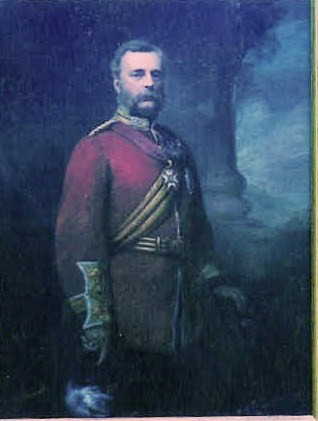
https://the-bechers-in-india.weebly.com/arthur-mitford-becher-1816-1887.html
Some sad particulars:
“Wasn’t it sad news I wrote you yesterday about poor Chester? I have since heard more accurate particulars about his death. It seems he lived for a minute or two after he was struck down, and young Barnard, Aide-de-Camp, jumped off his horse and went to his assistance, holding his head until he died. He was quite sensible at first, and spoke to Barnard, asking him to raise his head that he might look at his wound; and seeing – as well he might, poor fellow – that he couldn’t live, he want Barnard to leave him, which he would not do, but gave him some water to drink, on which he said, “What’s the use of giving me water?” But it seemed to revive him a little, and he died without apparent pain. His remains were interred in the burial ground yesterday evening, Mactier and I having had the body bound up in blankets, and got Mr. Rotton to perform the service. That poor fellow, Russell, also whose wound proved mortal, was laid by Chester’s side in another grave.
I am sorry to say that two more officers were killed that I had not of when I wrote to you yesterday: Harrison, Her Majesty’s 75th, and Delamain 56th Native Infantry, and poor Howell, I regret to add, died of cholera the night before we left Alleepore. Light, of the Artillery, slightly wounded in the forehead; Greville, 1st Fusiliers slightly in the hand, and young Davidson, of the Artillery, was severely burnt by the blowing up of a tumbrell. I don’t think there can be any more casualties among the officers, or I should have heard of them.” – Colonel Keith Young to his wife, Camp, Delhi Cantonments, Tuesday, 9th of June (10 1/2 A.M.)
Colonel Chester was mortally wounded by roundshot which tore through his side. It also killed his white horse, “Sir Walter” who he was riding at the time, instantaneously.
Staff Officers
Colonel Charles Chester, killed.
Born in 1803, the son of Sir Robert Chester and his wife Eliza, in Hintlesham, near Ipswich, Co. Suffolk. He entered the services of the EICo’s Bengal Army in 1820 and arrived in India the following year to take up duties with the Bengal European Regiment, then stationed at Ghazipur. The following year, he was in Sultanpur with the 2nd Battalion, 4th BNI, but in September 1823, now Lieutenant Chester was reposted to the 2nd Battalion of the same regiment before being appointed to the 1st Battalion, 20th BNI, then at Singapore. The army reorganisation saw him removed from the rolls of the 1st Batt. 4th BNI and placed on the newly formed 23rd BNI (lately 2nd Batt. 4th BNI), but he continued serve with the 25th BNI (lately 1st Batt. 20th BNI) in Singapore. In 1825, he returned to Calcutta, where he was appointed to the commissariat and, on their strength, would be sent to Arakan to serve out the rest of the First Burma War. However, he was not about to leave Burma. Appointed as Assistant to Mr. Craufurd, Envoy to the Court of Ava, he would not return to Calcutta until the end of February 1827. Furlough was the order of the day, and Chester went home, only returning to India in the autumn of 1830. His regiment, the 23rd BNI was in Ludhiana so it was off to the Punjab, where he would remain in various positions until 1833, when he resigned his adjutancy to attend and conduct to Calcutta a deputation from the Maharaja Ranjit Singh to the Right Honourable, the Governor-General,” that kept him busy until 1835. Ten months on sick leave in Simla were followed by furlough in 1837, and he did not return to India until 1839. What followed was a variety of postings, including Brigade Major of the Eastern Frontier District, officiating Deputy Judge Advocate General of the Presidency District, and not only officiating Deputy Assistant Adjutant General of the Saugor Division, but in 1846, of the Cawnpore Division. As Assistant Adjutant General of the Second (Gilbert’s ) Division of the Army of the Punjab for the Punjab Campaign of 1848-49, Chester was present at the crossing of the Chenab and at Chillianwallah, where he nearly lost his life trying, gallantly but fruitlessly, to save the life of a fellow officer. Immediately after the battle, he was appointed officiating Assistant Adjutant General of the Army, with the position of Second Assistant Adjutant General at Army Headquarters following barely two weeks later and dated with effect from the battle. In this capacity, he served for the remainder of the Punjab campaign, including the Battle of Gujerat.
Promoted to the rank of Lieutenant-Colonel by brevet and with the Punjab campaign medal with two clasps firmly pinned to his chest, Chester was nominated Dirst Assitant Adjutant General of the Army, which quickly turned into the charge of the Adjutant General’s office at the Presidency.
In 1850, he was granted two years’ leave to visit the Cape Colony, New South Wales and Egypt but returned to India before his leave was over in November the same year in time to accompany the new Commander-in-Chief, Sir William Gomm to the Upper Provinces. In 1855, Chester went home on sick leave and arrived back in India in March 1856 as Adjutant General of the Army.
In 1857, he was in Simla with the Army Headquarters when the mutiny broke out and accompanied the Anson until his death at Karnal, after which Chester continued on with the Delhi Field Force under Sir Henry Barnard. Colonel Chester was killed a Badli-ki-Serai when he was struck by a cannon-shot during the first few minutes of the battle. He was 53.
“To the memory of Colonel Chester Adjutant General of the army, who fell mortally wounded at the battle of Badlee Suraie. This monument is erected by his brother officers of the General Staff in token of their affectionate regard and esteem. his remains were here interred on the 8th June 1857.’ (Rajpura Cemetery at Delhi).
75th Regiment of Foot
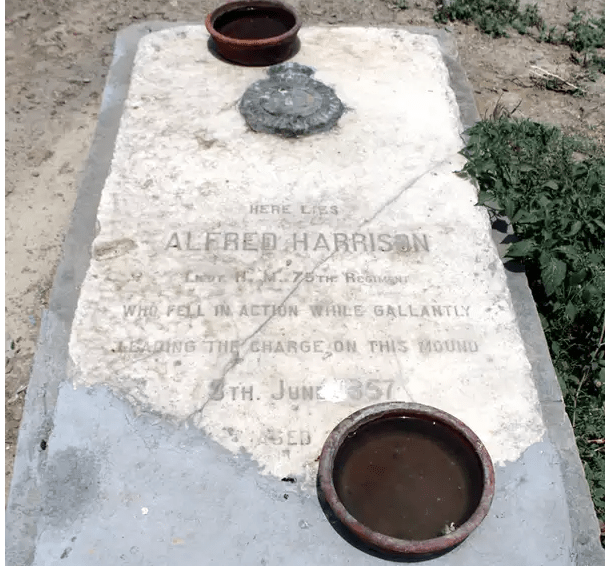
Lieutenants
Barter, R. – severely wounded
Rivers, C.R. – slightly wounded
Ensign C.M.Pymm – wounded
Assistant Surgeon S.A. Lithgow – wounded
Sergeant John Pearce – slightly wounded
Drummer William Magennis, killed
Corporals
Collins, Edwin – severely wounded “…by a musket ball, which entered the upper and outer side of the right thigh, and lodged, fracturing the femur; ball extracted; a piece of bone came away. July 20th. – Wound healed; right leg about two and a half inches shorter than left; femur bent; fractured ends of bone overlap, and there is abundant deposition of new bone; the long splint was used. Has a good, useful limb and can walk a long distance. September 6th, 1858.—Sent to modified duty. October 6th.- Invalided by an order from the Horse Guards.”
Ford, Aaron – killed
Harris, Samuel – slightly wounded
Herringshaw – Thomas, slightly wounded
Privates
Adams, William – killed
Alderidge, George – severely wounded
Armstrong, Edward – slightly wounded in the right knee
Armstrong, James – slightly wounded in the right foot
Austin, Nathan- wounded in the right side
Baker, George Baker – severely wounded
Baker, Frederick – wounded
Barry, John – slightly wounded
Bourke, Michael – slightly wounded
Burke, Michael – wounded in the left thigh
Calvin, John – severely wounded
Clyde, Samuel – slightly wounded
Condrin, John – slightly wounded in the left foot
Corbett, Michael – killed
Coughlan, Patrick – killed
Croad, John – killed
Daine, John – killed
Dalton, John – killed
Daniels, Christopher – severely wounded
Deveney, Brian – killed
Dobney, Thomas, severely wounded in the right ankle “…by a grape shot, which struck him on
the inner and posterior aspect of the tibia, one inch above the right ankle, and passed out through the external malleolus. Several pieces of bone have come away. July 20th.- Wound healed. Skin adherent to bone and parts much thickened. Ankle-joint anchylosed. Considerable loss of bone of both tibia
and fibula. November 11th, 1858.- Invalided.” At the time of his injury, he was 38 years old.
Douglas, John – killed
Dowton, Humphrey – killed
Gallagher, Patrick – severely wounded in the right foot
Galvin, John – severely wounded in the right thigh
Gillespie, John – killed
Grant, Thomas – killed
Greenfield, Charles – severely wounded in the chest by grapeshot
Hanlon – Michael, killed
Hawkins, Thomas – severely wounded in the left leg
Holmes, Henry – severely wounded in the right leg
Horan, Thomas – wounded in the neck
Houston, James – killed
Hugo, Hugh – killed
Johnston, John – dangerously wounded, arm amputated
Johnston, Thomas – severely wounded in the shoulder and chest
Jones, William – killed
Keane, Patrick – killed
Lally, Martin – killed
Leigh, Edward – wounded
Leckie, David – severely wounded in the arm
McClure, Robert – slightly wounded
MacLoughlin, Peter – slightly wounded in the left ankle
Metters, Thomas – killed
Montgomery Colin – slightly wounded
Morrison George – slightly wounded
Norton, William – killed
Paine, William – slightly wounded in the right hip
Parker, Thomas – bayonet wound in the right thigh
Reid, George – slightly wounded
Reynolds, John – slightly wounded
Rice, William – killed
Robson, Robert – slightly wounded in the left side
Ryan, Edward – severely wounded in the left arm
Silk, John – wounded in the right arm
Stafford, Jame – killed
Steggles, Charles, killed
Thompson, Francis – dangerously wounded, died of wounds
Varley, George – wounded in the left thigh
Walsh, Peter – killed
White, Edwin – slightly wounded
Wilson, James – killed
1st European Bengal Fusiliers
Privates
Brummage, William – killed. A carpet weaver from Kidderminster, Worcs, Brummage, enlisted at Cardiff on 20 February 1854, for a term of 10 years.
Liddle, William – killed. Liddle, a labourer from Falkirk, Stirling, enlisted on 31 May 1843 at Glasgow for unlimited service. At one point, he was discharged at his own behest, but cancelled it.
Manning, James – mortally wounded. Died of wounds on 9 June. A baker by trade from Loughrea, Galway, he had enlisted on 26 May 1852 at Athlone for 10 years.
McVey, Thomas – severely wounded. McVey’s injury required the amputation of his leg at the hip joint. He died on 9 June. A labourer from Drummore, Tyrone, McVey had enlisted on 13 October 1848 at Glasgow, for 10 years’ service. Had he lived, he would have been discharged in 1858.
Philipps, George – killed in action. A cabinet maker from Upton on Severn, Worcester, Philipps had enlisted on 5 June 1849 at Gloucester, for 10 years’ service.
Roberts, John – dangerously wounded, died of wounds, 16 August 1857. Hailing from Bilston, Stafford and a blacksmith by trade, Roberts enlisted on 11 May 1855 at Southampton for 10 years.
Siddle, William – killed
2nd European Bengal Fusiliers (raised 1839 as the 2nd Bengal European Regiment)
Sergeants
Kenney, Dennis – right arm shot off
Cain, William – wounded in the right shoulder. A labourer by trade from Portarlington, Queens, he enlisted on 23 April 1849 at Limerick for ten years. Cain was discharged with government sanction and struck off by Regimental Order on 14 July 1859.
Corporals
Barry, Edward – severely wounded in the foot, amputated. Originally from Fermoy, Cork, he had enlisted on 15 May 1839 at Cork, stating his trade as a labourer. He was invalided in March 1858.
Drummer John Stunt – dangerously wounded. Died of wounds 12 August
Privates
Angus, John, – wounded in the leg. A miner from Ardrie, Lanark, Angus had enlisted on 25 April, 1855 for a term of 10 years, at Glasgow. In 1858, he was appointed to the depot at Subathoo, but by November, he was invalided home.
Boyd, Robert – mortally wounded. Died of wounds 9 June
Brown, John – wounded in the shoulder. He would be invalided home in March 1858. A labourer hailing from Glasgow, he had enlisted for 10 years on 11 January 1855.
Coroner, Henry -mortally wounded. Died of wounds 9 June
Frost, Edward – dangerously wounded. Died of wounds 13 June. A tin smith from Dereham, Norfolk, Frost enlisted at London on 20 June 1854 for 10 years’ service.
Kain, James – wounded in the back, Kain died on 30 June 1859, “found drowned in the tank in the rear of the South Barracks.” Before enlisting at Dundee, his home town, on 12 February 1852, Kain had been a mill worker.
Maguire, Robert – burnt on hand
Meake, William, wounded slightly
54th Bengal Native Infantry
Captain Claude W. Russell – killed
56th Bengal Native Infantry
Captain John Weston Delamain – killed, aged 30.
Born in 1827, the son of Captain John Delamain would do his best to have a colourful career. He entered EICo’s Bengal Army in 1845, and upon his arrival in India the following year, joined his regiment, the 56th BNI, in Agra. With the 56th, Delamain would join the Army of the Punjab in 1848, where they were present at the passage of the Chenab, the action at Sadulapur and the following battle of Chillianwallah, where he lost his arm to grapeshot.
His career, up to Chillianwala, was being watched closely by his brother-in-law, Captain Henry Aimé Ouvry (3rd (The King’s Own) Regiment of (Light) Dragoons) who sent periodic progress reports to his wife, lamenting in, September 1848, that he was sorry to say that(Johnny), would not do much good, “without passing language examinations; he will never be able to get any appointment, and he not pass an examination, as he will not even try.” Furthermore, “He is among a terrible set, and it comes off safe, it will be next to a miracle., I have been told that he is not in debt, but who can tell what may happen when he sees around him bankrupt?” Besides this, Johnny was refusing to write back to Henry, who, persistent to the last, asked an old officer about him, “…he told me he that he did nothing but smoke and drink beer, and was obstinate when spoken to…” Henry presumed Johnny was worried that his overly concerned brother-in-law would write to his mother!
In November 1848, both their regiments were serving the Army of the Punjab. It was Ouvry’s squadron that was ordered out after the battle of Chillianwala to try and save some of the wounded, and the first man Ouvry came across was none other than John Delamain, together with a sepoy of his regiment that had steadfastly remained with the young man. What Ouvry saw filled him with horror. Delamain’s left arm had been shattered by a Zumbooruk ball, and as he could see, there would be no way to save it. Delamain had been wounded in the afternoon, around 2 pm, but with no provisions for the wounded, he spent the next four hours wandering about the battlefield, under fire, until Ouvry found him. As if to prove a point, as Ouvry was bundling Delamain into a doolie, the Sikhs opened fire on him.
Delamain was deemed by the surgeon to be too weak to withstand chloroform, so his arm was amputated close to the shoulder while he was conscious. The next day, when Ouvry saw him again, he was still lying in his bloodied dhoolie but with companions – two wounded men had crawled into it during the night to stave off the cold. Ouvry quickly disentangled Delamain from the other two men, one of whom was lying on top of him and sent him to his tent. This would come back to Ouvry years later in Cawnpore, when he took charge of another man, Lieutenant Colonel Ewart of HM’s 93rd, who was wounded in almost the same way as his poor brother-in-law. Delamain was eventually sent to the hills to recover; he received one year’s pay, a pension of £ 75 for the loss of his arm and a staff appointment. Ouvry, in the meantime, had changed his mind about his wayward brother-in-law, “Since I have been on the campaign, I have learnt to like him better than I thought I should have done at first, and he is too good to throw away in the Indian Service.”
Delamain remained in Simla on sick leave until October 1850; when he was fit enough to resume service, he was given a staff appointment with an irregular regiment in Fatehgarh, but at his own request, the appointment was cancelled, and he rejoined the 56th BNI as their adjutant, a post he held for the next five years. The regiment was called for duty against the Santhals, and Delamain was present throughout the entire operation. On gaining his captaincy, he continued acting as adjutant until his replacement arrived and then remained in the Santhal District with the 56th until the end of 1856, when the regiment was ordered up to Cawnpore. Fortune perhaps smiles on the brave, for Delamain, who was nominated Brigadier Major of the 56th in April 1857, happened to be away in Simla on private business and did not take up his appointment; he was still up in Simla when his regiment mutinied in June. On hearing of the outbreak in May, Delamain cancelled his leave and hurried down to Ambala, where he was attached to HM’s 75th. Acting as Orderly Officer to Brigadier Wilson, Delamain, ever in front, was shot in the mouth; the bullet passed through his spine, killing him instantly. As soon as Ouvry arrived on Delhi Ridge, he fulfilled a promise he had made to his wife – he would bury Johnny Delamain.
6th Dragoon Guards
Sergeant Edward Langford – wounded
Troop Sergeant Major Joseph Mantan – wounded
Corporal John Mayling – wounded
Privates
Hill, Samuel – killed
Taylor, Stephen – wounded. Died of wounds, 9 June
Smith, Alfred – severely wounded. Right leg amputated
9th Lancers
Troop Sergeant Major Patrick Nugent – killed in action
Sergeants
Lindsay, Horatio – killed
Helstone, Henry – slightly wounded
Ronayne, John – slightly wounded
Corporals
Bishop, John – killed
Kelly, J. – killed
Roberts, John – wounded. Died of wounds.
Saunders, William – wounded. Died of wounds
Privates
Allison, Samuel – killed
Arnold, Daniel – killed
Burns, John – killed
Clarke, WIlliam – killed
Daily, Hugh – killed
Donovan, Henry – severely wounded
Everett, Thomas H. – slightly wounded
Fairweather, James – killed
Gardiner, John – killed
Gray Andrew – killed
Hartley, John – killed
Martin, Thomas – dangerously wounded. Died of wounds
Parker, George – dangerously wounded. Died of wounds
Rimel, William – killed
Rudland, Francis – dangerously wounded. Died of wounds
Shepherd, Joseph – killed
Taylor, Richard W. – severely wounded
White, James – killed
Bengal Field Artillery
Second Lieutenant A.G. Davidson – severely wounded
Second Lieutenant Charles Hunter – slightly wounded
Sergeant John Orrall (1/2)- Severely wounded in the forehead. Orral was a labourer from Derry, who enlisted at Glasgow on 17 May 1844 for unlimited service. He was invalided to Chunar on 9 February 1858.
Gunners
Benyon, Henry – slightly wounded in the forehead
Howfield, Benjamin – unposted recruit, killed. A silk dyer from London, Howfield, enlisted on 16 February 1856 for 12 years’ service. He was killed in action at Badli-ki-Serai.
Kirkpatrick, James (Bombardier, 4/6) – killed in action. A labourer from Donegal, he enlisted at Liverpool on 19 September 1848 for 12 years.
Moffatt, Thomas – unposted recruit, contused wound from shell splinter. He would be invalided back to Europe on 10 October 1858. A labourer from London, Moffatt appears to have enlisted twice, the first time on 18 December 1855, and the second on 5 March 1856, for a term of 12 years.
Bengal Horse Artillery
Bombardier William Hill (1/2)- severely wounded in the shoulder (roundshot to the right shoulder). A grocer by profession, from Warrington, in Cheshire, Hill enlisted on 7 November 1851 and arrived in India the following year. In 1861, now a corporal, he volunteered to join the Royal Artillery.
The British force lost 51 killed, including 3 officers, 131 wounded and 11 missing out of a force of 600 cavalry and 2400 infantry. They were supported by 22 guns of questionable quality.
Sources:
Barter, Richard. The Siege of Delhi: Mutiny Memories of an Old Officer. London: Folio Society, 1984.
Campbell, George. Memoirs of My Indian Career. Edited by Charles E. Bernard. London: Macmillan & Co., 1893.
Hodson, W. S. R. Twelve Years of a Soldier’s Life in India: Being Extracts from the Letters of the Late Major W. S. R. Hodson, B.A. Edited by George H. Hodson. London: John W. Parker & Son, 1859.
Ireland, William Wotherspoon. History of the Siege of Delhi by an Officer Who Served There. Edinburgh: Adam & Charles Black, 1861.
Roberts, Frederick Sleigh. Forty-One Years in India: From Subaltern to Commander-in-Chief. London: Richard Bentley & Son, 1897.
Rotton, John Edward Wharton. The Chaplain’s Narrative of the Siege of Delhi, from the Outbreak at Meerut to the Capture of Delhi. London: Smith, Elder & Co., 1858.
Tavender, I. T., comp. Casualty Roll for the Indian Mutiny, 1857–1859. London: J. B. Hayward & Son, 1983.
Williamson, George. Military Surgery. London: John Churchill & Sons, 1863.
Young, Keith. Delhi—1857: The Siege, Assault, and Capture as Given in the Diary and Correspondence of the Late Colonel Keith Young. Edited by Henry Wylie Norman and Mrs. Keith Young. London: W. & R. Chambers, 1902.
Links:
https://www.britishbattles.com/indian-mutiny/siege-of-delhi/
 Mutiny Reflections