The Battle of Badli-Ki-Serai and the Taking of Delhi Ridge
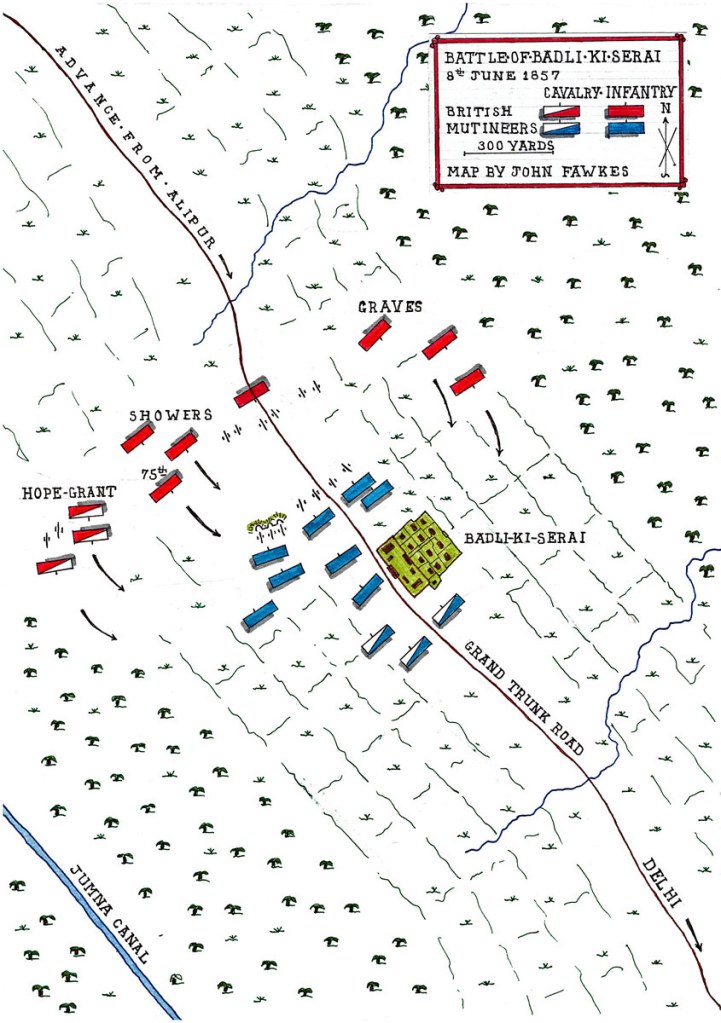
“The mutineers had selected an admirable position on both sides of the main road. To their right was a serai and a walled village capable of holding large numbers of Infantry, and protected by an impassable swamp. To their left, on some rising ground, a sandbag battery for four heavy guns and an 8-inch mortar had been constructed. On both sides, the ground was swampy and intersected by water-cuts, and about a mile to the enemy’s left, and nearly parallel to the road, ran the Western Jumna Canal.”
At midnight, Brigadier Hope Grant set off with the first advance column consisting of artillery and cavalry –
3rd Troop of the Horse Artillery under Major Frank Turner
four guns of the 2nd Troop of 1st Brigade under Major Tombs
three squadrons of H.M.’s 9th Lancers.
They were guided by Lieutenant Hodson with some Native Horse. First, the column crossed the bridge and then followed a bullock track that took them through the empty countryside back over the canal. They moved along the bank to come upon the flank of the enemy while Colonel Showers would attack with the main column from the front. Their progress was much hindered by the poor state of the roads, full of ruts and watercourses – by the time they achieved their position, the discharges of cannon told them the battle had already commenced.
At one o’clock in the morning of the 8th of June, the camp at Alipore was stuck, preparatory to an advance on the enemy’s position. Within an hour, they were ready to march. The plan was to attack the enemy at sunrise.
Second Column, Colonel Graves
6th Dragoon Guards (Carabineers)
four heavy guns were placed in position on the road
a party of Sappers commanded by Lieutenant Chesney
four guns of Major Scott’s Battery
H.M.’s 75th Foot
1st European Bengal Fusiliers
Third Column – Brigadier Grant
1st Battalion of 60th Royal Rifles
2nd European Bengal Fusiliers
the Sirmur Battalion
a party of Sappers under Lieutenant Salkeld of the Engineers,
2nd Troop of the 3rd Brigade under Captain Money
1 squadron of H.M.’s 9th Lancers
The rear guard was commanded by Major Cobbe of the 87th Royal Irish Fusiliers and consisted of one squadron of 6th Dragoon Guards, one company of 2nd European Bengal Fusiliers and two guns of Major Scot’s Battery. They were assembled in front of the siege train. Impressive though it may sound, none of the regiments named were present at their full strength.
“The advance column took a road to the right, so as to come upon the left flank of the enemy; other two columns, the first of which was commanded by Brigadier Showers and the second by Brigadier Graves, moved fully half an hour after the advance column.“
The mutineers had indeed chosen their position carefully, and their numbers were considerable, consisting of nothing less than seven entire regiments, two detachments of infantry and two regiments of cavalry. Their ranks were further strengthened by deserters and fugitives from Ferozepore, Meerut and Ambala, by soldiers on furlough, by policemen and chaprassies of all kinds, as well as innumerable volunteers from Delhi and the ever-present Gujurs from the countryside. Their guns were ably manned by the men of the 3rd Company, 7th Native Battalion of Artillery, by the gun lascars of the Delhi Magazine and retired Golundazes who lived in the city.
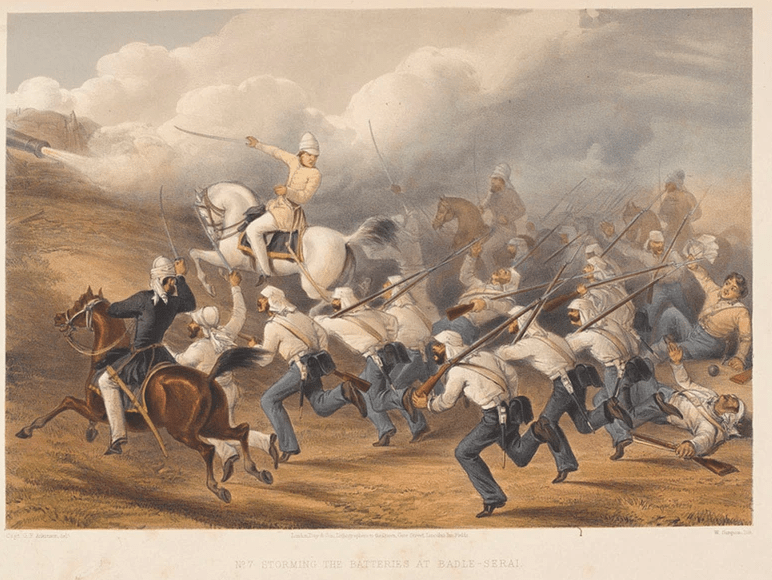
“At half-past four in the morning, the main body came up to the village of Badli-ki-Serai. The sepoys immediately opened fire from the battery in front of the serai. Then were heard the deep shouts of the Europeans and the yells of the sepoys. With deadlier hatred, two foes had never met…”
The Artillery advanced quickly and fired; the infantry deployed on each side of the road. “Their cannon told on our ranks; one of our waggons was blown up, and the bullock drivers of our heavy guns ran away. Captain Money’s troop of horse artillery galloped up, unlimbered and fired with great judgement and precision; but it was evident that the enemy’s guns in their strong and sheltered position could not be silenced.” As the British casualties mounted under the regular and sustained firing of the mutineer sepoys, it was quickly ascertained that the 2nd Column had fallen behind and was not yet in sight. “One round shot carried off the leg of Captain Money’s trumpeter and mortally wounded Colonel Chester, the Adjutant General. Captain Russell, another of the staff, was killed, and several horses fell; Sir Henry Barnard said he had never witnessed such a concentrated fire, even before Sebastopol. The 75th, who had been lying down in line and the 1st Fusiliers, were ordered to charge upon the heavy battery.”
First ordered to form a square to meet the attack of some cavalry, the men scrambled to their feet, only to be quickly formed again in a line when it was ascertained what had been taken for enemy cavalry was, in fact, their own men. “The ground was broken and covered with water…The enemy’s guns were pointed at the advancing line as it struggled through the mud…Seventy men were killed and wounded in a few minutes. Captain Harrison was shot through the head, and seven officers were wounded.”
The 75th “neither flinched nor stayed” and rushed the guns, driving before them at the point of the bayonet the Golundaze gunners and their protection detail of infantry. The 1st Fusiliers carried an enclosure and several houses, setting them on fire; then supported by the 75th, they rushed the serai, broke open the gates and bayonetted the defenders. The 2nd Brigade under Colonel Graves now appeared on the enemy’s right while Brigadier Grant with the Lancers took them in the rear on the left as the guns came up “one by one”. The Lancers wasted no time in falling upon the enemy and captured three guns as Colonel Yule cut down three men singlehandedly. This might have gone badly for Grant – the ground was broken and marshy, and the guns were slow in coming up. In their eagerness to charge, the Lancers dashed ahead, leaving the guns behind. Fortunately, the sepoys had not noticed and failed to capture the guns in the brief moment they were left unprotected.
The victory at Badli-ki-Serai was by no means the end of the day’s work. There was a real danger the mutineers, though routed, might rally – the British were outnumbered and desperately out-gunned; another fight so soon as Badli-ki-Serai would have meant their defeat. With that in mind, General Bernard decided to push home his advantage and mustered the men to move forward to Delhi. The goal for the 8th of June was not the recapture of Delhi – for that, Barnard had too few men. Instead, he set his sights on a more practical target, a rocky hill called the Ridge.
 Mutiny Reflections