Lieutenant Samuel Hill Lawrence, 32nd Regiment of Foot
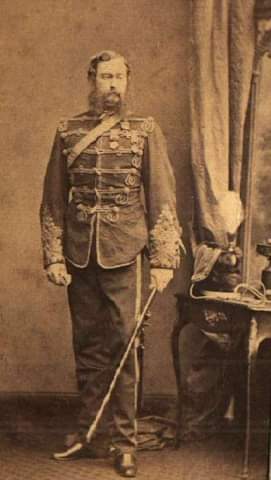
Born in 1831 in Cork, Ireland, Samuel Hill followed the footsteps of his father, also named Samuel Hill, into the 32nd Regiment. His father had seen service in the Napoleonic Wars and was wounded at Quatre Bas in 1815 – his son would proudly join the regiment in 1847 and immediately ship out to India, arriving in time to serve with his regiment in the 2nd Sikh War, with action at Multan and Gujarat.. It was a quick school for what was to come. His brother, Hector, born in 1833 and serving in the 34th Foot, would be killed at the Siege of Sebastopol in 1855.
On the 22nd of February, 1850, Lawrence was promoted to lieutenant and then just as rapidly promoted to field captain at Lucknow. He would be left in charge of Machchi Bawan, the fortress Sir Henry could not hold, and after organising its complete evacuation, on the night of the 1st of July, Captain Samuel Lawrence, with four other men of the 32nd, laid the charges and blew up the fort. 240 barrels of gunpowder and 594’000 rounds of ball and gun ammunition went up in such a tremendous blast, that the very walls of the Residency shook. Then Captain Lawrence rode, with all the calm a man could have, to the Residency.
“For distinguished bravery in a Sortie on the 7th of July, 1857, made, as reported by Major Wilson, late Deputy-Assistant Adjutant-General of the Lucknow Garrison, for the purpose of examining a house strongly held by the Enemy, in order to discover whether or not a mine was being driven from it. Major Wilson states that he saw the attack, and was an eye-witness to the great personal gallantry of Major Lawrence on the occasion, he being the first person to mount the ladder, and enter the window of the house, in effecting which he had his pistol knocked out of his hand by one of the Enemy:—also, for distinguished gallantry in a Sortie, on the 26 September 1857, in charging with two of his men, in advance of his Company, and capturing a 9-pounder gun.” ( “No. 22328”. The London Gazette. 22 November 1859. p. 4193)
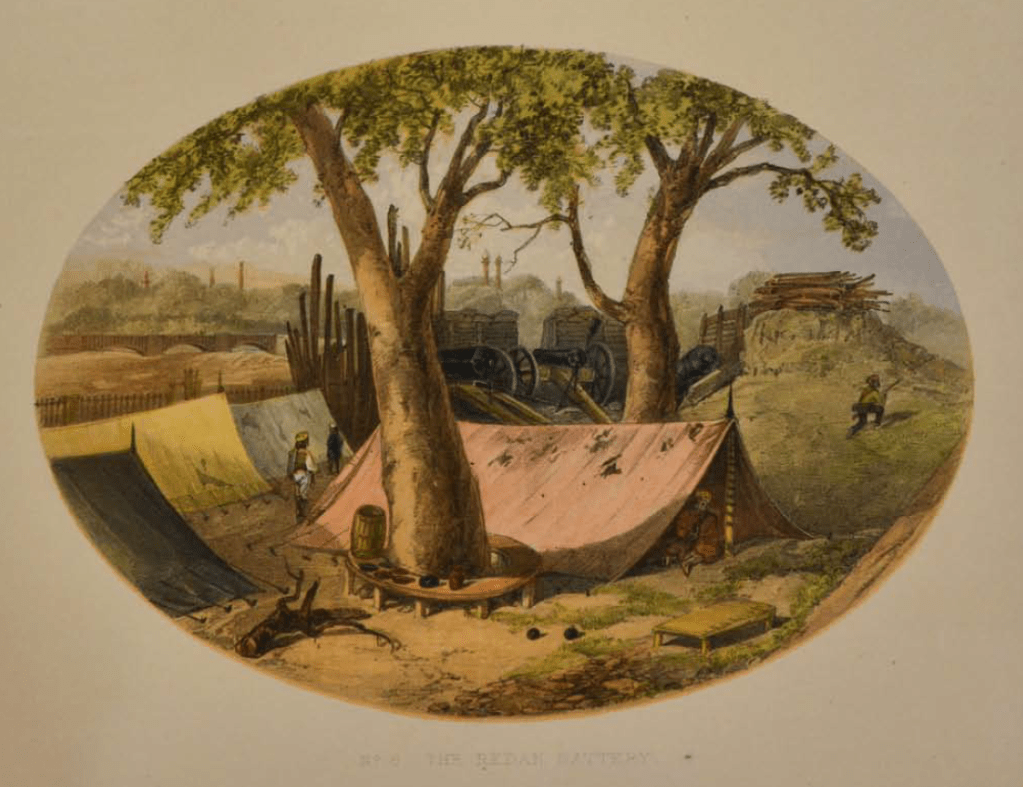
For the duration of the siege, Lawrence’s post was no other than the best battery the garrison had to offer, aptly named the Redan.
“This is the Redan Battery, and it is quite unnecessary for me to inform any member of the Lucknow garrison that that individual looking out of the tent, so thoroughly perforated with musket-bullets,—evidently on the watch to offer a passing friend the best of everything his scanty means may afford,—is its gallant commander, Sam Lawrence, of the 32nd Foot. It is impossible for me to call him “ Captain,” although he has since obtained that rank, which was never more hardly or more honourably earned. Strange to say, Sam, although commanding one of the most dangerous posts; a volunteer, too, upon every sortie; and one of the biggest men in the garrison, escaped throughout without a scratch. Some of his comrades aver that he principally exposed his burly personage upon these desperate sallies in the hope of obtaining the wherewithal to replenish a stomach which, he alleged, suffered sadly from the uncompromising diet furnished by the Commissariat. How far this may be true I cannot tell; but it is certain that he was ever foremost on these occasions. The bridge to the left is the celebrated iron bridge leading to cantonments, which was within the range of our guns, and consequently not much frequented by the enemy. The post was exposed to a very heavy musketry fire from the rebel sharpshooters stationed in the adjoining houses and mosques. Many men were hit in the battery by bullets that came through the loopholes. It was under that tree to the right that poor Mr. Ommanney, the Judicial Commissioner, received the wound which ended in his death. It was with the object of destroying this position that the enemy sprang their first mine on the memorable 20th of July. The attack, too, which they subsequently made upon the Redan was very determined. In fact, they evidently would have liked extremely to carry the battery; but Sam Lawrence and his band were in no mood to humour them, and their loss was always very heavy. (Mecham)
On the 7th of July, Lawrence showed just what kind of a soldier he was as he led the first sortie against Johannes’ House. Suspected a mine was being dug from that position towards the Residency position, 50 men of the 32nd and 20 Sikhs, led by Captains Mansfield and Lawrence, with Ensign Studdy of the 32nd, Ensign Green of the 15th NI, and accompanied by two engineers, Fulton and Anderson, were formed together for a sortie. They filed out swiftly through a sally port in the wall by the Martiniere Post at noon, covered by a brisk cannonade from the neighbouring batteries, while the officers on the roof of the Brigade Mess occupied the attention of a fearsome rebel sniper, who was watching, eagle-eyed as ever, from the tower of Johannes’ House. Occupied as he was, he did not perceive Captain Lawrence who was quick up the ladder and after a brief tussle in which Lawrene’s pistol was knocked out of his hand, dispatched the sniper. Below, the engineers were preparing charges of powder to blow up the house while Lawrence, Studdy and the others dealt with the rebels indoors. They bayonetted, according to some, 30, then continued, running out of the house and, in their fervour up the Cawnpore Road. At this juncture, Inglis curbed their enthusiasm, calling them back. He could see the rebels gathering in large numbers on the road, something the men could not see from their position on the road. They returned to the Residency, Lawrence sans a trouser leg, which was blown away. The affair had dampened the rebel attitudes for but a moment – as soon as the 32nd turned their backs, they deposited their dead and reoccupied Johannes’ House. Although it was not a victory by any means, the sight of Lawrence leading the charge had raised the spirits of the garrison, a sorely needed boost of morale.
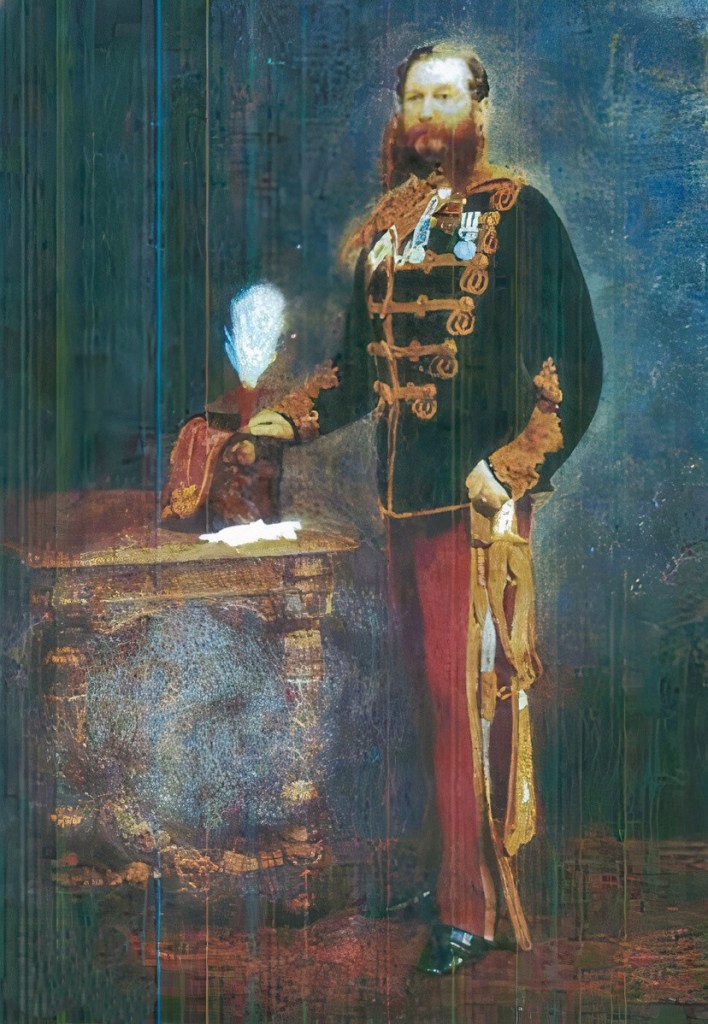
Described by Mcleod Innes as the “beau ideal of manly beauty, always genial and smiling, whether leading a sortie or waiting in quiet expectation of being blown up at the Redan,” Samuel Lawrence cheered everyone who came across him during the siege. His jovial nature bore the distress of the siege better than most; when he feared the rebels were digging a mine barely 40 yards from his battery, Lawrence joked with Inglis he “expected to shortly be among the little birds” and then roared with laughter. The engineers sallied out after dark to assure Lawrence that indeed no one was going to blow him up any time soon. His humour and bravery found an equal match in the formidable Captain McFarlan, who, during the attack on the Redan on the 20th of July watching his men dart out of the way of the falling shower of earth, called out to them, “Well, lads, when you are tired of running away, perhaps you’ll come back again.” Lawrence held the Redan and sortie after sortie, saw him sally out, always first.
On the 26th of September, with Havelock and Outram ensconced in the Residency, Samuel Hill Lawrence was called yet again to lead a sortie. By this time, Inglis’ patience with Outram was wearing thin and he protested against the ill-usage of the men of the 32nd. Outram ignored him and out went Lawrence, to secure the ground between the north of the Residency and the Gumti, including the capture of Captain’s Bazaar. Lawrence and his men left the compound by Innes’ Post at its north-western corner and pursued the rebels as far as the Iron Bridge before turning back to Captain’s Bazaar. Then, leading two of his men in the fore, Lawrence captured a 9-pound gun. It was the second citation for his VC.
After Lucknow, Lawrence returned home. Boarding the Ava in February 1858, in Calcutta with other survivors of the siege, the ship struck rocks off the east coast of Sri Lanka, close to Trincomalee. It was Lawrence whom Julia Inglis first saw, as he strode up to her, and seizing her hand, he said, “Don’t be afraid, Mrs. Inglis.” He then rushed up to the deck to ascertain how bad the damage was while Mrs. Inglis, fearing the worst woke her maid and children and prepared to abandon ship. Lawrence appeared again, this time less contained than before, “Don’t wait a minute,” he said, “Come up on deck at once!”
Together with Captain Forster, he persuaded Lady Inglis to board the first boat, she, the wife of their commander, however, put up a fuss, not wanting to leave the scene of danger. Lawrence and Forster swore to her they would follow in the next and she finally suffered herself to be rowed away. Meanwhile, Lawrence rushed down to her cabin and saved not only her cashbox and her writing desk, as the Ava slowly filled with water. Despite the best efforts of the crew, the Ava sank, but thankfully with no loss of life.
Lawrence arrived in England, not as planned on the Ava, but on the Himalaya, still together with Lady Inglis. He took his leave on shore and went home. He was awarded his brevet majority and received his VC on the 4th of January 1860 from Queen Victoria at Windsor Castle. Since VCs do seem to run in families, it was no exception for Samuel Hill Lawrence – his cousin, Lieutenant Thomas Cadell won his VC for actions at Delhi in June.
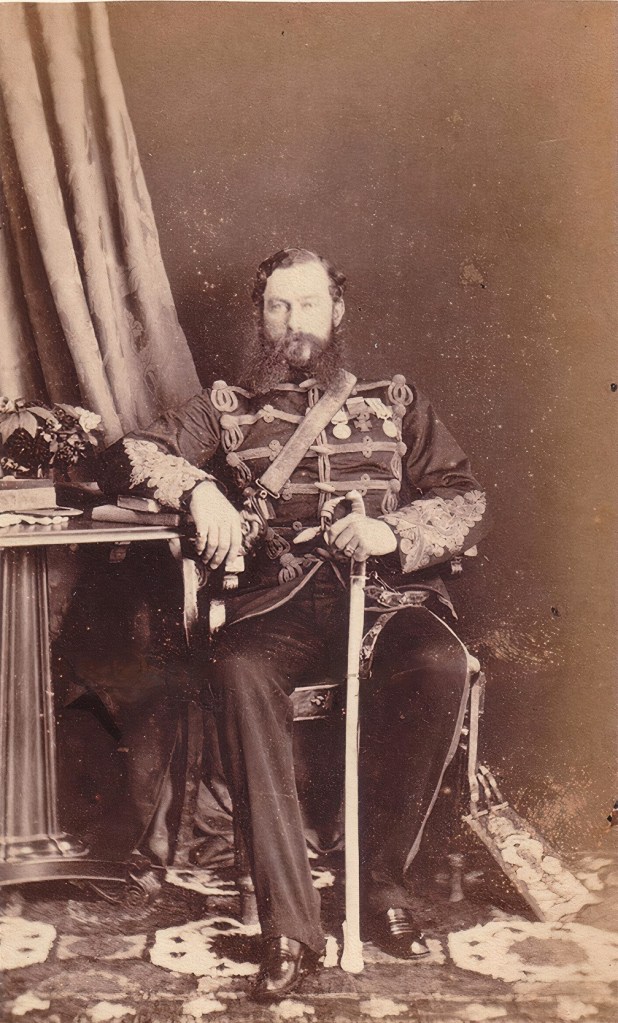
From here, the story of Samuel Hill Lawrence takes a strange turn. He had exchanged from the 32nd into the 25th Regiment of Foot in December 1859, but shortly after moved to the 8th Hussars in 1862. He returned to England for the last time in, on board the St Lawrence East Indiaman in April 1864. The 8th Hussars were proceeding to their station at York, but then, just as suddenly Lawrence exchanged into the 11th Hussars, stationed in Dublin, before retiring from the army altogether in 1865. The reason for all these moves is not known and besides being highly unusual, would have been very expensive. In 1868, he travelled the South America.
The United Services Gazette of the 15th of August 1868 reported that
“‘Major Samuel Hill Lawrence V.C., late of the 11th Hussars, died on 17 June at Estancia del Arazati, Monte Video, South America aged 37.’
The cause of death was never clearly ascertained but was put down to an illness he had contracted in India. What he was doing in South America, remains a mystery. According to some sources, he was buried initially in the Old British Cemetery at Montevideo but later disinterred and reburied at the British Cemetery, Avenue General Rivera in Montevideo. Unfortunately, even this is a matter of conjecture and no one can say for sure if he found his last resting place here after all.
 Mutiny Reflections
Engrossing read, thanks.
LikeLiked by 1 person