Private William Dowling, of the 32nd Regiment of Foot
“For distinguished gallantry on the 4th of July, 1857, in going out with two other men, since dead, and spiking two of the Enemy’s guns. He killed a Soubadar of the Enemy by one of the guns. Also, for distinguished gallantry on the 9th of the same month, in going out again with three men, since dead, to spike one of the Enemy’s guns. He had to retire, the spike being too small, but was exposed to the same danger. Also, for distinguished bravery, on the 27th of September, 1857, in spiking an 18-pounder gun during a Sortie, he being at the same time under a most heavy fire from the Enemy.” (No.22328. The London Gazette, 22 November 1859, p. 4193)
Thus, William Dowling received his VC.
Born in 1825, in Thomastown County Kilkenny, Ireland, little is known of Dowling’s early life. In 1845 he joined the army, and, posted to the 32nd Regiment of Foot, he was swiftly on his way to India, arriving in time to fight at Multan and Gujarat in the 2nd Sikh War.
In 1857, Dowling was still a private with the 32nd Regiment of Foot but Lucknow would show just how adventurous a man he was. Following Chinhat and the first furious days of bombardment against the Residency, three Irish privates of the 32nd and a handful of volunteers made a swift sortie. The objective of their sortie was to disable a 9-pounder the rebels had placed during the day behind a small mosque, on the road to the Iron Bridge. It was early afternoon on the 4th of July. Sir Henry Lawrence still lay dying at Dr. Fayrer’s House as William Dowling and the other men crept over the barricade at Innes Post. They were indeed unexpected guests, for at the post, they found some of the rebels asleep and others still at their dinner. Only the sentries were armed. Private William Cooney rushed the gun and drove home the spike with William Dowling killed the subadar and Private Michael Smith rapidly fired his musket at the others, and bayonetted two more. The volunteers acted on this occasion, as the covering party. Before the rebels realised what had happened, Dowling and the others were rushing back to Innes Post. They came through the ensuing heavy fusillade without a scratch.
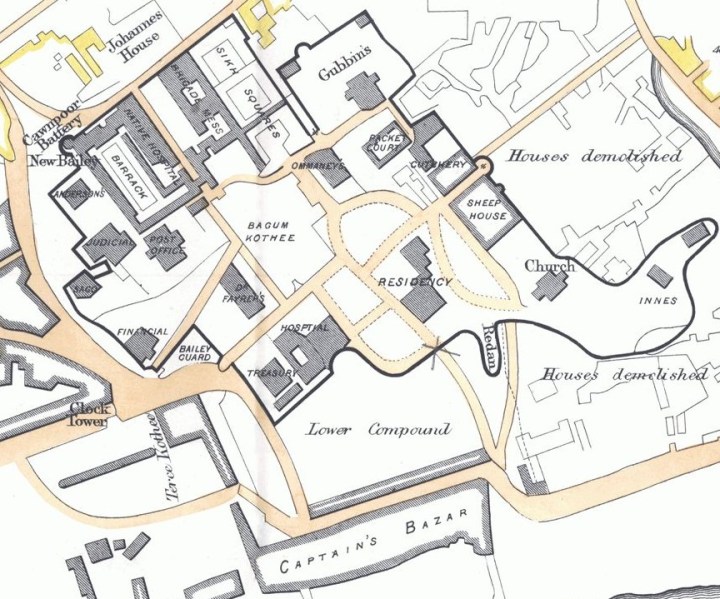
The next sortie, however, was not as successful. Once again, Dowling, this time with only 4 men, crept out of the garrison, making their way towards another gun, close to the defences. To his horror, Dowling found his spike was too short and would not completely block the touchhole. There was nothing for it but to retreat under a hail of bullets. It would be his last sortie until the 27th of September (after Havelock’s arrival) when on the ill-fated mission to capture the gun at the Phillip’s Garden Battery which cost the garrison dearly.
“We captured and spiked three guns after much firing, when, from want of confidence in the guide, and uncertainty as to where we were, the commander became confused — our men grew uneasy standing still — the enemy crowded forward, encouraged by yells and bugles — and we scrambled out of the battery, and followed our inclinations home... As we lingered in the battery a Sepoy of the 13th Native Infantry, who came out as a pioneer, advanced to a broad opening through which the enemy kept up a brisk fire, and, flourishing his pick-axe, called to the Europeans to follow him to another gun, till he was shot down. But the uproar and confusion at that, moment was such that nobody heeded him, and he would have been left behind had I not helped him out of the battery, and put him on the road, along which I was myself in full flight soon after.“
The sortie drew back under a murderous fire from the surrounding buildings which cost the lives of four men of the Madras Fusiliers, seven wounded of which two were mortally hit, and three men killed of the 32nd, among the Privates Cooney and Smith. The 32nd, which could ill-afford any losses, had one sergeant and four privates wounded, Lieutenant Huxham was severely injured and a young civilian named Crabbe was killed. However, Private William Dowling escaped unhurt, having spiked an 18-pounder.
However, there had been more than enough work for Private William Dowling to do between July and September. Like Lucknow Kavanagh, Dowling discovered he had a talent for that most hazardous occupation – mining. Towards the end of the siege, Captain Crommelin, who had arrived with Havelock’s force and would be in charge of much of the later mining operations would write in his report to the Governor General,
“I cannot close this report without noticing, in the most favourable manner, the important services performed by the undermentioned soldiers, as superintendents of the miners, Sergeants Cullimore, Bannetta and Farrer, and Corporal Dowling, all of the 32nd Regiment.”
Dowling would be promoted to sergeant before the end of the siege (on the 17th of November) and would be recommended for the VC.
“For distinguished gallantry on the 4th of July, 1857, in going out with two other men, since dead, and spiking two of the Enemy’s guns. He killed a Soubadar of the Enemy by one of the guns. Also, for distinguished gallantry on the 9th of the same month, in going out again with three men, since dead, to spike one of the Enemy’s guns. He had to retire, the spike being too small, but was exposed to the same danger. Also, for distinguished bravery, on the 27th of September, 1857, in spiking an 18-pounder gun during a Sortie, he being at the same time under a most heavy fire from the Enemy.” (No. 22328. The London Gazette. 22 November 1859. p. 4193)
He received his VC from Queen Victoria at Windsor Castle on the 4th of January, 1860. 1863 finds Dowling living at the Richmond Barracks in Dublin, celebrating the baptism of his son, Joseph Francis. When he exactly left soldiering is uncertain but he never rose past the rank of sergeant. Although he was drawing a pension, Dowling took employment with the Customs and Excise Office, a position he held until his death in February 1887, succumbing to bronchitis at the age of 60. He was buried at Ford Cemetery in Liverpool.
“Within this cemetery lies Serjeant William Dowling VC 32nd (Cornwall) Light Infantry; 1825-1887 of Thomastown, Co Kilkenny. Awarded the Victoria Cross for his; Gallantry at Lucknow on 4th and 9th July and 27th September 1857. William Dowling ended his days in this parish. This memorial plaque was moved from Ford Cemetery to here in 1991; Please pray for him.“
His Victoria Cross is currently in the possession of the Duke of Cornwall’s Light Infantry Museum in Bodmin in Cornwall, England.
 Mutiny Reflections
Engrossing read, thanks.
LikeLiked by 1 person