Corporal William Oxenham, 32nd Regiment of Foot
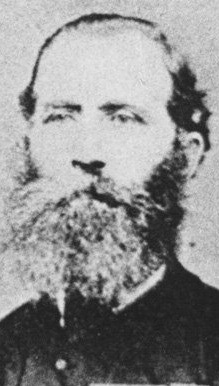
Born in October 1821 in Tiverton Devon, William Oxenham joined the army the 32nd Regiment in 1842 – it is likely poverty drove him to take the Queen’s shilling; he had married Hannah Harris in 1841 and had a little daughter, Charlotte, at the time of his enlistment. It is unlikely his family would have been allowed to follow him to India and during his 13-year absence from home, his wife died.
As his record tells, he served in the 2nd Sikh War. Oxenham was awarded the Punjab Medal with 2 clasps, Multan and Gujerat, but these were not the only medals he wore. Besides his VC, Oxenham wore the India General Service Medal with 1 clasp for North West Frontier, the Indian Mutiny Medal with 1 clasp, Defence of Lucknow and finally the Army Long Service and Good Conduct Medal.
Following the 2nd Sikh War, Oxenham was promoted to corporal and Oxenham would find himself, along with the rest of the 32nd, in 1857, doing duty in Lucknow.
“For distinguished gallantry in saving the life of Mr. Capper, of the Bengal Civil Service, by extricating him from the ruins of a Verandah which had fallen on him, Corporal Oxenham being for ten minutes exposed to a heavy fire, while doing so.” (“No. 22328”. The London Gazette. 22 November 1859. p. 4193)
His VC was awarded for an exceptional feat of bravery on the 30th of June, but unlike William Cubitt, it was not for Chinhat. It was for digging out a very unfortunate civilian, named Mr. Capper, from under the ruins of a veranda. It happened at the very badly battered Anderson’s Post, on the south face of the Lucknow Residency. Not wanting a golden opportunity like Chinhat to go to waste, the rebels lost no time in positioning their guns to face the newly formed posts, where men were still scrambling to get the defences in order, and while the injured men were still hobbling through the Bailey Guard Gate, the rebels opened fire on the Residency.
“So soon as our troops reached the Iron Bridge, one party went off to the Muchee Bawan, and the remainder came into the Residency: all the men were completely knocked up, and looked most miserable. The enemy kept up the pursuit, and we were now really and truly besieged at Lucknow. The gates were shut, and our guns opened. The mutineers soon filled the streets, and came howling up close to the outposts, where we were all ready for them; they also forthwith commenced getting guns into position.
At my garrison, a sharp fire was kept up from our loopholes, but the enemy brought a gun to bear on the pillars of our verandah, and soon brought it down with a terrible crash. Mr. Capper happened to be in the verandah and was firing out of a loophole, when a shot struck one of the pillars, and down it came. This gentleman was buried under some three or four feet of masonry, and, wonderful to say, he came out almost unhurt. There was, I fancy, no other such wonderful escape during the whole siege as this, and Mr. Capper has every reason to thank Providence for having his life spared in such an extraordinary manner. As the immense beams of the verandah were falling, they were suddenly checked by a single stout beam (which had been raised about two feet from the floor of the said verandah and formed a step for the volunteers to fire off), and in the interim Mr. Capper’s head, most fortunately, got under the space between this beam and the verandah floor, so that the other beams came down at a slant, instead of flat. When we heard that he was buried, we all rushed to his assistance, and heard only a low voice, saying, ” I’m alive! Get me out! Give me air, for God’s sake!” Someone remarked, ” It’s impossible to save him;” upon which Mr. Capper’s voice was heard to proceed, as if from a vault, saying, ” It is possible, if you try.”
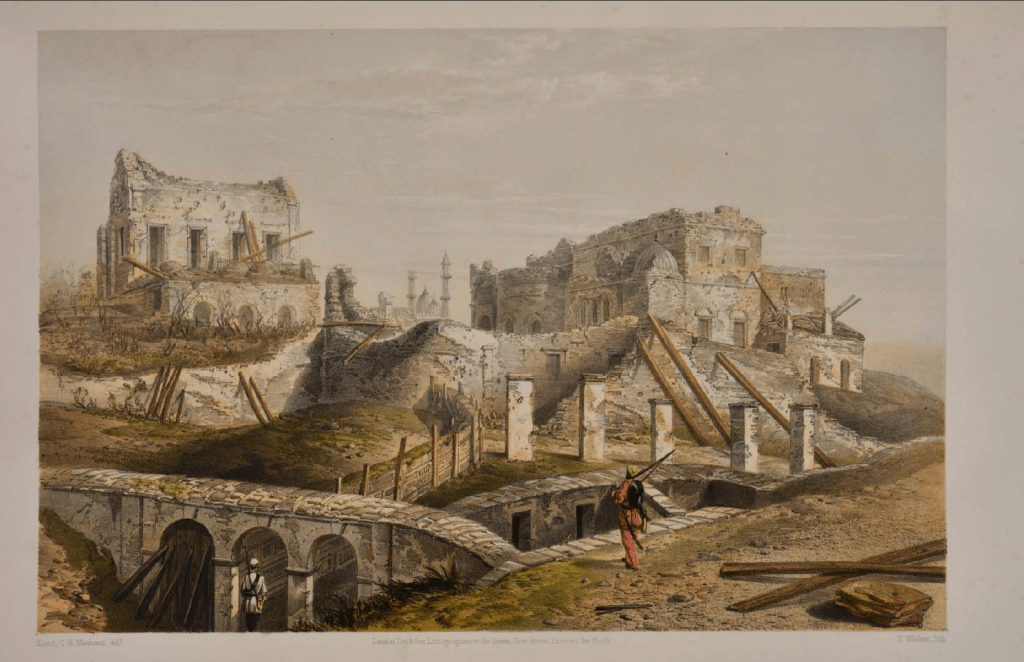
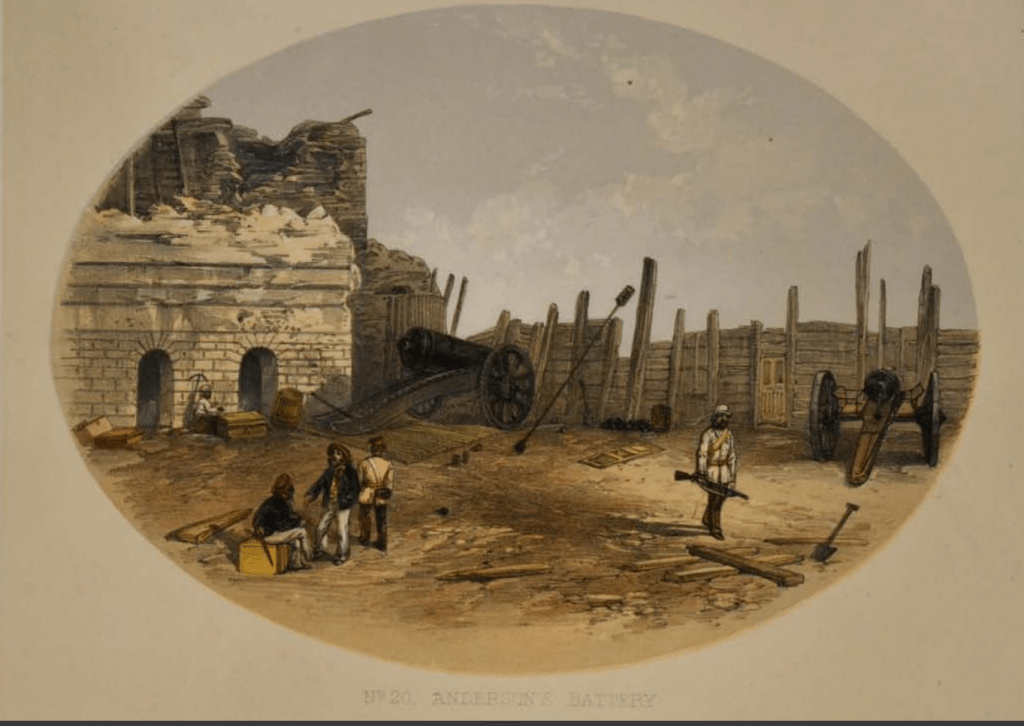
“We set to work at once, and a long and tedious affair it was. First, we had to displace huge pieces of masonry, and, as we did this, the broken bricks and lime kept filling up the little air holes, and poor Mr. Capper was constantly obliged to call out for “more air/’ During this time, be it remembered, the enemy kept up an incessant fire of round shot and musketry on the spot, knowing that we were working there; and all we had to protect us was about six inches of the wall, that just covered our bodies, as we lay flat on our stomachs, and worked away with both hands. After labouring for three-quarters of an hour, and when we were all quite exhausted, we managed to get the whole of Mr. Capper’s body pretty free; whereupon we set to work to get his legs out, and it was some little time before we could enable him to move his lower limbs. Throughout all this, a corporal, named Oxenham, of Her Majesty’s 32nd Regiment, behaved most nobly, and exposed himself considerably, so as to expedite the work of digging out our unfortunate volunteer, whose appearance amongst us seemed like as if one had risen from the grave; — we fully expected, at least, to have found that all his limbs had been broken; whereas, on the contrary, he had merely a few bruises, and felt faint.“
For this action, William Oxenham was rewarded with a Victoria Cross. However, had things gone Mr Capper’s way, who would spent years lobbying on behalf of Captain Anderson, he would have received his as well – but it would not be until 1868 when the recommendation was finally received by the War Office, by which time the fervour of Mutiny VCs was dying down. The application was turned down – over 10 years had passed since the action had taken place, and now it was simply too late to reward Captain Anderson.
It is hardly likely this was the only dangerous action in which Corporal Oxenham played a part. However, it was the only one cited for his VC. He would be desperately wounded in the arm in August, but unlike many others, he survived with his arm intact. He received his VC from Queen Victoria on the 4th of January, at Windsor Castle, in 1860. He remarried in 1862 and spent his final years in Exeter, with an annual pension of £10.- for his VC, and died of meningitis in December 1875. He was buried in High Cemetery, where he lies another VC holder, George Hollis.
His VC was sold in 1910 for a sum of £70.- but found its way to the Duke of Cornwall’s Light Infantry Museum in Bodmin where it rests today, together with his other medals.
 Mutiny Reflections
Engrossing read, thanks.
LikeLiked by 1 person