August 1857 dawned in the Ridge. The drenching monsoon rain had turned much of the area into a swamp; cholera continued to take its toll and the fighting, unabated, carried on.
Major Charles Reid wrote in his diary, for the 3rd of August:
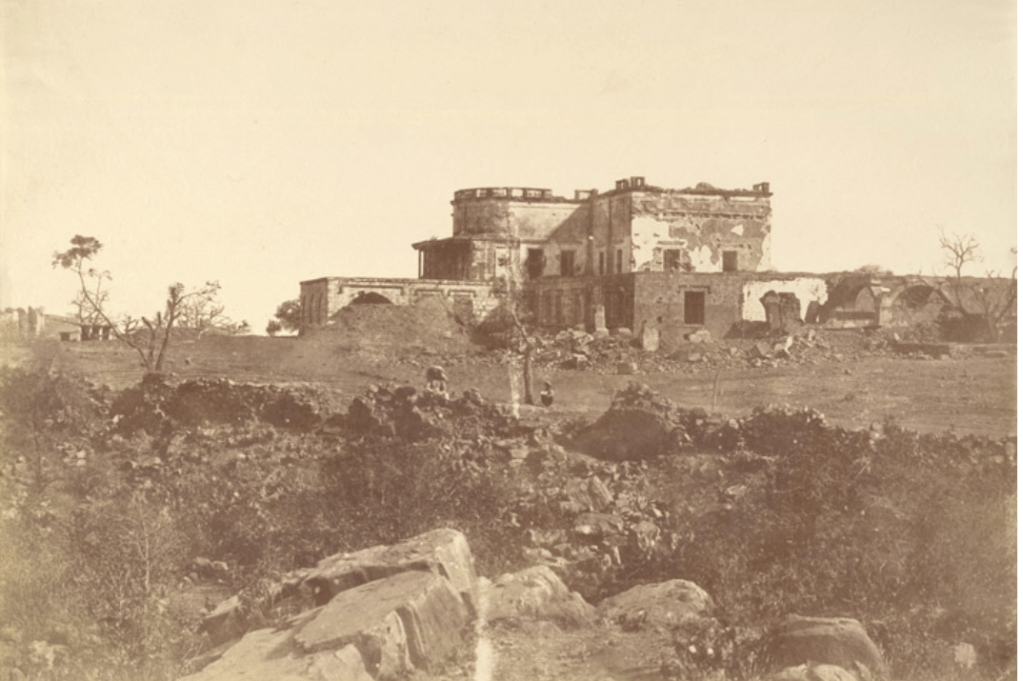
“The engagement commenced at sunset on the 1st, lasted the whole night, and until 4 p.m. yesterday. The mutineers tried hard to get in our rear. They managed to erect a bridge across the Canal at Bussie, but it was carried away by the flood; their guns were for some time left on one side and their Infantry and Cavalry on the other. This report was sent to me by the General at about 4 p.m. on the 1st. About half an hour later, I saw the whole force returning—guns, mortars, etc.; it was joined by about 3000 or 4000 from the city, and the whole force, in all about 20,000, came straight at my position. I was prepared for them. The General sent up my supports, sharp, as he always does, and we commenced work. The ‘ Sammy House ’ was attacked first by about 5000. At this time, I had only 150 of Coke’s men in it, under Travers, and 50 of the Guides. I at once sent them reinforcements from the Rifles and the 61st (Queen’s).
“At dusk, the enemy brought up their guns, supported by a very large force, and then commenced the sharpest fire I have ever heard on the whole of my position. They were very desperate indeed. Before midnight, we had driven them back a dozen times. The firing then ceased for about a quarter of an hour, and I began to think I had got rid of my friends, but, shortly after, the moon rose, for which they apparently had been waiting, and up came fresh troops from the city, bugling and shouting on all sides. I passed the word from right to left to allow the enemy to come up close and to keep a dead silence in the ranks. On came the enemy with their light guns, up the Grand Trunk Road, as also up the Kishanganj Road. My three light guns, which were in Battery across the road, were all loaded with grape, and when the enemy were close up, they opened fire. Round after round, with volleys of musketry from the Sammy House, had the effect of driving them back again. Still, there they were, within four hundred yards of me, making preparations for another attack, whilst their light guns kept up one continuous blaze, as also their heavy guns from the Mori and Burn Bastions. This sort of thing went on the whole night: 900 men against at least 20,000! My troops behaved admirably; all were steady and well in hand, and 1 never for one moment had any doubt about the results.
“At daybreak, more troops were seen in the Kishanganj buildings, and on they came again at the Sammy House. I accordingly sent Sir E. Campbell with a Company of the 60th Rifles to reinforce the troops at that post. At 8 a.m., they gave us time to get a little breakfast, but before 9 o’clock on they came again, and it was not before 5 p.m. last evening that I had the satisfaction of seeing them in full retreat, guns and all. Thus ended the great attack, being number twenty-four on my position ! . . . I have had no return as yet of killed and wounded, and I dread looking at the reports; the enemy’s loss must have been very severe. The escapes I have had are perfectly wonderful! People look at me after every engagement and say, ‘What, are you still unwounded ?’ Thank God for thus sparing me! I hope to keep my old head on my shoulders for some time yet! Anyhow, until I have seen the Imperial City fall! These persevering villains seem determined to wear us out; our spies say they are coming out again; all ready for them!”
In the meantime, Hodson and his spies had acquired quite a reputation on the Ridge. Rumours flew hard and fast regarding his exploits, that he had disguised himself and had gone within the walls of the city, which filled the men on the Ridge with admiration; they watched his exploits with growing enthusiasm.
Although his spies were prone to exaggerating the actual state of the city behind its formidable walls, Hodson was able to correctly ascertain how much damage the force was actually inflicting on the mutineers – although it was never substantiated, it was widely believed when the rebel magazine blew up in August, it was Hodson’s doing. Having reported to him that the mutineers were manufacturing their own powder and informing him it would be possible to blow it up, Hodson supposedly promised the men 1000 rupees if they succeeded. On the 7th of August, the magazine did indeed blow up, but since no one ever returned to claim the reward, it could not be affirmed by anyone that it was Hodson’s doing. For his part, he does not mention it in any letters.
 Mutiny Reflections
Wow, the amount of research and effort that must’ve went into this. I must admit this isn’t my area of expertise, so I can’t comment in the slightest, but I can appreciate hard work when I see it. So keep on keeping on!
LikeLiked by 1 person
Thank you for your lovely comment. It encourages me to keep going! Thank you!
LikeLike
A well-written account! Fascinating.
LikeLiked by 2 people
(I am not sure if my comments actually appear on your blog – I don’t think that I have the hang of it yet!)
Many thanks for this. Hodson is one of those fascinating characters which fills the history of the Mutiny – characters on both sides! Like so many others, Hodson is three dimensional in character, and never just black and white; as Sen describes him, ‘…his easy conscience and elastic standard of honour was an enigma to those who admired his warlike virtues … In serving his country he did not miss an opportunity of serving his personal interests, and he did not neglect the chance of making a penny, honest or dishonest, if it should come his way. His bravery and indefatigable industry earned him the friendship of many good men but his callous cruelty equally repulsed many potential well-wishers.’ (Sen, Eighteen Fifty-Seven, p.99). But there does seem to be remarkably little evidence for the things that he was accused of. William Forbes-Mitchell, then a corporal in the 93rd Highland Regiment, says that he was present when Hodson was killed in Lucknow, and he is adamant that no looting by Hodson or anyone else was going on at the time. ‘That Major Hodson was killed by his own rashness cannot be denied but for anyone to say that he was looting is a cruel slander on one of the bravest of Englishmen.’ (Reminiscences of the Great Mutiny 1857-59, Kindle Edition, Loc. 2530). The same is true of his killing of the princes in Delhi, an act that we quite rightly recoil at. But much is said about this without any actual evidence. I have read that the princes were promised their lives before a trial – but no contemporary writer mentions that; they surrendered unconditionally. There is talk that Hodson cut their heads off; but, again, not contemporary writer mentions this – even Hodson’s detractors never used this against him. Indeed, the first mention of it that I can find is in Sarvakar’s Indian war of Independence, and Sarvakar has a somewhat interesting take on what is factual. Again, there is rumour of ‘irregularities’ when he was with the Guides, but there is no evidence – just rumour.
The Revd. Canon Peter Yeats pinindia09@gmail.com St John’s Anglican Church, PH: 0422 762 935 PO Box 45, Balmain, NSW 2041 AUSTRALIA
>
LikeLiked by 2 people
I agree absolutely! Hodson is a controversial person, no doubt, yet it must also be remembered he had many detractors even when he was alive and much that was reported about him was false or painted with a very dark brush. I think when we look at the man in the context of his times we can get a sense of who he was. I think there was much that was honourable about William Hodson as a man., even with his faults. I think Sen makes the most sensible estimation of his character. Of course we cannot overlook the bad but especially in Hodson’s case it is usually the only thing people read about which is, as it goes, unfair. Everyone deserves a fair shake, Neill got his even though his barbarous treatment of Indians rarely is spoken of; the bloodthirsty civilians in Allahabad who enjoyed hanging so much they turned it into a game are given a passing glance, but everyone remembers it was Hodson who shot the princes!
Sarvarkar had a very loose interpretation of facts and for that matter, reality, and his book carries a very disturbing undertone of nationalism and patriotism to legitimise violence. There is a very interesting article, https://www.jstor.org/stable/4419575?read-now=1#page_scan_tab_contents called History as Revenge and Retaliation: Rereading Savarkar’s “The War of Independence of 1857” by Jyotirmaya Sharma. I have attached the link above.
Hodson certainly shot the princes, the beheadings are a Sarvarkar flourish.
“FIctions Connected with the Indian Mutiny Exposed.” https://archive.org/details/in.ernet.dli.2015.172893 makes very interesting reading , it attempts to give a more rounded view of the many articles that were circulating at the time.. It is a shame that the first casualty of war is the truth, and history becomes as malleable as those who write it.
Thank you so much for reading!
LikeLike