Brigadier General John Nicholson Arrives
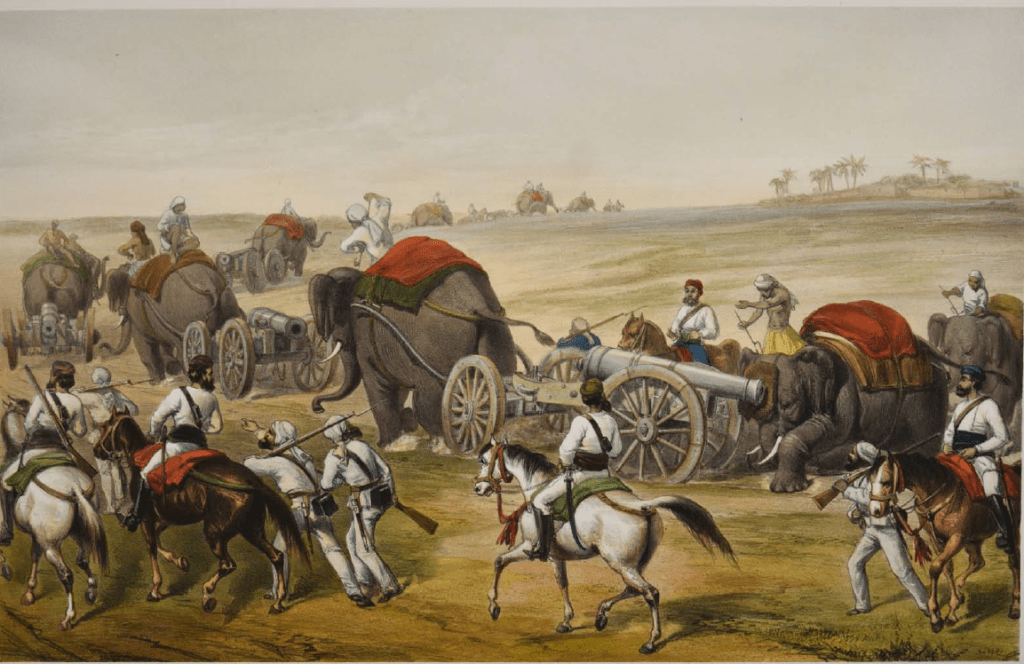
Ahead of his column, Brigadier-General John Nicholson arrived on the Ridge. After taking counsel with General Wilson, he returned to the column and on the 14th of August, he marched into the camp with his men.
The column consisted of
Captain Bouchier’s European Horse Battery
HM’s 52nd Light Infantry
Detachment of the 2nd Punjab Cavalry
The remaining wing of HM’s 61st Regiment of Foot
The 2nd Regiment of Punjab Infantry and 250 Multani horsemen.
The Multani Horse were men brought down from the frontier by Nicholson himself. They came out of personal loyalty to Nicholson, took no pay from the government and recognised no one as their leader but Nicholson. Mounted on their wiry hill ponies, they had
“…surrounded the column like a web; they rode in couples, each couple within signalling distance of the other, and so circled the column round for many a mile…” 19-year-old Reginald Wilberforce, who had ridden with the moveable column all the way to Delhi, had never seen anything like it, nor did he himself have anything but awe for Nicholson.
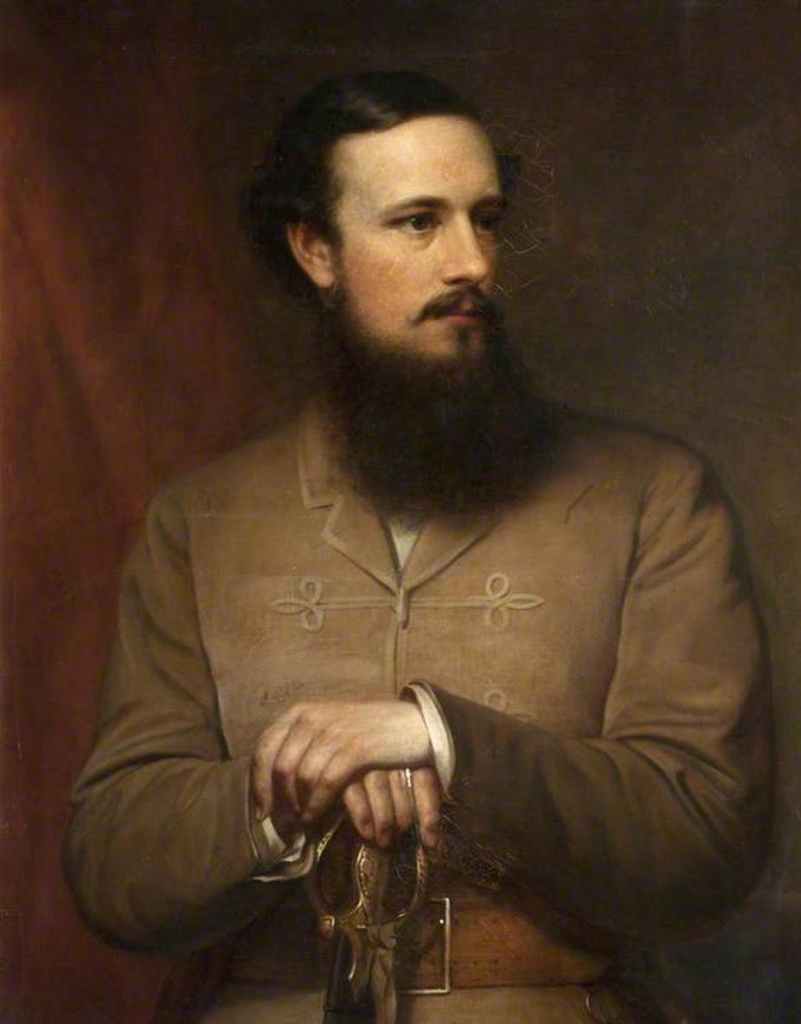
Standing over 6’2″, with a long black beard, strong of body and laconic of speech, Nicholson was a mountain among men. Frederick Roberts was moved to say Nicholson impressed him “more profoundly” than any man he had ever met and doubted he would ever meet one like him again. When he strode into camp on the 14th of August, a perceptible change came over the Ridge. For the first time since the start of the siege, the men suddenly felt they had a leader; if anyone could put an end to this awful stalemate, it was Nicholson.
He did not, however, impress everyone. At their first meeting at Hindu Rao’s House, Major Charles Reid disliked him intensely.
“I had never seen him before in my life. And I thought I had never seen a man I disliked so much at first sight. His haughty manner and peculiar sneer I could not stand. He asked several questions relevant to the enemy’s position and then moved on. Baird Smith was with me at the time…I complained of Nicholson’s overbearing manner. He replied, “Yes, but it wears off. I’m sure you’ll like him when you have seen him more.” Like many others, he would change his mind about the formidable soldier.
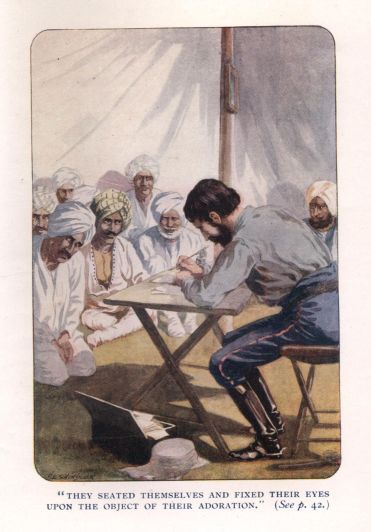
Like him or not, Nicholson was a force to be reckoned with. His overpowering presence had served him well through many lonely years on the wild frontiers and had won him the respect of the lawless tribes. One such set of men had even gone so far as to turn Nicholson into a living god, a deity they worshipped regardless of how he treated them. Called Nikelseyns, the cult embarrassed and infuriated Nicholson – it is anyone’s guess what he would have felt were he to know the last worshipper died in Abbottabad in 2004.
Dauntingly, Nicholson was followed everywhere by his very imposing Pathan orderly who was as little prone to smiling as Nicholson himself. He stood behind Nicholson’s chair in the mess tent, a cocked pistol in one hand while he served Nicholson with the other. With Nicholson in the room, there was little time for mirth -as everyone quickly surmised for a man of his disposition, war was not a laughing matter.
A masterful man in his own right, Sir John Lawrence found Nicholson difficult to work with, and it did not take Nicholson very long to fluster the already very undecided General Wilson. By now, nearly everyone was exasperated with Wilson. Baird Smith had initially found the man rather amusing but by August, after weeks of putting up with Wilson’s “fidgety fits” through which Baird Smith had had to soothe him like one comforts a child, he was finding Wilson a bore, “peevish and positively so childish...He combines a wonderous amount of ignorance and obstinacy. He is the most obstructive being ever created…” wrote Baird Smith to his wife, “and gets in a towering rage with me because I keep harping on about the necessity for an assault.” Wilson finally stopped speaking to Baird Smith altogether, insisting that all communication be done through his staff.
Nicholson was not having any of it, and his anger with Wilson’s fretting about attacking Delhi did not need months to boil over. In a letter to John Lawrence, he threatened that he would write to the military authorities and have Wilson replaced. As Nicholson would have been the obvious choice as the replacement, he proposed Campbell of the 52nd to prevent anyone from thinking he was motivated by personal reasons. It would have been a coup d’état which Nicholson was perfectly capable of instigating had Wilson not backed down. Nicholson had come to take Delhi, and Wilson could follow or not.
The rebels, in the meantime, had set their sights on the Siege Train, and Nicholson was having none of it. He would take to the field, battling through rain and swamps to mee the rebels at Najafgarh.
Five days after the Battle of Najafgarh, Major Charles Reid wrote:
“The great Mohurrum attack came off last night. As usual, they came at my poor old head. They commenced with Fort Sammy but were driven back sharp. They gave it up as a bad business about twelve o’clock and allowed us to go to our quarters. I am going to cut jungle to my right under their breastworks, in front of Fort Sammy. The enemy will no doubt try to prevent it – two can play at that game. I mean to drive them from their breastworks, hold them during the night, and destroy the works before we withdraw in the morning. They don’t at all approve of the new trench and six battery near Sammy House; when they see our 60 guns in position, they will get very desperate, I doubt it not.
I drove the enemy from their breastworks last night. No sooner had I got possession than 300 hatchets were at work felling trees, brushwood, &c. The work went on admirably the whole night in front of the trenches. and Sammy House picquet. ‘Pandy’ got into an awful state of mind, and we heard about a dozen bugles in the city sound first the ‘turn out’, then the ‘advance’ then the ‘double’ at length, the buglers got tired of the above, and sounded the ‘retreat’ the only one which was obeyed. I relieved the party at 11 o’clock when a little more popping commenced. At daybreak this morning, I found a good deal had been done. I shall now be able to see my friends. I never knew before what force they were in when they attacked the Sammy House, so thick was the jungle on all sides…”
The fighting was nearly done.
Sources:
Anson, Brevet Major O. H. G. S. With H.M. 9th Lancers During the Indian Mutiny. Edited by Harcourt S. Anson. London: W. H. Allen & Co., 1896.
Barter, Richard. The Siege of Delhi: Mutiny Memories of an Old Officer. London: The Folio Society, 1984.
Cave-Browne, Rev. J. The Punjab and Delhi in 1857. Vol. 2. Edinburgh: William Blackwood and Sons, 1861; repr., London: Forgotten Books, 1911.
Fanshawe, H. C. Delhi Past and Present. London: John Murray, 1902.
Greathed, H. H. Letters Written During the Siege of Delhi. Edited by Elisa Greathed. London: Longman, Brown, Green, Longmans & Roberts, 1858.
Handcock, Major-General A. G. The Siege of Delhi in 1857: A Short Account. Allahabad: Pioneer Press, 1897.
Hibbert, Christopher. The Great Mutiny: India 1857. London: Allen Lane, 1978; repr., New York: Viking Press, 1980.
Hodson, Rev. George H., ed. Twelve Years of a Soldier’s Life in India: Being Extracts from the Letters of the Late Major W. S. R. Hodson, B.A. London: John W. Parker and Son, 1859.
Holmes, T. Rice. A History of the Indian Mutiny. 5th ed. London: Macmillan and Co., 1904.
Ireland, W. W. History of the Siege of Delhi by an Officer Who Served There. Edinburgh: Adam and Charles Black, 1861.
Leasor, James. The Red Fort: An Account of the Siege of Delhi. London: peril Publishing, 1956.
Malleson, Colonel G. B. The Indian Mutiny of 1857. London: Seeley and Co., 1891.
Metcalfe, Charles Theophilus, trans. Two Native Narratives of the Mutiny in Delhi. Westminster: Archibald Constable and Co., 1898.
Nigam, N. K. Delhi in 1857. Delhi: S. Chand, 1957.
Norman, General Sir Henry Wylie, and Mrs. Keith Young, eds. Delhi-1857: The Siege, Assault, and Capture as Given in the Diary and Correspondence of the Late Colonel Keith Young. London: W. and R. Chambers, 1902.
Vibart, Colonel H. M. Richard Baird Smith: The Leader of the Delhi Heroes in 1857. Westminster: Archibald Constable and Co., 1897; repr., 1907.
 Mutiny Reflections
Wow, the amount of research and effort that must’ve went into this. I must admit this isn’t my area of expertise, so I can’t comment in the slightest, but I can appreciate hard work when I see it. So keep on keeping on!
LikeLiked by 1 person
Thank you for your lovely comment. It encourages me to keep going! Thank you!
LikeLike
A well-written account! Fascinating.
LikeLiked by 2 people
(I am not sure if my comments actually appear on your blog – I don’t think that I have the hang of it yet!)
Many thanks for this. Hodson is one of those fascinating characters which fills the history of the Mutiny – characters on both sides! Like so many others, Hodson is three dimensional in character, and never just black and white; as Sen describes him, ‘…his easy conscience and elastic standard of honour was an enigma to those who admired his warlike virtues … In serving his country he did not miss an opportunity of serving his personal interests, and he did not neglect the chance of making a penny, honest or dishonest, if it should come his way. His bravery and indefatigable industry earned him the friendship of many good men but his callous cruelty equally repulsed many potential well-wishers.’ (Sen, Eighteen Fifty-Seven, p.99). But there does seem to be remarkably little evidence for the things that he was accused of. William Forbes-Mitchell, then a corporal in the 93rd Highland Regiment, says that he was present when Hodson was killed in Lucknow, and he is adamant that no looting by Hodson or anyone else was going on at the time. ‘That Major Hodson was killed by his own rashness cannot be denied but for anyone to say that he was looting is a cruel slander on one of the bravest of Englishmen.’ (Reminiscences of the Great Mutiny 1857-59, Kindle Edition, Loc. 2530). The same is true of his killing of the princes in Delhi, an act that we quite rightly recoil at. But much is said about this without any actual evidence. I have read that the princes were promised their lives before a trial – but no contemporary writer mentions that; they surrendered unconditionally. There is talk that Hodson cut their heads off; but, again, not contemporary writer mentions this – even Hodson’s detractors never used this against him. Indeed, the first mention of it that I can find is in Sarvakar’s Indian war of Independence, and Sarvakar has a somewhat interesting take on what is factual. Again, there is rumour of ‘irregularities’ when he was with the Guides, but there is no evidence – just rumour.
The Revd. Canon Peter Yeats pinindia09@gmail.com St John’s Anglican Church, PH: 0422 762 935 PO Box 45, Balmain, NSW 2041 AUSTRALIA
>
LikeLiked by 2 people
I agree absolutely! Hodson is a controversial person, no doubt, yet it must also be remembered he had many detractors even when he was alive and much that was reported about him was false or painted with a very dark brush. I think when we look at the man in the context of his times we can get a sense of who he was. I think there was much that was honourable about William Hodson as a man., even with his faults. I think Sen makes the most sensible estimation of his character. Of course we cannot overlook the bad but especially in Hodson’s case it is usually the only thing people read about which is, as it goes, unfair. Everyone deserves a fair shake, Neill got his even though his barbarous treatment of Indians rarely is spoken of; the bloodthirsty civilians in Allahabad who enjoyed hanging so much they turned it into a game are given a passing glance, but everyone remembers it was Hodson who shot the princes!
Sarvarkar had a very loose interpretation of facts and for that matter, reality, and his book carries a very disturbing undertone of nationalism and patriotism to legitimise violence. There is a very interesting article, https://www.jstor.org/stable/4419575?read-now=1#page_scan_tab_contents called History as Revenge and Retaliation: Rereading Savarkar’s “The War of Independence of 1857” by Jyotirmaya Sharma. I have attached the link above.
Hodson certainly shot the princes, the beheadings are a Sarvarkar flourish.
“FIctions Connected with the Indian Mutiny Exposed.” https://archive.org/details/in.ernet.dli.2015.172893 makes very interesting reading , it attempts to give a more rounded view of the many articles that were circulating at the time.. It is a shame that the first casualty of war is the truth, and history becomes as malleable as those who write it.
Thank you so much for reading!
LikeLike