The 12th of August
“The enemy having established themselves in “Ludlow Castle” and planted a battery which contrived greatly to harass our picquet at Metcalfe House, it was deemed desirable to dislodge him.”
August was not quiet on the Ridge. The cycle of attack and repulse continued undaunted, and the losses on the side of the British, although less than July, did not cease. In one attack alone, on the 6th, four officers were killed or wounded, among them Lieutenant J.H. Browne lately of the 33rd BNI, now attached to the Kumaon Gurkhas. On the 8th, the mutineers attempted to build a battery at Ludlow Castle and continued a harassing fire on the Metcalfe piquet. It was therefore decided to capture Ludlow Castle and capture the guns that were causing such a nuisance.
To achieve this, a strong body of men was assembled on the night of the 11th, consisting of 200 men of the Guides Cavalry, 1200 of infantry from the 8th, 75th and the 1st and 2nd Fusiliers, eight guns, a squadron of HM’s 9th Lancers, Coke’s Rifles, and the Kumaon Battalion of Gurkhas, all under the command of Brigadier G. Showers, sufficiently recovered from a wound sustained on the 23rd of July.
By four o’clock in the morning, they were ready to advance. Showers started with his column, the 75th Foot, 1st Bengal Fusiliers, Coke’s Rifles and a battery of light field guns. Coke proceeded with his men through the Metcalfe compound to attack the battery to the left of the main road, while Showers moved down the Grand Trunk Road, directly to Ludlow Castle. Coke’s objective was to get as close to Ludlow Castle without being seen. Although he used the shelter provided by a high wall which ran parallel to the road, he still had to fight through some of the way, and eventually made it to the opposite to gate of Ludlow Castle. Here, he found the enemy had taken up position along the walls of the compound and being on full alert, immediately opened fire on Coke and his men.
To drive the enemy from the position, Coke had to find a way out of Metcalfe Park, surrounded as it was by a high wall that was impossible to climb with any safety. He circled along it until he found a hole in the wall that had been made by the batteries from the Ridge. “Through this, Coke managed to creep, followed by a number of his men, and he made a rush at the gate, from which he was able to enfilade the enemy lining the walls of Ludlow Castle. Here he fell with a gunshot wound through his thigh, but he was up again immediately, and present saw one of the enemy’s Horse Artillery guns standing on the road in front of him. The gunners and drivers and been shot down, but there stood the gun with four horses, and their heads turned towards Cashmere Gate. Coke at once saw that we should lose the gun unless their heads were turned towards Camp, so he walked up as best he could and quietly turned the gun round on the road, and started the horses off, full gallop without riders, and in they went straight into our camp.”
Brigadier Showers in the meantime had managed to take the mutineers by surprise and many were shot before they could get their guns. “Some drew their swords, and with the backs against the walls of Ludlow Castle, sold their lives dearly.” (Major Charles, Reid August 12th)
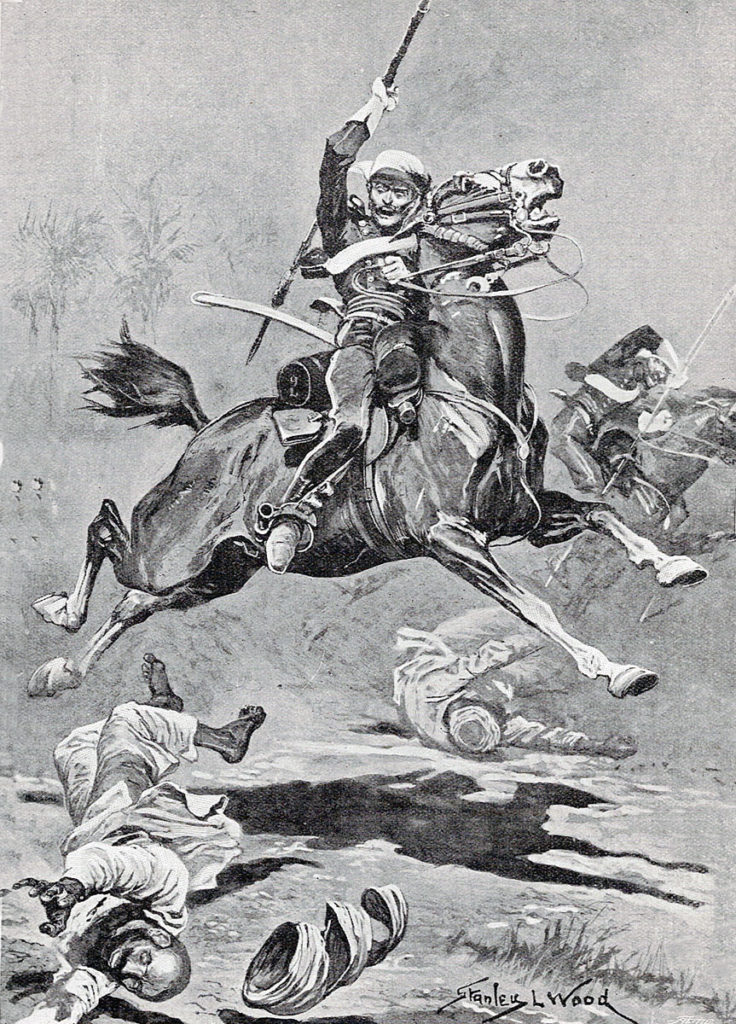
As plans go, this one had been a rousing success. The British succeeded in sneaking up to the rebel post and, sending a volley of musketry fire into the lines, which the mutineers had no chance of returning with any effect, being caught completely off guard, the British rushed the battery. The rebels managed to fire off two guns, but the third was stopped by Private Reegan, who dashed forward and bayonetted the artilleryman, who fell with his lighted port fire. The rest of the gunners put their backs to the wagons, fighting furiously until they too fell dead. For half an hour, a murderous fire raged, but the rebels had no chance. After a spirited fight, they turned and fled.
The 9th Lancers, although called to the column, were held back. Forced to sit mounted under fire, Brevet Major Octavius Anson observed,
“Strange to say, what between Pandy’s fright and his having been caught napping, he fired so high and badly that we had only two men wounded and five or six horses. One man was wounded close to me, young Whelan, by a spent ball. The ball did not go through him, but lodged in his side, inflicting a dangerous wound.”
The objective was achieved – all four guns were captured, and the Metcalfe picquet was saved from their fire, while Ludlow Castle now became part of the Ridge defences. The fight, though short, cost the British heavily. Brigadier Showers was once again wounded, suffering a long slash on the surface of his chest and a smashed finger on his right hand. Coke too was wounded as was Lieutenant Greville, who had captured one of the four guns with a handful of men, and a young lieutenant named Sheriff was killed. A further eight were wounded and one hundred and ninety men “hors de combat”.
However, they still came back to camp triumphant.
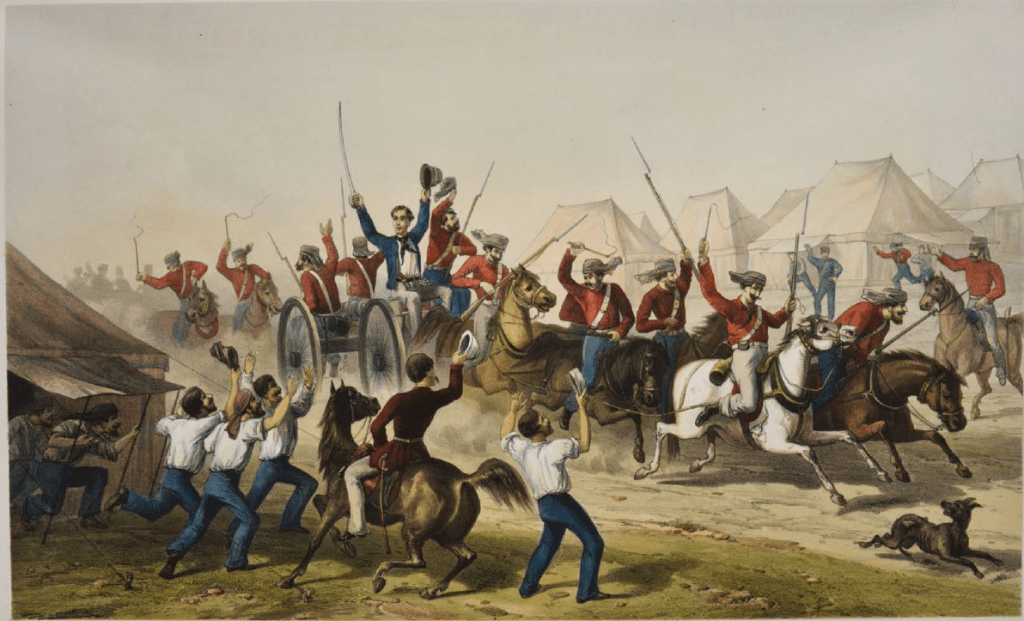
“The return to camp was a scene worth witnessing, the soldiers bringing home in triumph the guns they had captured, a soldier with musket and bayonet fixed riding each horse and brave young Owen astride one gun, and dozens clinging to and pushing it, or rather them, along with might and main, and cheering like mad things.”
 Mutiny Reflections
Wow, the amount of research and effort that must’ve went into this. I must admit this isn’t my area of expertise, so I can’t comment in the slightest, but I can appreciate hard work when I see it. So keep on keeping on!
LikeLiked by 1 person
Thank you for your lovely comment. It encourages me to keep going! Thank you!
LikeLike
A well-written account! Fascinating.
LikeLiked by 2 people
(I am not sure if my comments actually appear on your blog – I don’t think that I have the hang of it yet!)
Many thanks for this. Hodson is one of those fascinating characters which fills the history of the Mutiny – characters on both sides! Like so many others, Hodson is three dimensional in character, and never just black and white; as Sen describes him, ‘…his easy conscience and elastic standard of honour was an enigma to those who admired his warlike virtues … In serving his country he did not miss an opportunity of serving his personal interests, and he did not neglect the chance of making a penny, honest or dishonest, if it should come his way. His bravery and indefatigable industry earned him the friendship of many good men but his callous cruelty equally repulsed many potential well-wishers.’ (Sen, Eighteen Fifty-Seven, p.99). But there does seem to be remarkably little evidence for the things that he was accused of. William Forbes-Mitchell, then a corporal in the 93rd Highland Regiment, says that he was present when Hodson was killed in Lucknow, and he is adamant that no looting by Hodson or anyone else was going on at the time. ‘That Major Hodson was killed by his own rashness cannot be denied but for anyone to say that he was looting is a cruel slander on one of the bravest of Englishmen.’ (Reminiscences of the Great Mutiny 1857-59, Kindle Edition, Loc. 2530). The same is true of his killing of the princes in Delhi, an act that we quite rightly recoil at. But much is said about this without any actual evidence. I have read that the princes were promised their lives before a trial – but no contemporary writer mentions that; they surrendered unconditionally. There is talk that Hodson cut their heads off; but, again, not contemporary writer mentions this – even Hodson’s detractors never used this against him. Indeed, the first mention of it that I can find is in Sarvakar’s Indian war of Independence, and Sarvakar has a somewhat interesting take on what is factual. Again, there is rumour of ‘irregularities’ when he was with the Guides, but there is no evidence – just rumour.
The Revd. Canon Peter Yeats pinindia09@gmail.com St John’s Anglican Church, PH: 0422 762 935 PO Box 45, Balmain, NSW 2041 AUSTRALIA
>
LikeLiked by 2 people
I agree absolutely! Hodson is a controversial person, no doubt, yet it must also be remembered he had many detractors even when he was alive and much that was reported about him was false or painted with a very dark brush. I think when we look at the man in the context of his times we can get a sense of who he was. I think there was much that was honourable about William Hodson as a man., even with his faults. I think Sen makes the most sensible estimation of his character. Of course we cannot overlook the bad but especially in Hodson’s case it is usually the only thing people read about which is, as it goes, unfair. Everyone deserves a fair shake, Neill got his even though his barbarous treatment of Indians rarely is spoken of; the bloodthirsty civilians in Allahabad who enjoyed hanging so much they turned it into a game are given a passing glance, but everyone remembers it was Hodson who shot the princes!
Sarvarkar had a very loose interpretation of facts and for that matter, reality, and his book carries a very disturbing undertone of nationalism and patriotism to legitimise violence. There is a very interesting article, https://www.jstor.org/stable/4419575?read-now=1#page_scan_tab_contents called History as Revenge and Retaliation: Rereading Savarkar’s “The War of Independence of 1857” by Jyotirmaya Sharma. I have attached the link above.
Hodson certainly shot the princes, the beheadings are a Sarvarkar flourish.
“FIctions Connected with the Indian Mutiny Exposed.” https://archive.org/details/in.ernet.dli.2015.172893 makes very interesting reading , it attempts to give a more rounded view of the many articles that were circulating at the time.. It is a shame that the first casualty of war is the truth, and history becomes as malleable as those who write it.
Thank you so much for reading!
LikeLike