Rohtak
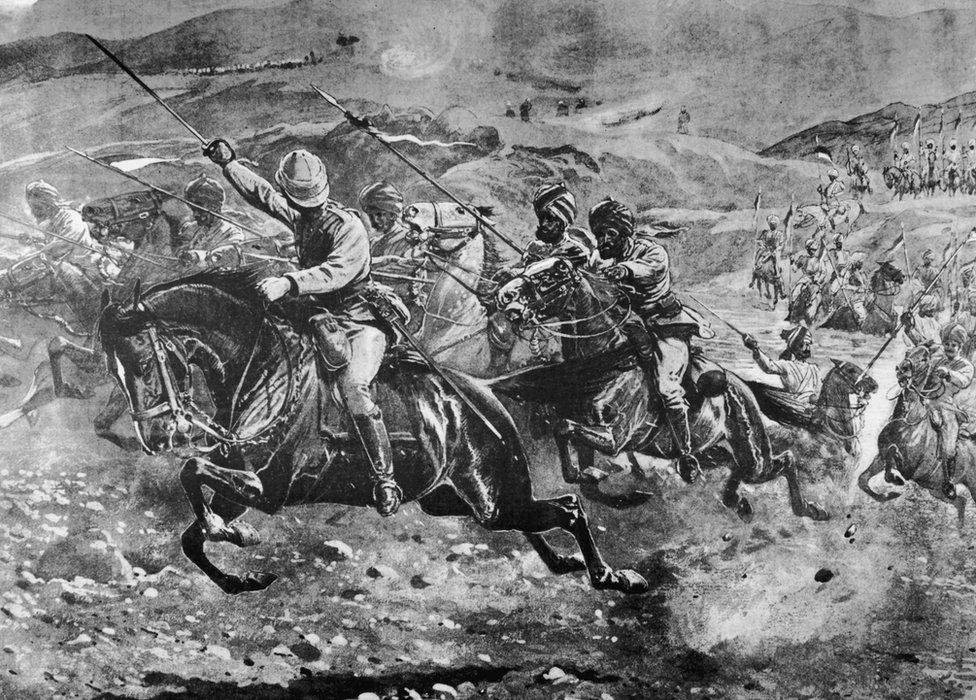
The very day the long-awaited siege train from the Punjab arrived on the Ridge, intelligence was received that a body of mutineers, mostly cavalry, had been sent out to cut off communication with the Punjab. The task of “watching” them was given to William Hodson. For this mission, Hodson took with him six European officers, a hundred Guides Cavalry, 25 Jhind horsemen and his own corps of 233 men who, in his estimation, were
“…merely an aggregation of untutored horsemen, ill-equipped, half-clothed, badly provided with everything, quite unfit for service in the usual sense of the term, and only forced into the field because I have will that it shall be so…”
Their warlike appearance, however, impressed those who saw them leave the Ridge – dressed in their khaki tunics with a scarlet sash and scarlet turbans, “the wild brave men from the border, ready to die for the one who knew how to command and lead them.” Hodson was taking a great personal risk leading his untried corps into battle, but if he was to prove their mettle, it was now. They left Delhi on the night of the 14th of August. The objective was to secure communications with the Punjab and teach the rebels a lesson. The first stop was the village of Khurkundah, where Hodson had been informed a troop of the Irregulars had taken refuge. Surprised by Hodson, the mutineers put up a spirited fight, but ultimately, Hodson prevailed, and the Irregulars were destroyed to a man. He then set his force to “reconnoitre and harass” a large body of cavalry and infantry, with two guns, who had been moving away from Delhi, willfully plundering villages in their path, though the ultimate goal was to attack Hansi. For their part, the mutineers were aware Hodson was not far behind, and they, believing “discretion the better part of valour”, quickly disappeared before Hodson could catch up.
The incident at Khurkundah was mired in some controversy, but only later – this can be read in full in T.R.E. Holmes, Appendix N, III p. 603 in the 4th edition. As it is currently not in the scope of this post to address it, this too shall be looked at in more detail in a different post.
Hodson’s objective, however, was Rohtak, and he wrote the following letter to Colonel Becher, Quartermaster General:
My dear Colonel,—We are getting on very well. I hope to take Rohtuck today, and I trust the arrangements
will be made for keeping it. The country will then be quiet from Hansie to Delhi. The Jheend Rajah should be told to take care of the district. I believe Greathed did make this arrangement, but Barnes put some spoke in the way so that the Rajah is uncertain about how to act. Please tell Greathed from me that there is nothing now to prevent the restoration of order here. I wish I had a stronger party, for though I feel quite comfortable myself, yet I should like more troops, for the sake of the men, who are not quite so easy in their minds.
The road by Alipore, Boanah, and Khurkundah is the best. The canal is easily fordable at Boanah, and just below that place (at the escape), it is quite dry, the banks having given way. We polished off the Khurkundah gentry in style, though they showed fight to a great extent. It has had a wonderfully calming effect on the neighbourhood. I hope the Jheend troops, or some troops, may be sent here. The Jheend men would more than suffice.—Yours very sincerely,
W. S. R. Hodson.
Hodson had a plan, and now he intended to carry it out.
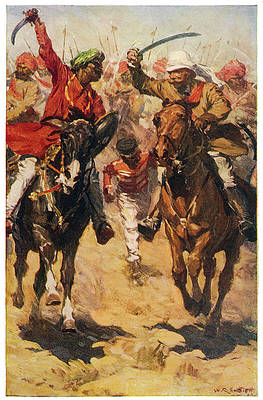
Reaching Rohtak on the 17th, Hodson found a large part of the population had turned out with a crowd of Irregulars, “drawn up on the walls,” while the rest waited on a mound outside. He rode forward with Captain Ward and a few orderlies to take a lay of the land, when the mutineers fired and dashed towards Hodson.
Hodson sent word for his cavalry to come up while he rode back slowly, intending to draw as many of the insurgents out into the open field as possible. As soon as the leading troop came up, Hodson swung around and ordered the charge. “We dashed at them and drove them helter-skelter into the town, killing all we overtook.”
He then encamped his men in what was left of the kutchery compound for what would turn out to be a quiet night. The rest of the population, better disposed than others, slowly approached Hodson, offering his men food and supplies and food for their horses. The morning, however, proved less restful.
During the night, word had been sent to 300 irregular horsemen of the mutineers – the 1st, 13th and 14th – headed, as they had been the night before, by Babar Khan, the chief of the Ranghar tribe. Accompanying them were no less than 1000 infantrymen. Their intention had been to attack Hodson before he had time to prepare his men; they were outwitted by his spies. Hodson had received notice earlier of the intended attack – as such, he had ordered his men to keep their horses saddled, and as the rebel cavalry came at a gallop down the road, Hodson and his men were ready. His strategy was simple.
“To drive them scattering back to the town was the work of only as many more, and I then, seeing their numbers, and the number of matchlocks brought against us from gardens and embrasures, determined to draw them out into the open country; and the ‘ ruse’ was eminently successful. I had quietly sent off our little
baggage unperceived half an hour before so that I was, as I intended, perfectly free and unfettered by
impedimenta of any sort. I then quietly and gradually drew off troop after troop into the open plain about
a mile to the rear, covering the movement with skirmishers.
“My men, new as well as old, behaved coolly and admirably throughout, though the fire was very annoying, and a retreat is always discouraging, even when you have an object in view. My officers, fortunately, first-rate ones, behaved like veterans, and everything went on to my complete satisfaction.
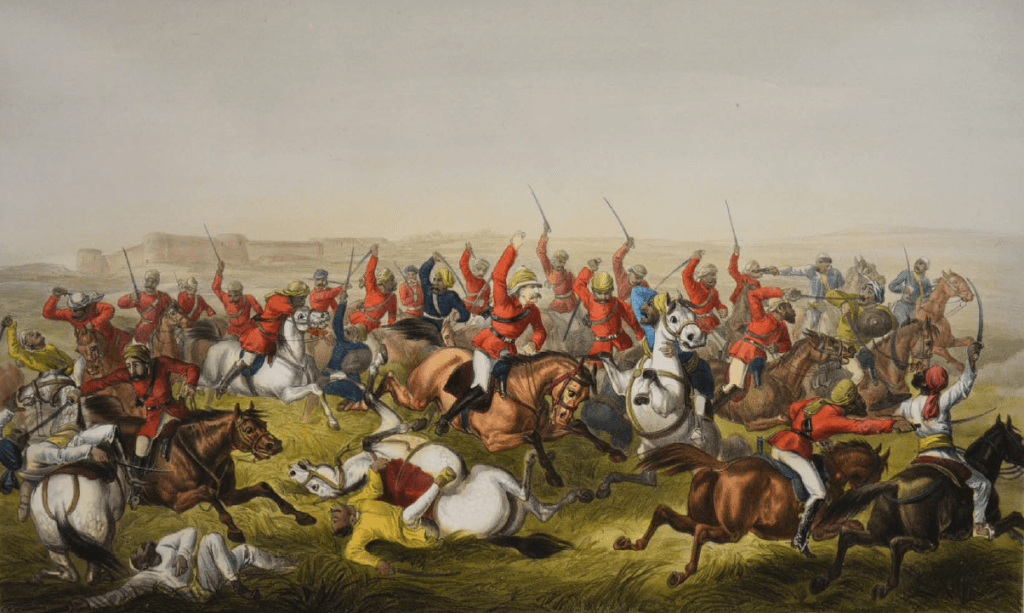
“Exactly what I had anticipated happened. The enemy thought we were bolting and came on in crowds, firing and yelling, and the Sowars brandishing their swords as if we were already in their hands, when suddenly I gave the order, ‘Threes about, and at them.’ The men obeyed with a cheer; the effect was electrical; never was such a scatter. I launched five parties at them, each under an officer, and in they went, cutting and firing into the very thick of them.
“The ground was very wet, and a ditch favoured them, but we cut down upwards of fifty in as many seconds. The remainder flew back to the town, as if not the Guides and Hodson’s Horse but death and the devil were at their heels. Their very numbers encumbered them, and the rout was most complete. Unfortunately, I had no ammunition left and therefore could not, without imprudence, remain so close to a town filled with matchlock men, so we marched quietly round to the north of the town and encamped near the first friendly village we came to, which we reached in the early afternoon. Our success was so far complete, and I am most thankful to say, with very trifling loss, only two men were rather severely wounded,
eight in all touched, and a few horses hit. Macdowell did admirably, as indeed did all. My new men, utterly untrained as they are, many unable to ride or even load their carbines properly, yet behaved beyond my most sanguine expectations for a first field, and this success, without loss, will encourage them greatly.”
Hodson was soon joined by reinforcements sent by his friend, the Jhind Raja, who supplied him with an additional 400 men and ammunition. In three days, he had frightened away a force no less than 2000 strong and had set an example that sent shock waves through the immediate countryside, a taste of what was to come if they stirred up trouble in the future.
 Mutiny Reflections
Wow, the amount of research and effort that must’ve went into this. I must admit this isn’t my area of expertise, so I can’t comment in the slightest, but I can appreciate hard work when I see it. So keep on keeping on!
LikeLiked by 1 person
Thank you for your lovely comment. It encourages me to keep going! Thank you!
LikeLike
A well-written account! Fascinating.
LikeLiked by 2 people
(I am not sure if my comments actually appear on your blog – I don’t think that I have the hang of it yet!)
Many thanks for this. Hodson is one of those fascinating characters which fills the history of the Mutiny – characters on both sides! Like so many others, Hodson is three dimensional in character, and never just black and white; as Sen describes him, ‘…his easy conscience and elastic standard of honour was an enigma to those who admired his warlike virtues … In serving his country he did not miss an opportunity of serving his personal interests, and he did not neglect the chance of making a penny, honest or dishonest, if it should come his way. His bravery and indefatigable industry earned him the friendship of many good men but his callous cruelty equally repulsed many potential well-wishers.’ (Sen, Eighteen Fifty-Seven, p.99). But there does seem to be remarkably little evidence for the things that he was accused of. William Forbes-Mitchell, then a corporal in the 93rd Highland Regiment, says that he was present when Hodson was killed in Lucknow, and he is adamant that no looting by Hodson or anyone else was going on at the time. ‘That Major Hodson was killed by his own rashness cannot be denied but for anyone to say that he was looting is a cruel slander on one of the bravest of Englishmen.’ (Reminiscences of the Great Mutiny 1857-59, Kindle Edition, Loc. 2530). The same is true of his killing of the princes in Delhi, an act that we quite rightly recoil at. But much is said about this without any actual evidence. I have read that the princes were promised their lives before a trial – but no contemporary writer mentions that; they surrendered unconditionally. There is talk that Hodson cut their heads off; but, again, not contemporary writer mentions this – even Hodson’s detractors never used this against him. Indeed, the first mention of it that I can find is in Sarvakar’s Indian war of Independence, and Sarvakar has a somewhat interesting take on what is factual. Again, there is rumour of ‘irregularities’ when he was with the Guides, but there is no evidence – just rumour.
The Revd. Canon Peter Yeats pinindia09@gmail.com St John’s Anglican Church, PH: 0422 762 935 PO Box 45, Balmain, NSW 2041 AUSTRALIA
>
LikeLiked by 2 people
I agree absolutely! Hodson is a controversial person, no doubt, yet it must also be remembered he had many detractors even when he was alive and much that was reported about him was false or painted with a very dark brush. I think when we look at the man in the context of his times we can get a sense of who he was. I think there was much that was honourable about William Hodson as a man., even with his faults. I think Sen makes the most sensible estimation of his character. Of course we cannot overlook the bad but especially in Hodson’s case it is usually the only thing people read about which is, as it goes, unfair. Everyone deserves a fair shake, Neill got his even though his barbarous treatment of Indians rarely is spoken of; the bloodthirsty civilians in Allahabad who enjoyed hanging so much they turned it into a game are given a passing glance, but everyone remembers it was Hodson who shot the princes!
Sarvarkar had a very loose interpretation of facts and for that matter, reality, and his book carries a very disturbing undertone of nationalism and patriotism to legitimise violence. There is a very interesting article, https://www.jstor.org/stable/4419575?read-now=1#page_scan_tab_contents called History as Revenge and Retaliation: Rereading Savarkar’s “The War of Independence of 1857” by Jyotirmaya Sharma. I have attached the link above.
Hodson certainly shot the princes, the beheadings are a Sarvarkar flourish.
“FIctions Connected with the Indian Mutiny Exposed.” https://archive.org/details/in.ernet.dli.2015.172893 makes very interesting reading , it attempts to give a more rounded view of the many articles that were circulating at the time.. It is a shame that the first casualty of war is the truth, and history becomes as malleable as those who write it.
Thank you so much for reading!
LikeLike