Hospitals and Burials
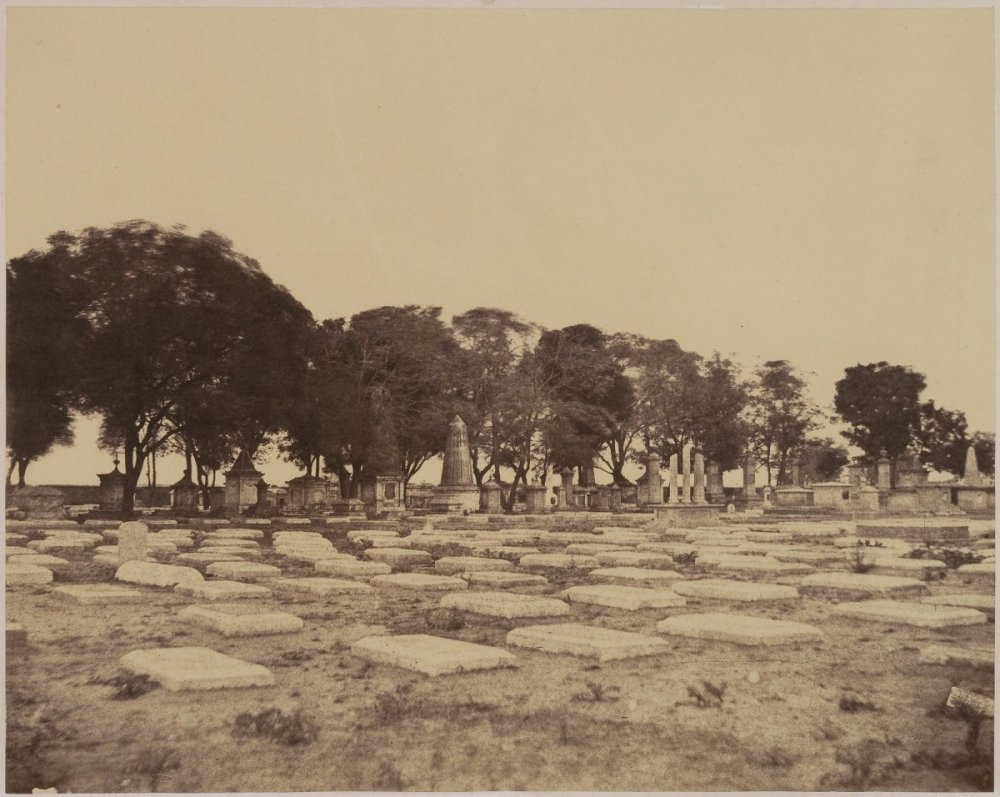
For those unlucky enough to be wounded or ill, the Ridge had a total of 14 hospitals, each treating its own regiment. The men of the 8th and 61st Foot, for example, shared one building – the 8th in the long centre room and the 61st on the two side verandas. The officers preferred, on the whole, to remain in their own tents where they were assured of the kind ministrations of friends and their servants; the Gurkhas stoutly refused to leave Hindu Rao’s House and established their dispensary in an upper room of the post, where they were taken care of by their own.
A strong camaraderie eventually sprang up between the European soldiers and the Sikhs and Gurkhas.
“Nothing could have been more satisfactory, and, at the same time, more ludicrous, than the way these men and the European soldiers fraternised together…They were constantly sitting and talking together in the camp; though, as neither understood more than a word or two of the other’s language, how they managed to keep a conversation is difficult to comprehend. A European would come to see one of the native officers, perhaps, who would get up, offer his friend the only stool in his possession, and then sit on his bed. Then the soldier would light his pipe, gravely puffing away, and begin to talk, the other following suit; and each holding forth quite independently of his companion…” (Seaton)
The men of the 75th shared not just their picquet and batteried duties but also their tents with the Sikhs of the 2nd Punjab Infantry with whom they struck up a fast friendship, while the Gurkhas held Hindu Rao’s with the 60th Rifles, and often the Gurkhas were heard exclaiming the 60th were “their rifles,” while the Rifles spoke of the Sirmoor Battalion as “them Gurkees of ours.” Calling each other brothers, the men fought and died together – Charles Reid often saw the Rifles carrying wounded Gurkhas off the field and vice versa.
It was thought prudent, however, to send the sick and wounded to Meerut and Ambala whenever convenient -it not only cleared much-needed room in the hospitals but also gave the patients a better chance of recovering away from the foetid air of Delhi. They were sent in any conveyance possible, together with a small escort. A medical officer was detailed to minister to their needs on the road. To aid their further convalescence, they would then be sent on to Dagshai and Simla in the Hills.
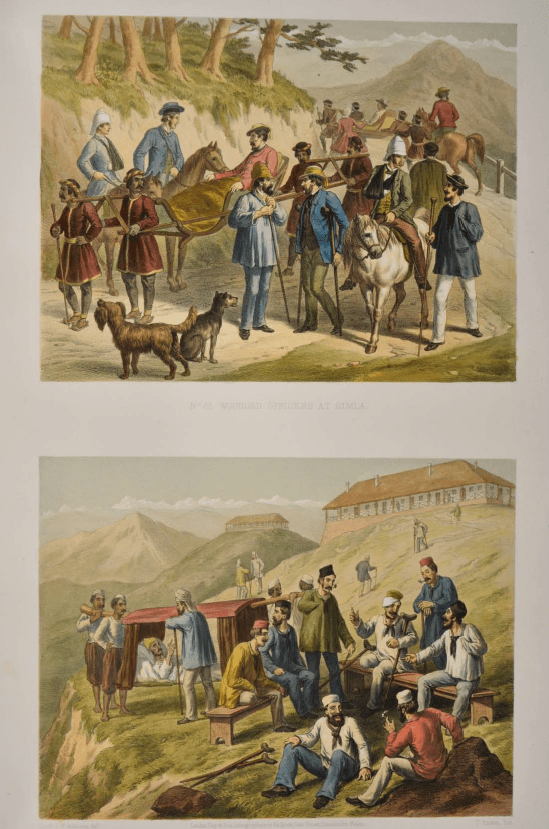
Surgeon Innes of the 60th Rifles was well known for not just his neat appearance but for keeping a clean and comfortable hospital for his regiment. He did his utmost to provide the wounded with punkahs to cool them and charpoys to lie on instead of just a blanket or straw on the floor, and secured for them as many small comforts as he could. Rotton particularly admired the medical establishment at Delhi – they were not the typical saw and bones men Rotton had seen; they were some of the finest surgeons the army had to offer, skilled and above all sympathetic. Although Rotten believed a Florence Nightingale would not have been amiss on the Ridge (Greathed was vehemently opposed to his wife and other women coming to Delhi to nurse the wounded, saying quite bluntly the surgeons could manage well without them), he felt at least Nightingale’s spirit had somehow imbued itself on the medical men at Delhi.
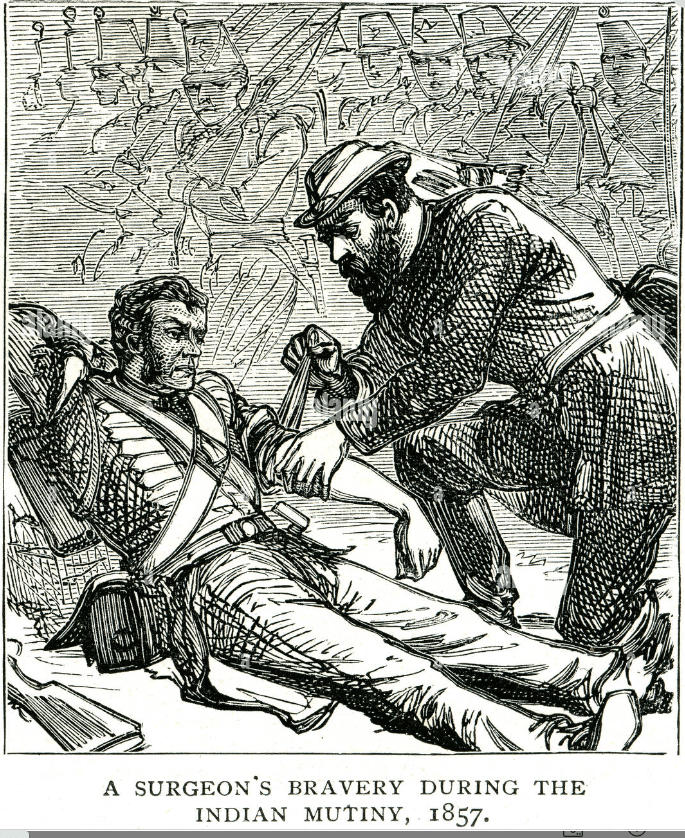
In all, 28 surgeons of the Indian Medical Service were killed or wounded during the Mutiny, and the Army Medical Department lost nearly as many. It is worth noting that these were two separate branches with surgeons either directly employed by the EICo or attached to regiments. Whereas men of the Indian Medical Service had, more often than not, other civilian duties to attend to, the men of the army were there not just to serve but to fight with their regiment. One such man was Surgeon John James Halls, who defended the Arrah house. All the surgeons during the Siege of Lucknow were dab hands with their guns. At Delhi, we have Dr Ireland, who accompanied Nicholson to Najafgarh, where he received a horrifying wound that cost him his eye and had him listed in dispatches as dead. It took Ireland three years to recover; in 1861, he was declared unfit for service and retired.
Ideally, each regiment should have had its own medical men; unfortunately, they too fell prey to disease and injury. Both Surgeon Coghlan and Assistant Surgeon Whylock of the 75th bth came down with cholera at the same time. Whylock survived, but not before he had made a perfect nuisance of himself. He demanded champagne which the mess of the 75th did not have (although some were procured from the 1st Bengal Fusiliers) and bothered everyone with his constant cries of “Boy, boy,” (to summon his khitmatgar) until he was finally sent off to the hills in July having done no work at all since arriving in Delhi. All the work fell onto Assistant Surgeon Stewart Aaron Lithgow following Coghlan’s death as the only surgeon left to minister to the needs of the 75th.
Lithgow very ably turned the old Mess House of one of the native regiments in the old lines into a hospital for the 75th. The building had a flat roof, so it could not be torched like those that had thatch. Despite the ruined interiors, it was deemed safe. The only piece of furniture left in the building that had escaped destruction was the billiard table, which Lithgow used for operations until the end of the Siege. Barter recalls Lithgow worked relentlessly, continuously on duty during the day and at night, moving to the 75th picquet in Sabzi Mandi, bolting his meals as he went and sleeping in snatches. He even found time to assist the other surgeons in their hospitals, lending a hand for the most dangerous operations being performed.
Surgeon J.H. Ker-Innes of the 60th Rifles was wounded at Ghaziudinagar on the 30th of May but continued working. Of the civilian doctors, Assistant Surgeon Anthony Dopping was one of those killed at Delhi on the 11th of May and Assistant Surgeon Thomas Hewlett Woodward was killed on the 31st of August.
General Wilson made it a point to mention some of the medical officers in dispatches –
Superintending Surgeon Edmund Tritton (Bengal Medical Service)
Officiating: Superintendent Surgeon Campbell Mackenzie (Bengal Medical Service)
Surgeon J.H. Ker- Innes, 60th Rifles
Surgeon Edward Hare, 2nd Fusiliers
Surgeon James Peter Brougham, 1st Fusiliers and Bengal Medical Service
Surgeon David Scott, Medical Storekeeper (Bengal Medical Service)
Assistant Surgeon J.J. Clifford, 9th Lancers
Assistant Surgeon W.F. MacIntyre, Commander in Chief’s Staff
Reverend Rotton further mentions Assistant-Surgeon Alexander Grove Duff and Assistant Surgeon T.J. Biddle “of H.M.’s service” and Assistant-Surgeon Moore of the Carbineers. Moore was severely wounded on the 30th of May at the Battle of the Hindun and died of his injuries on the road back to Meerut.
Lord Canning did not forget the medical officers either, writing in the General Orders of the 5th of November 1857:
“The arrangements made by Superintending Surgeon E. Tritton, for the care and comfort of the numerous patients in the hospital, have been most satisfactory, and the Governor General in Council has pleasure in offering to that officer, as well to the regimental and staff officers of the Medical Department by whom he was supported, this acknowledgement of their good service.”
The numerous patients that Canning refers to would horrify even the most hardened medical man – by August, there were over 2000 men sick and wounded on the Ridge, nearly half the fighting force. It is no surprise that Rotton notes the surgeons took little heed of their own health or comfort, barely sleeping and hardly eating. Surgeon Edmund Tritton, who had already served in the Sikh war of 1848, was 54 at the time of the mutiny – he never recovered his health fully after Delhi and died, aged 55, on the 15th of June, 1858, in Simla.
J.J. Clifford of the 9th Lancers appears to have been a most obstinate man in Octavius Anson’s mind – to care for his patients, Clifford demanded three tents, which Anson saw as unreasonable; but Clifford insisted and got his way – he performed a rudimentary triage in the camp before removing his patients to a bungalow in the ruined Civil Lines. Clifford did not even spare his own comfort to look after his patients, as Anson recalls:
“When I got up this morning, I saw Clifford, Drysdale, and Wilkinson (who live together), sitting outside without a tent over their heads. They looked like three disconsolate mermaids dripping with dew. On enquiring I found out that the little doctor had run rusty with his colleague, Smith, for striking one of his hospital tents, (Smith, you must know, had orders to take a tent with him, and he must have either taken a hospital tent or the one in which Clifford & Co. lived). Smith did not know that Clifford, sooner than part with one of his hospital tents, was prepared to strike the Government hospital tent he and his friends were using. When he heard that Smith had taken one of his hospital tents, he, Clifford, immediately struck his own and sent it off to replace the one Smith had taken.”
Many men were struck down with cholera, particularly those of the 8th and 61st Foot. Rotton made it a point to visit them as often as he could, but
“It was melancholy to see nearly every man in either of the three wards languishing from that terrible disease, cholera; hardly an inmate was suffering from any other cause. It required strong nerves to withstand the sickening sights of these two infirmaries. The patients’ constantly retching made the place very offensive...So general was this mortal sickness in these hospitals, that at last, I could only hope to discharge my duty by taking up a central position, with a chair for a hassock to kneel on in prayer, and making a general supplication for all the patients; while afterwards, with Bible in hand, I read and expounded extemporaneously some appropriate passage of Scripture.”
The medical officers were at a loss to explain why cholera was so prevalent in these two regiments when it was rare in the rest of the camp. It was generally put down to their having “a long fatiguing march in the height of the rains.” Reverend Rotton, however, made an interesting connection which might have been useful to the medical officers – he noted:
“Most men were complaining and acknowledged to a constantly distressing feeling of sickness, especially before and after breakfast. I was a martyr to it myself, and attributed much of this nausea not only to the quality of the food which we ate, and which was at times very coarse and inferior, during the rains, but to the presence also of an overwhelming number of flies, who soiled everything which they came in contact. As I have before observed, the misery arising from these creatures only, was something almost intolerable; they sought you out in your tent, at your meals, when occupied in the discharge of duty; and the only time you could secure rest from this annoyance was during the hours of sleep at night, when they themselves felt the necessity of repose. Whatever might be the dish you selected to feed upon, as soon as it was uncovered, a legion of flies would settle upon it; and even so simple a thing as a cup of tea would be filled in a few minutes, unless you were very watchful, the surface of the liquid presenting a most revolting dark appearance from flies floating thereon, some dead and others dying.”
Perhaps if someone had taken a closer look at Rotton’s observations, they might have concluded, that although the flies did not primarily cause cholera they were certainly the culprits in spreading the disease through the camp – nowadays it is well-known the common housefly can transmit at least 65 diseases to humans including typhoid fever, dysentery, cholera, poliomyelitis, yaws, anthrax, tularemia, leprosy and tuberculosis. R. Knox concluded, in his paper in 1853, “The Cholera Fly”, more or less the same.
The surgeons faced a myriad of injuries, many of which are too horrifying to contemplate, ranging from those caused by bullets, grapeshot and shells to lance, sword and bayonet wounds. In the conditions they were working under, there was a very high probability of hospital gangrene and secondary infections following the initial treatment, and many patients died not so much die of the wound but from the infection that followed. To get an idea of what the surgeons saw at Delhi, I will quote some examples from Williamson’s “Notes on the Wounded of the Indian Mutiny,” in which he describes the cases he saw when they arrived back in England.
75th Regt.—Sergeant John M’Donald, aged 26, was wounded at Delhi, June 15, 1857, by a musket-ball, in the posterior part of the left elbow-joint. Excision, by H incision, of the fractured parts was immediately performed, and several pieces of bone came away at the time, and several pieces came away afterwards.
July 20, 1858. The wound healed; arm in an extended position, and can be only slightly bent; he cannot open the little and ring fingers, and the others are also powerless. The arm is about three inches shorter than the right. September 8, 1858, sent to modified duty.
24th. Private Patrick Farrell, aged 30, wounded 7th July, 1857, by a musket-ball which entered on the right side of the third lumbar vertebra, two inches from the spinous processes, passed across the back, and made its exit a little below the centre of the crest of the left ilium; several pieces of bone came
away from the aperture of exit.
August 2nd. Aperture of entrance is healed; that of exit is still discharging, leading down to diseased bone. There is some thickening over the spinous processes of the lumbar vertebras.
Undisposed of.
75th Regt.—Private Edward Collins, wounded at Delhi, June 8, 1857, by a musket-ball, which entered the upper and outer side of the right thigh, and lodged, fracturing the femur; ball extracted; a piece of bone came away.
July 20th, Wound healed; right leg about two and a half inches shorter than left; femur bent; fractured ends of bone overlap, and there is abundant deposition of new bone; the long splint was used. Has a good, useful limb, and can walk a long distance.
September 6, 1858. Sent to modified duty.
9th Lancers.—Private Joseph Twining, wounded at Delhi by a sabre cut on the posterior and under surface of the left elbow-joint, which appears to have cut the external condyle of the humerus and olecranon. No pieces of bone came away, and the wound did not heal completely for three months.
August 2nd. Wound healed. Elbow-joint in a bent position, and completely anchylosed. Cannot pronate and supinate the hand.
September 3, 1858. Sent to modified duty.
There was little the surgeons could do for stomach injuries, and most patients invariably died shortly after receiving the wound. Head wounds were often fatal – in the case of one Lieutenant Bannerman, who was shot in the head, a thoughtful young corporal dug a little hole for Bannerman’s brain and buried it with as much reverence as he could. Elkington underwent the disputed process of trepanning after Najafgarh to relieve pressure on his brain, but he died five days later without recovering consciousness.
Some cases mystified even the most experienced surgeon – Lieutenant Blair was shot in the chest and was expected to die; however, it was supposed the bullet had glanced off a rib, and instead of penetrating his liver as they had imagined, burst an existing abscess on the organ and then came out of his body, leaving him injured but not mortally; another man swallowed the bullet that injured his jaw, along with some of his teeth – the doctor refused to believe him and made his life miserable looking for the projectile. Seaton was not expected to survive his injury – a musket ball in the chest at thirty-five paces, which fractured his rib that in its turn drove down onto his lung before the bullet exited from his back. The remedy prescribed by Dr Mactier was certainly interesting – after three days of continuous bleeding from the lung, it finally stopped, and the doctor said that as long as Seaton did not cough or speak, he would recover. He was then given over to the care of William Hodson, who put an “embargo on his tongue”, shooed away all visitors and looked after Seaton himself. By the 1st of September, a few weeks after the initial injury, the wound had healed, but Seaton was still not able to return to duty as he “…could not make the least exertion without intolerable pain. To stand or sit in the sun, or to walk, was to thrust a red-hot iron along the course of the ball, and to make the left side of my chest one great pain.” However, he remained on the Ridge and entered the walls of Delhi on the 14th of September.
Medicine had made progress by 1857, and the lessons of Crimea were not lost on the doctors on the Ridge in regard to patient care. However, the methods resorted to, such as trepanning for head wounds, cupping and leeches, amputation without anaesthetic for patients who were deemed too weak for chloroform, and the application of wet linen to suppurating wounds, might still smack of barbarism to us today from our comfortable seats 165 years later. The surgeons at Delhi were considered some of the best men in their field – just their ability to work under such horrible conditions stands as their testament; they should not be judged for their knowledge but praised today for their perseverance.
Ministering to the Dying
While Father Bertrand was still on his way down from the Punjab, Dr. Coghlan had to take his last rites from James Rotton. Rotton was not happy ministering to a Roman Catholic, and Coghlan asserted he had lived a Catholic he would die one too. Nevertheless, the dying man requested Rotton to read to him from the Bible. Rotton obliged, and upon concluding his recital, they said the Lord’s Prayer together – Coghlan died shortly after. It appears to have taught Rotton a small lesson in humility – if his choice of sermons is anything to go by, even a Catholic would not have minded his blessings.
Although Rotton and Bertrand divided up their flock along religious lines, one Protestant and the other Roman Catholic, after the affair with Coghlan, Rotton instructed his servants to wake him at night should any injured man request his presence; Father Bertrand for his part imparted a blessing on all the regiments going for the final assault on Delhi, saying, a prayer from an old man could not harm anyone. The two men remained divided by creed but were not averse to spending time together in what little leisure time they had, often sitting together in the evening outside Rotton’s tent, Bertrand solemnly smoking his hookah. Rotton, in his own fashion, admired the old campaigner –
“Father Bertrand, a pattern Roman Catholic priest, whose services have been justly recognised—not
by the Government, perhaps; for judging by its acts, the clergy, and particularly that more self-denying
portion of it belonging to the Roman Catholic Church, seem to have been regarded as a necessary
inconvenience; but by his own Vicar Apostolic, Dr. Persico, in terms not by any means too flattering,
considermg his labours in camp – was in this respect in a much worse predicament than myself. He had
infinitely smaller allowances, and infinitely fewer comforts than I enjoyed, but an equal amount of labour. This excellent man—and surely I may venture thus to designate him, without risk of offence to any, except the most bigoted—lived as sparingly as a hermit, while he worked as hard as an English dray-horse. If Government should overlook this good man and his extraordinary services, his own flock never can and never will: those services and that self-denial -will live in the recollections of the army as long as a single man survives to tell the tale.”
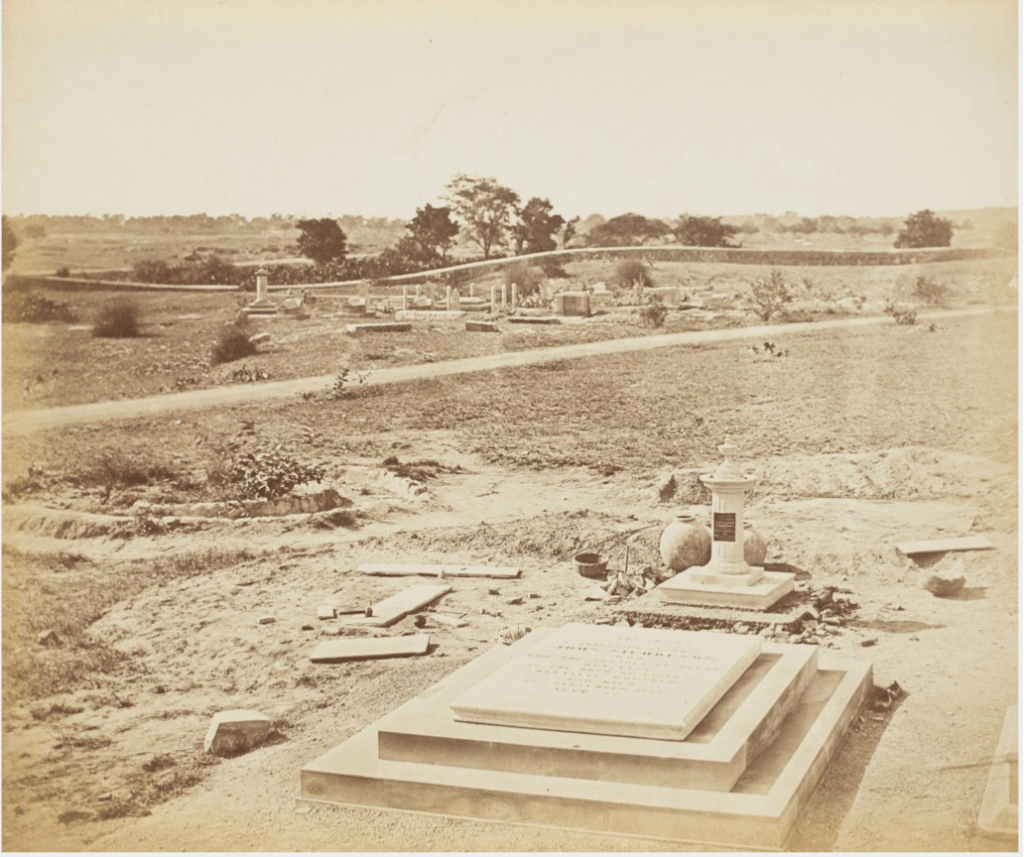
What with the short notice he had been given to accompany the force from Meerut to Delhi, Rotton had not thought to bring a saddle horse, much less a saddle with him, opting instead for a palki gharry which soon proved too difficult to drive on the camp roads with only one horse to draw it. Therefore, Rotton was left with no choice but to walk the entire Ridge, visiting all fourteen hospitals by foot regardless of the weather. He would have been a striking figure, though he calls himself decidedly unclerical with a khaki-coloured Indian choga taking the place of a canonical coat. With his uncut black hair and unkempt beard, he looked more like a preacher of retribution rather than the mild-mannered chaplain he really was. As discomfiting as he found his own appearance, Father Bertrand was at least quick to point out the Lord did not worry about appearance and for that matter, neither did the men he ministered to. His words were, after all, what they needed to hear in their time of need. Rotton and Bertrand had the worst part of the job on the Ridge – they could not retreat to their tents after a battle, nor find distractions in wrestling alligators -to comfort the sick and wounded, bless and reassure the dying and at night, see them wrapped in sheets and placed side by side in shallow graves. A quick service, and all was over until they could do it all again the next day.
 Mutiny Reflections
Fascinating! Thanks for this informative, well-researched and superbly written piece!
LikeLiked by 1 person
Thank you so much!
LikeLiked by 1 person
Thank you! I am glad you found it interesting! Please do browse the rest of the site, there is quite a bit about Delhi.
LikeLike
Keep up the great work Eva!
Ryan
LikeLiked by 1 person
Fascinating. Learning a bit of the history of the place is quite neat. Excellent post.
Ryan
LikeLiked by 1 person
Thank you for this! Your research and eye for detail are extraordinary!!!
LikeLiked by 1 person
Thank you! This post has been a hard one to do and took far too long to complete; my list of notes just kept getting longer. I am pretty sure tomorrow I will find something to add to it! I hope you enjoy reading it!
LikeLiked by 1 person
I can well imagine!! The foort is clear. It is a great piece of work!
Haha, you can always slip something extra in if you do find something you had overlooked! ;-) I am guilty of doing that myself! ;-)
LikeLiked by 1 person