Feeding and Clothing the Ridge
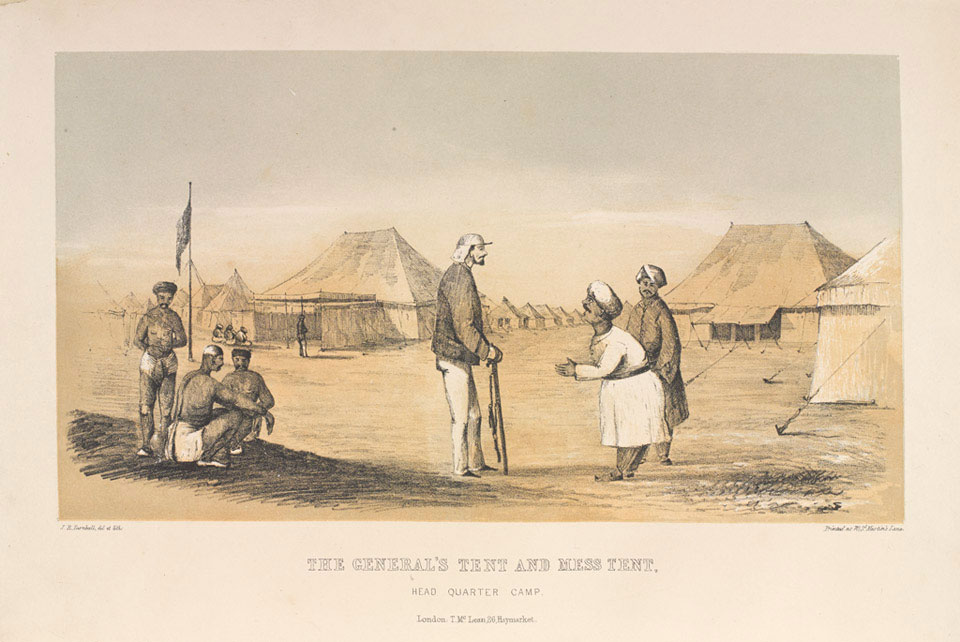
Before we dive into the grimmer aspects of the Delhi camp, a detour is needed regarding food. Provisions, though never lacking, for many men were the most basic. However, as lines of communication improved and a reasonably stable supply chain was established, things improved drastically; that is, at least for the officers in their messes. For the regular soldier, Harriet Tytler very curtly points out,
“Housekeeping…through the siege was nil. We had our rations like any private soldier, (though paying for the same) and the one servant did his best to make what variety he could out of it. It was a case of mutton curry one day, mutton koftas another say, mutton hash the third and mutton minced the fourth. These with chupattees made our dinner, week in and week out. Breakfast was always dall and chupattees or dall and rice, supper bread and butter, such as there was, hunger made us enjoy them all the same. Officers had their messes and many luxuries which we penniless refugees could not afford…”
There was a substantial civilian population on the Ridge in June, which consisted mostly of officers of the customs department, deputy collectors and “others” who had either been hiding in or around Delhi and had made their way to the Ridge with their families as soon as it was controlled by the British. The only one who seemed to have spared them any thought of these civilians was Reverend Rotton. Through his kind offices and the generosity of the soldiers, the refugees did not simply starve to death. It never occurred to anyone to request Captain Thomson of the Commissariat Department to issue them rations.
“During the few days these refugees remained with the army, they did not know from whence to obtain their daily bread. The British soldier assisted the poor people…such as these brave fellows had, they gave, nothing grudging, dividing all they had, even to a crust and a rag, with those whose wants were real…”
Some had managed to procure a tent or two, and into these, they crowded as best they could, men, women and children all huddled together in profound misery. Rotton notes,
“Some of these refugees died while in camp. One infant, with its young mother sitting and watching beside it with sad countenance and tearful eyes, I fancy I can now see before me; its attenuated limbs, its sunken and glazed eyes, its drawn and pinched features, its convulsive frame: that pitiful sight I shall never forget. The results which I saw before me were attributed to two causes, viz., the heartless desertion by its native wet nurse, and the inability of the child’s system to assimilate other than that natural nourishment which its mother could not give it. The company crowded within this tent, men, women, and children, all seemed paralysed. The men were unmanned, and the women broken-hearted; even the very children themselves had apparently forgotten the gambols and the mischief which characterize their years: there was an unnatural depression here that told its own tale. Those who had the power to think sat brooding over their sorrows, reviewing the past and anticipating the future with a settled gloom, which no cheering word or promise from a stranger’s lips seemed sufficient to break.”
For General Barnard, this scarred, small mass of humanity was nothing more than a nuisance – on the 17th of June, he ordered them off the Ridge, and under a paltry escort, they were sent on their way with some of the wounded to Meerut. Who they were or what became of them is anyone’s guess; neither their names nor their providential escapes are recorded.
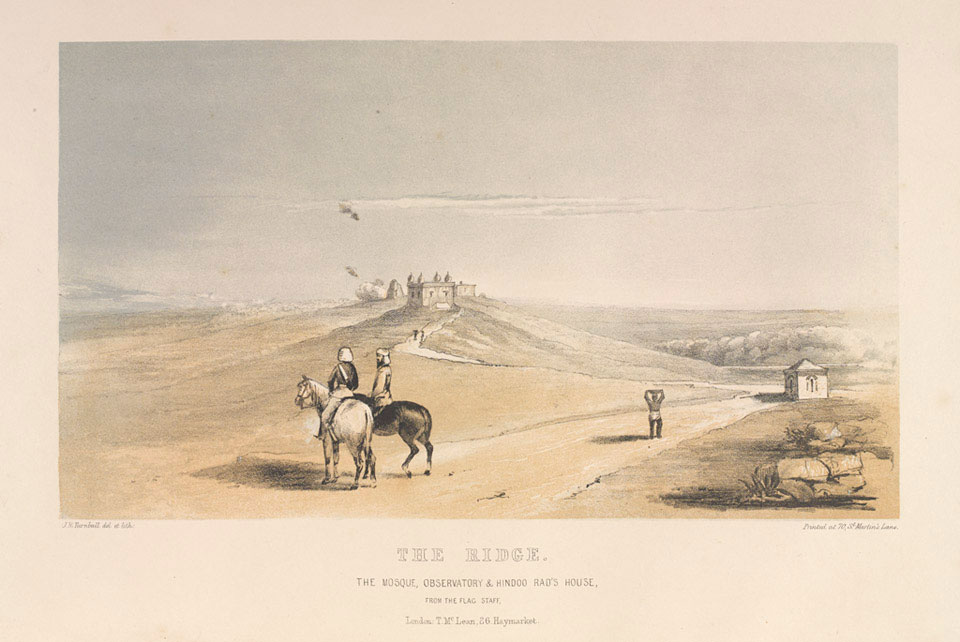
The Engineers were luckier than others and had occupied from the first a house which had escaped destruction on the 11th of May. By the time Baird Smith arrived on the 3rd of July, their Mess numbered 22. The house proved to be their best investment – it only had three rooms, but the central one ran the length of the building, and there was also a wide veranda. The grounds were large enough for their tents to be pitched in the garden, and nearby stood the park for their stores. A few enterprising officers repurposed a billiard table they had found in one of the ruined bungalows – by sawing off the edges, it was turned into a dining table which could seat twenty, and as needs be, could be used as an impromptu bed. With a punkah fan and a capital cook, an invitation to the Engineer’s Mess was a step into normalcy.
The officers of the 9th Lancers, too, had set themselves up as best they could. Octavius Anson was appointed Mess President, and it would appear one of his chief concerns was supplying the officers with soda water, a consignment of 36 dozen reaching the Ridge in late June. However, the run on the beverage was so great that he worried the machinery in Ambala would soon be worn out; he also found it impossible to get saltpetre or potatoes and to make things worse, when the claret ran out, he was concerned they would be reduced to drinking the Commissariat rum. However he did, in June, have “Very pleasant news, considering that I have just been made Mess President, and have sent an order to McDonald to supply the mess with 150 dozen monthly (soda water) and to Crump & Co. to send us every month fifty dozen of beer, twelve dozen of claret, and nine dozen of brandy.”
He complains excessively about how his own mess bill was ruining him, but this he puts down to the woes of rank.
“Were I not so high up in the regiment, I would not think it my duty to dine at mess, but holding now rather a conspicuous position, it would not do for me to eat alone in my tent and abstain altogether from the society of my brother officers. I am, however, disgusted at the great but unavoidable expense which the mess entails. All I eat, too, is soup, meat, and onions (the potatoes being very bad), and bread and butter washed down with sherry and water.”
Thanks to the rank he appears to hold responsible for destroying him financially, Anson was given certain treats not readily available to others. A senior officer treated him to a beer, of which he had a personal supply of 20 bottles. The 9th Lancers had quickly bought all of the deceased General Anson’s wine and beer when his effects came up for auction, spending £400 for it, and even three avid sweet-tooths were taken into consideration.
“We are going to add a filter to our luxuries at mess and buy all the General’s jams, &c., for F. Grant,
Blair and Jones are great devourers of sweets of that sort.”
Being invited to dine with others, too, had its advantages. Anson writes in August,
“Hope (Hope Grant) wrote and invited Upton and myself to dinner, but as Upton would not go, I got leave to take Hunter instead. We had an exquisite little dinner: grouse, soup from P., A. and Co., to remind Hope of the grouse shooting season at home, and a green young goose, with some very good fresh-looking peas from a Parsee merchant just come here, hash and fricassee, and a nice pudding. We drank a bottle of beer each and enjoyed our dinner very much, Hope slyly observing he did not know what his wife would say to his extravagance.”
Soon after, however, he found that Grant’s tiffins of mutton broth and beer did not agree with him and meant to “avoid the snare in the future,” preferring to stay where he was with his tea and Mango Fool. By August, Anson sent his wife a reckoning of the blasted mess bill – “My wine bill for June is Rs. 73, 14a. 3p., and mess for July Rs. 70, 15a. 4p., making a total of Rs. 144, 14a. 3p.—enormous sum, I think. I can, by screwing to avoid mess oftener, bring it down to Rs. 100; one must live generously.”
By August, Anson was obliged to provide his Mess with a new tent – the rough monsoon weather had finished it off. Only the inner fly pitched, leaving the rain streaming through the holes. The officers had no choice but to scramble under the table to eat their food during the frequent downpours.
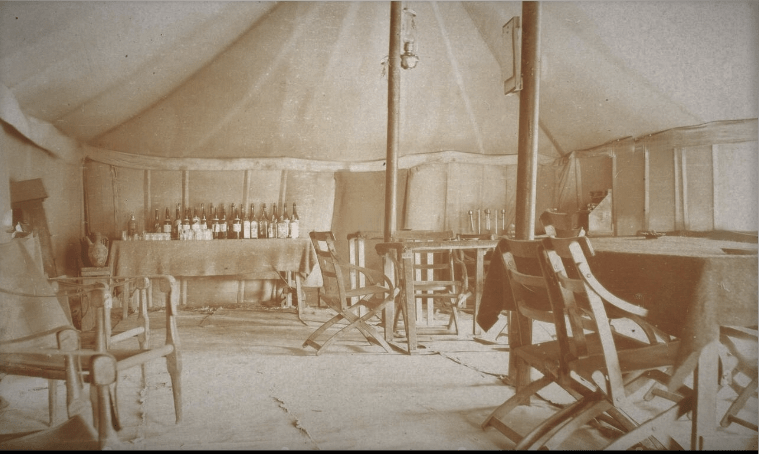
Meanwhile, Colonel Young, of the Artillery, appears to have hardly felt any privations at all. Writing to his wife in June, when he optimistically felt the siege would soon be over,
“It is not very pleasant, the prospect of being in tents for another ten days or so, but you would be surprised to see how comfortable we are with tatties and a punkah. As to our living, we could not dine more luxuriously than we do if we were quietly located at Simla, and I have not seen better gram mutton anywhere; and you will be amused when I tell you that the pastry at the mess is about the best I have come across in India — it seems that the Artillery mess cook or confectioner is famous for his skill. I give you all these little details that you may know we are not utterly miserable! Of our party, Norman, Mactier, and myself always dine at the mess, and Becher sometimes. Our tiffin, Mactier’s and mine, is a biscuit and a glass of wine or brandy and water. We are nearly at the end of the two boxes I got from Anderson’s, but Mactier has picked up another box somewhere, which will last us, I hope, until we get into Delhi.”
His Mess was well stocked, and Young could even spare some sympathy for the Rifles, who apparently had nothing. “The mess to which we belong has plenty of everything, wine and beer included; but the unfortunate Rifles are entirely out of beer and wine, so, as someone remarked yesterday, they make up for it by keeping up the strictest etiquette at the dinner table, and prohibiting smoking till the cloth is removed. They are always very particular, too, in wearing their green uniforms.” And this from a “luxurious set of fellows” (as some called the Artillery) who engaged in the use of tablecloths in their mess.
There were some set backs.
The Fusiliers lost all their grain-fed mutton to the shepherd who herded the flock straight to Delhi; Anson commiserated with the cook of the Lancer’s mess when he reported he could not produce any dinner as the wind kept blowing out the cooking fire, and the rain had drowned three ducks and five fowls. Charles Reid notes another incident at the beleaguered Hindu Rao’s House:
“About a quarter of an hour before our usual breakfast time, Dr Morris’ table attendant came into the portico with a very long face, followed by own khit (table attendant) trembling from head to foot…A 24-pounder shot had passed through the kitchen immediately over the stove on which was placed our breakfast stew. It was not knocked over, our khits informed us, but it was full of plaster and mortar and sundry pieces of brick. This was a trifle compared with the intelligence that followed; it appeared that before the shot made its exit through the opposite wall of the kitchen it must needs travel through a box which was placed, amongst other articles of use, all the delicacies of the season, and which had just been sent up from Messrs Peak, Allen and Co., from Umballah. Out came a mug in all manners and shapes, then a piece of salmon tin, and so on. All, of course, were in fits of laughter, but the poor khits who had had a narrow escape did not appear to see the fun at all. Several shots had before struck the cook room, but this iron messenger was the one that had done any real mischief…The khits, after being laughed into good humour, went back at the stew, which, after all, was not so bad, though pronounced somewhat gritty.”
On another occasion, Reid’s grain seller had procured a quantity of flour from the camp. It was unfortunately piled into one of the outhouses of Hindu Rao’s House- a ten-inch shell, lobbed from the Kissengunge battery, thudded into the middle of the storeroom, covering everyone nearby with flour. A similar shell fell into a pile of packed tents, and Reid recalled, “it was amusing to see them when they were afterwards pitched; there was certainly no want of ventilation!”
Towards July, the camp was beginning to resemble a small town. A few enterprising merchants had ventured to set up shop, and a native bazaar had sprung up to the rear of the camp. The camp followers, of which there were thousands, had their emcampment by the banks of the river. “The cantonment roads are useful and the native merchants repaired and reoccupied the shops of the old regimental bazaar… the long line of tents, the thatched hovels of the native servants, the rows of horses tied by the heels, the parks of artillery…Outside the camp… a border of filth and rottenness, heaped with dead camels and horses…In the rear are the booths of the native bazaars, and farther out on the plain beyond, the thousands of bullocks, camels and horses that carry our baggage.”
By August, Peake & Allen & Co. had set up shop on the Ridge, sending from Ambala two representatives – Mr Allen was something of a dandy and was known as the best-dressed man in camp. To give them competition, two enterprising Parsi merchants, Jehangeer and Cowasjee, quickly established a trade with numerous goods, but particularly beer, brandy and soda water. Initially, the merchants all charged exorbitant prices for beer, which they sold for Rs 24 a dozen. However, when the Artillery Mess bought 100 dozen procured at Rs 15 for the ” best English bottled” prices dropped. It was tough competition, for the Commissariat barreled beer that was said to be first-rate. Dr Ireland asserts the merchants were not allowed to sell alcohol in the camp – a daily allowance of grog was dolled out to not only the European soldiers but the Gurkhas and the Sikhs, but the Sikhs, in their turn, sold their rations to the Europeans at a small profit. The European soldiers felt their allowance was far too small for the work demanded of them, and graffiti appeared on walls close to their piquets written in chalk – “Plenty grog, plenty, work,” “Give us two totts and we’ll go in (to Delhi)” and “Gif us enoffe grog.”
With the dark days of June behind them and reinforcements steadily arriving in the camp, Henry Daly noted,
” I can scarce give you a better illustration of the change which is influencing the country than in the supplies
which reach our camp; on our first arrival the feeling that our rule was doomed and at an end was so
widespread and so thoroughly believed that nobody brought in anything for sale; sheep, poor and thin, could be had only at the commissariat, and at rupees 5 each! Grain 10 seers the rupee! Fowls unknown. Now sheep are as common as were jackals at Sekrora; grain is 45 to 50 seers; poultry of all kinds abundant; boots, shoes, even macassar oil! These are strong symptoms. The servants in camp have behaved marvellously well.”
Without the servants, the Delhi Field Force and the subsequent reinforcements would have been lost. Ireland notes there were 10 Indians for every European; many of the officers had brought their personal staff along who would share their employer’s trials and tribulations and more often than not without the thanks they deserved.
Alexander Taylor, who arrived on the Ridge from the Punjab with scarcely anything but the clothes he wore, despaired he would see his servants – he had sent his chaprassi to Murree to collect everything he would need in camp in the way of clothes, tents, wine and stores with instructions to pack everything on mules as far as Rawalpindi and then onto camels to Delhi, while Taylor rode on ahead. He half expected his staff would simply abscond with his goods instead of attempting the 500-mile journey to Delhi. Much to his delight, one morning after returning from a five-hour tramp around the camp, he found his khitmatgar, dressed immaculately in white, “standing bowing in the sunshine, and heard the dulcet words, ‘the Sahib’s bath is ready.’ – no allusion to the journey, or the time that had elapsed since they last met – found his tent pitched, grass blinds hung in the doorway, flies driven out, a hot bath steaming invitingly on the ground, and changes of linen lying on his bed…”
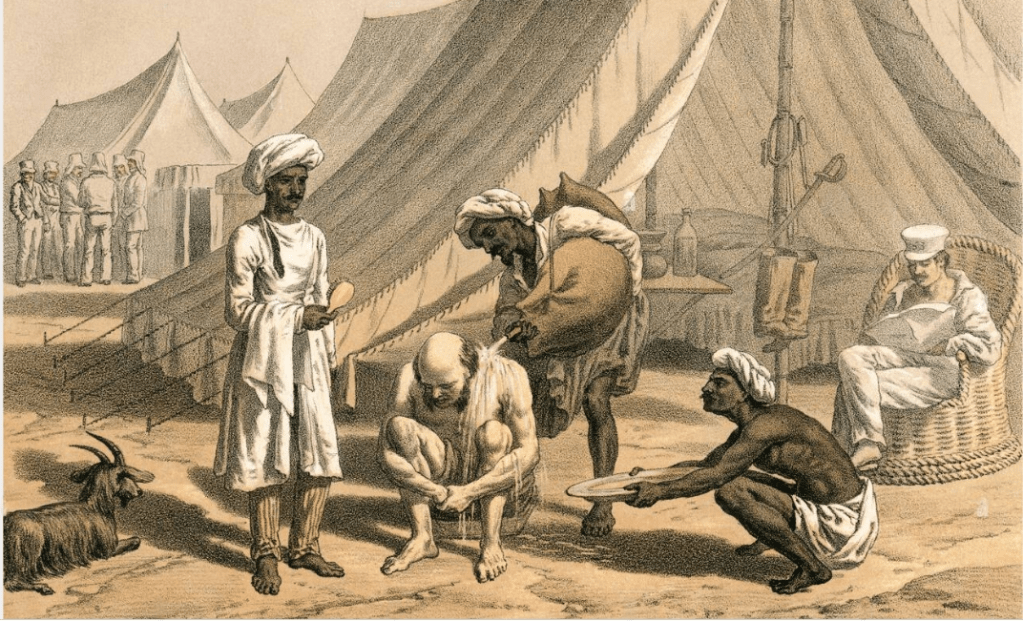
One of the commonest sights on the Ridge, at midday and again at sunset, was of servants, moving cautiously along, carrying dishes, glasses and food for their officers, ignoring the incessant ping ping of the shot around them. Regardless of how far they had to go, his officers, at least, would not go hungry. The servants kept some semblance of normalcy in a world that, for all intentions, had gone mad, never complaining and always on call. Without the solid bravery of the khansamah, the khitmatgars, the syces, the bhistis and all the other domestics, there could have been no force on the Ridge. It is no wonder the 9th Lancers nominated their bhisti for a Victoria Cross.
Clothing was sorely lacking. The weeks of hard fighting quickly told on the garments, and the men on the Ridge soon took on a singular appearance. Although the Sirmoor Battalion and the Rifles kept to their green uniforms, no matter how tattered, almost every other regiment turned out in some sort of khaki “it was of so many different shades, puce colour, slate colour, drab, that a delightful variety was exhibited, not only in the uniforms of different corps but in men belonging to the same company.” The officers cared little about what their men looked like as long as they could fight. Among the staff and the engineers, no two men were dressed alike. A variety of boots, trousers, breeches and coats of all descriptions, accompanied by an equally startling array of the headwear that included turbans, helmets, solah topis and wide-awakes. Some men attached flaps to the backs of their caps to protect them from the sun; others took to wearing thin veils, which additionally provided some relief from the flies. Anson complained the forage caps were too small to protect his men from the heat and asked his wife to organise padded curtains which could be attached to their cap covers. Wilson, exasperated by what he considered a slovenly state of affairs, insisted the men should not fight in their shirtsleeves alone and don their uniforms no matter how they looked. Many of the women safe in the Hills were not idle, providing their husbands as best they could with clothing; however, the ladies of Mussoorie went one step further. On hearing the Gurkhas had been reduced to rags, they got up a subscription to send five bundles of clothes and shoes to the battalion, which were received in August. The new clothes so puzzled the mutineers so much they believed Reid had received reinforcements at Hindu Rao’s House.
Strangely too, Mr Goud sent two boxes of clothing to Delhi, to Colonel Young, who was more than a little surprised when, on opening them, they contained ladies’ dresses! Unfortunately, Young either did not know Harriet Tytler or it simply did not occur to him that perhaps she might have been happy for the change of apparel – all she had in her wardrobe was 2 petticoats she had bought from her ayah and a single dress. What her French maid, Marie, wore is anyone’s guess, but she did manage to snare a husband.
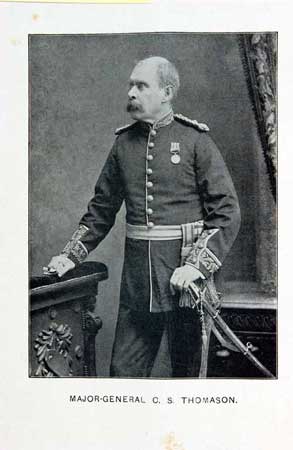
Some men were very careful in regards to their appearance like “ Little Dr Innes looks as if he had always just jumped out of a bandbox, so neat and clean—very different from the Staff…” while Charles Thomason of the Engineers was less particular – having spent some years working alone on the Western Yamuna Canal and had developed some eccentricities, continued to allow his servants to design and sew his clothes. His only requirement was his shoulders and spine be covered in bright green cloth, which he asserted repelled the sun’s rays, a theory he refused to part with, no matter how ludicrous his patchwork clothes looked.
For Harriet Tytler, things were very different.
She had survived the massacre at Delhi, escaping in nothing but the clothes she wore. With her husband, maid and two children, she escaped to Ambala, which should have been the end of her adventures. However, her husband was sent to Delhi to take charge of the treasury, and he felt it best to take his family with him, the idea being he could easily send them on to Mussoorie. So he bundled his family and maid Marie into a cart and took them to the Ridge.
They arrived lacking in everything, hoping above hope that at least some of the possessions had survived the 11th of May and perhaps their bungalow was still standing. Her husband quickly ascertained there was indeed nothing left, and Harriet would have to content herself with living in the cart until he could find a way to send her and the children away, as Mussoorie proved out of the question. Initially, she was to have joined the refugees leaving the Ridge on the 17th of June, but Harriet, in an advanced stage of pregnancy, refused to mount the pad elephant that had been made ready, stating it would mean her certain death. Her husband pleaded on her behalf with General Barnard, and Harriet was allowed to remain on the Ridge with the children. She gave birth to her son (who was given the rather outlandish name, Stanley Delhi Force Tytler), on the 21st of June in the cart the family called home.
In June, Harriet was by no means the only woman on the Ridge who had accompanied her husband into war. Colonel Laughton of the Engineers had brought his Persian wife and her retinue of 32 elephants, while Mrs Holland had initially accompanied the Tytlers to look for her husband in Delhi. When he finally sent her a message, he was safe in Meerut, she left them in Alipore and hastened to her husband. Laughton and his wife were soon sent packing – he had found little time to engineer anything, being fully occupied with entertaining his wife. It was a relief for the camp when the Laughtons left. However, Harriet stayed.
Until the monsoon rains began in earnest, Harriet lived with her children in the cart. Captain Tytler, distressed in finding his family soaking wet under the leaky roof (he was living in a tent close to the camp treasure), moved them to the nearby bell of arms, which would be their home until September. After Delhi was taken, they found new quarters in the palace grounds, until finally, Tytler was able to send them off in safety to the Hills.
 Mutiny Reflections
Fascinating! Thanks for this informative, well-researched and superbly written piece!
LikeLiked by 1 person
Thank you so much!
LikeLiked by 1 person
Thank you! I am glad you found it interesting! Please do browse the rest of the site, there is quite a bit about Delhi.
LikeLike
Keep up the great work Eva!
Ryan
LikeLiked by 1 person
Fascinating. Learning a bit of the history of the place is quite neat. Excellent post.
Ryan
LikeLiked by 1 person
Thank you for this! Your research and eye for detail are extraordinary!!!
LikeLiked by 1 person
Thank you! This post has been a hard one to do and took far too long to complete; my list of notes just kept getting longer. I am pretty sure tomorrow I will find something to add to it! I hope you enjoy reading it!
LikeLiked by 1 person
I can well imagine!! The foort is clear. It is a great piece of work!
Haha, you can always slip something extra in if you do find something you had overlooked! ;-) I am guilty of doing that myself! ;-)
LikeLiked by 1 person